








Executive Overview
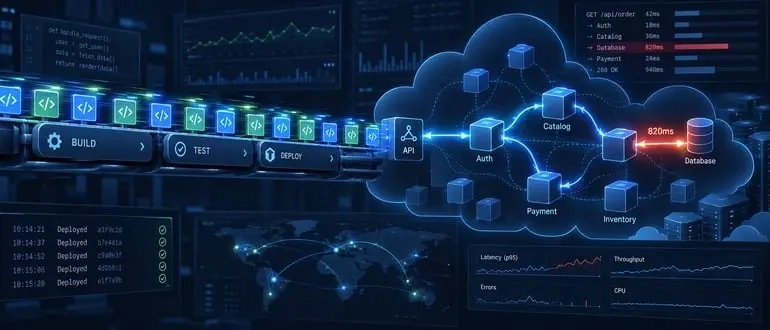
In modern software engineering, the relentless pursuit of high deployment frequency is often treated as the ultimate metric of organizational maturity. Organizations proudly tout continuous deployment cadences that ship code to production multiple times a day or week. Yet, beneath the surface of these high-velocity delivery pipelines lies a quiet, pervasive technical debt that consistently undermines software quality: mock drift.
For decades, standard dependency mocking—the bedrock of integration and end-to-end testing—has operated on an inverse relationship with deployment frequency. Simply put: the more often your upstream services deploy, the faster your test mocks decay. A microservice architecture deploying twice a week generates exponentially more opportunities for mock configurations to drift from live behavior than one deploying twice a month. Yesterday’s accurate test fixture quickly becomes tomorrow’s false positive, blinding engineering teams to emerging integration bugs.
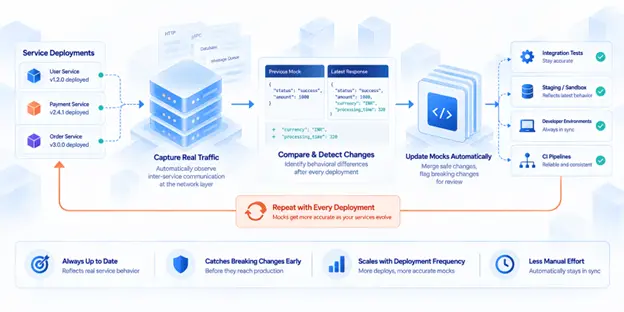
This architectural paradox has forced a radical rethinking of service virtualization. Emerging traffic-based dependency mocking approaches—championed by tools like Keploy utilizing eBPF (Extended Berkeley Packet Filter) technology—completely invert this dynamic. By automatically capturing real request-response exchanges during staging environments after upstream deployments, higher deployment frequencies transform from a liability for test accuracy into a powerful asset.
This article explores the systemic flaws of traditional specification-based mocking at scale, examines the mechanics of event-driven traffic recording, defines where these strategies fit within the modern testing stack, and analyzes the profound operational shift occurring across DevOps pipelines worldwide.
The Anatomy of Mock Decay: What Standard Dependency Mocking Gets Wrong at Scale
To understand why traditional mocking models fail in high-velocity environments, one must examine where behavioral assumptions originate.
In standard dependency mocking, a developer manually authors what they believe an upstream service will return. Whether encoded in a WireMock mapping, a Pact contract, a custom test fixture, or an inline mock file, this specification takes the form of a static contract: This specific request structure produces this exact response; this edge case triggers this error payload.
At the moment of authoring, this specification is typically accurate. However, microservice architectures are dynamic ecosystems where individual services evolve on independent cadences. When an upstream service updates, the gap between the mock’s static specification and the real service’s live behavior begins to widen.
[Upstream Service Deploys] ──(Unannounced Changes)──> [Behavioral Gap Widens]
                                                              │
[Static Mock Remains Fixed] <──(Developer Ignorance)──────────┴─> [Integration Tests Pass / Production Fails]
The Silent Drift of Non-Breaking Changes
While major breaking changes are often broadcasted through comprehensive changelogs, API version bumps, and release notes, minor behavioral adjustments frequently bypass formal communication channels. Upstream teams routinely introduce subtle modifications that they deem "non-breaking":
- New optional response fields nested deep within JSON payloads.
- Reorganized error response structures that alter error-handling paths.
- Modified HTTP header semantics or updated status code mappings.
- Altered rate-limiting thresholds or subtle latency profiles.
Because these changes do not violate strict semantic versioning rules, they often go undocumented. Meanwhile, the consuming team’s test mocks remain static. The downstream integration test suite validates compatibility against an idealized, frozen specification rather than the living reality of the upstream service.
The False Security of Growing Test Suites
This structural mismatch gives rise to a particularly insidious failure pattern: the divergence of test coverage and real-world accuracy.
Over time, engineering teams naturally expand their integration test suites. They add more test cases, cover deeper edge cases, and write assertions for complex error paths. On paper, test coverage metrics improve sprint over sprint.
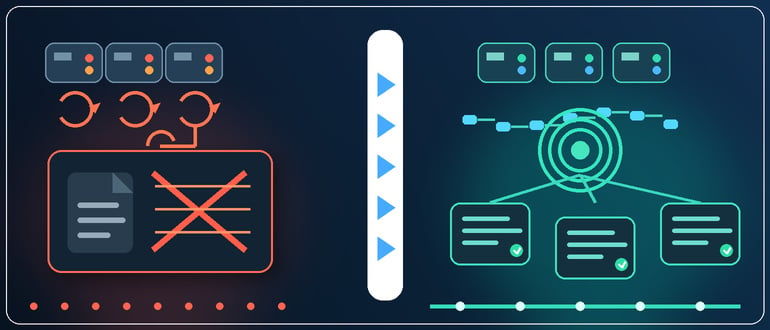
In reality, however, the underlying mock configurations become progressively more obsolete. The test suite grows increasingly confident while running against a fictional representation of upstream behavior. The result is a dangerous paradox: the test suite passes with flying colors in CI/CD, only for the application to fail immediately upon encountering live production traffic.
The Traffic-Based Alternative: Inverting the Accuracy Equation
Traffic-based dependency mocking fundamentally transforms the source of behavioral truth. Instead of relying on developer-authored specifications or interpretations of API documentation, traffic-based mocking derives behavioral assumptions directly from observed, real-world interactions.
In this paradigm, recording sessions capture the exact request-response exchanges passing between services during integration testing or staging environments. These recorded exchanges become the mock configurations consumed by subsequent test runs. Rather than reflecting what a developer thought an API returned six months ago, the mock reflects what the service actually returned during the most recent observation window.
The Deployment-Triggered Observation Engine
The true power of traffic-based mocking lies in how it responds to upstream changes. By coupling recording mechanisms directly to CI/CD deployment pipelines, upstream releases act as active triggers rather than sources of risk.
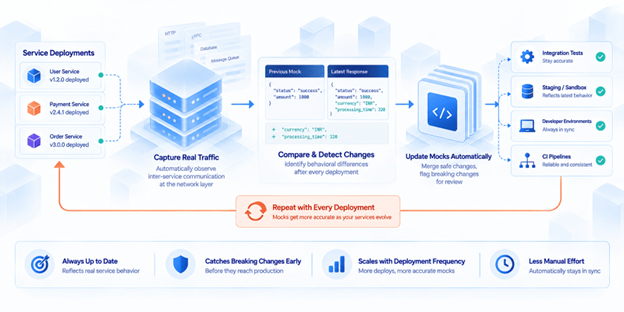
When a payment processing microservice deploys a new version to a staging environment, the deployment event automatically instantiates a recording session. Downstream services execute their integration tests against this newly updated staging service, capturing its exact current behavior. Consequently, mock configurations for dependent services (such as an order-processing service) update automatically to reflect current reality—eliminating the need for manual fixture updates or frantic reading of changelogs.
This architectural shift yields three critical properties that specification-based mocking cannot replicate:
- Automated Behavioral Parity: Mocks dynamically adapt to upstream evolution without manual intervention.
- Immediate Diff Visibility: Upstream changes generate immediate behavioral diffs, alerting teams to modifications at the deployment stage rather than during a production incident.
- Decoupled Maintenance Burden: Maintenance effort shifts from reactive human analysis to automated, event-driven observation.
Architectural Implementation: The Deployment-Triggered CI/CD Pipeline
To capture the accuracy benefits of traffic-based dependency mocking, organizations must integrate recording sessions directly into the event loops that generate accuracy risks: upstream deployments.
Relying on arbitrary schedules—such as running a weekly recording cron job—leaves dangerous gaps where dozens of unrecorded deployments can alter service behavior undetected. True protection requires an event-driven architecture embedded within the CI/CD pipeline.
[Upstream Pipeline] ──> [Deploy to Staging] ──> [Trigger Recording Session]
                                                        │
                                                        ▼
[Run Downstream Tests] <── [Generate Updated Mocks] <──┘
The Three-Component Architecture
A robust traffic-based mocking architecture within a modern CI/CD environment consists of three core components:
- Deployment Event Listeners: Webhooks or pipeline triggers attached to upstream service registries that detect when a new build has successfully deployed to an isolated staging or integration environment.
- Automated Interception Engines: Tools capable of listening to, recording, and serializing network traffic (such as HTTP/HTTPS, gRPC, and GraphQL exchanges) between the consuming service and its dependencies without altering application source code.
- Diff-Driven Verification Pipelines: Automated comparison engines that evaluate newly recorded traffic against previous mock baselines, generating clear change summaries for reviewing engineers.
When configured correctly, every upstream deployment that modifies service behavior produces a precise diff. This signal alerts downstream teams to exact behavioral shifts at the moment of deployment, shifting quality gates left from production telemetry to pre-production validation.
Where Traffic-Based Mocking Fits in the Modern Testing Stack
It is vital to recognize that traffic-based dependency mocking is not a silver bullet designed to replace every form of testing. Different dependencies require different virtualization strategies based on their inherent technical characteristics.
┌──────────────────────────┬──────────────────────────────┬─────────────────────────────┐
│ Dependency Type          │ Optimal Testing Strategy     │ Primary Rationale           │
├──────────────────────────┼──────────────────────────────┼─────────────────────────────┤
│ HTTP/REST/GraphQL APIs   │ Traffic-Based Mocking        │ Observable network traffic; │
│                          │                              │ high risk of drift.         │
├──────────────────────────┼──────────────────────────────┼─────────────────────────────┤
│ Databases & Caches       │ Testcontainers / Real        │ Complex state, SQL          │
│                          │ Containers                   │ constraints, and atomicity. │
├──────────────────────────┼──────────────────────────────┼─────────────────────────────┤
│ Internal Contracts (Same │ Specification-Based (e.g.,   │ Strict structural           │
│ Team / OpenAPI)          │ Pact)                        │ guarantees via contracts.   │
└──────────────────────────┴──────────────────────────────┴─────────────────────────────┘
1. HTTP and API Dependencies
For internal microservice APIs, third-party REST endpoints, and GraphQL services, traffic-based mocking shines. Because HTTP traffic is inherently observable and standardized, recording actual request-response exchanges captures the exact behavioral nuances required for robust integration testing.
2. Infrastructure Dependencies
For stateful infrastructure dependencies—such as relational databases, message queues (e.g., Kafka, RabbitMQ), and distributed caches (e.g., Redis)—mocking is generally discouraged. Real service containers managed via tools like Testcontainers provide vastly superior fidelity. Genuine service semantics, such as SQL constraints, transaction rollbacks, index behaviors, and message ordering guarantees, cannot be accurately replicated through static HTTP-level mocks.
3. Contract-Driven Boundaries
For tightly coupled internal boundaries where teams maintain strict OpenAPI specifications and actively verify contracts, specification-based approaches like Pact remain highly effective. When both producer and consumer strictly adhere to automated contract verification, the behavioral accuracy problem is solved at the contract specification layer.
Traffic-based dependency mocking specifically fills the vast middle ground: HTTP API dependencies—particularly third-party integrations—where neither real service calls in testing nor manually maintained specifications can reliably keep pace with upstream evolution.
The Operational Shift: From Reactive Maintenance to Event-Driven Observation
The transition from specification-based to traffic-based dependency mocking represents an existential operational model change rather than a simple tooling swap.
The Limits of Reactive Maintenance
In traditional environments, mock maintenance is entirely reactive:
- An engineer notices an integration test failure in CI.
- They investigate whether the failure is a genuine code bug or an upstream API change.
- If upstream, they comb through release notes or ping the upstream team on Slack to understand what changed.
- They manually update JSON fixtures, WireMock stubs, or mock assertions.
The maintenance burden here scales linearly—or exponentially—with the number of upstream services and deployment velocity. The human attention required per upstream deployment remains high, leading to developer fatigue and neglected test suites.
The Power of Event-Driven Observation
Traffic-based maintenance, by contrast, is fundamentally event-driven. Upstream deployments automatically trigger observation sessions that capture current behavior and surface delta reports.
Advanced implementations leverage kernel-level interception techniques—such as eBPF (Extended Berkeley Packet Filter)—to capture HTTP and network exchanges directly at the operating system kernel level. This approach eliminates the need to modify application code, inject custom proxy configurations, or instrument test runners. Furthermore, kernel-level capture is entirely language- and framework-agnostic: the exact same recording mechanism seamlessly handles upstream services built in Go, Python (FastAPI), Node.js (Express), or Java (Spring Boot), regardless of the client libraries utilized by downstream consumers.
By delegating the identification of behavioral changes to automated observation pipelines, the human effort required per deployment plummets. Engineers no longer waste hours debugging mysterious test failures caused by stale fixtures; instead, they review automated diffs generated at the exact moment of upstream release.
Future Outlook: Redefining Pipeline Confidence
As software systems grow increasingly distributed and deployment velocities accelerate toward continuous deployment maturity, the traditional methods of managing test mocks are reaching their absolute limits.
Static test fixtures and manually maintained mock specifications are relics of a slower software era. When deployment frequency was measured in months, manual mock maintenance was an annoyance; in an era of multiple daily deployments, it is an architectural failure point.
By inverting the relationship between deployment frequency and mock accuracy, traffic-based dependency mocking redefines what CI/CD pipeline results actually mean:
- The Legacy Model: A green integration test suite confirms that the application behaves correctly against an idealized, outdated assumption of upstream services. Pipeline health and production reality slowly drift apart over time.
- The Modern Traffic-Based Model: A green integration test suite confirms that the application correctly handles behavior observed from live upstream services immediately following their most recent deployments. Pipeline health remains tightly coupled to production reality.
For DevOps leaders, platform engineers, and software architects navigating the complexities of modern microservices, the path forward is clear. To maintain high velocity without sacrificing reliability, testing infrastructure must evolve from static speculation to dynamic, event-driven observation. Accuracy must no longer decay with speed; it must compound with every deployment.