In the rapidly evolving digital ecosystem, the traditional boundaries that once separated niche internet subcultures from the global mainstream have officially dissolved. According to a landmark report published by YouTube examining the evolution of contemporary culture, the democratization of internet access has created a paradox: while audiences are more fragmented across specialized, hyper-niche communities than ever before, the fundamental human desire for shared cultural experiences remains as strong as it was in the era of mass-media broadcasting.
The report, titled The Modern Mainstream, challenges the long-held assumption that the rise of targeted internet algorithms and algorithmic echo chambers has led to the death of a unified cultural consciousness. Instead, YouTube’s findings—based on comprehensive research conducted by NRG surveying nearly 1,000 individuals aged 14 to 44—reveal that the mainstream has not disappeared. Rather, its definition has fundamentally shifted.
Today, traditional cultural gatekeepers—such as Hollywood studios, major television networks, and legacy media conglomerates—no longer hold a monopoly on what defines the cultural zeitgeist. They now share the stage with digital creators, independent streamers, viral memes, and decentralized online communities. These digital entities act as the new arbiters of cultural relevance.
This transformation highlights a critical paradigm shift in modern media consumption: participation has replaced passive observation. For an idea, concept, or piece of entertainment to achieve true mainstream status in the 21st century, it must no longer merely broadcast a message to an audience. It must invite collaboration, foster engaged communities, and sustain ongoing conversations that bridge the gap between niche fascination and global phenomenon.
Detailed Chronology & Background
To understand how we arrived at this pivotal moment in media history, it is necessary to examine the trajectory of internet culture over the past two decades.
Phase 1: The Era of Mass Broadcasting (Pre-2010s)
For decades, popular culture was defined by scarcity. A handful of television networks, film studios, and music labels acted as gatekeepers, filtering out the vast majority of creative output and presenting a uniform menu of entertainment to the global public. Audiences were largely passive consumers. Cultural touchstones—such as season finales of major television shows, blockbuster movie premieres, or globally televised sporting events like the Super Bowl—acted as universal conversation starters because everyone experienced the exact same media ecosystem.
Phase 2: The Fragmentation of the Web (2010s–Early 2020s)
As broadband internet penetration surged, mobile devices became ubiquitous, and platforms like YouTube, Twitter, and Reddit matured, the media landscape shattered. Algorithms designed to maximize user engagement began serving hyper-personalized content. Suddenly, users could retreat into deeply specific digital enclaves. Whether someone was obsessed with hyper-realistic miniature painting, obscure retro video game speedruns, or avant-garde fashion curation, the internet could supply an endless stream of tailored content. During this period, cultural critics frequently warned that the "mainstream" was fracturing beyond repair, leading to an era where no two people shared the same cultural reference points.
Phase 3: The Convergence and the "New Mainstream" (Present Day)
YouTube’s latest report marks the realization of a counter-trend: rather than drifting infinitely apart, internet users are actively synthesizing their fragmented experiences into a new kind of collective culture. The digital landscape has matured to the point where online-native phenomena can scale upward to match or exceed the cultural footprint of traditional institutional mainstays.
Today, phenomena that originate in the deepest corners of the internet routinely cross over into traditional entertainment spaces, and vice versa. The timeline of cultural relevance is no longer linear (from studio to screen to consumer); it is circular, iterative, and driven entirely by the participatory momentum of online communities.
Supporting Context & Metrics: Decoding Modern Fandom
To quantify these profound shifts, YouTube’s research team, in partnership with insights firm NRG, investigated the attitudes and behaviors of 939 respondents aged 14 to 44. The resulting data paints a vivid picture of how modern audiences navigate the intersection of niche communities and mass culture.
The Pull of the Collective
Despite the dizzying array of personalized content choices available today, the survey revealed a surprising counter-intuitive trend: 63% of respondents indicated that, compared to five years ago, it is more true today that they watch content or follow creators that everyone they know is also watching or following.
This statistic underscores a deep-seated psychological need for shared cultural touchstones. While people enjoy exploring niche interests in their spare time, they derive equal, if not greater, satisfaction from participating in collective cultural moments that bond them with their peers.
The Equalization of Cultural Authority
Perhaps the most striking metric in the report concerns how modern audiences perceive the origin of popular culture. When survey participants were asked to identify what "many people seem to be into nowadays," digital entities scored neck-and-neck with traditional cultural titans:
The Super Bowl: 83% perceived it as widely known.
Hollywood Celebrities: 79% perceived them as widely known.
Memes: 78% perceived them as widely known.
YouTube Creators: 77% perceived them as widely known.
The fact that digital-native phenomena like memes and YouTube creators are viewed by nearly 80% of the surveyed population as being on par with institutional giants like Hollywood and the Super Bowl signals a watershed moment in media perception. Online culture has successfully achieved mainstream status, operating on an equal playing field with legacy institutions.
The Demographics of Digital Fandom
The report places special emphasis on the digital habits of younger demographics, specifically those aged 14 to 24. Within this critical cohort:
82% turn to YouTube specifically for content, conversation, or information regarding their personal fandoms.
Of those, an overwhelming 95% consume content related to their favorite subjects at least on a weekly basis.
These figures illustrate that YouTube is no longer merely a video-hosting platform; it has evolved into the primary social and informational infrastructure for modern fandoms.
Official Statements & Industry Analysis
Articulating the core philosophy behind the research, YouTube’s official commentary highlights the systemic transformation of how cultural relevance is manufactured and sustained in the digital age:
"Our cultural landscape is more fragmented than ever, but our desire for shared experiences remains strong. The mainstream hasn’t disappeared, but its meaning has shifted: digital creators and communities now stand alongside traditional cultural gatekeepers as the arbiters of what makes it into the mainstream."
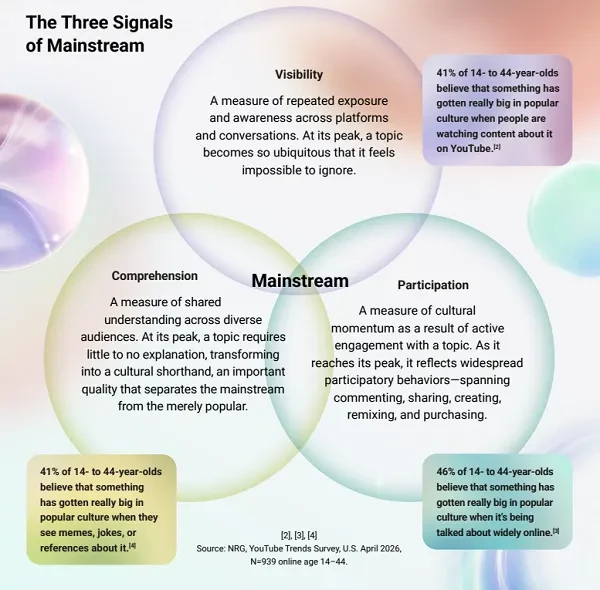
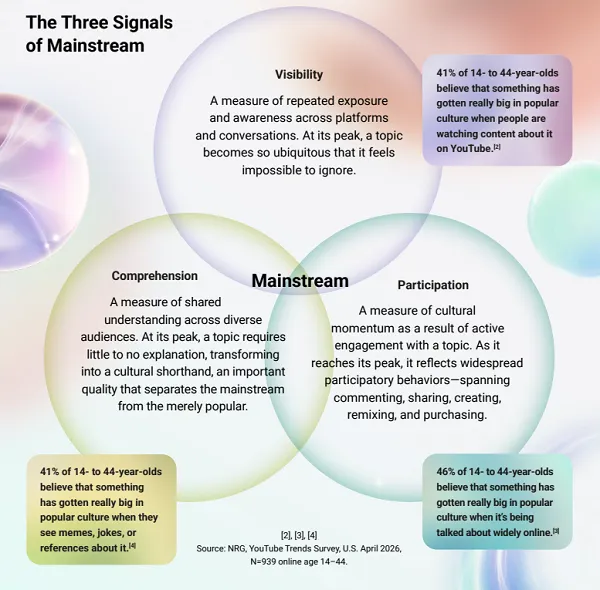
The report goes on to outline the three fundamental signals that define mainstream culture in the modern era, with participation serving as the foundational pillar. Unlike the 20th-century model of broadcasting—where audiences received culture top-down—modern culture is built bottom-up through active engagement.
"Digital culture has created new pathways to mainstream success," YouTube notes. "The ideas that break through are those that inspire participation, foster communities, and sustain conversation, building the visibility, participation, and comprehension needed to become mainstream."
YouTube emphasizes that simply having a large, passionate fanbase is no longer a guaranteed ticket to mainstream ubiquity. Many subcultures boast millions of dedicated followers yet remain siloed because they fail to meet the three-part criteria of visibility, participatory invitation, and broad thematic comprehension. To cross the chasm from niche to mainstream, an idea must empower its audience to become co-creators.
Case Studies: From Digital Subcultures to Global Blockbusters
To illustrate how these theoretical shifts manifest in the real world, the YouTube report highlights several high-profile case studies where internet-native concepts successfully transitioned into global cultural phenomena.
1. The Backrooms
Originating as a short, eerie, internet-pioneered concept born from a simple image and a creepy creepypasta text on 4chan and Reddit, The Backrooms expanded exponentially through user-generated YouTube videos, most notably Kane Parsons’ viral short film series. The concept—a seemingly endless maze of yellow office rooms—sparked a massive digital fandom that built lore, created spinoff games, and sustained online conversations for years. This grassroots momentum eventually caught the attention of Hollywood, leading to a greenlit feature film adaptation. The Backrooms represents the ultimate modern pipeline: digital ideation to participatory community building to institutional Hollywood adoption.
2. Five Nights at Freddy’s
An independent survival horror video game created by Scott Cawthon, Five Nights at Freddy’s achieved initial prominence almost entirely through YouTube. Creators recorded their jump-scare reactions, while fans dissected the game’s notoriously complex, hidden lore through fan-made videos, theories, and animations. The community’s deep participation transformed a low-budget indie game into a global multimedia empire, culminating in a blockbuster theatrical release that dominated box offices worldwide.
3. MrBeast (Jimmy Donaldson)
As the most-subscribed independent creator on YouTube, Jimmy Donaldson (MrBeast) exemplifies how individual digital creators now command cultural authority that rivals traditional A-list celebrities. By pioneering high-concept, philanthropic, and hyper-engaging video formats that invite audience investment and massive online discourse, MrBeast has become a household name across generations—proving that personal brands built on digital platforms can achieve broader cultural awareness than traditional television and movie stars.
Future Outlook: Navigating the Participatory Culture
As we look toward the future of media, entertainment, and technology, the implications of YouTube’s findings are profound for creators, brands, and traditional media institutions alike.
What This Means for Creators and Brands
For content creators and corporate brands attempting to capture the attention of modern consumers, the mandate is clear: unidirectional broadcasting is dead. Brands can no longer rely on slick, highly polished advertising campaigns that talk at consumers. Instead, they must design campaigns and content frameworks that invite user participation, encourage remix culture, and leave room for community-led storytelling. If an audience cannot interact with, modify, or converse about a piece of content, it is unlikely to achieve cultural longevity.
The Evolution of Entertainment Gatekeeping
Traditional Hollywood studios and media networks are increasingly adopting a "data-first" approach to greenlighting projects. Rather than relying solely on executive intuition, studios are scanning digital ecosystems—tracking YouTube view counts, Reddit engagement metrics, and TikTok trends—to identify pre-validated concepts with built-in participatory fanbases. This de-risks creative investments while ensuring that new entertainment offerings already possess an engaged audience ready to mobilize upon release.
The Enduring Human Element
Ultimately, YouTube’s comprehensive research into the modern mainstream offers an optimistic view of human connectivity in the digital age. While technology has exponentially increased our choices and threatened to splinter our attention across infinite digital silos, our fundamental social wiring remains unchanged. We still yearn to gather around the metaphorical campfire, share cultural reference points, and feel part of something larger than ourselves.
The only difference is that today, anyone with a camera, a creative idea, and an internet connection can help build that campfire.