










Executive Overview
Artifact repositories occupy a strange, often misunderstood blind spot within modern enterprise security architectures. Unlike outward-facing web applications, they rarely front the public internet directly. Unlike hardened production databases, they do not hold raw customer Personally Identifiable Information (PII) or credit card repositories.
Yet, these platforms harbor assets that are arguably far more valuable: the foundational binaries, container images, compiled software packages, and source components that every enterprise build pipeline pulls from before proprietary code ever ships to production.
Compromise a typical corporate web server, and an attacker generally gains access to a single localized application instance. Compromise an enterprise artifact repository, however, and the threat actor effectively poisons the well. They are no longer attacking a single product; they are hijacking every downstream dependency, injecting malicious code directly into the software supply chain where it can quietly propagate to global end-users.
It is against this high-stakes backdrop that a security research report from cloud-native security firm Wiz has sent ripples through the software engineering and DevSecOps communities. The report details active, widespread exploitation campaigns targeting three distinct vulnerabilities in JFrog Artifactory—all of which already have official patches available.
The core of this unfolding crisis is not merely a technical failure of software code, but a systemic organizational failure: the dangerous lag time between when a security patch is publicly released and when enterprise IT departments actually apply it.
As threat actors rapidly operationalize these flaws, deploying custom Rust-based backdoors, malicious Groovy plugins, and persistent web shells, security leaders are forced to confront an uncomfortable truth. Organizations continue to treat their core build infrastructure as background plumbing, leaving critical backdoors wide open while scrambling to secure outward-facing web portals.
Detailed Chronology of the Vulnerabilities and Exploitation Vectors
The multi-stage exploitation campaigns documented by Wiz rely on a calculated mix of standalone critical flaws and clever privilege-escalation chaining. Security analysts tracking the activity note that multiple distinct threat groups are currently exploiting these vulnerabilities independently, a clear indicator that functional proof-of-concept (PoC) exploits spread rapidly across underground forums and automated vulnerability scanners shortly after the flaws were disclosed.
1. The Crown Jewel: CVE-2026-82329 (Authentication Bypass)
The most severe of the trio is CVE-2026-82329, an authentication-bypass vulnerability that lets an unauthenticated attacker with basic network access reach the target repository and walk straight into administrative privileges.
- Patch Release Date: August 28
- Impact: Complete, unauthenticated takeover of the Artifactory administrative plane.
- Exploitation Profile: Because administrative access grants total control over package repositories, caches, and storage backends, threat actors seizing this flaw can immediately modify existing packages or inject malicious updates into clean repositories. Wiz observed multiple independent threat actors actively leveraging this bug in the wild within days of disclosure.
2. The Chained Attack Vectors: CVE-2026-42018 & CVE-2026-42016
Rather than waiting for a single critical silver bullet, sophisticated attackers are increasingly bundling lower-severity flaws into potent attack chains. This exact pattern emerged in the targeting of Artifactory through the combination of two separate bugs:
- CVE-2026-42018 (Improper Authentication): Patched by JFrog on August 12, this flaw causes the system to return internal anonymous-user tokens to callers even when anonymous access has been explicitly disabled across the instance. This provides an attacker with an initial foothold, allowing them to authenticate as if they legitimately belonged inside the perimeter.
- CVE-2026-42016 (Privilege Escalation): Patched earlier on July 27, this vulnerability is rooted in improper token-scope validation. It enables a low-privileged, already-authenticated user to climb the permission ladder to administrative rights they were never granted.
By chaining CVE-2026-42018 (for the initial unauthenticated-yet-recognized foothold) with CVE-2026-42016 (to escalate those privileges), attackers effortlessly bypass security boundaries, moving from zero access to full administrative control of the Artifactory instance without ever triggering the alarms associated with a high-profile perimeter breach.
Anatomy of the Intrusion: Tooling and Persistence
Once inside an Artifactory instance via these bypasses, threat actors are not simply conducting casual reconnaissance or exfiltrating data. Forensics from Wiz indicate that intruders are actively entrenching themselves for long-term operational persistence:
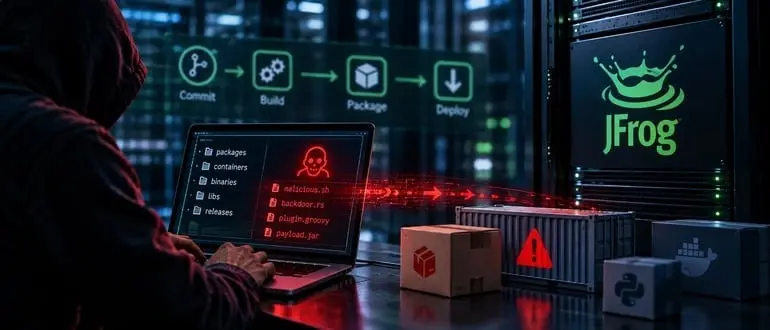
- Custom Rust-Based Backdoors: Intruders are dropping lean, highly efficient, custom-compiled Rust binaries designed to blend into standard system processes while maintaining covert, encrypted command-and-control (C2) communication channels.
- Groovy Plugins for Remote Code Execution (RCE): Artifactory supports extensible Groovy scripts to manage internal repository behavior. Attackers are weaponizing this native feature, uploading custom malicious Groovy plugins that execute arbitrary code directly on the underlying server architecture.
- Web Shells: Traditional web-based backdoors are being left behind in accessible web directories, assuring persistent backdoor access even if primary service accounts are reset or security teams attempt partial remediation.
This specialized toolkit is meticulously tailored to the exact nature of an artifact repository server: an environment where malicious code can sit quietly, embedded deep inside the build pipeline, waiting to ride downstream into every compiled software package, container image, and enterprise release.
Supporting Context & Metrics: The Perils of Slow Patching Velocity
The narrative surrounding the JFrog Artifactory compromises is ultimately as much a story about organizational patch management hygiene as it is about software bugs. The sheer velocity at which attackers move stands in stark contrast to the sluggish pace at which enterprise IT and DevSecOps teams push updates to internal infrastructure.

Wiz’s global telemetry paints a startling picture of how long these critical vulnerabilities remain exposed in production environments long after vendors have provided remedies:
- CVE-2026-42016 (Privilege Escalation): Still actively present and unpatched in 59% of scanned enterprise Artifactory instances a full six weeks after the patch went live.
- CVE-2026-42018 (Improper Authentication): Still unpatched in 62% of scanned instances a full month after disclosure and patching.
- CVE-2026-82329 (Authentication Bypass): Even this most critical, high-profile authentication bypass was found to be unpatched and fully exploitable in 49% of instances two weeks after JFrog rushed out a fix.
As Wiz researchers bluntly noted in their technical write-up, enterprise "patching velocity has been slow," leaving a massive window of opportunity for automated scanners and human threat actors alike.
Expert Analysis and Industry Perspectives
To understand why internal development infrastructure consistently suffers from delayed patching cycles, industry experts point to ingrained institutional biases regarding risk prioritization.
Mitch Ashley, vice president and practice lead for CIO & Technology Buyers and Software Lifecycle Engineering at The Futurum Group, views these alarming statistics through the lens of skewed organizational priorities.
"Patch urgency still prioritizes internet exposures versus downstream dependence," Ashley observes. "Which is why a repository manager can sit unpatched for weeks while a public web app gets fixed in hours or days. Compromising a repository is a software supply chain security event. Every build that pulls from it inherits the result."
Ashley issues a stark warning regarding how enterprise security groups categorize their attack surface, arguing that legacy mentalities must evolve.
"Build infrastructure deserves the same patch clock as anything customer-facing," Ashley prescribes. "Security teams should be asking today who holds administrative tokens on their repository and what those tokens can reach."
Security analysts point out that this incident highlights a broader flaw in traditional Common Vulnerability Scoring System (CVSS) metrics. Vulnerability scoring models rarely account for the compound danger of chained lower-severity flaws. Two "High" severity CVEs sitting unpatched side-by-side can quietly become exponentially more dangerous than a single "Critical" vulnerability, yet automated asset scanners frequently prioritize them lower simply due to their individual rating tags.
Future Outlook: Securing the Upstream Attack Surface
The active exploitation of JFrog Artifactory is unlikely to remain an isolated incident. Artifact repositories, container registries, and continuous integration/continuous deployment (CI/CD) servers have steadily morphed into primary targets for advanced persistent threat (APT) groups and financially motivated ransomware gangs alike.
These platforms represent the ultimate leverage point: compromise one central repository manager, and you effectively compromise every product built downstream by hundreds of downstream developers.
Recommendations for Security and DevSecOps Teams
Mitigating risks of this magnitude requires moving beyond reactive patching toward a comprehensive posture of continuous supply chain defense:
- Reclassify Build Infrastructure Attack Surface: Treat repository managers, CI/CD orchestrators, container registries, and code-signing servers as first-class, high-priority attack surfaces. They demand the exact same rapid patch cadence traditionally reserved for customer-facing web applications.
- Aggressive Token and Identity Auditing: Regularly audit service accounts, API keys, and administrative tokens. Security teams must verify who holds administrative rights over their artifact repositories and precisely what resources those tokens can access.
- Advanced Threat Hunting and Behavioral Monitoring: Security teams must actively monitor repository servers for anomalous behavior—such as unexpected plugin uploads, unrecognized background processes, unusual outbound network connections, or unfamiliar service accounts interacting with storage volumes.
- Rethink Vulnerability Management Logic: Update internal vulnerability management workflows to flag chained risks. When multiple high-severity flaws exist concurrently within foundational infrastructure components, treat their combined risk profile with critical urgency.
The vulnerabilities themselves are ultimately temporary, solved by applying vendor patches that have already been available for weeks. Whether those vulnerabilities turn into full-scale enterprise breaches, however, depends entirely on organizational velocity—how quickly security teams can bridge the gap between a patch existing on paper and that patch reaching production.


