The landscape of professional motion picture lighting is undergoing a quiet but profound revolution. For decades, high-intensity discharge sources—most notably Hydrargyrum Medium-arc Iodide (HMI) fixtures—have remained the undisputed kings of high-output, daylight-balanced illumination on professional film sets. However, their dominance has come at a steep cost: massive power consumption, delicate ballasts, significant heat generation, and a lack of real-time color tunability.
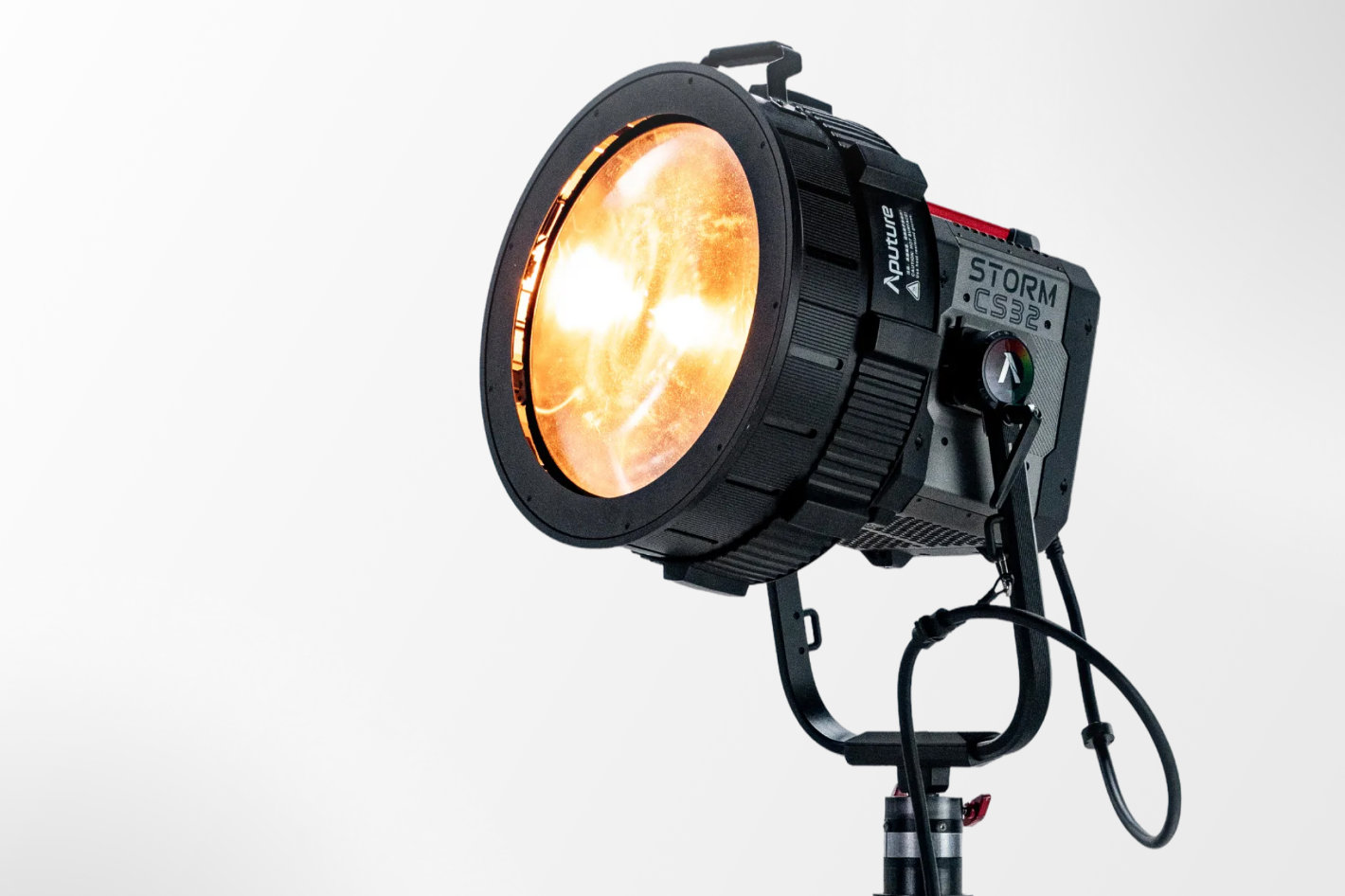
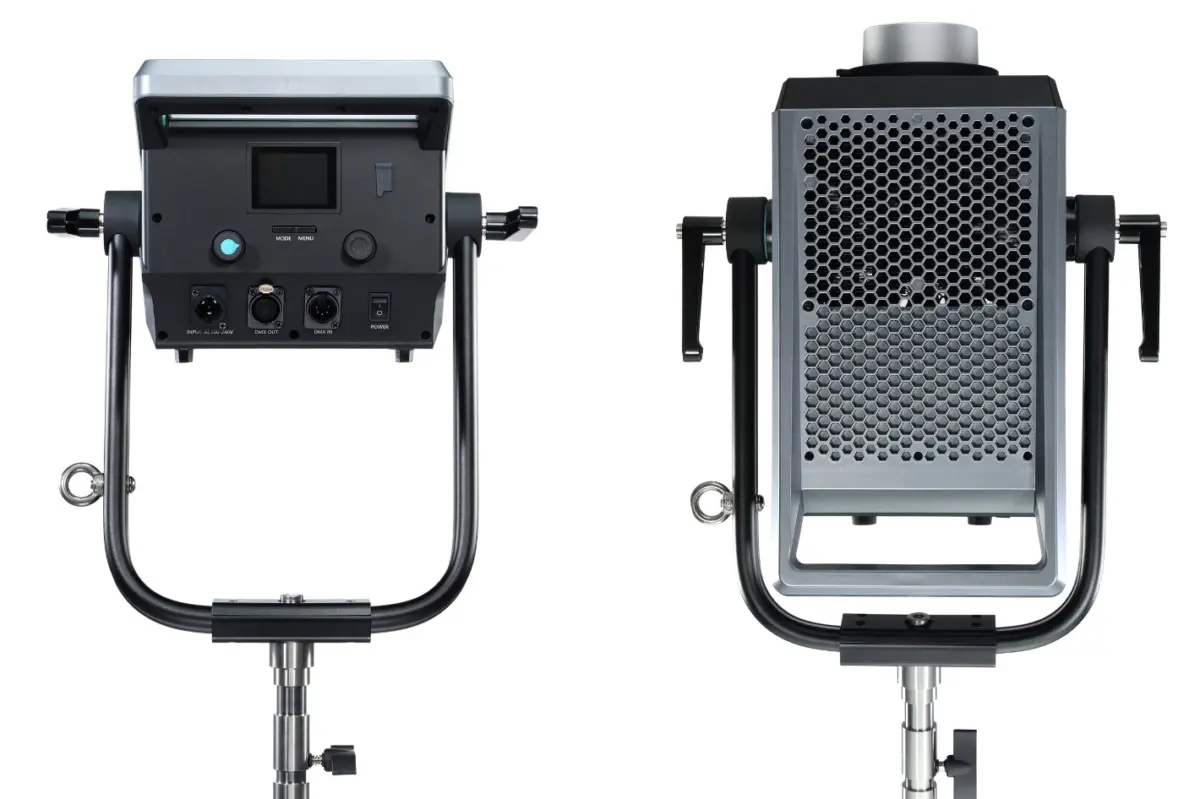
At the International Broadcasting Convention (IBC), Aputure disrupted this status quo with the official unveiling of the STORM CS32. Positioned as a direct, highly portable replacement for traditional 4K HMI fixtures, the STORM CS32 represents a significant leap forward in solid-state lighting technology.
At the core of the STORM CS32 is Aputure’s newly developed, state-of-the-art BLAIR-CG with Extended Red light engine. This proprietary technology allows the fixture to deliver highly saturated colors across the visible spectrum alongside an incredibly wide, highly accurate range of tunable white light. Crucially, Aputure has achieved this massive output without sacrificing the compact form factor that modern, fast-moving production crews require. Designed to be operated easily by a single crew member and sized to fit onto a standard production head cart, the STORM CS32 aims to transition high-output color fixtures from specialty, single-day rental items into everyday "always-on-truck" workhorses.
Detailed Chronology: The Path to the STORM CS32
To understand the technological significance of the STORM CS32, one must trace the evolutionary path of LED lighting in the motion picture industry over the past decade.
[Early 2010s: Low-Output LED Panels]
       │
       ▼
[Mid 2010s: COB Bi-Color Monolights (e.g., LS 300d)]
       │
       ▼
[Late 2010s: High-Output Daylight/Bi-Color (e.g., LS 600d, LS 1200d)]
       │
       ▼
[Early 2020s: Multi-Emitter Color Engines (RGBWW, RGBACL)]
       │
       ▼
[Present: BLAIR-CG with Extended Red (STORM CS32)]
  - Replaces 4K HMI output
  - Full-spectrum accuracy (SSI in the 90s)
  - Single-operator form factor
The Early Era of LED Adoption
In the early 2010s, LED fixtures on film sets were largely confined to low-output, bi-color tile panels. While convenient for close-up interviews, they lacked the punch, throw, and beam control required for key lighting or simulating natural sunlight through windows.
The introduction of high-output Chip-on-Board (COB) LEDs—pioneered in large part by Aputure’s Light Storm (LS) series—shifted the paradigm. Fixtures like the LS 300d and later the LS 600d Pro proved that LEDs could match the output of small HMIs and tungsten sources while running on standard household power circuits.
The Color Calibration Challenge
Despite these advancements, high-output fixtures remained largely limited to daylight or bi-color configurations. When full-color (RGB) lighting was introduced, it often suffered from a steep drop-off in total lumen output and poor color rendering metrics, particularly in the yellow, gold, and deep red wavelengths. Cinematographers were frequently forced to choose between the raw power of a daylight-balanced monolight or the color flexibility of a lower-output RGBWW fixture.
The Breakthrough of BLAIR-CG
The development of the STORM series represents the culmination of years of color science research. Recognizing the limitations of standard RGBWW (Red, Green, Blue, Warm White, Cool White) and even newer RGBACL (Red, Green, Blue, Amber, Cyan, Lime) arrays, Aputure engineered the BLAIR (Blue, Lime, Amber, Indigo, Red) emitter mix.
By upgrading this architecture to the BLAIR-CG (incorporating Cyan and Green) and integrating an Extended Red emitter set, Aputure successfully bridged the gap between raw lux output and clinical spectral accuracy. The STORM CS32 stands as the commercial realization of this long-term development pipeline, delivering a fixture that matches or exceeds the output of a 4K HMI while offering full-spectrum color tunability.
Supporting Context & Metrics: Deconstructing the Tech
The STORM CS32’s capability is best understood through its technical specifications, optical performance, and color science metrics.
Feature / Metric
Aputure STORM CS32 Specification
Traditional 4K HMI Equivalent
Light Engine
BLAIR-CG with Extended Red
Hydrargyrum Medium-arc Iodide (HMI)
Output Level
Exceeds standard 4K HMI output
Baseline reference (4,000W draw)
Spectral Similarity Index (SSI)
High 90s (Tungsten & Daylight)
Mid-to-high 80s (frequently exhibits green spikes)
None (UV filtered out completely or unshielded safety hazard)
Crew Requirements
1 Person (Fits on standard head cart)
Multi-person setup (Heavy ballast, heavy-duty stands, head cables)
Power Efficiency
High efficiency, instant on/off, dimmable
High draw, requires strike/warm-up time, limited dimming
The Physics of the BLAIR-CG Engine with Extended Red
Traditional white LEDs generate light by passing a blue emitter through a yellow phosphor coating, which often results in a "spectral valley" in the cyan and red regions. This spectral deficit is why skin tones can sometimes look muddy or lifeless under cheap LED lights.
Aputure’s BLAIR-CG engine bypasses this limitation by using a carefully calibrated cluster of discrete color emitters:
Blue, Lime, Amber, Indigo, Red, Cyan, and Green (BLAIR-CG): This multi-diode array fills in the spectral gaps standard LEDs leave behind.
Indigo Emitter Technology: One of the most innovative aspects of the CS32 is the inclusion of an indigo emitter. Indigo light sits just on the edge of the visible spectrum. It activates the natural fluorescent optical brighteners found in modern fabrics, papers, and laundry detergents. This matches the subtle, organic way real daylight and tungsten light interact with environments, achieving a level of realism previously impossible with pure digital light sources—all without emitting harmful ultraviolet (UV) radiation.
Extended Red: By expanding the red emitter set, the STORM CS32 maintains rich, highly saturated skin tones and a full spectral curve, even when operating at maximum output levels. This prevents the "washout" effect common when pushing color fixtures to their limits.
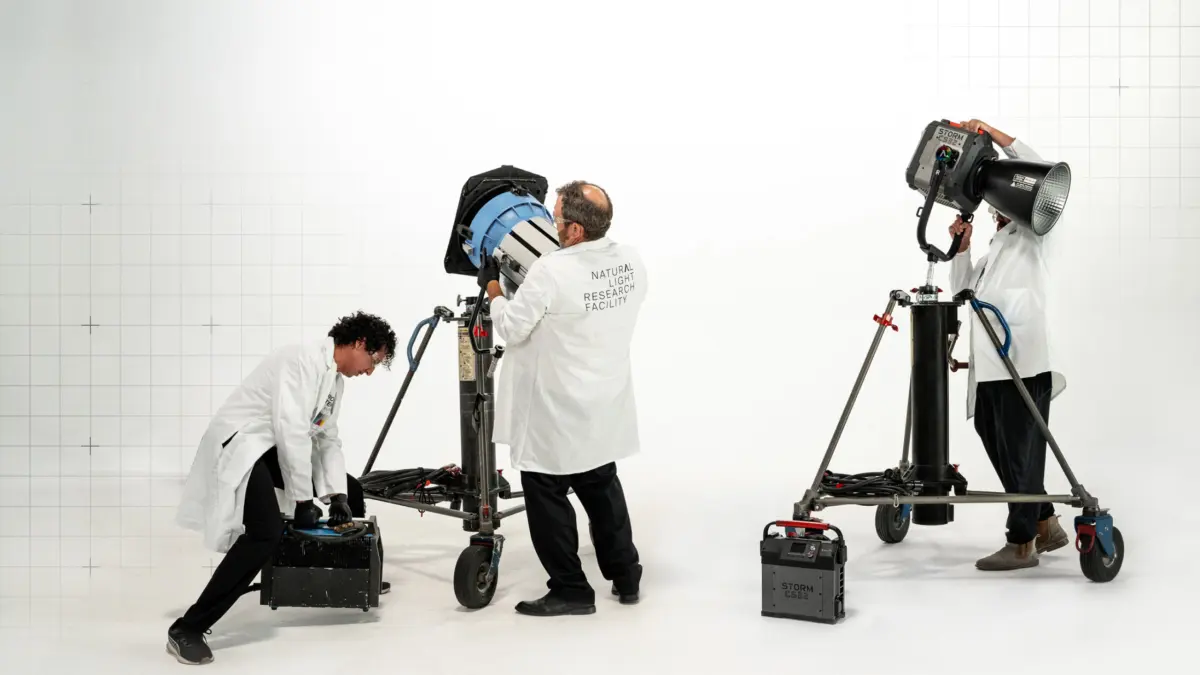
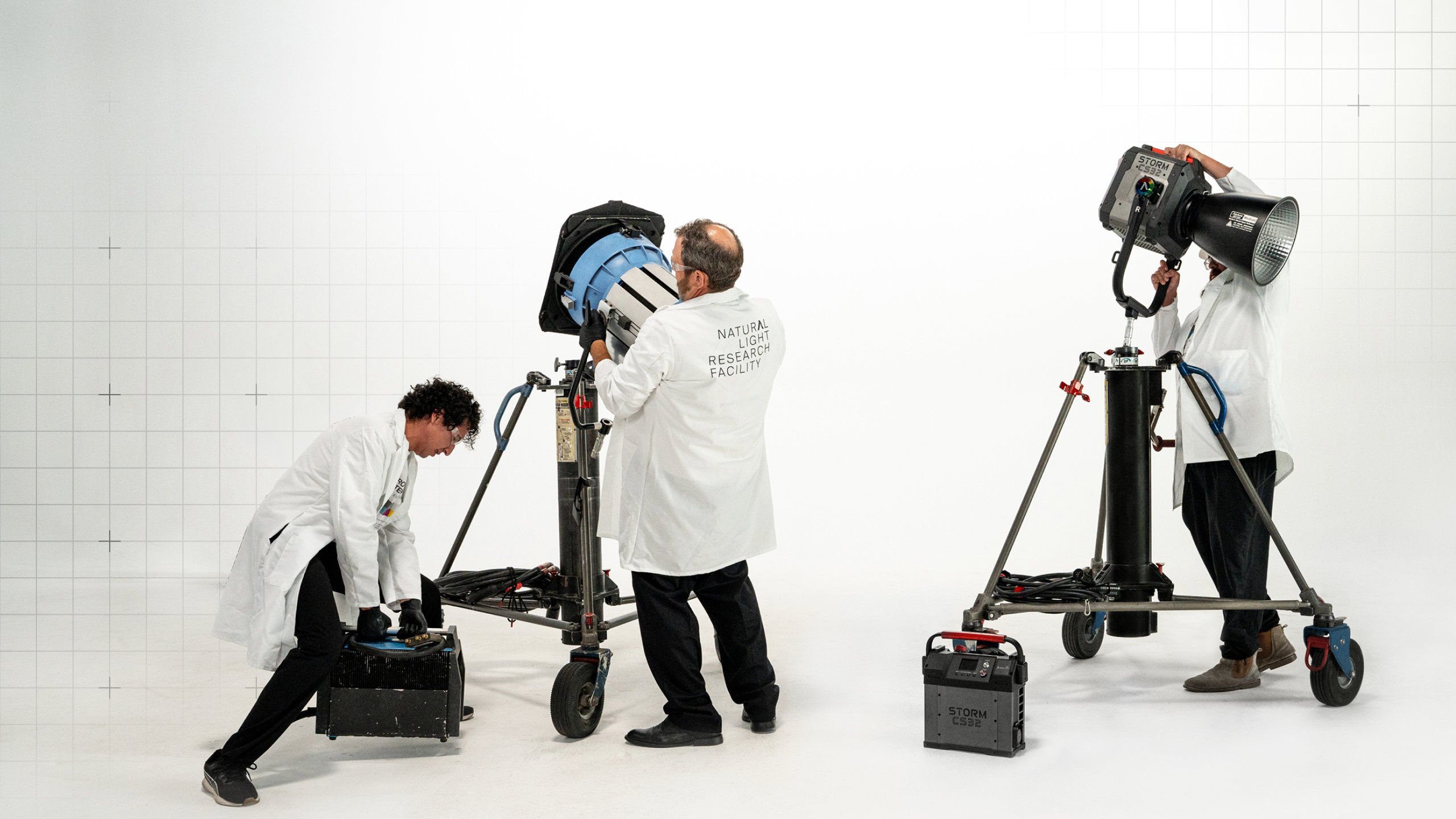
Beyond its color quality, the STORM CS32 addresses a major logistical bottleneck on modern film sets: physical size and weight. A traditional 4K HMI setup requires a massive lamp head, a heavy external ballast, thick head cables, and a heavy-duty junior or senior stand. It is a system that almost always requires at least two grip/electric crew members to safely transport, rig, and strike.
Aputure designed the STORM CS32 with a power-to-weight ratio optimized for single-person deployment. The fixture fits seamlessly onto a standard head cart alongside other common production tools. This footprint reduction allows smaller crews—such as those on indie features, high-end documentaries, and commercial shoots—to deploy HMI-level output without the overhead of a large lighting package.
Official Statements
The design philosophy behind the STORM CS32 emphasizes versatility and utility, aiming to replace niche rental gear with a flexible daily tool. Mitch Gross, Aputure’s Director of Marketing, highlighted this shift:
“The STORM CS32 can be seen as a 4K HMI replacement, but it is so much more. It has a huge range of tunable white light with amazing spectrum accuracy to match natural light, with unprecedented SSI scores in the 90s. But the CS32 is also a full color tunable light with an enormous range of deep colors and the best yellows and golds available for shooting gorgeous sunset effects. And even with all this power and range, Aputure designed the CS32 so that it fits on a head cart and one person can set it up. Instead of the special light you rent only for big shoot days, the STORM CS32 can be the main light you carry all the time.”
This sentiment is echoed in Aputure’s official product positioning statements, which position the fixture as an investment in a production ecosystem designed to grow alongside a filmmaker’s career:
“The STORM CS32 is designed to be the light that grows with you. It’s so capable that some may think it is more light than they need. The CS32 is best in class for what you need now and what you might need in the future. The STORM CS32 features the latest iteration of Aputure’s full tunable color light engine, BLAIR-CG with Extended Red. Indigo activates the natural fluorescence in many fabrics and surfaces, matching the effects of real daylight and true tungsten light without any UV. By expanding the red emitter set with Extended Red, rich skin tones and a fuller spectrum are maintained with increased output. All that performance in a light one person can carry. High Output, Full Spectrum, Small Size.”
Future Outlook: The Death of the HMI?
The introduction of the STORM CS32 at the International Broadcasting Convention (IBC) in Amsterdam marks a clear turning point for the film and television production industries. As environmental regulations tighten worldwide and production budgets demand faster turnaround times, the days of legacy gas-discharge lighting are drawing to a close.
HMIs are notoriously inefficient, delicate, and potentially hazardous. They draw immense amounts of power, run hot enough to cause severe burns, and contain pressurized gases that present a risk of explosion upon failure. Furthermore, they cannot be dimmed easily without shifting color temperature, and they require a warm-up and cool-down period before they can be restruck.
The STORM CS32 circumvents every single one of these operational pain points:
Instantaneous Operation: It strikes instantly, dims from 0% to 100% without color shifting, and runs cool to the touch by comparison.
Power Efficiency: By utilizing solid-state LED emitters, it draws a fraction of the power of an equivalent HMI, allowing it to run off standard household circuits or portable battery stations. This drastically reduces the need for loud, diesel-powered generators on location.
Advanced Control Systems: Unlike legacy HMIs, which require manual gel frames to alter color temperature or hue, the CS32 integrates into modern wireless DMX, Art-Net, and Sidus Link ecosystems. Gaffer and programmers can adjust color, match ambient lighting conditions, and trigger complex lighting effects instantly from a console or tablet.
Virtual Production and Beyond
As virtual production stages (LED volumes) continue to proliferate, the need for lighting fixtures that can accurately match the color space of LED walls is paramount. The BLAIR-CG engine, with its wide color gamut and precise spectral tuning, is uniquely positioned to integrate into these advanced workflows.
By delivering a fixture that combines HMI-level punch with the color precision of a reference monitor, Aputure is not just releasing a new light—it is laying the groundwork for the next decade of digital cinematography. The STORM CS32’s showcase at IBC confirms that the future of high-output lighting is smart, sustainable, highly accurate, and accessible to crews of any size.