Executive Overview
Silicon Valley has long subscribed to the disruptive tech mantra of “move fast and break things.” However, for David Zagaynov, co-founder and CEO of Poseidon Aerospace, the ethos is much simpler and decidedly more utilitarian: just move things fast.
While the broader aerospace and venture capital markets have been thoroughly captivated by the glitzy promises of advanced air mobility (AAM)—often pouring billions of dollars into high-profile passenger electric vertical takeoff and landing (eVTOL) vehicles and hydrogen-electric propulsion concepts—Poseidon is charting a radically pragmatic course. The startup is entirely bypassing the complex, capital-intensive pursuit of passenger transport and bleeding-edge alternative fuels. Instead, it is focusing its energy on what it considers to be a vastly underserved, economically ripe sector: the uncrewed transportation of commercial and defense freight.
This pragmatic, cost-obsessed strategy is already winning over top-tier investors. Poseidon Aerospace has successfully closed a $60 million Series A funding round, coming hot on the heels of an $11 million seed round secured last year. The latest capital infusion was led by prominent early-stage venture capital firm TQ Ventures, with notable new participation from Hanwha Asset Management, G Squared, and JAWS. They were joined by returning early backers Starship Ventures, Draper Associates, and Drover Ventures.
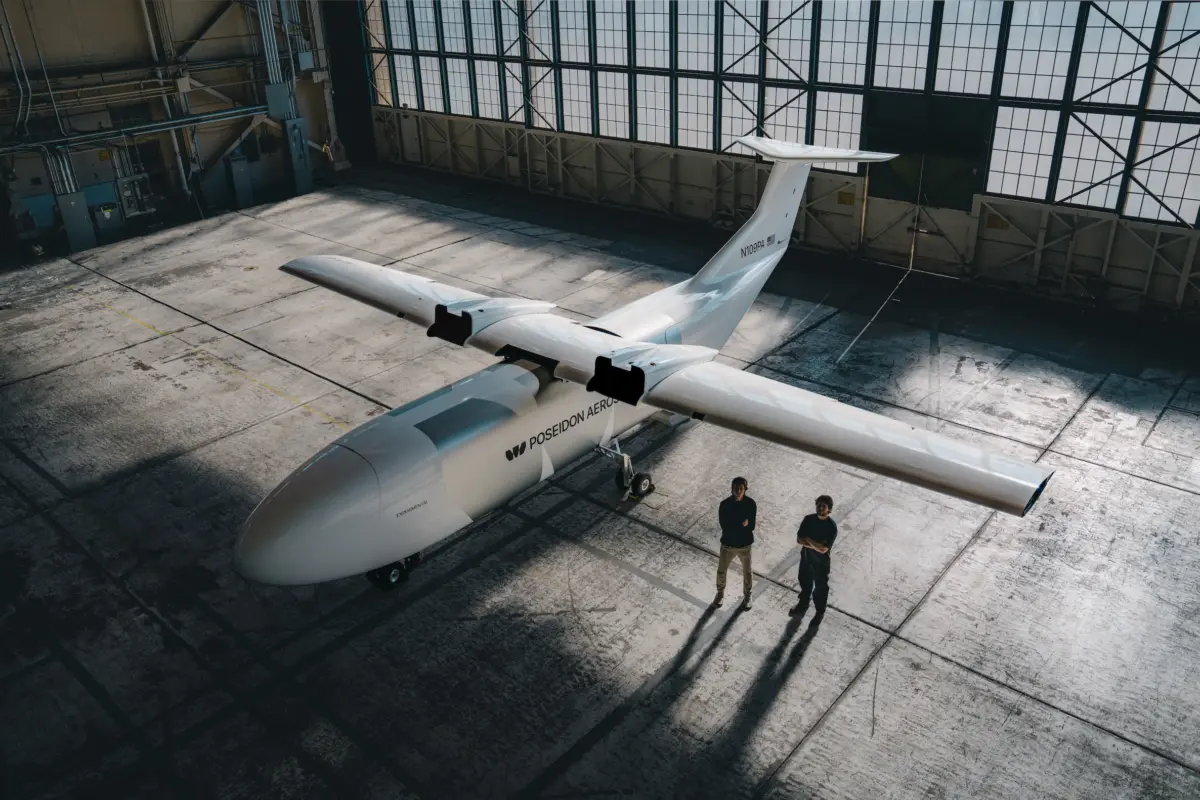
This substantial financial backing arrives precisely as Poseidon prepares for a critical operational milestone: the maiden test flight of its flagship uncrewed cargo aircraft, the Egret, scheduled before the end of the year. By deliberately stripping away the engineering roadblocks, immense regulatory hurdles, and structural weight penalties associated with human pilots and exotic powertrains, Poseidon believes it can fundamentally rewrite the cost curve of regional logistics. In an industry where air cargo remains heavily reliant on aging fleets, constrained pilot supply pools, and rigid hub-and-spoke models, Poseidon is positioning itself to become an agile, low-cost powerhouse capable of competing directly with logistics giants like UPS and FedEx—while simultaneously delivering resilient, decentralized supply chain capabilities to global defense networks.
Detailed Chronology: From Amazon and Lockheed Martin to a $60M Series A
The origins of Poseidon Aerospace trace back to 2024, rooted in the everyday operational frustrations of its co-founders. At the time, David Zagaynov was deeply entrenched in logistics strategy at Amazon, while co-founder Parker Tenney was working within aerospace titan Lockheed Martin.
As they monitored the explosive rise of the advanced air mobility sector, Zagaynov and Tenney found themselves returning to a recurring conversation: nearly every startup entering the market was fundamentally distracted. In their view, aspiring aerospace entrepreneurs were being "nerd-sniped" by exceptionally cool, futuristic technologies—such as vertical lift capabilities, distributed electric propulsion, and complex autonomous urban air taxis—while losing sight of the core economic realities of the businesses they were trying to build.
"Philosophically, we want to build the future of aerologistics," Zagaynov stated in an exclusive interview. "Not to be a hater, but I think a lot of people who start aerospace companies get nerd-sniped by very cool technology and then want to implement it into market. For us, we want to improve cargo."
Driven by this realization, the duo left their respective positions to found Poseidon Aerospace, driven by a singular mandate: to optimize cargo transport through uncrewed, fixed-wing aviation designed from the ground up for maximum economic efficiency.
Capital Accumulation and Milestones
- Early 2024: Zagaynov and Tenney conceptualize Poseidon Aerospace, setting aside passenger mobility to focus entirely on uncrewed cargo logistics.
- Late 2024 (Seed Round): The startup successfully closes an $11 million seed funding round led by existing backers Starship Ventures, Draper Associates, and Drover Ventures. This early capital allows the team to transition from concept to hardware development.
- Mid-Development Milestone: Poseidon designs, builds, and successfully flies a quarter-scale prototype of its vehicle, affectionately named Seagull, proving out its core aerodynamic and control system concepts.
- Current Expansion: To accommodate full-scale manufacturing, Poseidon relocates its operations into a historic Navy hangar located in Alameda, California, providing the vast vertical and horizontal clearance necessary to assemble its 50-foot-wingspan aircraft.
- Present Day (Series A): The company closes a $60 million Series A financing round led by TQ Ventures, with new strategic investments from Hanwha Asset Management, G Squared, and JAWS, alongside follow-on capital from its seed investors. The funding immediately supports preparations for the maiden flight of the full-scale Egret cargo aircraft before the end of the year.
Supporting Context & Metrics: The Economics of Uncrewed Aerologistics
To understand why Poseidon’s approach is resonating with investors, one must analyze the stark economic and operational inefficiencies plaguing traditional regional air cargo.
The Problem with Pilot Constraints and Asset Utilization
In conventional aviation, human pilots are both the ultimate safety guarantor and the primary operational bottleneck. Federal aviation regulations strictly limit the maximum number of consecutive hours a pilot is legally permitted to fly and remain on duty.
Consider a standard five-hour regional cargo leg in a single direction:
- The Turnaround Problem: Once the pilot completes the outbound leg, they have often reached or approached their legal duty limits.
- The Overnight Expense: Unless a pre-positioned relief pilot is waiting at the destination, the operating company must absorb the cost of lodging, per diems, and logistical overhead for the pilot to spend the night.
- Asset Idleness: The aircraft itself—an exceptionally expensive capital asset—sits dormant on the tarmac, generating zero revenue while waiting for its human crew to become legally eligible to fly again.
By entirely removing the human pilot from the aircraft, Poseidon shatters these constraints. Without a cockpit, life support systems, oxygen routing, ejection mechanisms, or crew comfort amenities, the fundamental weight profile of the aircraft changes dramatically.
"Get rid of the cockpit; get rid of the life support systems," Zagaynov explains. "You get to pull a ton of structured weight out, which then means that your ratio of payload to empty weight changes. Your engines can be much lighter, much more efficient, and so it’s like a virtuous cycle in the positive direction of just lighter, cheaper."
Rejecting Tech Hype: Why Combustion and Fixed-Wings Win
While much of the modern aviation startup ecosystem has chased zero-emission propulsion—such as hydrogen fuel cells and heavy battery-electric packs—Poseidon has deliberately chosen a more conservative, highly functional path.
The Egret and its amphibious seaplane variant, the Heron, are fixed-wing aircraft powered by traditional internal combustion engines. While this may draw skepticism from climate-tech purists, Zagaynov points to the unyielding laws of physics and chemistry:
"It’s really hard to beat the energy density of fuels of anything carbon-related. Can I make a really good box with wings to move things for super cheap? If you do that, then abstracting the tech away, we’re left with unmanned cargo like planes that are able to operate on a much lower cost curve, and have much higher utilization."
Furthermore, Poseidon has consciously avoided vertical takeoff and landing (VTOL) technology. While VTOL is celebrated for its ability to land in urban environments, it imposes severe aerodynamic penalties, high energy consumption during the vertical lift phase, and diminished payload capacities. By sticking to conventional fixed-wing configurations, Poseidon ensures that its aircraft maximize range, payload efficiency, and mechanical simplicity—keeping maintenance costs low and reliability exceptionally high.
Official Statements and Strategic Vision
Poseidon’s market entry strategy is deliberately bifurcated into two high-value verticals: defense logistics and commercial regional cargo.
1. The Defense Sector: Resilience in Contested Environments
On the defense front, Poseidon is engineering its aircraft specifically to service remote communities, austere environments, and underserved routes where traditional air cargo infrastructure is severely constrained or entirely nonexistent.
As geopolitical tensions rise and military planners look for ways to safeguard supply chains against sophisticated adversaries, decentralized logistics has become a paramount national security priority. Poseidon has previously noted that global competitors—most notably China—are aggressively testing their own heavy cargo drones to solve similar logistical challenges.
"We want our planes to handle locations with degraded or nonexistent infrastructure," Zagaynov notes, explaining that such capabilities make a nation’s supply networks "harder to disrupt and more resilient to adversary denial."
2. Commercial Cargo: Competing on a Commodity Scale
On the commercial side, Poseidon is breaking away from the traditional aerospace manufacturing playbook. Rather than simply selling aircraft to third-party airlines, the startup intends to operate its own regional air cargo network, positioning itself to bid directly for contracts from logistics behemoths like UPS, FedEx, and regional carriers.
Because logistics is fundamentally a commodity market, winning boils down to a simple equation: speed, reliability, and cost.
"Logistics is a commodity, and so if you sell a commodity and do it better, faster, cheaper, the demand is all yours," Zagaynov asserts.
Moreover, autonomy introduces unprecedented routing flexibility. Without being anchored to regional pilot pools living in specific geographic hubs, Poseidon can dynamically shift its aircraft to wherever demand spikes. This capability allows the startup to challenge the traditional hub-and-spoke model that has dominated regional air freight for decades. Instead, Poseidon envisions a nimble, point-to-point routing model closely mirroring the operational philosophy of low-cost commercial passenger airlines like Breeze Airways or Avelo Airlines.
Future Outlook: Scaling Up in Alameda and Navigating Modern Regulations
With $60 million in fresh capital now sitting in its bank accounts, Poseidon Aerospace is poised for rapid expansion. The company’s immediate operational focus is centered on its newly acquired facility: an expansive, historic Navy hangar in Alameda, California.
Transitioning from the quarter-scale Seagull prototype to the full-scale, 50-foot-wingspan Egret required a massive industrial footprint. The Alameda hangar provides the exact scale needed for assembly, integration, and structural stress testing as the team pushes toward the aircraft’s inaugural test flight before the end of the year. To support this aggressive schedule, Poseidon is preparing for a major hiring blitz across aerospace engineering, flight control software, autonomous systems integration, and manufacturing operations.
A Favorable Regulatory Tailwind
Beyond hardware and capital, Poseidon is benefiting from an increasingly cooperative regulatory climate. Over the past several years, aviation regulators—most notably the Federal Aviation Administration (FAA)—have demonstrated a growing willingness to engage with novel aircraft designs.
While the FAA’s recent pilot programs and regulatory pathways were initially designed to accommodate electric vertical takeoff and landing (eVTOL) passenger startups, the broader institutional shift has lowered the barrier to commercialization for all uncrewed and advanced aviation innovators.
Reflecting on the evolving regulatory landscape, Zagaynov observed that there is now a "path to commercialization that I don’t think existed like five to 10 years ago."
The Road Ahead
As Poseidon Aerospace rolls the Egret out of its Alameda hangar and prepares for its historic first flight, the company stands at the vanguard of a quiet revolution in global logistics. By tuning out the noise of hyper-speculative passenger tech, embracing the unmatched energy density of traditional fuels, and systematically engineering the human pilot out of the operational equation, Poseidon is proving that the most radical innovation in aviation isn’t necessarily a brand-new way to fly—it’s a vastly smarter, cheaper way to deliver.