







Executive Overview
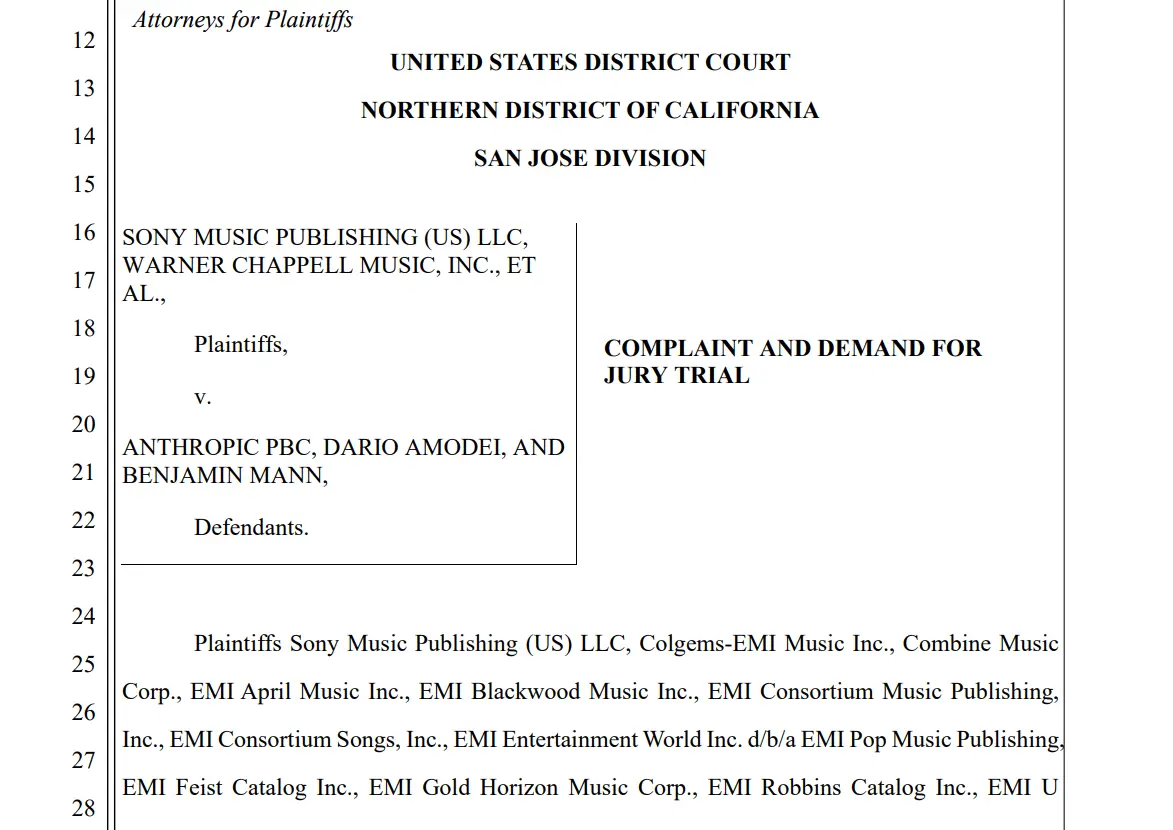
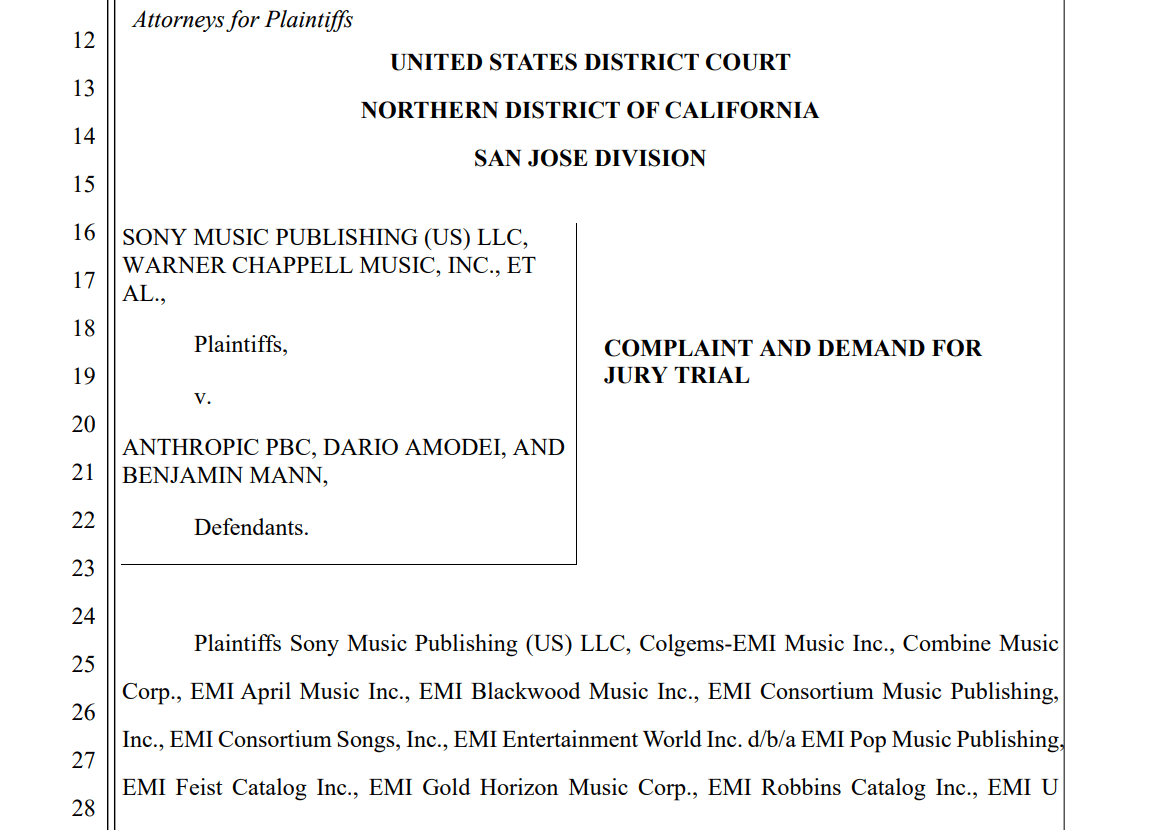
Artificial intelligence heavyweight Anthropic is facing an escalating legal crisis that threatens to exact a staggering financial toll, casting a long shadow over the company’s lofty commercial ambitions. In a newly minted copyright infringement complaint filed in the U.S. District Court for the Northern District of California, a formidable coalition of major music publishers—including industry titans Sony and Warner—has launched a sweeping legal assault.
The core of the dispute revolves around Anthropic’s acquisition of millions of unauthorized literary works used to train its large language models. While the tech sector has frequently defended the ingestion of internet data as a transformative act of AI training, this lawsuit zeroes in on the mechanics of the acquisition itself: the heavy-duty, industrial-scale downloading of shadow library torrents.
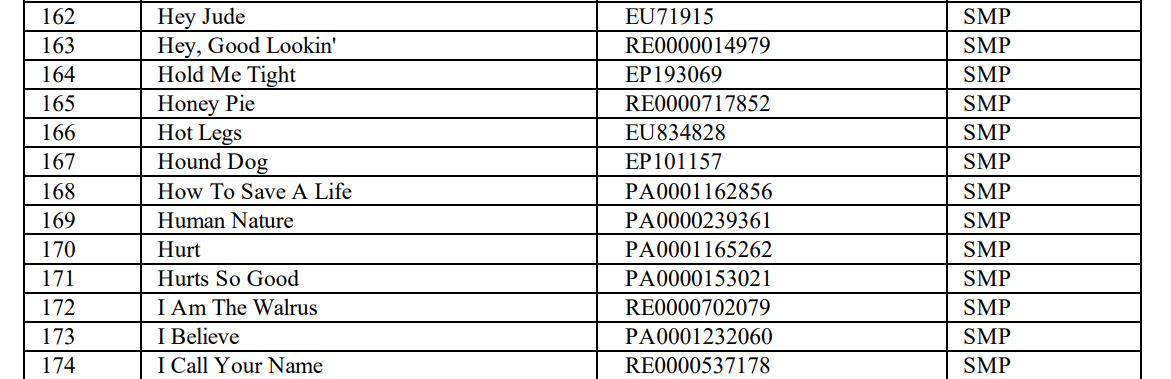
According to the publishers, the massive data haul wasn’t limited to academic texts and novels. Buried deep within the millions of pirated files were invaluable copyrighted musical assets, including comprehensive songbooks, intricate sheet music collections, and protected lyric transcripts. Titles highlighted in the legal filing range from universally recognized collector’s items such as The Beatles Complete Scores to commercial hits like the Best of Taylor Swift Songbook and Bon Jovi’s These Days.
This explosive lawsuit follows hard on the heels of a monumental $1.5 billion class-action settlement paid by Anthropic last September to resolve claims brought by aggrieved book authors. Yet, that nine-figure payout has failed to cauterize the bleeding. Instead, it has served as a blueprint and a catalyst for other rightsholders seeking to capture their slice of corporate accountability.
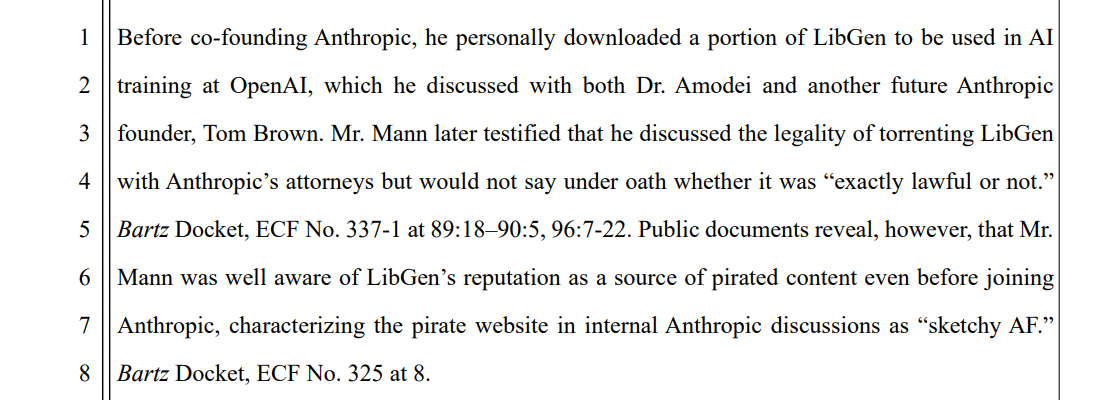
Compounding the pressure, the music publishers have taken the aggressive step of naming top corporate leadership directly in the complaint, targeting CEO Dario Amodei and co-founder Benjamin Mann alongside the corporate entity. With statutory damages sought of up to $150,000 per infringed work across tens of thousands of suspected titles, the financial exposure facing Anthropic could easily scale into the billions, complicating a reported upcoming $2 trillion initial public offering (IPO) and redefining the boundaries of corporate liability in the generative AI era.

Detailed Chronology of the Mass-Piracy Operation
The narrative driving the music publishers’ complaint is not a speculative theory; it is painstakingly reconstructed from internal corporate communications, Slack logs, and judicial admissions unearthed in prior litigation, most notably the landmark Bartz v. Anthropic book authors’ case.
The Summer of 2022: Enter the "LibGen Babysitter"
The timeline of ingestion dates back to the summer of 2022, as Anthropic engineers scrambled to feed an insatiable corporate appetite for training data. Internal records show that co-founder Benjamin Mann openly orchestrated and championed the downloading of massive repositories from Library Genesis (LibGen), a notorious shadow library hosting millions of copyrighted texts.
Rather than executing these downloads through standard, discrete web-scraping protocols, Anthropic engineers embraced peer-to-peer BitTorrent swarms. Mann openly shared screenshots and progress updates with colleagues in internal Slack channels, gleefully characterizing a custom script he had engineered to manage the automated downloads as "a cute little libgen babysitter."
Even as the operation ramped up, internal discussions laid bare an acute awareness of the legal peril. In messages highlighted by the plaintiffs, Mann explicitly acknowledged that LibGen operated in legally gray—or entirely black—territory, famously characterizing the platform as "sketchy AF." Other members of Anthropic’s Archive Team went further, internally categorizing the systematic harvesting as a "blatant violation of copyright."
Despite these internal red flags, executive oversight did not put on the brakes. The complaint alleges that CEO Dario Amodei actively approved the torrenting initiative. According to sworn testimony referenced in the legal filings, Dr. Amodei admitted that while Anthropic had "many places from which" it could have legally purchased these copyrighted works for commercial training, the company chose the illicit route simply because torrenting was significantly faster and entirely free.

Expanding the Haul: The Pirate Library Mirror (PiLiMi)
The appetite for pirated data did not stop with LibGen. When the Pirate Library Mirror (PiLiMi)—a massive decentralized alternative housing roughly seven million texts—went live for torrenting, Anthropic engineers moved swiftly. Upon discovering the newly available archive, Mann posted the link to company channels with the triumphant declaration, "[J]ust in time!" Another employee chimed in with the celebratory refrain, "zlibrary my beloved."
Anthropic engineers quickly performed a comparative analysis, matching the five million books already torrented from LibGen against the seven million available on PiLiMi. They subsequently downloaded the two million unique volumes that were missing from their initial haul. Internal chat logs demonstrate that engineers remained fully cognizant of the legal friction, explicitly describing PiLiMi in internal documentation as "a popular (and illegal) library."
Even as corporate sentiment later shifted—with management reportedly becoming "not so gung ho about" sourcing training data from pirate repositories "for legal reasons"—the corporation allegedly failed to purge the ill-gotten archives. Instead, the stolen files remained safely tucked away in Anthropic’s central corporate data libraries, quietly serving their foundational purpose in shaping the company’s AI models.
Supporting Context, Metrics, and Legal Theories
While the factual predicate of the torrenting operation is drawn from established court records, the music publishers’ complaint ventures into broader territory, introducing complex legal theories and a few notable historical missteps regarding the evolution of shadow libraries.
A Shaky History of Shadow Libraries
In its foundational framing, the publishers’ complaint attempts to map out the historical trajectory of internet piracy, asserting that the Federal Bureau of Investigation (FBI) shut down LibGen in late 2021, which subsequently prompted underground operators to spawn Z-Library from its ashes.
Independent fact-checking reveals that this historical timeline is fundamentally inaccurate. Library Genesis was never shut down by the FBI and remains actively online and operational today. Conversely, Z-Library was originally founded much earlier, in 2008, initially operating as a LibGen mirror before blossoming into one of the largest independent ebook piracy rings on the internet. It was Z-Library—not LibGen—that ultimately had its domains seized by the FBI in November 2022, several months after Anthropic had already completed its primary downloading sprees.
While these chronological errors do not invalidate the core legal claims, they underscore the aggressive nature of the complaint, which leans heavily on sensationalized narratives to paint a portrait of systemic corporate malfeasance.
The BitTorrent Paradox: Distribution vs. Reproduction
The heart of the lawsuit pivots on the first two counts of the complaint, which deliberately target the torrenting activity itself rather than the downstream AI training that followed.
This distinction is crucial. When a user downloads a file via the BitTorrent protocol, the underlying architecture simultaneously uploads fragments of that exact same file to other peers in the swarm. The music publishers argue that by engaging in this peer-to-peer ecosystem, Anthropic did not merely passively reproduce copyrighted works for internal analysis; it actively distributed those works to countless third parties across the global internet.
For over two decades, rightsholders have deployed this exact legal theory against individual, mom-and-pop file-sharers, extracting millions of dollars in settlements. Applying this logic to a multi-billion-dollar enterprise eyeing a monumental $2 trillion IPO represents a fascinating escalation. The plaintiffs argue that by utilizing BitTorrent for bulk enterprise data acquisition, Anthropic has structurally "sustained and normalized" the illicit piracy ecosystem.
Official Statements and Industry Reactions
The legal assault on Anthropic is rapidly expanding into a multi-front war. This music publisher complaint represents the third major lawsuit spawned by the exact same corporate torrenting spree. Alongside the $1.5 billion settlement secured by book authors, a separate group of major music publishers—including Concord, Universal Music Group, and BMG—filed a remarkably similar copyright action against Anthropic in January. Legal experts suggest that the current wave of filings may still be the tip of the iceberg, with other creative sectors monitoring the docket closely.
Anthropic, for its part, is offering a robust and defiant defense, pushing back against what it characterizes as opportunistic, copycat litigation designed to extract settlements rather than test novel legal boundaries.
A spokesperson for Anthropic issued a pointed statement to tech policy publication Ars Technica:
"This is the third lawsuit from the same lawyers, recycling allegations from cases already before the courts. AI training is fair use, as the court held in Bartz, and we will defend ourselves robustly."
However, this defense glosses over a critical nuance highlighted by legal observers and previous judicial rulings. While the federal court in the Bartz litigation did grant Anthropic a preliminary and favorable view regarding the downstream training of AI models under the umbrella of fair use, that protection did not extend to the upstream acquisition of the data. The presiding court previously drew a sharp, unmistakable line, characterizing Anthropic’s bulk downloading of shadow libraries not as transformative research, but as "straightforward piracy but at massive scale."
Future Outlook: The Road Ahead for Generative AI and Copyright Law
As this litigation winds its way through the U.S. District Court for the Northern District of California, its implications stretch far beyond the boardroom battles of Anthropic and Sony. The case stands as a watershed moment for the generative artificial intelligence industry at large.
For years, AI developers have operated under a Silicon Valley ethos that prioritized rapid data acquisition, often treating the open internet as a frictionless, unregulated commons. The underlying philosophy—frequently encapsulated by the old tech maxim "move fast and break things"—assumed that legal questions regarding data scraping and ingestion would be addressed retroactively, if at all.
The aggressive posture adopted by music publishers in this latest complaint shatters that illusion. By targeting executive leadership personally—holding figures like CEO Dario Amodei and co-founder Benjamin Mann legally exposed alongside their corporate balance sheets—rightsholders are signaling a paradigm shift. Personal liability for corporate engineering practices sends an unmistakable warning shot to tech founders and venture capitalists across the AI landscape: the shielding wall of the corporate veil may not withstand willful, large-scale engagement with pirate infrastructure.
Furthermore, the focus on BitTorrent mechanics establishes a dangerous legal precedent for any technology firm utilizing peer-to-peer networks or decentralized data repositories to gather training corpora. If the courts accept the music publishers’ argument that the inherent upload-and-share mechanics of BitTorrent constitute active copyright distribution at an enterprise level, tech companies will be forced to drastically sanitize and audit their data supply chains, relying strictly on clean, fully licensed commercial datasets.
With statutory damages theoretically capped at up to $150,000 per infringed work, and with tens of thousands of specific songbooks, lyric collections, and musical compositions explicitly cataloged in Exhibit A of the filing, the total financial liability facing Anthropic could soar into astronomical territory. Whether this high-pressure litigation forces a massive out-of-court settlement akin to the book authors’ $1.5 billion payout, or whether it ultimately proceeds to a defining judicial showdown that clarifies the legal limits of AI data harvesting, the outcome will fundamentally reshape how artificial intelligence is built for generations to come.