








In the world of information security governance, the ISO 27001 risk assessment serves as the foundational cornerstone of an organization’s security posture. It is designed to be an objective, traceable narrative—a verifiable trail demonstrating how a multidisciplinary team identified a threat, judged its likelihood, quantified its potential business impact, and systematically selected a mitigating treatment.
However, when this chain of logic is broken or obscured, even the most robust technical controls and meticulously drafted corporate policies can appear improvised under the scrutiny of an external auditor. When an auditor asks the simple question—"Why was this specific risk scored this way, and who authorized its treatment?"—ambiguity can quickly derail a recertification audit.
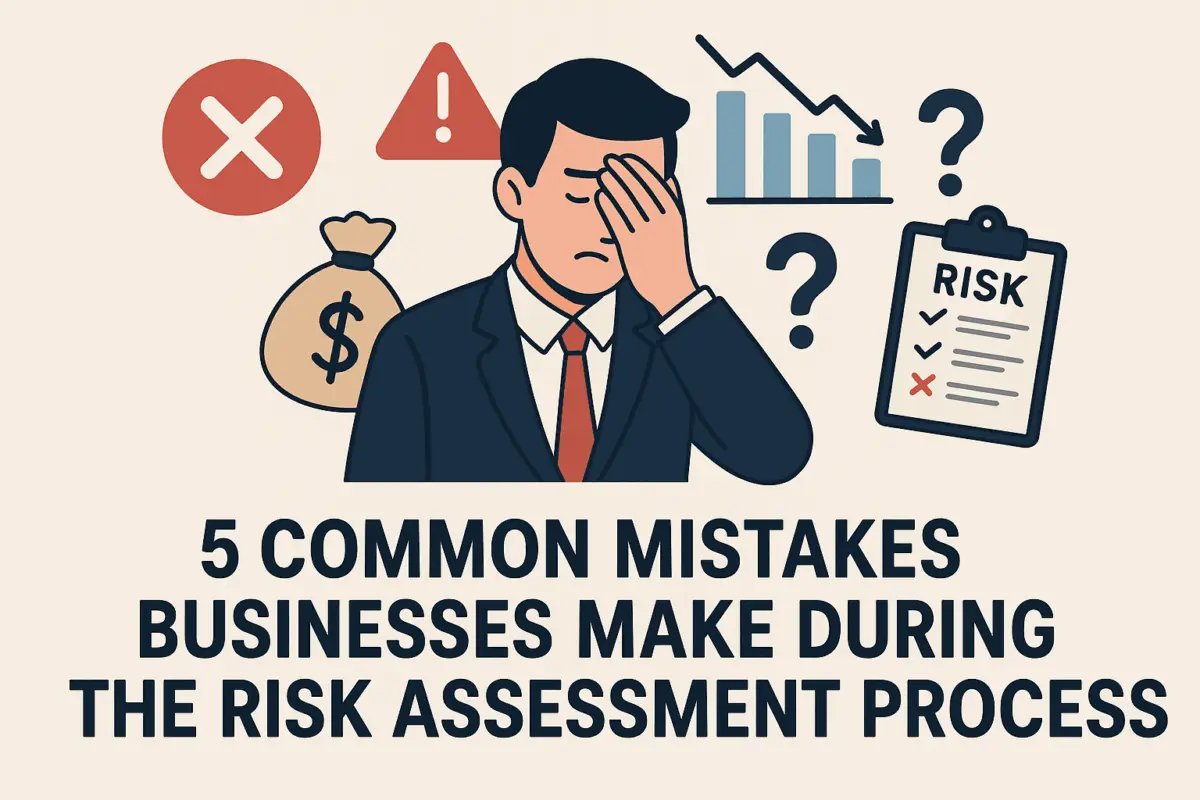
Despite the high stakes of regulatory compliance and cyber resilience, many organizations repeatedly stumble over preventable methodological hurdles. To maintain a defensible, audit-ready security framework, organizations must recognize and rectify the five most common mistakes that weaken the ISO 27001 risk assessment process.
Executive Overview
Achieving and maintaining ISO 27001 certification is rarely a simple walk through a checklist. At its core, the standard mandates an ongoing, evidence-based approach to managing information security risks. Yet, many enterprises treat the required risk assessments as administrative hurdles rather than dynamic operational tools.
When risk registers become static documents, scoring matrices descend into academic debates, and treatment plans lack basic accountability, the entire security management system collapses under audit scrutiny. More importantly, these failures leave organizations blind to real-world threats. With the global cost of data breaches climbing into millions of dollars, the stakes extend far beyond a lost certificate; they touch upon the fundamental financial and reputational survival of the enterprise. This report provides an authoritative breakdown of the structural missteps organizations make during ISO 27001 risk assessments and outlines actionable strategies to build a resilient, defensible risk management life cycle.
Detailed Chronology: The Lifecycle of a Flawed Risk Assessment
Understanding how risk assessments fail requires examining the typical lifecycle of compliance management within an organization. By tracing the journey from initial implementation to ongoing maintenance, we can pinpoint precisely where procedural decay sets in.
Phase 1: The Initial Compliance Sprint
The journey typically begins months before the Stage 1 audit. Under immense pressure to secure certification, an organization pulls together a preliminary risk register. Teams scramble to document assets, identify basic vulnerabilities, and map out Annex A controls. Because speed is prioritized over cultural integration, the initial assessment functions as a point-in-time compliance artifact. It satisfies the auditor’s immediate requirement, allowing the organization to cross the finish line and earn its initial ISO 27001 certificate.
Phase 2: The Post-Certification Lull
Once the certificate is secured, organizational complacency frequently sets in. The risk register is archived in a shared drive or compliance software platform, left untouched as the business continues to evolve. Leadership shifts its focus back to product development, sales, and day-to-day operations, assuming the security box has been permanently checked.
Phase 3: The Operational Drift
As months pass, the business undergoes structural changes. New cloud infrastructure is provisioned, remote-work policies are expanded, third-party software vendors are onboarded to handle customer data, and corporate mergers or acquisitions alter the digital footprint. Meanwhile, the risk register remains frozen in time. The assumptions made during the initial certification sprint—such as the likelihood of a supply chain disruption or the impact of a ransomware attack—are no longer aligned with reality.
Phase 4: The Surveillance Audit Collision
The friction point arrives when the annual surveillance audit or triennial recertification approaches. Teams scramble to update dates on documents, hoping the auditor won’t notice that the underlying risk profile hasn’t shifted an inch despite radical company growth. When the auditor probes deeper into the Statement of Applicability (SoA) and asks for the risk rationale behind newly deployed infrastructure, the gaps in the audit trail become glaringly obvious. The assessment is exposed for what it has become: an improvised exercise in retrospective justification.
Supporting Context & Metrics: The Real Cost of Neglect
To treat ISO 27001 risk assessments as mere checkboxes is to fundamentally miscalculate the financial and operational realities of modern cybersecurity. The global threat landscape is evolving at a breakneck pace, and regulatory frameworks are tightening oversight across every industry vertical.
The Financial Stakes of Data Breaches
Organizations often underestimate the true cost of failing to manage security risks proactively. According to IBM’s comprehensive global research on data security incidents, the global average cost of a data breach is staggering. While compliance frameworks are often viewed through the narrow lens of avoiding audit non-conformities, their primary purpose is risk reduction. A current, well-scoped risk register provides executive leadership with a practical, data-driven mechanism to spot, fund, and track material vulnerabilities before they manifest as catastrophic incidents.
The Pitfalls of the Five-by-Five Matrix
A classic technical misstep documented in organizational risk management is the over-engineering of scoring matrices. In an effort to achieve absolute precision, risk teams frequently expand standard qualitative frameworks into complex nine-by-nine or higher numerical grids.
This hyper-granularity rarely improves accuracy; instead, it creates analysis paralysis. Decision-makers find themselves spending hours debating whether a vulnerability rates a 42 or a 44 on an arbitrary scale, frequently because stakeholders lack a shared, standardized definition of "likelihood" and "impact." This administrative bloat wastes valuable executive time and disengages non-technical business unit owners from the security conversation.
Official Guidelines and Methodological Standards
Aligning internal risk processes with globally recognized standards ensures that your methodology remains defensible to auditors, board members, and cyber insurance underwriters alike.
NIST Guidelines on Risk Management
The National Institute of Standards and Technology (NIST) frames risk assessment not as an isolated mathematical exercise, but as a disciplined lifecycle process that must be meticulously prepared, conducted, and maintained. According to NIST guidelines, organizations must actively check their cognitive biases during these exercises.
For instance, recency bias is a common trap: a recent operational outage or near-miss can cause stakeholders to drastically overstate the likelihood of a business-process failure. Conversely, deep familiarity with a legacy operational process can lead teams to dangerously understate the actual business impact of a potential data breach.
The ISO 27001 Clause 6.1.2 Mandate
The standard itself leaves little room for ambiguity regarding the frequency and trigger points of risk reassessments. Clause 6.1.2 explicitly expects organizations to perform risk assessments at planned intervals, as well as whenever significant operational changes occur.
Scheduling a review solely because an annual surveillance audit falls in a specific month completely misses the spirit of the standard. An ad-hoc business event—such as migrating core databases to a new cloud service provider, executing a corporate merger, or signing a contract with a third-party vendor handling sensitive personal data—demands an immediate, targeted review of the organization’s risk profile.
Detailed Analysis of the Five Most Common Pitfalls
To build a truly resilient compliance framework, organizations must systematically identify and eliminate the specific procedural errors that compromise their risk management efforts.
1. Treating Risk Assessment as a One-Off Project
As highlighted throughout the audit lifecycle, treating risk assessment as a project rather than an ongoing operational process is the most pervasive structural error. When an enterprise completes its initial assessment for certification and files it away until recertification looms, it violates the core intent of Clause 6.1.2.
The Remedy: Establish a recurring review schedule embedded directly into the corporate calendar—optimally on a quarterly basis. Furthermore, define clear operational triggers that mandate an out-of-cycle risk review, such as the deployment of major new IT infrastructure, shifting regulatory compliance mandates, or onboarding high-risk suppliers who interface with customer data. If your risk register looks identical across multiple audit cycles, it ceases to be a management tool and becomes a liability.
2. Overengineering the Scoring Matrix
Complexity is often mistaken for rigor. When organizations deploy overly complicated risk matrices, they alienate non-security stakeholders who own the actual business risks. Protracted debates over decimal points or granular numeric scales drain organizational momentum without adding genuine analytical value.
The Remedy: Keep the scoring matrix elegantly simple. A straightforward $3times3$ or $5times5$ scale, backed by unambiguous, plain-language written definitions for each level of likelihood and impact, is infinitely more valuable than an intricate model that internal stakeholders neither trust nor understand.
3. Writing Treatment Plans with No Owner and No Budget
A risk treatment plan that outlines necessary actions without explicitly assigning a designated owner, a firm completion deadline, and a verified allocation of financial and human resources is not a management plan—it is a wish list. When accountability is nebulous, remediation tasks languish, and residual risks are effectively accepted by default rather than through a conscious, informed decision by executive leadership.
The Remedy: Every identified risk treatment must have a single, accountable owner, a concrete timeline, and a secured budget. This operational discipline is vital during ISO 27001 audits, where evaluators scrutinize the Statement of Applicability (SoA). Auditors will explicitly ask why individual Annex A controls were included or excluded, and they expect those decisions to trace cleanly back to concrete risk register findings, rather than arbitrary checklists completed from memory.
4. Using the Assessment to Justify a Predetermined Outcome
Some organizations commit the inverse methodological error: they determine which Annex A controls they want to implement (or avoid due to budgetary constraints) before conducting the risk assessment, and then manipulate the scoring to justify the predetermined outcome. Alternatively, they implement every single Annex A control blindly, terrified of having to explain a rational control exclusion to an auditor.
The Remedy: Allow the risk assessment to honestly dictate control necessity. If a specific control is deemed unwarranted for your operational environment, the Statement of Applicability must explicitly identify the underlying risk finding and demonstrate that an authorized risk owner has formally accepted the residual risk. Documentation must reflect objective reality, not retroactive rationalization.
5. Treating the Whole Thing as a Certification Checklist
Underlying all other technical missteps is the cultural error of viewing the ISO 27001 risk assessment purely as an administrative exercise performed to satisfy an external auditor. When compliance is treated as a hollow bureaucratic hurdle, the process is inevitably rushed, delegated to the most junior available staff member, and abandoned the moment the certificate is handed over.
The Remedy: Shift the organizational paradigm. Integrate the risk register directly into broader corporate risk management and governance frameworks. Conduct honest, unvarnished gap analyses ahead of certification cycles, and leverage executive management reviews to aggressively challenge overdue remediation treatments, shifting threat assumptions, and the internal cognitive biases that quietly distort organizational decision-making.
Future Outlook: The Evolution of ISO 27001 Risk Management
As the regulatory and cyber threat environments continue to mature, the expectations placed upon certified organizations are shifting rapidly. Regulatory bodies and international standards organizations are placing unprecedented emphasis on genuine operational resilience over superficial paperwork compliance.
The Rise of Dynamic Risk Quantification
Looking ahead, the traditional static spreadsheet model of risk registers is giving way to dynamic, data-driven risk quantification platforms. Forward-thinking organizations are beginning to integrate automated asset discovery tools, real-time threat intelligence feeds, and continuous vulnerability scanning directly into their risk management workflows. This convergence allows security teams to dynamically adjust risk scores and treatment priorities as the digital ecosystem changes, rather than waiting for a quarterly review or an annual audit.
Auditor Expectations and Stricter Scrutiny
External auditors are also adapting. Rather than accepting high-level qualitative statements at face value, modern ISO 27001 auditors are demanding empirical evidence of how risk decisions are operationalized. They are cross-referencing risk register entries against incident response logs, board-level budget allocations, and employee security training metrics. Organizations that continue to treat risk assessment as a last-minute scramble will find their certificates increasingly difficult to defend.
Conclusion: Embracing True Resilience
Ultimately, mastering the ISO 27001 risk assessment process is not about mastering the art of pleasing an auditor. It is about building an organizational nervous system capable of perceiving, evaluating, and mitigating threats before they disrupt business operations. By eliminating procedural complacency, simplifying scoring methodologies, enforcing strict accountability for treatment plans, and treating the risk register as a living document, organizations can transform compliance from an administrative burden into a powerful strategic advantage.