






Executive Overview
Telegram, known globally for its robust encryption, privacy-focused architecture, and expansive broadcast channels, has long operated as a double-edged sword. While it serves as a vital tool for journalists, activists, and communities operating under restrictive regimes, its hands-off moderation policies and sophisticated feature set have also made it a premier sanctuary for digital illicit activity. Among the most pervasive illicit enterprises flourishing on the platform is digital video piracy.
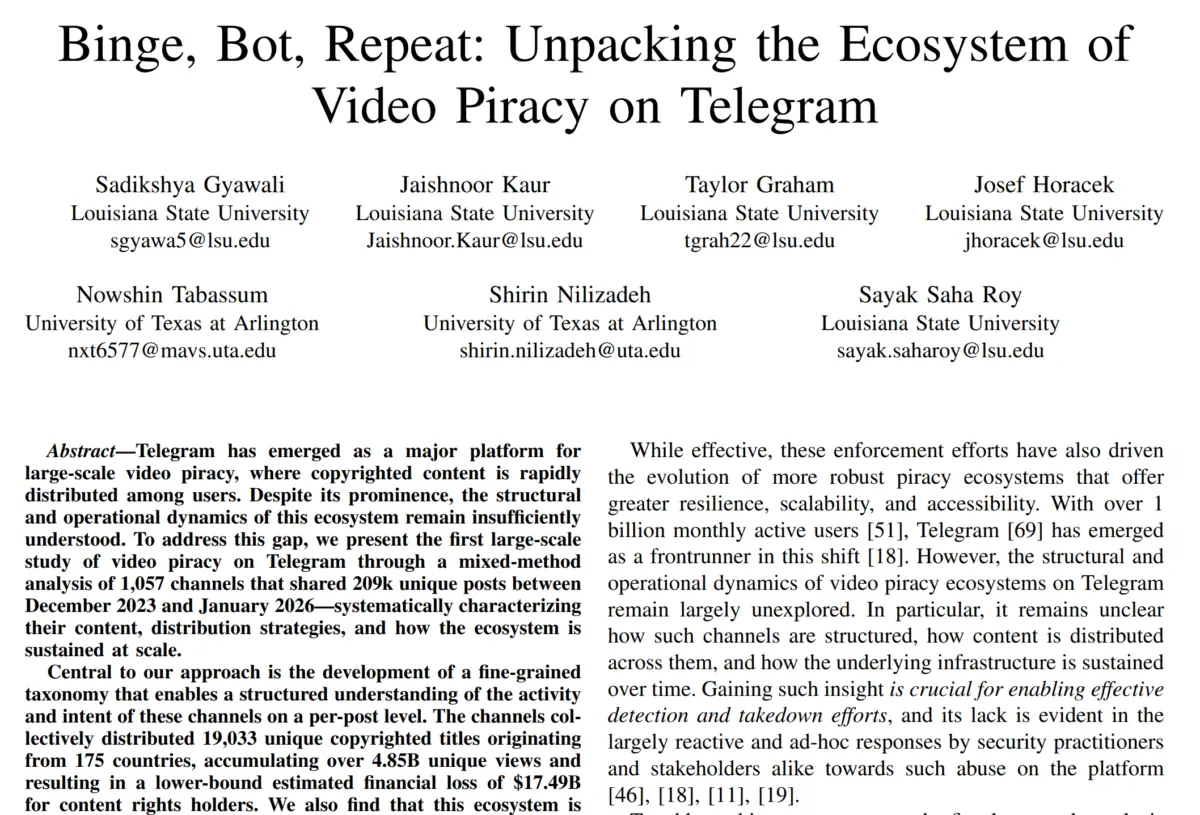
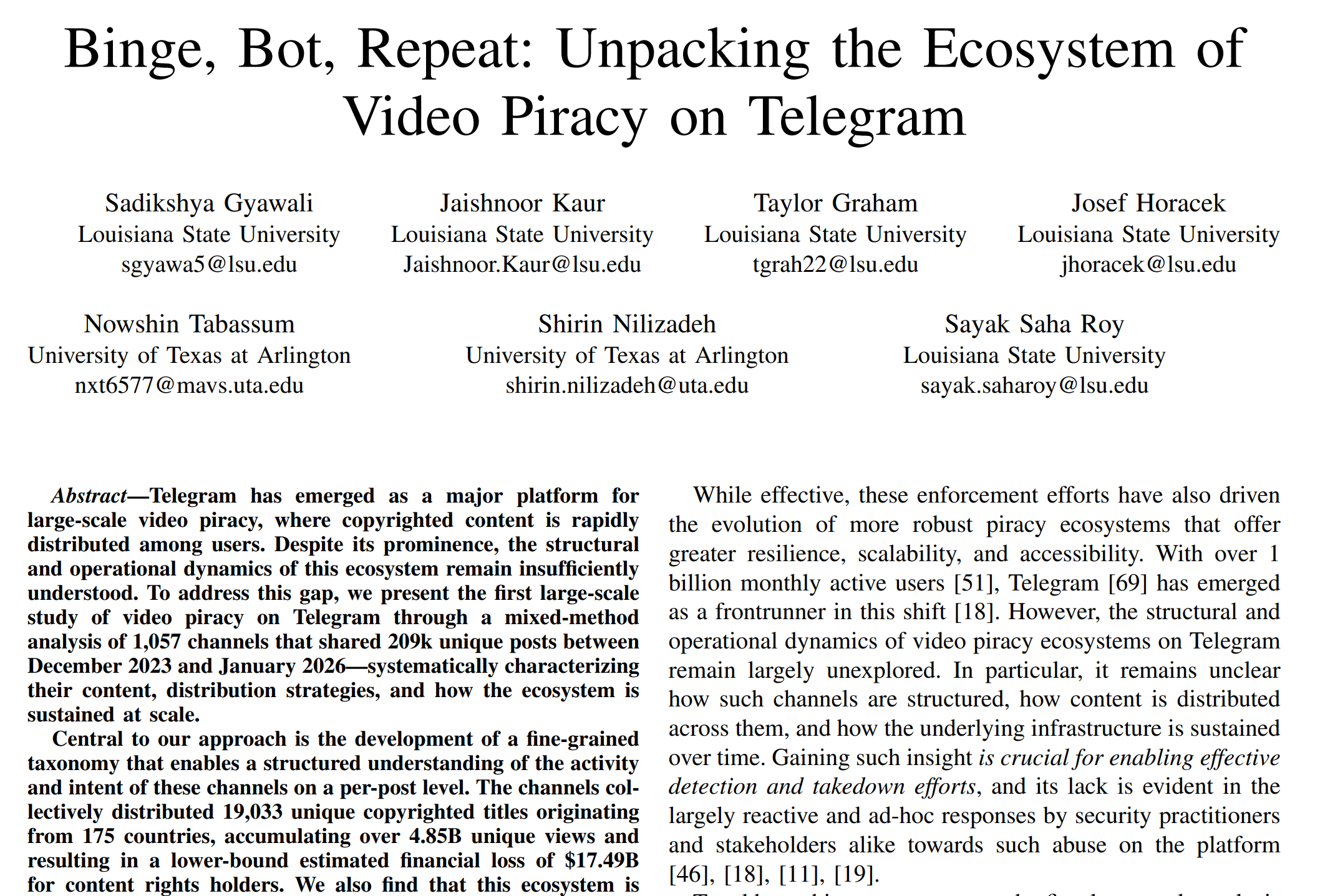
Despite persistent warnings from media conglomerates and rightsholders regarding widespread intellectual property theft, the exact contours, architecture, and economic scale of Telegram’s piracy ecosystem have remained largely opaque—until now. A landmark academic paper titled "Binge, Bot, Repeat: Unpacking the Ecosystem of Video Piracy on Telegram" sheds unprecedented light on the shadows of the platform. Authored by a dedicated team of researchers from Louisiana State University and the University of Texas at Arlington, the comprehensive study offers the first-ever large-scale empirical mapping of video piracy networks operating within Telegram.
By deploying localized large language models (LLMs) to sift through massive datasets, the researchers uncovered a staggering enterprise. Between December 2023 and January 2026, the team analyzed 1,057 interconnected piracy channels housing roughly 209,000 distinct posts. Their findings reveal that piracy on Telegram is not a collection of isolated, fringe infractions, but a heavily industrialized, highly organized underground economy. The identified channels amassed an astounding 4.85 billion post views across 19,033 unique pirated titles—spanning feature films, television shows, and anime series.
Furthermore, the study moves beyond mere academic observation by introducing a practical, proactive defense mechanism. Dubbed "Anti-RIP," this real-time, AI-powered framework was engineered to proactively hunt down, map, and dismantle nascent piracy channels before they can establish a foothold in the ecosystem. By weaponizing artificial intelligence against the architects of digital theft, the researchers successfully facilitated the takedown of hundreds of illicit operations in real-world testing. However, as this exhaustive investigation reveals, the battle lines are shifting toward an automated cat-and-mouse game defined by generative AI, evasion tactics, and systemic structural challenges.
Detailed Chronology and Methodology: Mapping the Telegram Underworld
To understand how video piracy thrives on Telegram, the research team had to pioneer a methodology capable of navigating the platform’s sprawling, encrypted, and heavily obfuscated architecture. Past investigations into online piracy have largely focused on open web index sites, traditional torrent trackers, or public cyberlockers. Telegram, however, presents a unique challenge due to its closed-loop infrastructure, which blends instant messaging, broadcast channels, automated bots, and external media storage hubs.
Phase One: Data Collection and LLM Annotation (December 2023 – January 2026)
The research began in earnest in late 2023. Over a multi-year observation period, the investigators tracked and cataloged 1,057 distinct Telegram channels explicitly dedicated to the distribution of unauthorized video content. From these communities, they harvested approximately 209,000 individual posts containing media links, descriptive metadata, and promotional text.

Because manual auditing of millions of data points is virtually impossible, the team deployed a locally run large language model. This specialized AI tool was tasked with parsing the textual and structural data of the posts, categorizing content, and identifying specific media titles. Through this automated analysis, the model successfully isolated 19,033 unique pirated titles, comprising 14,632 feature films and 4,401 television series originating from 3,941 distinct corporate entities.
Phase Two: Building "Anti-RIP" (February – April 2026)
Recognizing that reactive takedown notices—often sent weeks after a channel has already amassed a massive audience—are largely ineffective, the researchers pivoted toward a preventive approach. Between February 3 and April 10, 2026, they tested "Anti-RIP," their proprietary AI-powered detection framework.
Rather than waiting for rightsholders to flag violations, Anti-RIP actively probed the platform. The system algorithmically generated candidate Telegram channel handles and interrogated them to determine whether they exhibited behavioral patterns consistent with piracy rings. During this live sweep, the tool scanned an incredible 249,133 newly discovered channels.
The operational timeline of Anti-RIP yielded immediate results:
- Early Detection: The tool successfully flagged 802 newly minted piracy channels, boasting a median age of less than five days at the time of discovery.
- Ecosystem Mapping: Alongside the primary channels, the system identified 299 interconnected secondary channels and 108 automated utility bots designed to facilitate the distribution chain.
- Targeted Evidence Reporting: Instead of dumping raw URLs onto abuse desks, the research team compiled comprehensive evidence dossiers. Each report paired flagged channels with granular contextual labels detailing their specific function—whether they acted as primary hosting repositories, redirection hubs, or monetization engines.
Phase Three: Coordinated Disruption and Takedown Wave
Armed with these structured evidence reports, the researchers disseminated their findings to Telegram’s official abuse department, alongside 17 major U.S.-based entertainment conglomerates and intellectual property rightsholders.
The response from the corporate sector was overwhelmingly cooperative. Out of the 17 major U.S. studios contacted, 14 officially acknowledged receipt of the data. Crucially, four studios explicitly noted that the contextual labeling system provided by the researchers drastically streamlined their workflow, allowing them to rapidly assess, prioritize, and legally process the infringement notices.

Over a strict 61-day monitoring window following the deployment of Anti-RIP reports, the collaborative effort resulted in the permanent takedown or inaccessibility of 524 previously unknown piracy channels and 71 specialized bots, alongside the mass removal of individual infringing posts by Telegram administrators.
Supporting Context & Metrics: The Scale of Telegram Piracy
The empirical data compiled in "Binge, Bot, Repeat" shatters any lingering illusions that Telegram is merely a minor vector for digital piracy. The platform functions as a primary distribution pipeline for global media theft, rivaling historical torrent networks and dedicated streaming index sites.
The Rightsholders Under Siege
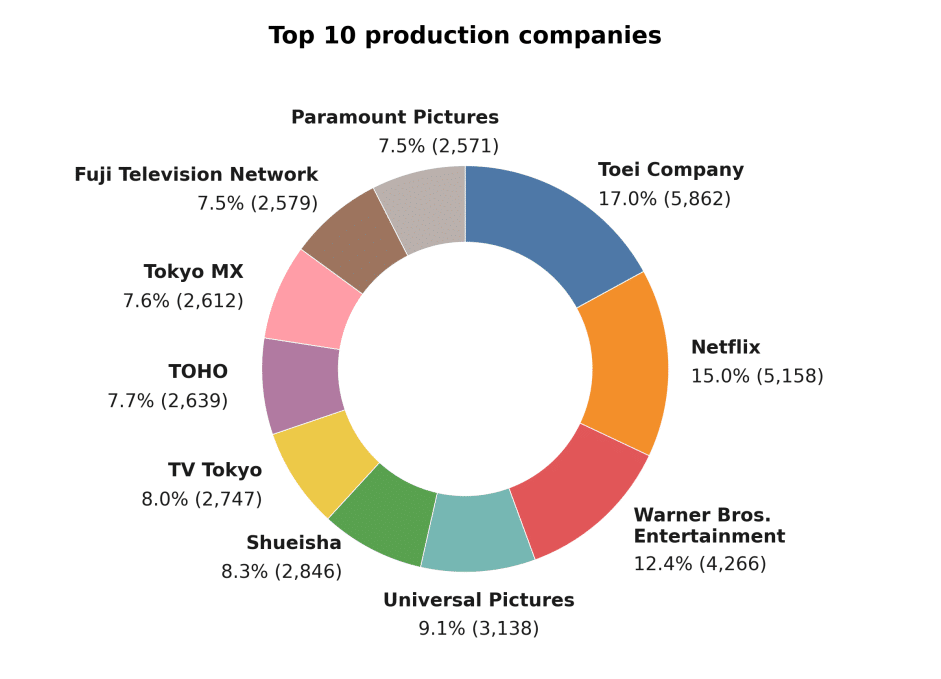
While live-action Hollywood blockbusters and prestige television series form a massive portion of the pirated catalog, the study highlights a profound demand for Japanese animation. Topping the list of affected rightsholders is Japan’s iconic Toei Company—the creative powerhouse behind global anime juggernauts such as One Piece and Dragon Ball. Toei accounted for a staggering 17% of all unique pirated titles identified in the study.
Major American media conglomerates occupied the remaining top tiers:
- Netflix: Ranked second, accounting for 15% of the targeted titles.
- Warner Bros.: Secured third place, representing 12.4% of the catalog.
Billions of Views and Billion-Dollar Losses
The sheer volume of engagement these channels command is staggering. The researchers documented that piracy-related posts were concentrated across 983 active channels, where they collectively amassed 4.85 billion post views.
Based on these consumption metrics, the study attempted to quantify the economic damage inflicted upon the creative industries. Using a conservative economic model—assuming that a mere 1% of total post views would have otherwise converted into a paid subscription or purchase, calculated at the cheapest available legal market rate—the researchers estimated total financial losses at an eye-watering $17.49 billion.
Geographically, the financial impact heavily skewed toward Western and East Asian markets:
- United States Content: Accounted for $8.17 billion in estimated lost revenue.
- Japanese Content: Accounted for $3.72 billion in estimated lost revenue.
(Note: To prevent compounding inflation within the model, the researchers capped estimated losses at a single subscription cost when a single post or channel linked to multiple titles originating from the same streaming service.)
Architectural Resilience: Designed to Survive Takedowns
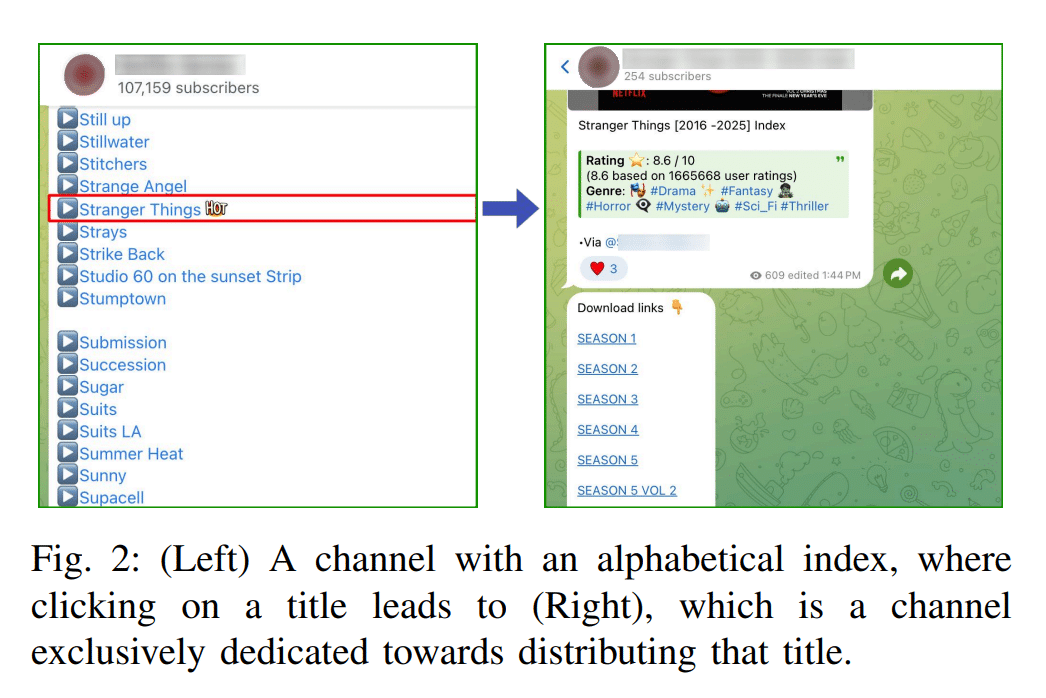
Why have traditional enforcement mechanisms struggled to curb Telegram piracy? The LSU and UTA researchers discovered that the ecosystem is deliberately engineered for structural resilience. Approximately 94% of all AI-mapped piracy channels were not isolated entities; instead, they were interconnected nodes tied to web networks of backup channels, redirection scripts, and automated bots. Furthermore, a vast majority of these channels were deliberately hidden, making them unfindable via Telegram’s native, in-app search bar.
"This ecosystem is deliberately engineered to be resilient against takedown efforts, frequently redirecting users through chains of intermediary channels and automated bots that collectively handle hosting, access control, monetization, and channel discovery," the authors note.
Interestingly, the mechanics of sharing have evolved. Gone are the days when Telegram channels directly hosted massive video files or relied heavily on peer-to-peer protocols. The researchers noted that traditional torrent files and magnet links were an extreme rarity, with only nine such links discovered across the entire dataset. Instead, pirate operators leveraged external, third-party cloud storage and file-hosting platforms—most notably TeraBox, Terashare, and GoFile—using Telegram strictly as a high-speed command-and-control index.
Beyond distributing raw media links, the investigation uncovered ancillary illicit services. Several channels actively traded in compromised user account credentials for premium streaming platforms—including Netflix, Hulu, Disney+, and Crunchyroll—while others provided comprehensive, localized VPN tutorials designed to help users bypass regional ISP blocks and geo-restrictions imposed by copyright enforcement agencies.
Official Statements and Academic Insights
The publication of "Binge, Bot, Repeat" has triggered urgent conversations across the cybersecurity, academic, and legal sectors regarding the responsibilities of encrypted communication platforms in policing illicit marketplaces.
Lead researchers emphasized that the proliferation of AI-driven piracy tools represents a profound structural shift in how intellectual property theft operates online. While Telegram has historically maintained a posture of strict neutrality—arguing that encrypted communications and public broadcast channels must remain unfettered to protect civil liberties—legal experts point out that the platform’s commercial and architectural expansion has inadvertently created safe havens for organized copyright infringement syndicates.
Representatives from participating rightsholder organizations praised the granularity of the Anti-RIP framework. In feedback provided to the research team, studio compliance officers noted that standard automated DMCA (Digital Millennium Copyright Act) notices often fail on Telegram because automated web scrapers cannot parse the deeply nested chains of private invitation links, bot handoffs, and channel redirections. By providing a human-readable, context-aware intelligence report categorized by operational function (e.g., hosting vs. monetization), the Anti-RIP tool bridged the gap between raw data collection and actionable legal enforcement.
Nevertheless, the academic authors remain candid about the technological limitations of their creation. During rigorous back-end validation tests involving human coders reviewing a random sample of 1,000 posts, the underlying AI model exhibited a minor error rate, incorrectly flagging four legitimate, non-infringing posts as piracy vectors. While the model demonstrated an impressive 98% accuracy rate in controlled testing environments, the researchers readily concede that applying AI at scale in the wild inevitably introduces false positives—a reality that could lead to the wrongful censorship of innocent community channels if adopted blindly by platform administrators.
Future Outlook: The Dawn of the AI Cat-and-Mouse Game
As the ink dries on this groundbreaking preprint paper—which remains open for public review via arXiv—the landscape of digital copyright enforcement stands at a critical crossroads.
By open-sourcing the Anti-RIP framework and releasing their comprehensive dataset publicly via GitHub, the Louisiana State University and University of Texas at Arlington researchers have democratized advanced detection capabilities. Rightsholder associations, platform safety engineers, and anti-piracy coalitions now possess a blueprint for systematically dismantling automated channel networks on Telegram and similar messaging ecosystems.
However, the war against digital piracy is rarely static. Security analysts warn that publishing open-source detection tools inevitably hands a playbook to the adversary. Just as academic researchers and entertainment conglomerates are weaponizing large language models and predictive algorithms to hunt down illicit networks, underground piracy syndicates are expected to adopt generative AI to randomize channel handles, obfuscate metadata, and dynamically mutate their redirection chains in real-time.
This dynamic sets the stage for an unprecedented technological arms race: an AI-driven game of cat-and-mouse where automated defense frameworks must continually adapt to outsmart increasingly autonomous, decentralized criminal operations. Whether Telegram itself will integrate native structural defenses inspired by tools like Anti-RIP, or whether the platform will face mounting regulatory pressure from international lawmakers to dismantle its underground indexing networks, remains one of the defining digital policy questions of the coming years.