








Executive Overview
In an era where enterprise data volumes are expanding exponentially and leadership teams face intense pressure to monetize Artificial Intelligence (AI) investments, cloud infrastructure decisions have evolved from technical choices into core financial strategies. Enterprise IT leaders are scrutinizing cloud vendors not merely on feature availability, but on measurable financial returns, system performance, and operational simplicity.
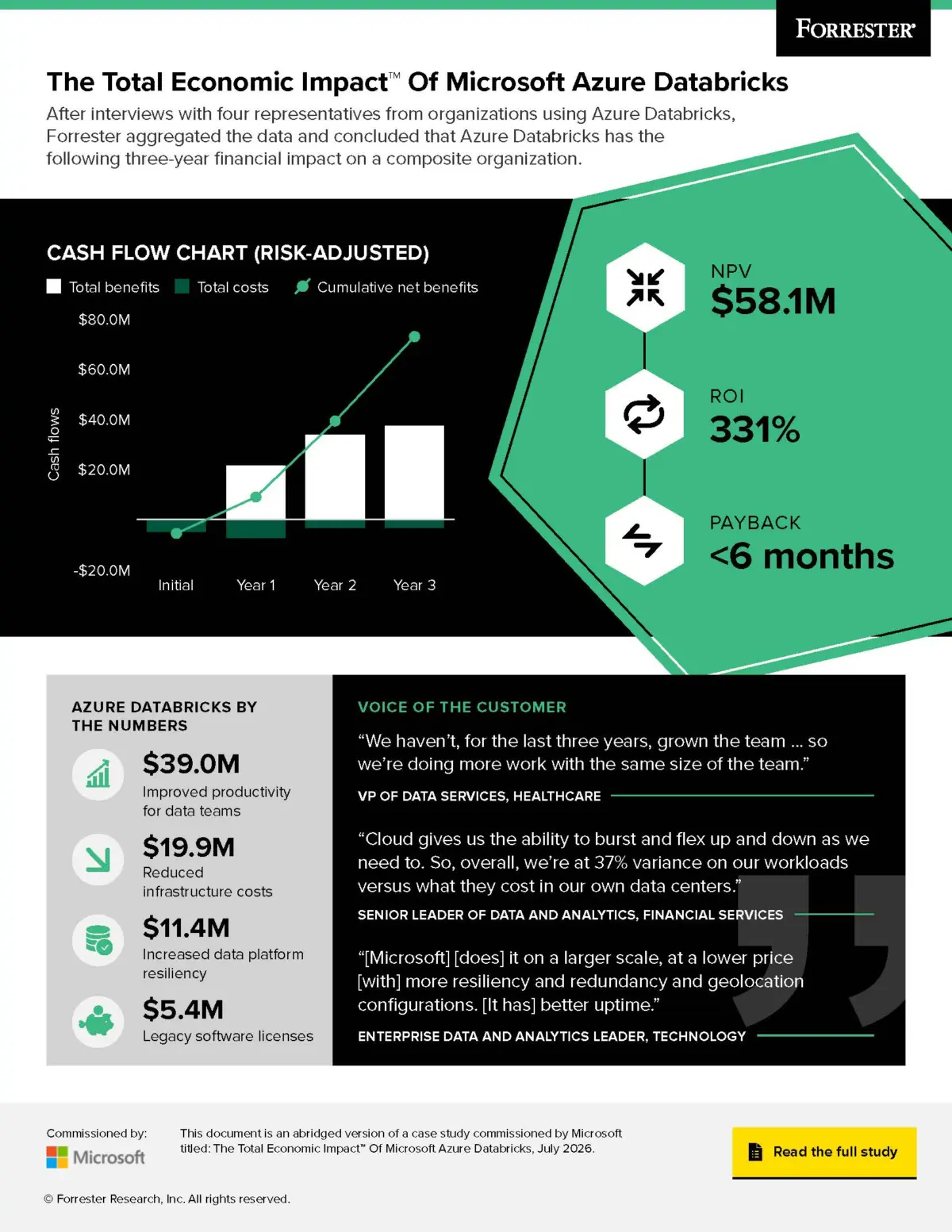
A newly released Total Economic Impact™ (TEI) study commissioned by Microsoft and conducted by Forrester Consulting delivers definitive metrics on one of the cloud ecosystem’s most prominent joint offerings: Microsoft Azure Databricks. The study revealed that a composite enterprise operating Azure Databricks achieved an extraordinary 331% Return on Investment (ROI) over three years, generating $58.1 million in Net Present Value (NPV) with a full capital recovery period of less than six months.
+-----------------------------------------------------------------------+
|                    FORRESTER TEI STUDY KEY FINANCIALS                 |
+-----------------------------------+-----------------------------------+
| Metric                            | Impact Value                      |
+-----------------------------------+-----------------------------------+
| 3-Year Return on Investment (ROI) | 331%                              |
| Net Present Value (NPV)           | $58.1 Million                     |
| Payback Period                    | Less than 6 Months                |
| Total 3-Year Benefits             | $75.6 Million                     |
| Total 3-Year Implementation Cost  | $17.5 Million                     |
+-----------------------------------+-----------------------------------+
These financial outcomes are driven by the platform’s unique market position. Unlike third-party Software-as-a-Service (SaaS) applications bolted onto cloud infrastructure, Azure Databricks is co-engineered by Microsoft and Databricks as a native, first-party Azure service. This direct architectural integration removes the friction, security risks, and latency traditionally associated with running external data platforms on cloud infrastructure. Combined with independent performance benchmarks showing significant speed advantages over rival cloud deployments, the study highlights how deep engineering alignment directly yields superior corporate economics.
Detailed Chronology: The Evolution of a First-Party Cloud Engine
To understand the economic figures, one must examine the multi-year trajectory of the Microsoft and Databricks strategic alignment.
                               HISTORICAL EVOLUTION

  2017–2018             2019–2022             2023–2025             2026 & Beyond
+------------+        +------------+        +------------+        +---------------+
| Co-Engineered       | Native Azure        | Unified             | GenAI Deep    |
| First-Party         | Security &          | Lakehouse &         | Integration   |
| Service Launch      | MACC Billing        | Governance          | (Copilot &    |
|            |        | Alignment  |        | (Unity Catalog)     | Genie)        |
+------------+ +------------+ +------------+ +---------------+-
Phase I: The Architectural Foundation (2017–2018)
Recognizing that enterprise organizations were struggling to operationalize Apache Spark at scale due to complex cluster management and data movement overhead, Microsoft and Databricks established a joint engineering initiative. Rather than delivering a simple marketplace add-on, the companies integrated the Databricks platform directly into the Azure control plane, creating Azure Databricks as a native first-party cloud service. -
Phase II: Deep Platform Integration & Procurement Convergence (2019–2022)
As cloud adoption accelerated, the joint roadmap focused on platform alignment. Azure Databricks was deeply tied into Azure Active Directory (now Microsoft Entra ID), Azure Data Lake Storage (ADLS) Gen2, and native Azure security protocols. Crucially, billing was fully unified: customers could draw down their software spend directly against their Microsoft Azure Consumption Commitment (MACC), eliminating separate vendor procurement cycles and procurement friction. -
Phase III: The Lakehouse & Governance Epoch (2023–2025)
With data workloads shifting toward massive scale, the platform integrated Unity Catalog to solve complex multi-cloud and multi-workspace governance challenges. Microsoft and Databricks streamlined unified governance across structured and unstructured data assets, ensuring enterprise-wide data access could be audited and managed without compromising processing performance. -
Phase IV: Generative AI and Copilot Convergence (2026 & Beyond)
The engineering alignment extended into generative AI. Through deeper integrations between Azure Databricks Genie and Microsoft Copilot Cowork, plain-language data querying was brought natively into everyday enterprise productivity tools like Microsoft Teams and Microsoft 365 Copilot, backed by the security boundaries of Unity Catalog.
Supporting Context & Metrics: Unpacking the Economics and Benchmarks
The Forrester Total Economic Impact™ Financial Framework
To measure the business value of Azure Databricks, Forrester Consulting constructed a composite model representing real-world interviewed customers. The composite organization was defined as a $6 billion enterprise operating in a highly regulated industry, managing roughly 10 petabytes (PB) of data across disparate global operations.
The Pre-Adoption State
Prior to adopting Azure Databricks, the composite organization suffered from systemic operational drag:
- Data Estate Fragmentation: Disparate data siloes required constant, expensive Extract, Transform, Load (ETL) pipeline maintenance.
- Scale and Reliability Constraints: Existing legacy infrastructure repeatedly failed under heavy batch processing or concurrent analytics workloads.
- Governance and Compliance Deficits: Securing sensitive data across fragmented environments required redundant policies, increasing audit prep times and heightening regulatory risk.
The Post-Adoption Impact
Following the transition to Azure Databricks, the model documented a stark shift in financial performance. Over three years, the platform yielded $75.6 million in total present value benefits against $17.5 million in total implementation and operational costs, establishing an net present value (NPV) of $58.1 million.
                        3-YEAR FINANCIAL COMPARISON

  $80M +--------------------------------------------------------- $75.6M
       |                                                         |      |
  $60M +--------------------------------------- $58.1M ----------+      |
       |                                       |      |          |      |
  $40M +---------------------------------------|------|----------|------|
       |                                       |      |          |      |
  $20M +------------------- $17.5M ------------|------|----------|------|
       |                    |      |           |      |          |      |
    $0 +--------------------+------+-----------+------+----------+------+
                            Costs              NPV             Benefits
The primary economic drivers identified in the study stem from four key operational shifts:
- Infrastructure Consolidation and Cost Reduction: Eliminating legacy, redundant analytics tools and data copies yielded immediate infrastructure savings.
- Data Engineering and Science Productivity Gains: Automated cluster management, native serverless options, and collaborative workspaces drastically reduced developer operational toil.
- Accelerated Time-to-Value for Analytics: Faster pipeline execution allowed real-time analytics to directly impact line-of-business revenue and operational efficiency.
- De-risking Compliance and Security Operations: Centralized governance minimized compliance prep hours and significantly lowered exposure to data breaches.
In addition to these quantified financial benefits, Forrester highlighted strategic, unpriced qualitative advantages: direct integration with native Azure services, accelerated delivery of business intelligence, broader organizational data democratization, and simplified policy management via Unity Catalog.
Performance Benchmarks: The Speed Advantage
Economic value in modern data architectures is intrinsically linked to processing velocity. Slower query completion directly inflates compute runtime costs and delays decision-making.
To evaluate raw platform performance, independent benchmarking firm Principled Technologies conducted an industry-standard, TPC-DS-like decision-support benchmark across a 10-terabyte (TB) dataset, comparing Azure Databricks directly against competing cloud deployments.
                    BENCHMARK PERFORMANCE COMPARISON

  Single Query Stream Execution Time
  +-------------------------------------------------------+ 100% (AWS)
  +--------------------------------------------------+ 78.9% (Azure)
  [Azure Databricks completed queries up to 21.1% faster]

  Concurrent Query Streams (4 Concurrent Streams)
  +-------------------------------------------------------+ Base Time (AWS)
  +-------------------------------------------+ >9 Min Faster (Azure)
The benchmark results demonstrated clear engineering efficiencies:
- Single Query Stream Execution: Azure Databricks completed a single query stream in up to 21.1% less time than Databricks on Amazon Web Services (AWS) with autoscaling disabled.
- Concurrent Query Workloads: When running four concurrent query streams simultaneously—simulating heavy enterprise user demand—Azure Databricks completed the workload more than nine minutes faster than its AWS counterpart.
These performance dividends translate directly into lower compute costs under consumption-based pricing models, demonstrating that deep platform integration provides a technical foundation that directly accelerates enterprise financial returns.
Technical Deep-Dive: Co-Engineered Architecture and AI Convergence
The superior performance and economic metrics reported by Forrester and Principled Technologies are not accidental; they stem from the native architectural co-engineering between Microsoft and Databricks.
+-----------------------------------------------------------------------+
|                    AZURE DATABRICKS ARCHITECTURE                      |
+-----------------------------------------------------------------------+
|                       FRONT-END USER INTERFACES                       |
|   Microsoft Teams  |  Microsoft 365 Copilot  |  Copilot Cowork      |
+-----------------------------------------------------------------------+
|                          INTELLIGENCE LAYER                           |
|        Azure Databricks Genie  <-->  Genie Ontology Context           |
+-----------------------------------------------------------------------+
|                      UNIFIED GOVERNANCE & SECURITY                    |
|          Unity Catalog  <-->  Microsoft Entra ID (Identity)          |
+-----------------------------------------------------------------------+
|                        CORE DATA & COMPUTE                            |
|    Delta Lake (ADLS Gen2)  <-->  Co-Engineered Spark Compute Engine   |
+-----------------------------------------------------------------------+
1. Eliminating Structural Data Friction
When running third-party software across cloud environments, organizations frequently face silent operational drag. Data must cross network boundaries, security contexts must be re-mapped, and billing involves multiple vendors.
As a first-party Azure service, Azure Databricks mitigates these structural inefficiencies:
- Unified Identity and Access: Uses Microsoft Entra ID natively, ensuring active access token management and continuous enterprise security enforcement without custom middleware.
- Single-Pane Consumption Billing: Operations draw down directly against a customer’s Microsoft Azure Consumption Commitment (MACC), eliminating vendor fragmentation.
- Single-Support Routing: Technical issues are triaged through a single support channel co-managed by Microsoft and Databricks engineering teams.
2. Generative AI Operationalization
A major driver of long-term value is the operational convergence between Databricks data lakehouses and Microsoft’s enterprise AI suite.
- Genie Integration with Copilot Cowork: Azure Databricks Genie allows non-technical business users to query complex data lakehouses using plain language. Through recent platform enhancements, Genie now plugs directly into Microsoft Copilot Cowork, Microsoft Teams, and Microsoft 365 Copilot.
- Contextual Semantic Grounding: Using the Genie Ontology, business context is maintained across natural language prompts, translating colloquial business questions into precise, optimized SQL queries execution paths against underlying Delta tables.
- Enforced Enterprise Governance: Intelligence reaches front-line enterprise software without compromising security boundaries. Every response generated by Genie within Teams or Copilot is bounded by Unity Catalog permissions, ensuring users only retrieve information they are explicitly authorized to view.
Official Perspectives: Strategic Realities for Enterprise Leaders
Enterprise executives navigating the complex data and AI vendor ecosystem emphasize that long-term value depends on architectural alignment rather than feature lists.
Data leadership teams frequently note that managing disparate cloud tools creates structural risks: fragmented governance frameworks lead to security blind spots, while disconnected data infrastructure causes compute costs to scale unpredictably.
"When evaluating cloud platforms, technical leaders are no longer looking at raw processing speeds in isolation," noted a senior cloud architecture strategist familiar with the study. "They are evaluating how fast an integration delivers enterprise-wide impact without blowing past governance boundaries. The Forrester findings validate what cloud architects have observed for years: native integration reduces operational friction, which directly drives down the cost of execution."
Analyst coverage of the Forrester report highlights that the sub-six-month payback period is particularly rare for platform-level infrastructure shifts of this scale. The rapid break-even point is driven by immediate operational efficiency gains: developers waste less time stitching together custom infrastructure connectors, security teams manage unified access policies through Unity Catalog, and procurement departments manage a single cloud bill.
Future Outlook: The Blueprint for Enterprise Data Estates
As enterprise organizations move past initial generative AI experiments toward enterprise-wide deployment, the underlying data platform becomes the primary factor determining success or failure. Large Language Models (LLMs) and autonomous agents require clean, governed, high-throughput access to real-time corporate data estates.
                          FUTURE OUTLOOK MATRIX

+-------------------------+---------------------------------------------+
| Operational Focus       | Strategic Advantage of Co-Engineered Stack  |
+-------------------------+---------------------------------------------+
| AI Operationalization   | Direct integration of LLMs with governed    |
|                         | lakehouse data via Genie & Copilot Cowork   |
+-------------------------+---------------------------------------------+
| Unified Governance      | Single security perimeter across global     |
|                         | datasets via Unity Catalog & Entra ID       |
+-------------------------+---------------------------------------------+
| Cost Predictability     | Tighter compute efficiency, reduced network |
|                         | egress, and simplified MACC drawdowns       |
+-------------------------+---------------------------------------------+
The synthesis of the Forrester Total Economic Impact™ study and independent benchmarks from Principled Technologies presents a compelling roadmap for enterprise technology leaders. The strategic combination of Microsoft Azure and Databricks addresses the fundamental enterprise dilemma: how to scale processing power and democratize AI access while maintaining tight operational controls and controlled infrastructure spending.
By eliminating operational friction through native co-engineering, Microsoft Azure Databricks turns complex data architecture into a reliable economic advantage. For organizations evaluating their long-term data strategy, the message is clear: native platform engineering yields measurable financial returns, offering a proven blueprint for modernizing the enterprise data estate.