







Executive Overview
In the ongoing digital battle between major Hollywood studios and online piracy networks, a significant legal milestone was quietly achieved in the United Kingdom earlier this year. Initially presented to the World Intellectual Property Organization (WIPO) by the Motion Picture Association (MPA) in May, a groundbreaking judicial measure—dubbed the "omnibus" site-blocking order—was designed to dramatically streamline how internet service providers (ISPs) neuter unauthorized streaming domains.
For months, however, the exact mechanics, boundaries, and text of this order remained entirely hidden from public view. Missing from official legal repositories like BAILII and the National Archives, the mandate existed solely through the promotional and informational summaries provided by the MPA.
That veil of secrecy was unexpectedly lifted following a transparency filing submitted by infrastructure giant Cloudflare to the Lumen Database. The filing finally brought the first public version of the UK High Court order to light, revealing sweeping enforcement powers. Handed down by Mr. Justice Mellor on May 7, 2026, the order empowers a coalition of major Hollywood studios to unilaterally expand blocklists without returning to court for individual domain approvals.
This deep dive examines the anatomy of the omnibus order, how it shifts enforcement power directly into the hands of rightsholders, the unexpected role played by third-party content delivery networks (CDNs) like Cloudflare, and the broader implications this UK legal precedent holds for international digital copyright enforcement.
Detailed Chronology: From Courtroom Secrecy to Accidental Transparency
The timeline of the omnibus order traces a deliberate strategy of tightening the noose around modern, fragmented streaming networks, contrasted with an unusual opacity regarding the legal instruments used to do so.

1. The WIPO Revelation (May 2026)
When representatives of the Motion Picture Association addressed WIPO, they framed their latest legal victory in the UK as an evolutionary leap for copyright protection. Traditional site-blocking injunctions—while effective at curbing traffic to specific marquee domains—had run up against a persistent phenomenon: the "whack-a-mole" effect. As soon as a primary pirate domain was blocked by British ISPs, operators would simply spin up dozens of mirrored sites, alternative top-level domains (TLDs), or rebranded interfaces to capture displaced users.
To counter this, the MPA secured what it termed an "omnibus" order. According to the association’s presentation, the ruling allowed Hollywood studios to target any structurally infringing audiovisual piracy service meeting a predefined set of criteria, entirely bypassing the need to initiate fresh, costly court applications for every newly spawned domain name.
2. The Information Black Hole
Despite its prominence in international forums and its subsequent citation as a model in foreign jurisdictions—such as a Canadian Federal Court ruling handed down the following month—the actual document remained inaccessible. Journalists, researchers, and legal analysts searched in vain across official UK legal databases, including BAILII and the National Archives. None of the major consumer-facing ISPs targeted by the injunction had published the text, leaving the MPA’s marketing and regulatory summaries as the sole narratives available.
3. Cloudflare’s Transparency Filing
The impasse broke when a routine archival sweep of transparency disclosures caught a new entry submitted by Cloudflare to the Lumen Database. Attached to this filing was a heavily anticipated document: a "Public Version" of the May 7, 2026, High Court order, complete with confidential schedules redacted. For the first time, independent watchdogs could inspect the legal architecture underpinning Hollywood’s newest anti-piracy weapon.
The Mechanics of the Omnibus Order: Scope and Execution
The public version of the judgment, docketed under Columbia Pictures v. BT, outlines a sweeping collaborative effort between Hollywood’s major players and the UK’s telecommunications infrastructure.

The Litigants and Respondents
The legal applicants read like a roll call of major global entertainment conglomerates:
- Columbia Pictures Industries, Inc.
- The Walt Disney Company
- Netflix Studios, LLC
- Paramount Pictures Corporation
- Universal City Studios Productions LLLP
- Warner Bros. Entertainment Inc.
The respondents compelled to execute the blocks are the six largest internet service providers in the United Kingdom:
- BT
- EE
- Plusnet
- Sky
- TalkTalk
- Virgin Media
Part 1 vs. Part 2: Seeds and Open-Ended Expansions
The architecture of the order divides targeted websites into two distinct operational categories:
- Part 1 ("The Seeds"): The schedule explicitly names foundational domains acting as initial anchors for the blockade. Prominent examples highlighted in the documentation include streaming hubs such as
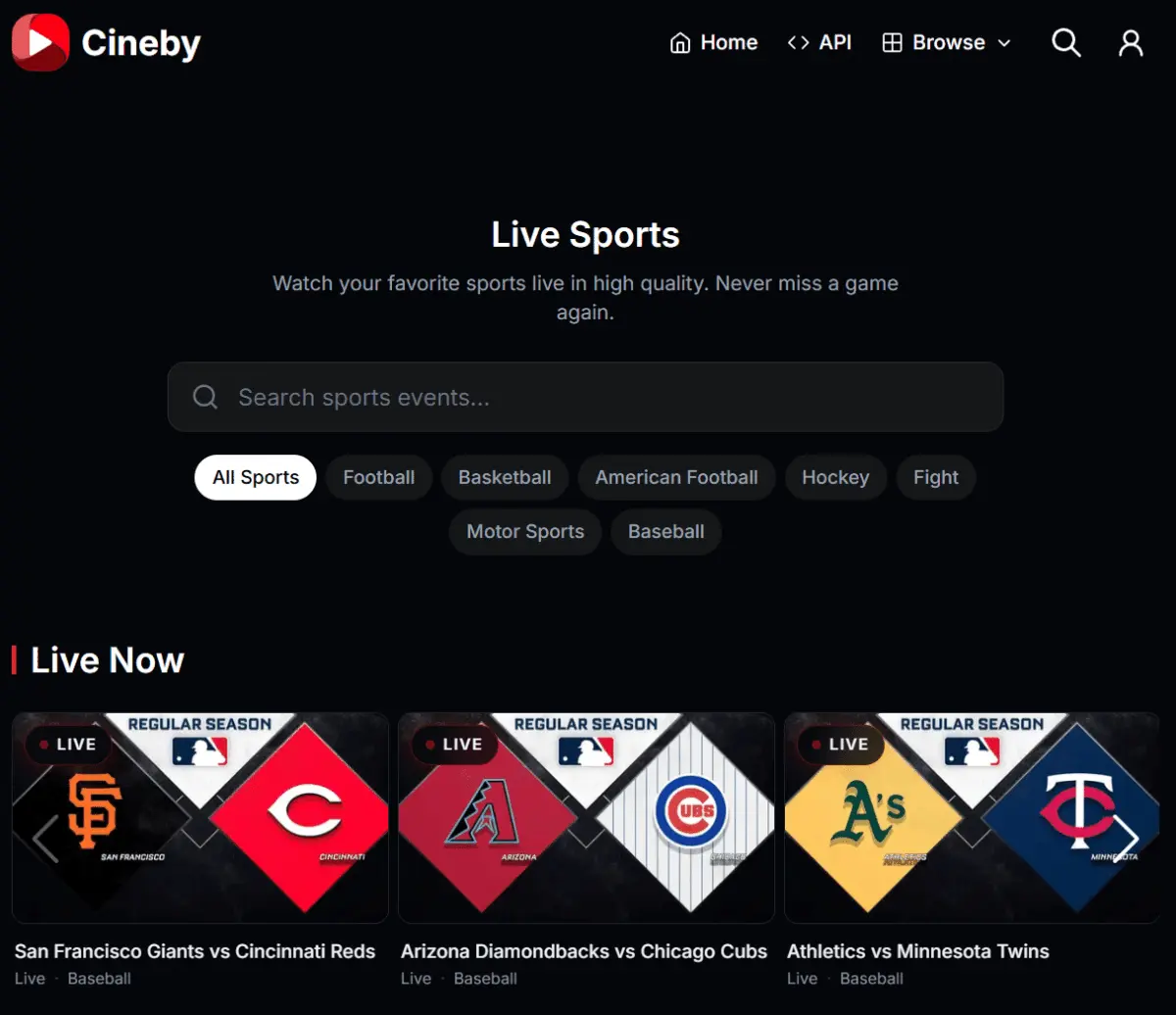
345movie.nl,456movie.nl,cineby.app,movies2watch.watch, andstreamm4u.com.co. - Part 2 (The Open-Ended Framework): Building upon precedents established in UK jurisprudence since 2022, Part 2 grants rightsholders the authority to demand the blocking of subsequent, similarly structured websites.
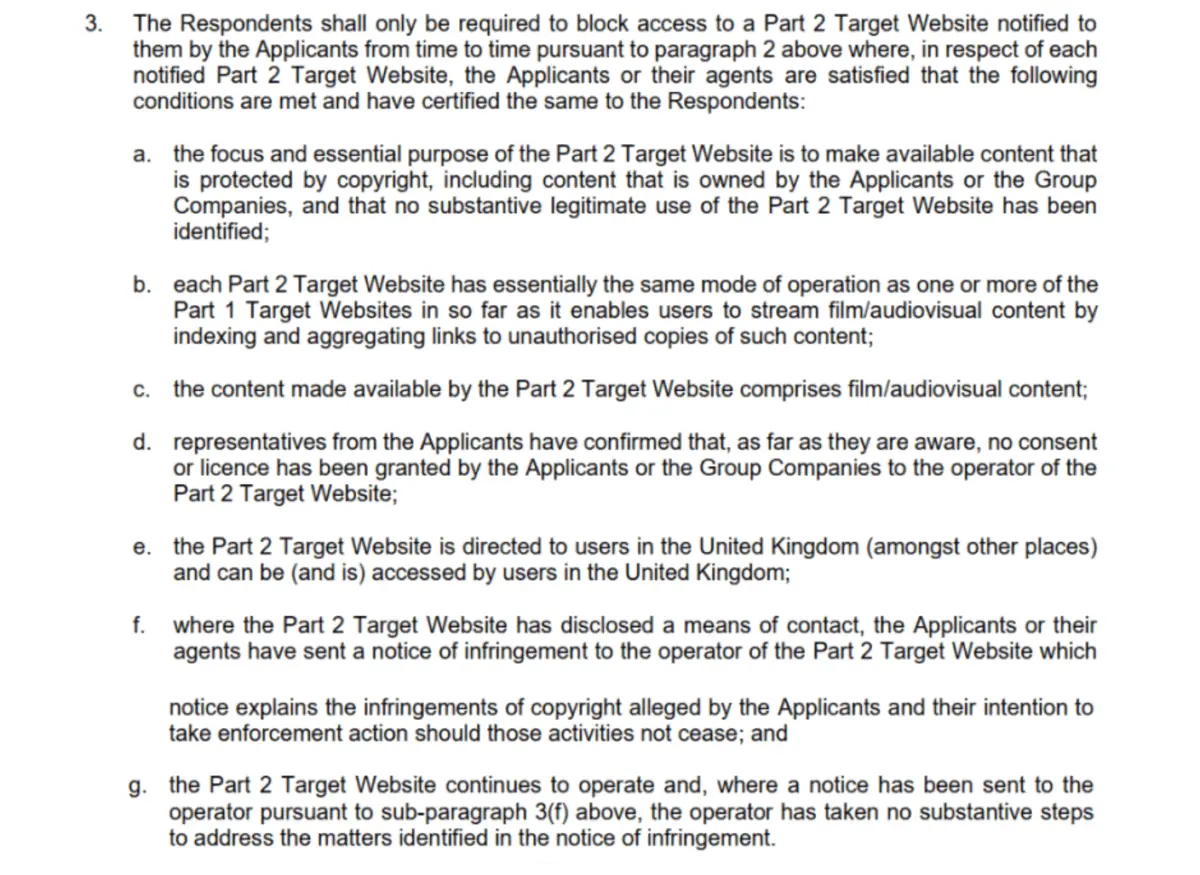
Crucially, the order notes that Part 2 target websites do not need to share branding with the original seeds; they merely need to match the underlying technological "mode of operation." The order defines this as any service that "enables users to stream film/audiovisual content by indexing and aggregating links to unauthorised copies of such content."
Bypassing the Judiciary
Perhaps the most controversial aspect of the omnibus order is the removal of the judiciary from day-to-day enforcement. When studios identify a new Part 2 site that meets the established operational criteria, they do not file a motion for a judge to review. Instead, they notify the ISPs directly that the conditions have been satisfied, and the ISPs implement the blockade.

Text within the order explicitly clarifies that the participating ISPs are "wholly reliant on the Applicants accurately identifying" the URLs in question and hold "no obligation to verify whether the Applicants’ or their agents’ determination is correct." In short, Hollywood has been handed the administrative keys to the UK’s network-level blocklist.
Supporting Context, Metrics, and the Voluntary CDN Dimension
While the core of the order traditionally binds regional ISPs operating at the DNS and IP routing layers, the recent transparency disclosures highlight how modern content delivery networks are integrating into these private-public enforcement pipelines.
The Cloudflare Factor
Cloudflare is not a named respondent in Columbia Pictures v. BT. Yet, the American infrastructure giant voluntarily complies with the spirit and requirements of the UK High Court order when sites utilizing its Content Delivery Network (CDN) are flagged by rights holders.
For UK-based visitors attempting to reach sites like movies2watch.watch through Cloudflare-proxied routes, the traditional browsing experience is interrupted by an HTTP 451 Error ("Unavailable For Legal Reasons"). This response explicitly informs the user that access has been restricted pursuant to legal compliance. By extending blocking duties beyond consumer ISPs down to core infrastructure and CDN providers, the friction points for pirated content multiply exponentially.
International Ripple Effects
The influence of this UK ruling extends far beyond British borders. As noted by digital rights researchers, the "expanded scope" framework modeled on this omnibus order was explicitly referenced in Canadian Federal Court proceedings. Courts globally are grappling with the same logistical bottleneck: traditional injunctions move too slowly for an internet economy built on instantaneous domain generation and cloud-based site deployment. By granting broad categorical powers rather than hyper-specific URL lists, jurisdictions like the UK and Canada are attempting to future-proof their judicial interventions against technological evasion.

Guardrails, Limitations, and Public Accountability Concerns
Despite the expansive powers granted to major studios, the court order incorporates specific legal boundaries designed to prevent runaway overblocking and abuse.
Technical and Operational Safeguards
- IP Address Protections: Rightsholders are strictly prohibited from requesting the blocking of an IP address if that exact server hosts legitimate, non-infringing web properties alongside illicit ones. This safeguard aims to prevent "collateral damage" where innocent websites are taken offline due to shared hosting infrastructure.
- Right to Object: Site operators, webmasters, or third parties inadvertently caught in the blocking net retain formal mechanisms to object to the restrictions.
- Sunset Clauses and Renewals: The omnibus order is not indefinite. It features a strict six-month operational lifespan, formally slated to expire at 23:59 PM six months from its issuance date unless extended by the court.
The Accountability Deficit
Despite these structural guardrails, digital rights advocates and open-internet advocates have raised sharp criticisms regarding transparency and accountability:
- Absence of a Public Blocklist: Unlike some regulatory transparency frameworks, the omnibus order contains no clause requiring the active, public publication of every domain added to the blocklist under Part 2. This leaves journalists and public watchdogs unable to independently audit whether studios are maintaining strict adherence to the operational criteria.
- Privatized Censorship: Because ISPs have no contractual or legal duty to independently verify the accuracy of studio-submitted URLs, critics argue the system effectively privatizes digital censorship. Decisions regarding what information remains accessible to the British public are delegated to corporate rightsholders operating behind closed doors.
- The Irony of Disclosure: The only reason the public is aware of the exact parameters of a High Court order impacting millions of UK citizens is because a third-party American infrastructure company filed a routine transparency notice in an independent database. The official judgment itself remains missing from standard public archives like BAILII.
Future Outlook
The release of the public version of the omnibus blocking order marks a watershed moment in digital copyright enforcement. It demonstrates a judicial willingness to accommodate the hyper-fragmented nature of modern piracy by trading granular, court-supervised oversight for automated, rightsholder-driven administrative efficiency.
As other common-law jurisdictions—exemplified by Canada’s recent adoption of similar expanded-scope frameworks—look to the UK as a blueprint, the pressure on global infrastructure providers will only increase. Whether CDNs like Cloudflare will expand their voluntary compliance globally, and whether public transparency will catch up with private enforcement mechanisms, will shape the contours of internet freedom for years to come.
For now, the machinery of modern site-blocking operates largely out of sight: efficient for Hollywood studios, opaque to the public, and entirely dependent on private corporate channels to keep the digital ledger transparent.