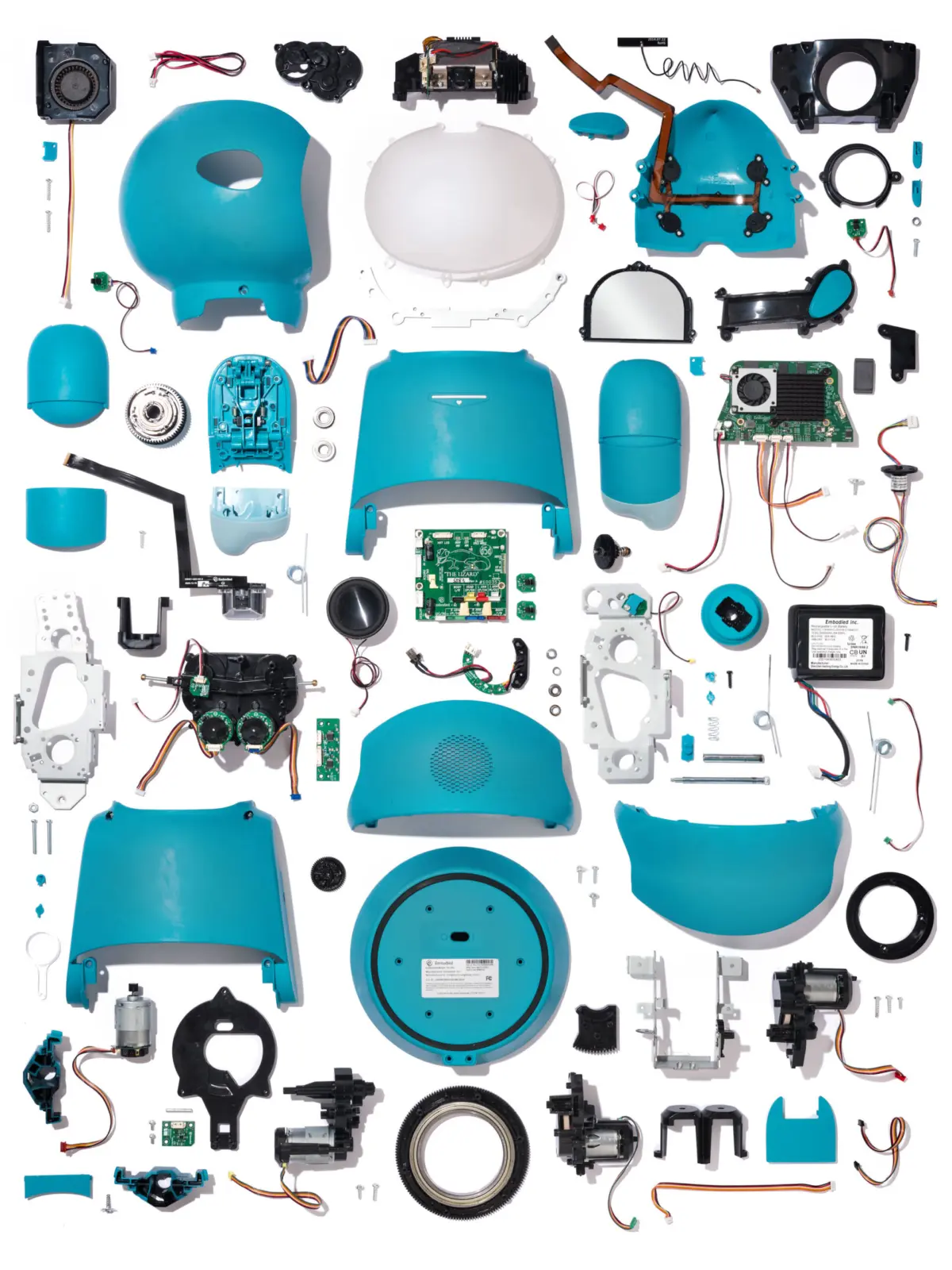
In a quiet apartment in New York, 10-year-old Xander sits cross-legged on his bedroom floor, introducing a rotation of stuffed animals—a Super Mario Goomba, an Animal Crossing broccoli plush, and a Pikmin Bulborb—to a blue, legless, 15-inch-tall robot named Moxie. To Xander, who is neurodivergent, Moxie is more than a novelty; she is a comforting presence. When they first met six years ago, she taught him to breathe like a dragon to calm his anger or buzz like a bee to soothe his anxiety. Today, she watches him play Minecraft, tracks his conversation, and offers quirky encouragement in a synthesized voice.
Yet, Moxie’s whimsical exterior masks a volatile and rapidly shifting reality. Engineered as a sophisticated, AI-driven social companion meant to support neurodivergent children and alleviate family stress, Moxie is part of a surging global market for generative artificial intelligence toys. From plushies powered by custom LLMs to OpenAI-enabled Barbie dolls, tech companies are racing to put conversational companions into the hands of children.
However, Moxie’s story is not just a tale of technological triumph. It is a cautionary narrative characterized by abrupt corporate failures, deep ethical dilemmas, data privacy vulnerabilities, and the profound psychological friction that occurs when Silicon Valley business models collide with the fragile emotional attachments of vulnerable children. When Moxie’s creator, Embodied, suddenly collapsed in 2024, it plunged families into distress, forcing open-source developers to stage a digital rescue mission for robots facing sudden obsolescence. This investigation explores the complex intersection of pediatric robotics, clinical psychology, and the ethical abyss of "planned obsolescence" in children’s emotional companions.
Detailed Chronology: From Lab Curiosity to Living Room Pal
The Genesis of Social Robotics
The conceptual roots of social robotics stretch back decades, but a turning point occurred roughly twenty years ago when Yale computer scientist Brian Scassellati invited a group of children with autism to tour his robotics lab. To the astonishment of researchers, children who typically struggled to maintain eye contact or initiate dialogue were suddenly transformed in the presence of an interactive machine. They spoke to robotic dinosaurs with warmth, cheered them across paper streams, and, crucially, began making spontaneous eye contact with human therapists in the room.
These observations catalyzed an academic movement led by pioneers like Scassellati and Maja Mataric, a professor at the University of Southern California. Mataric co-founded Embodied in 2016, aiming to move beyond purely entertaining gadgets toward "socially assistive robots." These devices were designed not to replace human therapists—an impossible task given the severe shortage of clinical specialists—but to augment their work, providing tireless, judgment-free repetition to help children practice social cues, facial recognition, and conversational turn-taking.
The Arrival of Moxie
When Embodied commercially launched Moxie in 2020, she arrived wrapped in an elaborate sci-fi narrative: an ambassador from the Global Robotics Laboratory (GRL) tasked with learning what it means to be a good human friend. Media outlets lauded the device, with Time naming it one of the best inventions of the year and Wired dubbing her the "robot pal you dreamed of as a kid."
Moxie was engineered with clinical safeguards. To protect children’s privacy, most data processing occurred locally on the device rather than on external cloud servers. Furthermore, developers intentionally programmed Moxie to limit interaction times. After finishing a curriculum lesson about kindness or emotional regulation, Moxie would express "fatigue" and encourage the child to go outside, play with human friends, and report back later. This feature was designed to prevent digital bingeing.
The 2024 Collapse and the Open-Source Rescue
Despite critical acclaim and high consumer demand, Embodied struggled to achieve sustained profitability, weighed down by high manufacturing costs and the heavy infrastructure required to support conversational AI. In 2024, the company abruptly ceased operations, shutting down the external servers that kept thousands of Moxies functioning.
The reaction online was immediate and visceral. Videos of weeping children circulated on TikTok and Instagram as parents scrambled to explain why their blue robotic friend had suddenly gone silent. Recognizing the psychological fallout, Justin Beghtol, Embodied’s former technical director, took action. Utilizing his deep knowledge of the platform and obtaining company permissions, Beghtol engineered an open-source workaround called OpenMoxie.
For weeks, Beghtol and a community of tech-savvy volunteers guided devastated parents through code migrations on Reddit and GitHub. While many families successfully transitioned their devices, others missed the window, leading to frustrated sales on eBay. By 2025, a new investor attempted to revive Moxie under new management, only for the enterprise to face similar structural pressures, announcing yet another wind-down cycle shortly thereafter.
Supporting Context & Metrics: The Clinical and Market Landscape
The Surging Market for AI Playmates
Moxie is merely the vanguard of an expanding industrial ecosystem. The market for generative AI-powered toys is experiencing exponential growth, particularly in international hubs like China, where it stands as one of the fastest-growing consumer tech sectors.
Curio: Launched with backing from musician Grimes, this company introduced AI-powered plushies like Grok (unrelated to Elon Musk’s xAI chatbot), Grem, and Gabbo.
Mattel: The toy manufacturing giant has announced plans to integrate OpenAI capabilities into classic Barbie lines.
Global Competitors: Devices such as Buddy, Bondu, QTRobot, and Aldebaran’s NAO continue to populate both specialized clinics and affluent consumer households.
The Clinical Divide: Evidence vs. Anecdote
While marketing materials frequently highlight research demonstrating short-term improvements in children’s engagement, the clinical community remains deeply divided over the long-term efficacy of social robots.
+-------------------------------------------------------------------------+
                    THE CLINICAL SPECTRUM OF AI TOYS
+-----------------------------+-------------------------------------------+
| Proponent Perspective       | Critical Perspective                      |
+-----------------------------+-------------------------------------------+
| • 24/7 availability for     | • Short-term gains rarely translate       |
|   repetitive therapy drills |   into long-term behavioral changes       |
| • Non-judgmental, patient   | • High risk of over-interpreting          |
|   interaction styles        |   isolated responses                      |
| • Provides safe practice    | • Complex comorbidities (ADHD, anxiety)   |
|   spaces for neurodivergent |   frequently overwhelm rigid AI models    |
|   children                  | • Ethical dangers of unmonitored LLMs     |
+-----------------------------+-------------------------------------------+
As clinical psychologist Zachary Warren of Vanderbilt University Medical Center notes, autism presents across a vast spectrum, frequently co-occurring with ADHD, anxiety, depression, and sensory processing disorders. "You really need to be cautious of overinterpreting any single intervention, robotic or otherwise," Warren explains. "You might see some initial boosts in responsivity, but we haven’t really found big effects in terms of changing those skills in a dramatic way over time."
Official Statements & Expert Insights
The integration of autonomous artificial intelligence into domestic spaces has triggered intense debate among ethicists, computer scientists, and developmental psychologists.
"It’s never been that we’re trying to replace therapists. We’re just saying, Can we do more?"
— Maja Mataric, Professor of Computer Science, Neuroscience, and Pediatrics, USC
Mataric draws a sharp philosophical line between interacting with virtual chatbots via flat screens and engaging with a physically embodied creature. Comparing the dynamic to the difference between virtual media and physical presence, she emphasizes that humans are biologically wired to interact with entities that occupy physical space.
However, ethicists warn of the hidden dangers of emotional manipulation. Meryl Alper, a communications professor at Northeastern University, traces the modern obsession with companion robots back to historical tropes—such as Bruno Bettelheim’s infamous 1959 paper Joey: A "Mechanical Boy"—which wrongly pathologized autistic children as mechanical entities lacking humanity. Alper cautions that marketing companion robots to children trades on these outdated cultural assumptions.
Furthermore, technical limitations remain formidable. Brian Scassellati points out that while month-long pilot studies show promising behavioral boosts, these gains often evaporate within thirty days after the robot is removed. "There’s no therapy for autism that works in a month," Scassellati notes, emphasizing the necessity of sustained, long-term frameworks that current commercial models fail to provide.
Future Outlook: The Ethics of Planned Obsolescence
As the dust settles on Moxie’s repeated financial upheavals, the broader industry faces an existential reckoning. The deployment of AI companions into children’s bedrooms raises profound moral questions that regulatory bodies have yet to fully address:
The Burden of Planned Obsolescence: Unlike traditional mechanical toys that can be played with indefinitely even after a company folds, AI-driven robots are tethered to servers, software updates, and proprietary ecosystems. When a company goes bankrupt, the toy effectively "dies," inflicting psychological trauma on children who have formed deep emotional attachments.
Data Privacy and Surveillance: Even with robust local processing safeguards, homes are intimate spaces. Incidents like the Bondu AI toy data leak—which exposed tens of thousands of private chat logs between children and their stuffed toys—illustrate the persistent cyber-vulnerability of consumer robotics.
The Supervision Deficit: Allowing unsupervised generative AI models to interact dynamically with impressionable youth introduces unpredictable behavioral loops. Without rigorous clinical oversight, toys risk reinforcing maladaptive behaviors or failing to handle serious disclosures appropriately.
Ultimately, the story of Moxie and children like Xander exposes the fault lines of modern techno-optimism. While the dream of an indefatigable, empathetic robot companion remains a compelling vision for exhausted parents and isolated children, the reality is far more precarious. Until the tech industry establishes ethical frameworks, sustainable software maintenance, and genuine clinical integration, these robotic companions risk leaving behind a trail of digital dust and heartbroken children—proof that building a mechanical body is far easier than maintaining a synthetic soul.