Executive Overview
In a strategic maneuver to deepen its footprint in the enterprise and small-to-medium-sized business (SMB) sectors, Meta has officially launched a dedicated macOS version of its Meta AI application. This release marks a critical evolution for the tech giant’s artificial intelligence ecosystem, bridging the gap between mobile convenience and desktop-driven productivity. By bringing its sophisticated conversational assistant directly to Apple’s desktop operating system, Meta is not merely offering an alternative access point; it is embedding its AI engine into the daily workflows of professionals, creators, and entrepreneurs.
The new Mac-specific iteration of Meta AI is engineered to function as an organic extension of the desktop environment. It encapsulates all the core capabilities of its mobile predecessor while introducing advanced, workflow-centric functionalities tailored specifically to the demands of modern business management. From live screen-sharing capabilities that allow the AI to contextualize ongoing projects to system-wide dictation and automated task management, the app represents a concerted effort to move beyond consumer-facing novelty and into indispensable professional utility.
Crucially, this rollout serves as a foundational pillar in Meta’s broader monetization strategy for its artificial intelligence suite. While the application is currently free to download and utilize, the company is systematically laying the groundwork for a transition toward paid enterprise tiers—specifically highlighting the upcoming subscription service dubbed "Meta One." By deploying a classic "freemium" adoption model—hooking users on high-utility workflows before introducing paywalls—Meta is attempting to convert its massive social media advertiser base into dedicated subscribers of its standalone AI enterprise tools.
Detailed Chronology and Technical Integration
The Evolution from Mobile to Desktop
For the better part of the past two years, Meta’s artificial intelligence strategy has heavily emphasized mobile integration, embedding Meta AI across its ubiquitous family of apps—including WhatsApp, Instagram, Facebook, and Messenger. While this strategy successfully brought generative AI to billions of consumers, the constraints of mobile interfaces inherently limited deep professional workflows. Users could chat, generate images, or ask general knowledge questions, but complex tasks such as document drafting, data analysis, and cross-platform multitasking required a desktop environment.
Recognizing this operational bottleneck, Meta began quietly developing desktop pathways. The release of the Meta AI Mac app represents the culmination of this developmental phase. Built to leverage macOS’s native architecture, the application does not merely replicate the web-based version of Meta AI; it integrates deeply with the operating system’s API framework to deliver localized utility.
Key Functional Capabilities of the Mac App
The newly released macOS application introduces several groundbreaking features designed to merge artificial intelligence directly with human productivity:
- Contextual Screen Sharing: One of the standout features of the Mac app is its ability to share an active window during a session. Instead of forcing users to manually upload screenshots, export data files, or copy-paste dense blocks of text, the app allows professionals to visually display what they are working on in real time. Meta AI analyzes the visual context and provides tailored, immediate advice, code optimization, or design critique specific to the project at hand.
- System-Wide Dictation: Moving beyond simple speech-to-text plugins, Meta has embedded a powerful built-in dictation engine that operates seamlessly across all native and third-party apps on macOS. Whether drafting an email in Apple Mail, writing a proposal in Microsoft Word, or inputting data into a spreadsheet, users can leverage Meta AI’s natural language processing to dictate with high accuracy and contextual awareness.
- Cross-Platform Document Generation: Business managers can prompt Meta AI to synthesize information drawn simultaneously from internal business profiles and the live web. The AI can automatically generate comprehensive presentation decks, formal documentation, and complex spreadsheets, significantly reducing the manual labor associated with administrative preparation.
- Automated Task Management: To combat operational fatigue, the application allows users to set up recurring tasks, automated reminders, and performance tracking metrics. By offloading routine administrative tracking to the AI, business owners can maintain real-time oversight of their operational health without drowning in logistical upkeep.
Supporting Context & Metrics: Empowering SMBs Through Proprietary Data
Leveraging the Meta Advantage
The true value proposition of the Meta AI Mac app for small and medium-sized businesses lies not just in general productivity, but in its exclusive access to proprietary ecosystem data. For years, SMBs have relied on Meta’s suite of advertising and social management tools to reach consumers. However, extracting actionable business insights from these platforms often required navigating dense analytics dashboards, Ads Manager reports, and disparate metrics.
The new Mac application addresses this friction by allowing business owners to query Meta AI using natural language and receive answers drawn exclusively from proprietary contextual data. As Meta executives noted during the launch, users can ask hyper-specific operational questions—such as "How did our latest video campaign perform among Gen Z demographics compared to last month?"—and receive immediate, synthesized insights drawn from account engagement metrics and ad performance histories.
Competitive Benchmarking and Public Insights
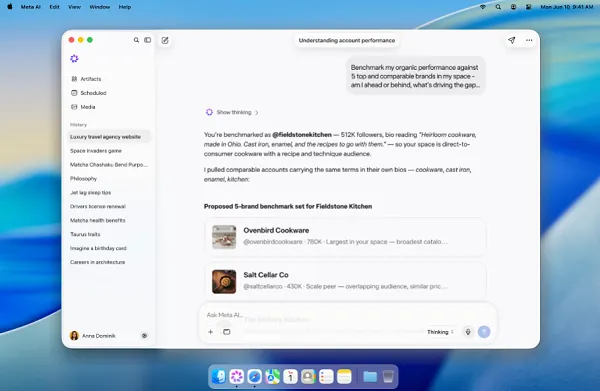
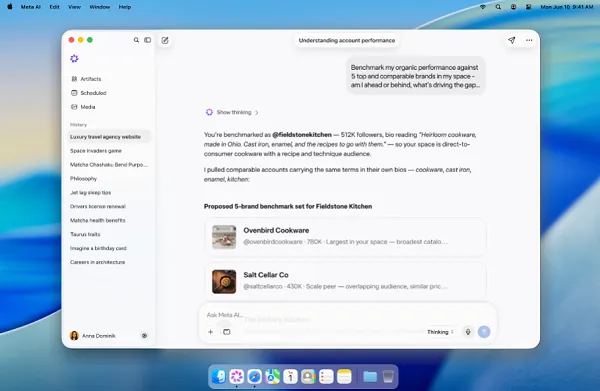
Beyond internal analytics, the system bridges the gap between private performance and public market intelligence. The Meta AI Mac app integrates publicly available insights regarding comparable brands within the same industry sector. By analyzing how competing businesses are building their organic presence, structuring their ad creatives, and engaging with audiences across Meta’s platforms, the AI provides direct, data-driven benchmarking insights.
This capability democratizes high-level enterprise intelligence. Historically, comprehensive competitive analysis required dedicated marketing agencies or expensive enterprise software suites. By baking this intelligence directly into a free desktop assistant, Meta is positioning its AI as an essential co-pilot for bootstrapping entrepreneurs who lack expansive operational teams.
Official Statements and Corporate Strategy
The Vision Behind the Integration
Meta’s leadership has framed the launch of the Mac application as a critical milestone in making artificial intelligence a daily collaborative partner rather than a transactional search engine. In official product documentation and accompanying corporate statements, Meta emphasized the shift toward ambient, workflow-integrated computing.
"With the new Mac app, you can share a window during a session to show what you’re working on, and it responds with tailored advice to the work in front of you. You can also use built-in dictation that works across all apps on your Mac," stated Meta in its official release notes.
Furthermore, the company highlighted the administrative relief the tool provides to resource-constrained business owners:
"You can also prompt Meta AI to use information from your business info and the web to create decks, docs, and spreadsheets you need to keep your business growing. And, you can let Meta AI handle work you’ve been doing manually by setting up recurring tasks and reminders to stay up to date on how your business is doing."
The Transition to "Meta One" and Monetization
Beneath the veneer of productivity enhancements and workflow optimization lies a calculated commercial strategy. Meta has poured billions of dollars into its generative AI infrastructure, compute clusters, and large language models (LLMs). While the short-term objective has been ecosystem expansion and user acquisition, the long-term mandate from shareholders is clear: monetization.
The launch of the Mac app represents the next phase in this financial trajectory. Meta is actively building specialized business-use cases to prove undeniable ROI to enterprise managers. Once these systems become deeply embedded in the daily routines of SMBs, the company plans to introduce tiered pricing structures.

In its rollout communications, Meta explicitly signaled this transition. While the mobile and desktop versions of Meta AI are currently free to download and use as an entry point, the company confirmed that "businesses that want to use them even more will be able to subscribe to Meta One."
This mirrors Meta’s historical playbook: build massive, habit-forming utility at scale, capture user loyalty, and subsequently gate advanced features, higher compute limits, and premium enterprise integrations behind a recurring monthly subscription model.
Future Outlook: The Competitive Landscape and Market Implications
Positioning Against Ecosystem Rivals
Meta’s aggressive push into the desktop AI space places it in direct competition with entrenched heavyweights. Apple has been rolling out its own suite of native AI capabilities ("Apple Intelligence") across macOS Sequoia, while Microsoft continues to deeply integrate Copilot into Windows and Office 365. Furthermore, standalone desktop applications from competitors like OpenAI (ChatGPT for Mac) and Anthropic (Claude for Desktop) have already established a strong foothold among power users and developers.
However, Meta’s competitive moat lies in its unmatched dominance over social commerce and SMB advertising infrastructure. While a user may turn to ChatGPT for general coding or academic writing, Meta AI possesses a unique monopoly on social media marketing data, ad-spend efficiency metrics, and consumer engagement analytics across Facebook, Instagram, and WhatsApp. For any business whose primary customer acquisition funnel relies on social media advertising, a desktop AI assistant that natively understands their ad performance and competitor landscape offers a compelling alternative to generalized productivity tools.
The Road Ahead for SMB AI Adoption
As Meta continues to refine its desktop applications and prepare for the commercial rollout of Meta One, the broader business landscape is undergoing a structural transformation. The barrier to entry for executing complex marketing campaigns, financial modeling, and administrative tracking is dropping precipitously.
However, this transition also raises important questions regarding data privacy, enterprise dependency, and subscription fatigue. As small businesses increasingly anchor their operational workflows to proprietary platforms like Meta’s, the switching costs grow exponentially—precisely the outcome Meta’s strategists are banking on.
For now, the release of the Meta AI Mac app signals that the battle for the desktop productivity market is officially intensifying. By combining deep OS-level integration, context-aware screen sharing, and exclusive access to advertising analytics, Meta is transforming its AI assistant from a social media novelty into an indispensable operating partner for the modern digital economy.