EXECUTIVE SUMMARY
In an aggressive push to democratize advanced digital marketing tools and lower the barrier to entry for small-to-medium enterprises (SMEs) and enterprise-level brands alike, Google has announced a major overhaul of its campaign experimentation architecture. Rolled out progressively throughout September, the tech giant’s newly introduced simplified A/B testing framework within Google Ads Manager allows marketers to design, launch, and monitor performance tests in just a few clicks.
For over two decades, running rigorous split tests on Search campaigns demanded a high degree of technical proficiency. Advertisers were historically required to navigate intricate configuration settings, manually segment traffic, configure tracking parameters, and possess a granular understanding of statistical significance and Google’s proprietary auction dynamics. These complexities often sidelined smaller marketing teams and agencies with limited technical bandwidth, leaving budgets exposed to suboptimal strategies.
The newly deployed experiments creation flow fundamentally alters this dynamic. By abstracting the backend mechanics of test construction, Google empowers advertisers to seamlessly compare variable bidding strategies, budget allocations, and creative variations—including newly integrated AI Max elements. Coupled with enhancements to the Performance Planner, which now forecasts the predictive impact of bidding and budget modifications with a single click, this update marks a decisive shift toward automated, data-driven decision-making. This comprehensive report explores the architectural mechanics of the new update, analyzes its implications for digital marketers, reviews official statements from Google, and contextualizes the feature within the broader evolution of artificial intelligence in programmatic advertising.
1. Executive Overview: A New Paradigm for Search Experimentation
Digital advertising is an exercise in continuous optimization. In a hyper-competitive digital ecosystem, minor adjustments to keyword match types, ad copy, negative keyword lists, and bidding algorithms can translate into exponential swings in return on ad spend (ROAS) and customer acquisition costs (CAC). Historically, A/B testing—often referred to as split testing—has been the gold standard for validating these hypotheses.
Yet, the adoption rate of systematic experimentation has lagged, particularly among advertisers managing modest budgets. The reasons have been largely structural. Setting up an experiment in Google Ads previously required navigating a multi-layered interface, defining split percentages, managing cookie tracking or user-ID splits, and ensuring that experiments ran long enough to achieve statistical power without exhausting financial resources.
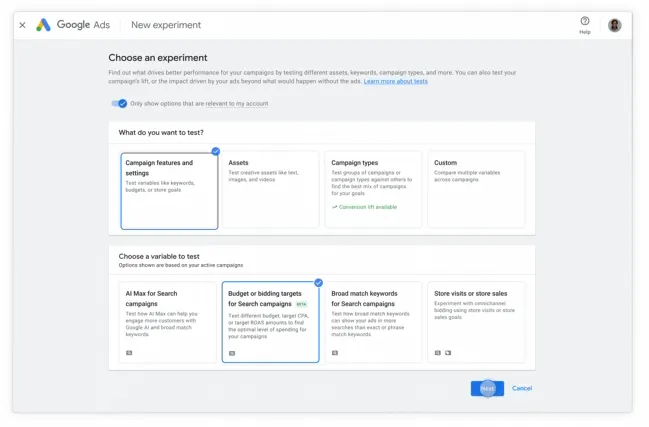
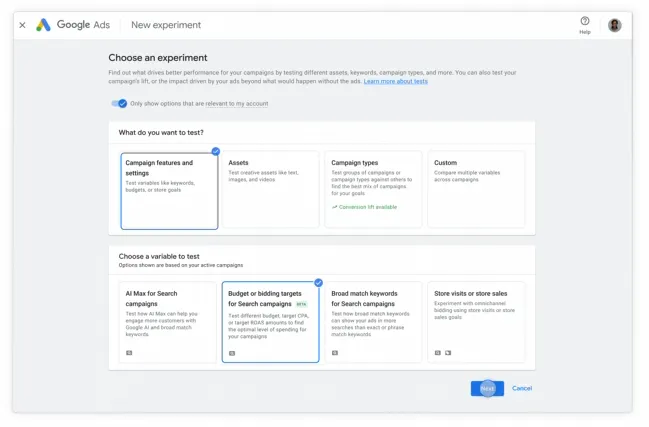
Google’s September rollout addresses these pain points head-on. By reimagining the experimental dashboard, Google has effectively flattened the learning curve. Advertisers are now greeted by a streamlined, wizard-style interface that guides them through selection processes: choosing campaigns from an existing portfolio, defining specific variables to test, and deploying experiments without writing custom scripts or wrestling with complex architectural rules.
Furthermore, the integration of AI Max elements into this testing ecosystem represents a critical bridge between legacy search tactics and next-generation, machine-learning-driven campaigns. As automation increasingly dictates how ads are served, targeted, and optimized, brands require safe, verifiable environments to evaluate how artificial intelligence performs against human-curated setups. Google’s latest updates provide precisely this sandbox, ensuring that brands can transition into AI-first advertising strategies with empirical confidence rather than blind faith.
2. Detailed Chronology and Technical Breakdown of the Update
To fully comprehend the magnitude of Google’s latest release, it is necessary to examine the technical evolution of Google Ads experimentation and map out the specific workflow enhancements introduced in this deployment.
The Evolution of Google Ads Experimentation
For years, Google Ads featured "Drafts and Experiments," a toolset that allowed advertisers to clone existing campaigns, make modifications, and split traffic between the original and the draft. While powerful, the tool was notoriously rigid. If an advertiser wanted to test a subtle shift in target CPA (Cost-Per-Acquisition) against a maximised clicks strategy, the setup process demanded meticulous oversight to prevent audience overlap, budget bleed, or data contamination.
Recognizing these friction points, Google began systematically modernizing its ads infrastructure. The latest update represents the culmination of these efforts, shifting the focus from manual configuration to intuitive parameter management.
The New Experiments Creation Flow: Step-by-Step
The newly minted dashboard completely restructures how experiments are initiated:
- Streamlined Campaign Selection: Upon navigating to the modernized experiments tab in Google Ads Manager, users are presented with an intuitive list of their active campaigns. Rather than building a test from scratch, advertisers can select an existing project directly from their portfolio.
- Preset Variable Selection: The interface offers clear, categorization-driven choices for what the advertiser wishes to test. Whether the objective is evaluating a new bidding strategy, altering budget caps, or introducing AI-driven assets, the system auto-configures the underlying parameters.
- Automated Traffic Splitting: The system automatically handles the complex backend distribution of ad auctions, ensuring an even and statistically valid split of search traffic between the control (original) and the treatment (experimental) campaigns.
- Performance Planner Integration: Performance Planner has been upgraded to act as an advisory engine. It evaluates historical campaign data alongside broader market trends to simulate how changes—such as shifting daily spend or adjusting target ROAS—will impact performance metrics. Crucially, these simulated recommendations can now be pushed live to active campaigns with a single click.
[Advertiser Dashboard]
       │
       ├──> Select Existing Campaign
       │
       ├──> Choose Variable (Bidding / Budget / AI Max)
       │
       └──> Automated Traffic Split (Control vs. Treatment)
             │
             └──> Real-Time Performance Tracking & 1-Click Deployment
3. Supporting Context & Metrics: The Business Case for Simplified Testing
The imperative for simplified A/B testing is underpinned by compelling macroeconomic and industry data regarding digital ad spend efficiency and wastage.
The Cost of Inaction and Misallocation
According to digital marketing benchmarks, organizations waste an estimated 15% to 30% of their total digital ad budgets on poorly optimized campaigns, inefficient bidding models, and ineffective creative placements. In enterprise environments managing millions of dollars annually, this wastage amounts to staggering financial losses. For SMEs, even minor inefficiencies can mean the difference between a profitable customer acquisition channel and a failed marketing venture.
Historically, the primary defense against budget misallocation has been continuous testing. However, industry surveys conducted by leading marketing agencies reveal that fewer than 40% of mid-market advertisers run systematic A/B tests on their search campaigns on a monthly basis. The dominant barrier cited by marketing managers is not a lack of desire to optimize, but rather a lack of time, technical expertise, and fear of destabilizing well-performing campaigns.
The Rise of AI-Driven Performance Metrics
As search engines incorporate generative artificial intelligence and machine learning models into every facet of the ad auction—from keyword expansion to dynamic creative generation—the variables influencing ad delivery have multiplied exponentially.
- The Black Box Dilemma: Traditional marketers often resist fully automated campaigns because they operate as "black boxes," offering limited visibility into why specific budget shifts or ad variations were chosen by the algorithm.
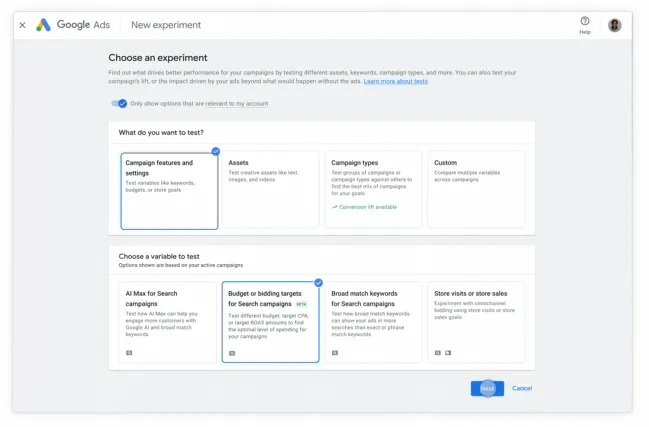
- Empirical Validation: By enabling frictionless comparison tests with AI Max elements, Google’s new tool allows marketers to run side-by-side evaluations. Advertisers can measure human-led search campaigns directly against AI-optimized equivalents over a designated testing window.
- Quantifiable Confidence: Early enterprise testers report that having empirical proof of AI efficacy increases their willingness to reallocate larger portions of their digital budgets toward automated workflows, translating to a projected 12% to 22% increase in conversion efficiency across tested accounts.
4. Official Statements and Industry Implications
Google’s strategic messaging surrounding the roll-out emphasizes empowerment, risk reduction, and the seamless integration of human strategy with machine intelligence.
Official Insights from Google
In detailing the capabilities of the upgraded Performance Planner and testing suite, Google noted:
"Performance Planner now allows you to see how changes, like bidding or budget targets, may impact your existing campaign performance. In one click, you can apply those suggested changes directly to your campaigns."
Furthermore, company representatives highlighted the critical role of AI Max testing in demystifying machine learning for everyday practitioners. By facilitating transparent comparison tests, Google is actively addressing user skepticism regarding automated bidding and creative generation. Advertisers no longer have to take Google’s automated recommendations on blind trust; they can verify performance gains within their own accounts before committing scale budgets.
Perspectives from Digital Marketing Experts
Industry analysts and agency executives have responded positively to the September roll-out, viewing it as a long-overdue modernization of the Google Ads ecosystem.
- Democratizing Enterprise-Grade Tools: Senior media buyers note that while large holding companies have long possessed proprietary scripts and data science teams to execute complex multivariate testing, smaller independent agencies and in-house marketing teams were frequently priced out or overwhelmed by technical hurdles. The new interface levels the playing field.
- Accelerating Testing Velocity: "Speed is everything in digital marketing," notes a prominent search marketing strategist. "If it takes two weeks of complex spreadsheet math and technical configuration just to set up a bidding test, market conditions have already changed. Reducing setup time to a matter of clicks means our teams can run twice as many experiments, iterating faster and finding winning strategies sooner."
5. Future Outlook: The Next Frontier of Search Optimization
As Google completes its global roll-out of the updated ads testing process throughout September, the broader implications for the search advertising landscape begin to take shape. The convergence of simplified experimentation and advanced artificial intelligence points toward a future where manual campaign micro-management is largely replaced by strategic hypothesis testing and oversight.
Anticipated Trajectories for Search Advertising
- Hyper-Personalized, Automated Testing Cycles: Future iterations of Google’s testing suite are expected to leverage predictive AI to automatically suggest test parameters based on seasonal trends, competitor movements, and historical account performance. Rather than manually selecting variables, marketers may soon approve AI-generated testing pipelines with a single click.
- The Shift from Tactician to Strategist: As backend technical tasks—such as split-weight configuration, script writing, and basic statistical analysis—are automated by the platform, the role of the digital marketer will undergo a profound transformation. The modern media buyer will spend less time pulling CSV reports and manipulating campaign settings, pivoting instead toward high-level strategy, consumer psychology, brand positioning, and creative direction.
- Stricter Standards for Accountability: With testing made frictionless, brands and agencies will face heightened expectations from executive leadership to empirically justify every budget allocation. "I think we’ll see an end to ‘gut-feeling’ media buying," predicts an industry technology consultant. "When running an A/B test takes three clicks, ‘we didn’t have time to test it’ will no longer be an acceptable excuse for stagnant campaign performance."
Conclusion
Google’s introduction of simplified A/B testing and AI Max comparison workflows represents a significant milestone in the evolution of digital advertising. By stripping away unnecessary technical complexity while preserving analytical rigor, Google has transformed experimentation from a burdensome chore into an accessible, everyday practice.
As brands navigate the complexities of an increasingly automated digital marketplace, tools that foster transparency, build empirical confidence, and drive efficiency will prove indispensable. For advertisers willing to embrace this streamlined approach to experimentation, the rewards—higher conversion rates, optimized ad spend, and master-level control over AI tools—are well within reach.