Executive Overview
For the better part of the last decade, the holy grail of software-as-a-service (SaaS) was the pure, unadulterated product-led growth (PLG) motion. The gospel preached by elite tech founders was simple: build a brilliant tool, place it on the open internet, let it virally loop through user adoption, and allow the product to speak entirely for itself. Traditional outbound sales and heavy corporate marketing were widely viewed as archaic relics of enterprise software—expensive crutches utilized by legacy companies whose products simply weren’t good enough to win on their own merit.
That ideological orthodoxy is currently undergoing a radical, highly visible collapse.
In a recent, widely circulated statement that sent shockwaves through the startup ecosystem, Amjad Masad, founder and CEO of collaborative cloud development platform Replit, confessed a profound ideological shift: "I thought I hated sales culture. By the end of this year, more than half my company will be salespeople."
Masad’s realization is far from an isolated incident; it represents a macroeconomic tipping point across the B2B landscape. Driven by the complexities of modern enterprise procurement, the scaling realities of AI-era businesses, and the sheer weight of accumulated inbound demand, even the most staunchly product-led darlings are discovering an immutable truth: eventually, almost everyone has to build a sales team.
This deep dive explores the structural forces driving this movement, examining how threshold barriers have shifted in the age of AI, the hidden costs of deferring a go-to-market (GTM) engine, and why tomorrow’s most successful software companies are blending technical innovation with world-class commercial execution.
Detailed Chronology: From Twitter-Driven Marketing to Enterprise Inundation
To understand how software enterprises transition from zero-sales purists to heavy commercial operations, it is vital to trace the historical timeline of PLG scalability.
The Pre-AI Golden Era (2015–2023)
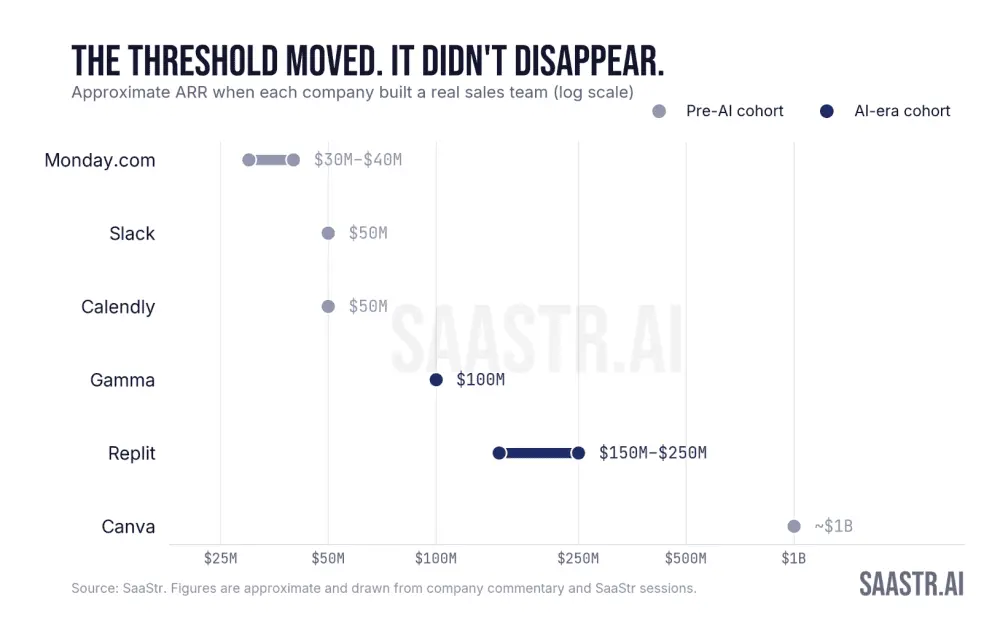
During the mid-2010s, iconic companies like Slack, Twilio, Box, Stripe, and Calendly proved that hyper-growth could be achieved with minimal direct enterprise sales teams. In February 2015, during the inaugural SaaStr Annual event, Slack famously operated at roughly $30 million in Annual Recurring Revenue (ARR) without having hired a single traditional sales rep.
When questioned about how Slack could scale past $100 million without an outbound machine, co-founder Stewart Butterfield famously demurred. Slack did not employ "salespeople"; instead, they utilized "account managers" who engaged almost exclusively with corporate buyers who had already decided to purchase the tool. Their job was not to pitch or persuade, but to "midwife the sale"—navigating vendor reviews, security policy analysts, and in-house legal teams to sign off on corporate agreements. There were no aggressive cold-calling quotas, and there was no cold outbound.
However, as these companies scaled, reality inevitably set in. Viral bottom-up adoption inevitably hit the glass ceiling of corporate procurement. Enterprises deploying software across dozens of fragmented, unsanctioned teams eventually required enterprise-wide consolidation agreements. That consolidation required a human conversation, which required a negotiator, which ultimately necessitated a fully fledged sales organization. Slack, like its peers, eventually evolved into a balanced sales-led and product-led hybrid enterprise.
The AI-Era Acceleration (2024–2026)
Fast forward to the current landscape, and the timeline for introducing commercial operations has shifted dramatically. Because modern artificial intelligence startups can scale their user bases to unprecedented heights with lean engineering teams, the point at which self-serve funnels break under the weight of enterprise demand has been pushed significantly further down the road.
Take Replit’s trajectory as a primary case study. For years, Masad operated as a textbook modern tech founder, treating his personal Twitter account as the company’s primary marketing department while allowing the product’s organic network effects to drive adoption. Sales was perceived as an unnecessary friction point.
The strategy worked until enterprise demand reached a boiling point. Corporations began emailing Replit en masse, noting that their engineering departments were already utilizing the platform deeply, and demanding to know "how do we buy it properly?" Initially, Replit attempted to absorb this massive wave of high-intent enterprise interest with a single employee handling those conversations alongside three other operational roles. Predictably, the dam broke. The market wanted far more than a skeleton crew could manually process, forcing Masad to confront the reality that organic momentum requires structured commercial backing to survive.
Supporting Context & Metrics: The Financial Realities of Scaling GTM
The debate surrounding sales culture is ultimately settled not by philosophy, but by hard financial data. Examining public company filings and private market surveys reveals precisely how much capital scaling enterprises must dedicate to go-to-market operations.

Public Market Benchmarks
An analysis of recent quarterly filings from SaaS market leaders reveals clear divisions in spending on Sales and Marketing (S&M) as a percentage of overall revenue:
- The High-Spend Cohort: Enterprise giants with complex, top-down selling motions consistently dedicate significant portions of their revenue to fuel GTM engines.
- The Product-Led Cohort: Companies built on high-velocity, low-friction self-serve models traditionally report lower S&M ratios, though these numbers are steadily ticking upward as they chase lucrative enterprise accounts.
Atlassian serves as the ultimate litmus test for this dynamic. Long championed as the canonical "we don’t have salespeople" organization, Atlassian historically relied on a massive indirect channel of third-party resellers and digital self-serve funnels rather than a direct enterprise sales force. Yet, recent metrics indicate a telling shift: Atlassian expanded its go-to-market spend significantly faster than its overall revenue growth. Even with a massive footprint across the Fortune 500, the company recognized that sitting on a mountain of unconverted internal demand without dedicated human follow-up leaves millions of dollars on the table.
Private Market Realities
Data from the 15th annual SaaS Capital survey—encompassing over 1,000 private B2B companies—underscores this trend across earlier-stage organizations:
- Median Selling Costs: Climbed to 15% of ARR (up from 13% the previous year).
- Marketing Spend: Remained stable at a median of 8% of ARR.
- Customer Success & Support: Rose to 9% of ARR (up from 8%).
Crucially, the data highlights a stark divergence between venture-backed and bootstrapped companies. Equity-backed startups spend upwards of 70% more on sales and 100% more on marketing than bootstrapped peers operating at the exact same revenue scale. Accepting venture capital is, by extension, signing an agreement to build a scalable, institutionalized sales engine.
Official Statements & Industry Perspectives
The structural transformation of the sales function is heavily influenced by the integration of agentic AI workflows, fundamentally altering how sales teams operate rather than simply shrinking their headcount.
Anthropic and the Rise of AI-Driven Commercial Operations
During recent industry conferences, enterprise leaders have emphasized that resisting the establishment of a sales infrastructure is rarely a calculated strategy; it is usually just an absence of one. Eleanor Dorfman, who leads commercial and industries sales at Anthropic, noted that even if a company wanted to aggressively multiply its sales headcount to meet surging demand, the sheer physical constraint of onboarding enough talent to maintain customer excellence makes instant scaling impossible.
Despite leaning heavily into a self-serve enterprise model—where a staggering majority of new enterprise logos originate directly from automated funnels—Anthropic simultaneously expanded its startup and enterprise sales teams dramatically. Notably, the company’s startup sales division scaled from under 10 people to over 150 within an 18-month window, supporting an influx of enterprise clients spending upwards of $1 million annually. Complex, high-value corporate contracts simply do not close inside automated checkout flows.
The Evolution of the Sales Role
Fears that artificial intelligence will entirely eliminate the need for human sales professionals have proven largely exaggerated. Instead, data from firms like Emergence Capital highlights a nuanced compression and expansion across different tiers of the GTM org:
- The Compression: Traditional, repetitive prospecting roles (SDRs and BDRs) have absorbed the sharpest headcount cuts, as software agents increasingly automate cold outreach and basic lead qualification. Vercel COO Jeanne DeWitt Grosser noted that deploying an automated lead qualification agent allowed a 10-person function to be streamlined down to a fraction of that headcount, simultaneously boosting remaining SDR quotas by 30%.
- The Expansion: Conversely, technical, relationship-driven functions are expanding. Account executives, sales engineers, and professional services roles are seeing consistent headcount growth.
As automated agents absorb deterministic, low-level administrative tasks, human sellers are shifting away from brute-force prospecting and moving closer to high-level technical consulting.
Future Outlook: Navigating the Inevitability of Sales
For technical founders preparing to make the leap from product-led growth to a hybrid or sales-led motion, the path forward requires careful navigation to avoid common strategic pitfalls.
- The First Hire is the Hardest: Recruiting a premier sales leader into an established mid-stage company with zero pre-existing sales culture, lack of forecast discipline, and a founder on record dismissing commercial operations is an uphill battle. World-class sales executives require organizational alignment, transparent data hygiene, and structural commitment from the top.
- Technical Debt of Delayed Infrastructure: Delaying the establishment of a sales team usually means deferring crucial sales infrastructure—such as clean account data, unified customer identity resolution, and CRM-integrated usage telemetry. Building these data pipelines at scale under intense time pressure is exponentially harder than laying the groundwork early.
- Protecting High-Intent Demand: As Amjad Masad astutely observed, starving inbound enterprise demand of human attention is an open invitation to competitors. Every quarter a high-intent corporate lead sits unserviced in a self-serve queue is an opportunity for a competitor with dedicated reps to swoop in and close the deal.
The Bottom Line
The ideological war between product-led purity and sales-led pragmatism is officially over. The most successful software companies of the coming decade will not be those that stubbornly refuse to build a sales organization, but those that successfully leverage AI to automate the mundane friction of customer acquisition while deploying elite, consultative human talent where it matters most.
For technical founders, the realization that sales is not the enemy of great products—but rather the engine that allows great products to reach the organizations that need them most—marks the true transition from building a cool piece of technology to building an enduring, generational enterprise.