Executive Overview
The debate over whether artificial intelligence belongs in software development is officially over. The argument that AI is a passing trend or a superficial feature has been settled by market realities; building with AI is now a baseline requirement for survival. Yet, as the broader tech ecosystem catches up to this paradigm shift, the most critical questions remain fundamentally unsettled. Modern B2B founders are forced to grapple with unprecedented uncertainties: What is a product built entirely on autonomous agents actually supposed to measure? And, perhaps more existentially, what stops a foundational model provider from making your core product obsolete next quarter?
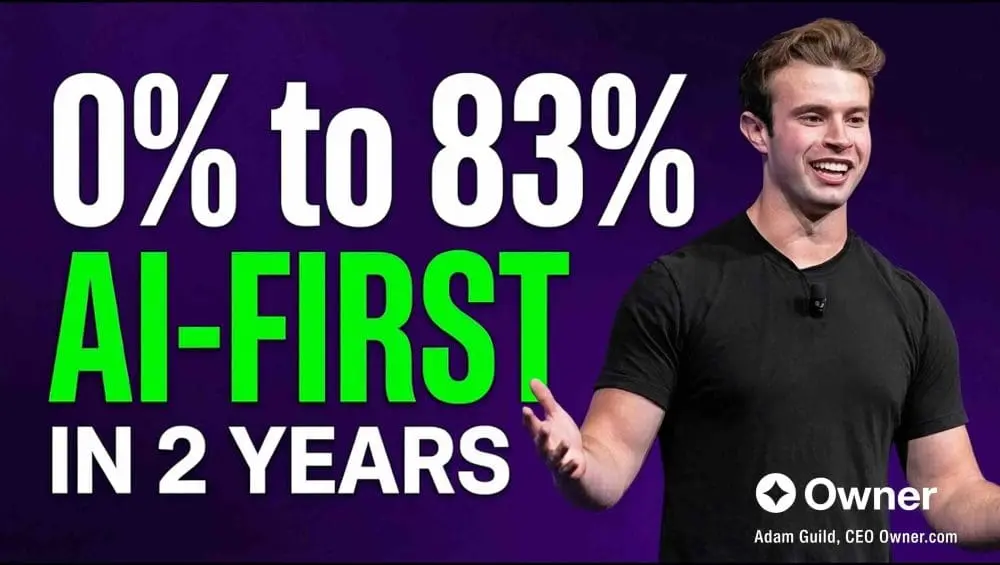
These are not merely academic thought experiments. They are the frontline operational hazards navigated by Adam Guild, CEO and co-founder of Owner, a comprehensive all-in-one platform for restaurants providing websites, online ordering, and marketing automation. Speaking candidly at the SaaStr AI stage, Guild shared the results of a high-stakes, multi-year corporate transformation. Having already surpassed the milestone of $100 million in Annual Recurring Revenue (ARR), Owner achieved accelerated growth metrics through 2025 and year-to-date 2026, outperforming its historical trajectories. Most strikingly, more than 83% of Owner’s new customers now originate entirely within its free AI-driven product experience—a staggering leap from 0% just two years prior.
However, the strategic conclusions Guild drew from this journey run completely counter to conventional wisdom taught in modern accelerators and boardrooms. In fact, many of these insights directly challenge standard Key Performance Indicators (KPIs), threatening to make traditional board decks look fundamentally broken. This report investigates how Owner stared down systemic stagnation, defied the consensus of its closest advisors, tore up its sales-led motion, and weaponized hyper-opinionated product architecture to build a defensible moat against foundation model encroachment.
Detailed Chronology: From Stagnation to the Agentic Pivot
1. The Invisible Two-Sided Threat
Between early 2023 and 2024, Owner found itself squeezed by a classic, silent corporate trap. From one direction, macroeconomic and technological pressures were shifting customer expectations faster than traditional software could adapt. From the other, competitive alternatives were nibbling at the edges of their traditional restaurant website builder category.
Yet, looking at Owner’s internal dashboards, everything appeared healthy. Growth charts ticked upward at standard, predictable rates. Churn remained within acceptable bounds. But Guild recognized a grim reality beneath the surface metrics: without a radical transformation, Owner would bleed out slowly over a multi-year horizon, culminating in an irrelevant business. The hard metrics kept whispering that everything was fine, but the strategic horizon shouted otherwise.
2. Reasonable Resistance: The Trap of Informed Consensus
Recognizing the existential risk was only the first hurdle. The truly formidable challenge lay in the fact that nearly every informed, invested stakeholder—industry veterans, internal product leaders, and customer success teams—disagreed with the need for a pivot.
Three distinct groups of smart people presented three entirely logical reasons to stay the course:
- The Customer Voice: Direct interviews with restaurant owners indicated they wanted incremental improvements to existing features, not radical, unproven AI automation.
- The Domain Experts: Industry veterans warned that the restaurant vertical was notoriously low-tech, relationship-driven, and historically resistant to automated onboarding.
- The Financial Guardians: Internal stakeholders pointed to healthy unit economics under the existing sales-led motion, arguing that disrupting a working machine was corporate suicide.
Each of these objections was entirely reasonable on its own terms. Two of the three perspectives came directly from professionals whose primary job was maintaining intimacy with the customer base. This is what makes this specific failure mode so deceptively dangerous: it does not manifest as stubborn resistance to change; instead, it masquerades as disciplined, prudent management.
3. The Accidental Catalyst at the Pizza Expo
The psychological dam broke not in a strategic board meeting or a Silicon Valley incubator, but unexpectedly on the floor of the International Pizza Expo.
Guild arrived early, setting up his laptop to demo Owner’s established product suite of websites and online ordering infrastructure. As the exhibition doors opened, the first wave of pizzeria owners streamed past. Then, one owner craned his neck, walked to the back of the booth, and pulled out his phone.
He was scanning a promotional poster that one of Owner’s product managers had brought along as an afterthought. It advertised a raw, highly unpolished Minimum Viable Product (MVP) designed to analyze everything broken about a restaurant’s digital footprint and instantly fix it using AI. Accompanying the pitch was a simple QR code. Joe, a 55-year-old pizzeria owner hailing from Pennsylvania, became utterly transfixed by the prospect.
Throughout the remainder of the event, the pattern repeated itself. Across dozens of spontaneous conversations, AI emerged as the single most compelling topic of discussion for visiting operators—completely eclipsing the traditional software collateral displayed on the main tables. Restaurant owners wanted to know how generative AI could drive customer discovery and drop labor costs.
The customer discovery interviews conducted three months prior had yielded completely opposite conclusions. So had the collective wisdom of industry veterans. The variable that changed the equation in the interim was simple: ChatGPT had successfully permeated the consciousness of main street small business owners. They had already decided that artificial intelligence was an operational advantage they desired, long before any software vendor formally offered it to them. Sensing the shift, Owner pivoted entirely on the spot, channeling engineering resources toward the AI initiative despite leaving real fires burning elsewhere in the product ecosystem.
Supporting Context & Metrics: The Rebuild and the Moat
Rebuilding the Funnel: From "Book a Demo" to "Type in Your Restaurant Name"
Historically, Owner operated as a 100% sales-led enterprise. The inbound user journey required booking a demo, speaking with a sales representative, transferring to an onboarding specialist, and waiting days or weeks for a custom website to be manually built.
The strategic question Guild and his team posed was simple: How much friction can we strip from this journey now that generative AI exists?
The answer was a radically simplified free product experience where a restaurant owner types their business name into a text box, and autonomous agents handle the rest. In under five minutes, the system autonomously executes a comprehensive digital overhaul:
- Scrapes and analyzes existing online footprints.
- Synthesizes customer sentiments pulled from community platforms like Reddit, Instagram, and Facebook to generate localized dish spotlights.
- Dynamically constructs professional photo galleries and rich media assets.
- Formats bar, cocktail, and menu details optimized for local search engines.
- Generates promotional video content the restaurant owner had never previously possessed.
When this autonomous onboarding flow was showcased to the broader tech community, it ignited viral interest, drawing over two million views on X (formerly Twitter) within a fortnight. Within the restaurant industry, however, the impact had been compounding quietly for over two years, fueling an astonishing operational milestone: approaching $100M ARR while accelerating year-over-year growth.
The Architectural Moat: Why Opinionation Defeats Foundation Models
A central anxiety plaguing B2B software founders is the looming threat of general-purpose foundation models. If a user can prompt Claude Code or Codex to generate a bespoke, beautiful website for a local Thai restaurant, why do they need an application layer like Owner? Pretending this threat does not exist is a surefire way for founders to squander their enterprise value over the next twenty-four months.
However, Guild identifies a critical distinction: foundation models possess generalized knowledge trained on the entire public corpus of web design—much of which is structurally subpar. What foundation models fundamentally lack is proprietary outcome data.
A general model does not inherently know which UI components on a specific restaurant’s homepage correlate with actual sales growth, which calls-to-action maximize mobile food delivery conversions, or what exact structural hierarchy pushes a local merchant to the top of regional search engine results.
Owner survives and thrives because its product is deeply opinionated. An agent only feels magical to a user when software autonomously drives a desired business outcome without requiring manual configuration. If software must constantly pause to ask the user what to do at every single fork in the road, it ceases to be an agent and merely becomes a web form with superior copywriting. Owner’s system successfully encodes hard-won best practices derived from powering thousands of restaurant websites and observing the transactional behavior of tens of millions of consumers.
This hyper-opinionated approach generates proprietary outcome data, and that data serves as an unassailable moat. If every customer receives a completely bespoke, unguided configuration, an enterprise learns nothing transferable—leaving it entirely vulnerable to displacement by general models.
Official Insights & Operational Shifts
Redefining Health Metrics: Logins as Failure Signals
In the legacy paradigm of B2B SaaS, Daily Active Users (DAU), Weekly Active Users (WAU), and Monthly Active Users (MAU) logged inside a dashboard were universally worshipped as the holy grail health metrics, signifying an engaged user base and a functional product.
Guild argues that the exact inverse is now true in an agentic workflow. If autonomous agents derive their true value from executing complex workflows and driving outcomes without requiring constant human intervention, then every single time a customer is forced to log into a dashboard to manually correct how the software set up their digital presence, that interaction represents a systemic product failure. It indicates that the user is expending mental energy to solve problems inadvertently created by the software.
The ultimate target for modern product architecture is an experience sufficiently low-touch that the customer rarely needs to open the dashboard at all. The underlying system must independently understand industry best practices and continuously execute them on the merchant’s behalf. This realization carries profound strategic teeth for leadership teams whose board decks rely heavily on traditional engagement charts: if an AI-native product is operating correctly, certain headline engagement metrics should naturally trend downward. Founders must prepare this narrative well in advance of the quarter it manifests.
Internal Transformation: Building "Owen" and Eliminating Busywork
The external product shift necessitated an internal cultural and operational overhaul. As Owner’s agentic grader tool gained traction, high-leverage individual contributors (ICs) began drowning in standard administrative coordination overhead—updating project management boards, chasing status updates, and syncing across asynchronous communication channels.
Refusing to accept builder busywork as an inevitable cost of scale, the engineering team applied the same agentic logic inward, creating an internal AI agent named Owen.
Owen operates by continuously ingesting real-time data streams from GitHub, Slack, Notion, Linear, and Google Meet transcripts processed via advanced multimodal AI. Consequently, team alignment is maintained automatically without endless sync meetings. Furthermore, when a team member flags a visual bug or user friction point in Slack—such as bullet points rendering incorrectly in an agent chat interface—Owen interacts directly with codebase inspection tools to generate a first-draft pull request (PR) instantaneously. This eliminates the multi-step friction of filing tickets, assigning front-end resources, and locating legacy components manually across sprawling codebases.
In tandem with Owen, Owner constructed several specialized internal hubs:
- The Product Insight Command Center: Aggregates qualitative user feedback and quantitative behavioral data to surface emergent product gaps without manual data wrangling.
- AI-Native Finance & Sales Automation: Streamlines administrative overhead while feeding real-time customer success validation back into the sales organization. To combat the psychological burnout inherent in outbound sales, Owner’s marketing team wired real-time customer testimonials directly into internal communication channels. When a restaurant owner reports driving an additional $150,000 in revenue with zero friction, the specific sales rep who closed the account receives immediate, quantifiable validation of their work’s impact, bolstering organizational conviction.
The CEO as Builder, Not Mandate Issuer
Guild offers a sharp psychological critique of leadership behaviors observed across the tech sector: executives who issue sweeping, intimidating mandates—such as demanding their teams achieve tenfold productivity gains via AI under threat of termination—while personally failing to engage with the technology themselves. Fear-based pronouncements unbacked by personal experimentation inevitably ring hollow.
Reflecting on this philosophy, Guild—who describes his technical background prior to Owner as a mediocre script kiddie building Minecraft servers, having written zero production code in the company’s history—decided to lead by example.
Prompted by a conversation with Juliana, a local Oaxacan restaurant owner who lamented spending $2,000 on professional menu photography only to find her smartphone-captured seasonal menu items looking glaringly inferior, Guild took action. Over the course of a six-hour weekend coding session, he personally built Owner Photographer.
The tool allows a merchant to upload a low-quality smartphone photo, select a desired aesthetic style, and pass the asset through a multi-step pipeline of visual models that analyze the image in precise detail. It applies rigorously tuned anti-prompts designed specifically to prevent food photography from slipping into the uncanny valley—the primary failure mode plaguing automated image generation. Juliana’s blurry taco photo emerged from the pipeline matching the exact professional lighting and styling that had previously cost her thousands of dollars. Today, hundreds of customers utilize the feature daily—marking one of several tools Guild personally coded in a two-month span.
Future Outlook & Strategic Conclusions
Jevons Paradox and the Headcount Fallacy
As the technology sector settles into the realities of the agentic era, leadership teams frequently stumble into what Guild identifies as a deeply flawed foundational question: Now that our workforce is exponentially more leveraged, how many fewer people do we need to execute our original operational plan?
Guild argues that this perspective mistakes efficiency for ambition. Applying Jevons Paradox to human capital reveals a different economic truth: as a resource becomes significantly more efficient, it becomes entirely rational to consume more of it, scaling output rather than shrinking footprints. Artificial intelligence represents a golden era for high-agency builders. Shrinking an organization simply to run a legacy roadmap with a lean headcount is a profoundly unimaginative use of a historic technological transition.
While reasonable operators may land on contrasting strategies regarding headcount management, the central takeaway remains clear: deciding to run the same plan with fewer people is a deliberate choice regarding corporate ambition rather than an economic inevitability. It is a strategic debate that founders must explicitly argue rather than implicitly assume.
Summary of Critical Failure Modes
To navigate the coming quarters successfully, software leaders must actively audit their operations against the primary failure modes that trap modern startups:
- Dashboard Illusion: Mistaking stable or slowly climbing legacy usage metrics for fundamental business health while a silent, two-sided market pressure erodes long-term defensibility.
- Consensus Paralysis: Yielding to reasonable objections from domain experts and customer service teams who mistake incremental feature requests for structural market direction.
- The Engagement Paradox: Celebrating high dashboard login frequencies as user engagement when they actually signal high friction and system failure caused by poor automation.
- Commodity Vulnerability: Building unopinionated wrappers around foundation models without capturing proprietary outcome data, leaving the enterprise exposed to immediate displacement.
- The Ambition Trap: Utilizing AI efficiencies purely to downsize headcount and execute legacy roadmaps instead of compounding organizational ambition to capture entirely new market categories.
As Owner’s trajectory past $100M ARR demonstrates, the future belongs not to those who merely integrate chat interfaces into existing workflows, but to leaders willing to tear down traditional sales motions, redefine core health metrics, and build hyper-opinionated agentic systems that deliver seamless, uncompromised business outcomes.