By Legal & Technology Correspondent
Published: August 2024
Executive Overview
While the United States lacks a comprehensive, nationwide statutory site-blocking framework akin to those found in the United Kingdom, Singapore, or several European Union member states, rightsholders are increasingly utilizing creative litigation strategies in federal courts to achieve similar ends. A landmark federal lawsuit recently adjudicated in the U.S. District Court for the Southern District of Florida demonstrates the potency of this approach. Filed by Mexican media giant TelevisaUnivision (TU), the case has resulted in a sweeping, highly aggressive preliminary injunction that deals a devastating blow to major Latin American illicit streaming networks.
What began as a targeted copyright and trademark infringement lawsuit against a handful of Internet Protocol Television (IPTV) services has rapidly evolved into a formidable judicial weapon. The preliminary injunction secured by TU does more than merely block current pirate operations; it establishes a self-expanding, dynamic enforcement mechanism. Under the terms of the order, TU’s legal counsel can unilaterally append new domains, platforms, and services to the enforcement schedule through sworn declarations, bypassing the traditional requirement of judicial approval for each newly discovered target.
Furthermore, the injunction reaches into the future, protecting intellectual property that has not yet been produced, licensed, or acquired, while targeting decentralized technologies such as the BitTorrent protocol alongside unauthorized streaming platforms. For digital rights advocates, internet service providers, and infrastructure intermediaries, this case represents a critical inflection point in American intellectual property enforcement—blurring the lines between traditional civil litigation and administrative censorship.
Detailed Chronology: From Emergency TRO to Dynamic Injunction
The Catalyst: FIFA World Cup Licensing Pressures
The legal battle commenced in early June when TelevisaUnivision initiated a federal lawsuit in Florida naming several prominent IPTV providers—specifically Thunder TV, Sunset TV, Pop TV, Kaelus TV, and Tele Latino—alongside their anonymous or pseudonymous operators.

The emergency driving TU’s expedited legal action was rooted in high-stakes contractual obligations. The broadcaster holds the exclusive broadcasting rights for the FIFA World Cup across 16 Latin American territories. However, its strict licensing agreement with FIFA mandates that the Mexican broadcast signal must be technologically restricted from leaking into the United States. TU argued that the unauthorized retransmission of its feeds by the defendant IPTV services placed the company in immediate breach of its international contract, exposing it to catastrophic financial liabilities, including the potential termination and forfeiture of hundreds of millions of dollars in licensing payments.
Emergency Relief and the Initial TRO
Recognizing the existential threat to its business operations, TU moved swiftly for an emergency Temporary Restraining Order (TRO). On June 5, just one day after the initial complaint was filed, U.S. District Judge Kathleen Williams granted the TRO ex parte—meaning the decision was rendered without hearing arguments from the defendants, who had yet to make an appearance in court.
The initial order barred the named defendants from infringing upon TU’s copyrighted works (including popular telenovelas and sports broadcasts) and utilizing its trademarks. Crucially, at TU’s request, the TRO also swept in third-party internet intermediaries acting "in active concert" with the infringers. This included internet service providers (ISPs), hosting companies, content delivery networks (CDNs), domain registrars, app stores, advertising networks, social media platforms, search engines, and payment processors. These entities were ordered to disable listed domains and IP addresses and to assist in unmasking the anonymous operators behind them.
Conversion to Preliminary Injunction
On July 24, Judge Williams formally converted the TRO into a preliminary injunction. By the time this order was handed down, the scope of the litigation had expanded exponentially. Rather than serving as a standard, static injunction frozen in time, the July 24 order institutionalized a self-expanding framework that granted TU unprecedented administrative agility within the parameters of the U.S. federal judiciary.
To date, none of the individual defendants, operators, or secondary intermediaries have appeared in court to contest the allegations or object to the breadth of the injunction. As a result, the sweeping judicial order remains fully operational as the litigation proceeds toward a final resolution.

The Mechanics of a "Futuristic" and Self-Expanding Injunction
The most legally provocative aspects of Judge Williams’ preliminary injunction lie in its forward-looking architecture and its delegation of enforcement discretion to the plaintiff’s legal team.
Proactive Protection of Future Assets
Traditional copyright injunctions are strictly tethered to the specific works enumerated in the plaintiff’s complaint. The Southern District of Florida’s order completely upends this standard. The injunction explicitly extends protection not only to TU’s current catalog and World Cup transmissions, but also to "any copyrighted works or broadcasts that Plaintiffs may in the future produce, license, or acquire rights to transmit."
In practice, this means the injunction operates as a preemptive shield over intellectual property that does not yet exist and may not even be conceived at the time the order was signed.
Capturing Unborn Pirate Infrastructure
In tandem with its protection of future content, the injunction casts an extraordinarily wide net over future infringement vectors. The order targets the named IPTV operations as well as "any comparable system," whether "currently in existence or developed in the future," and applies "regardless of the branding, domain name, or technical configuration used."
Consequently, if an operator targeted by the injunction launches a brand-new website under an entirely different domain name and corporate alias, that new entity is theoretically bound by the existing judicial order from the moment of its inception—provided TU asserts that it carries pirated content. Furthermore, the injunction explicitly incorporates references to peer-to-peer file-sharing mechanisms, noting that the BitTorrent protocol and associated content delivery methodologies fall squarely within the scope of prohibited distribution channels.

Dynamic Supplementation Without Judicial Oversight
Perhaps the most controversial mechanism within the injunction is the provision allowing TU’s attorneys to expand the enforcement schedule without seeking judicial modification. Under the terms of the order:
"Plaintiffs may supplement Schedule A by filing a verified declaration identifying additional infringing services, IP addresses, domains, applications, or platforms, which supplementation shall take effect immediately upon filing and service."
This grants rightsholders a unilateral, administrative power to blacklist digital infrastructure. While dynamic blocking orders have become commonplace in jurisdictions such as the United Kingdom, Spain, and other parts of the European Union—where courts or specialized administrative bodies oversee real-time updates—such mechanisms are fundamentally novel within the United States federal court system.
TU has wasted no time utilizing this capability. Following an initial supplementation on June 12, a second major filing on July 10 added an entire roster of high-profile piracy brands that were never named as original defendants in the lawsuit. These additions included XuperTV, Tarjeta Roja, Pirlo TV, Roja Directa, RBTV, Strikeout, and StudioMax.
Intermediary Compliance and Empirical Metrics
The operational success of an injunction of this magnitude relies heavily on the cooperation of digital intermediaries. An analysis of the targeted domains reveals distinct patterns in how global infrastructure providers responded to the federal court order.

Domain Registrars and the "ClientHold" Status
Rather than functioning as a traditional ISP-level network blocking order—which forces internet service providers to block subscriber access to specific IP addresses—TU’s legal strategy heavily leveraged domain registrars and edge-security providers like Cloudflare.
Independent WHOIS analyses conducted on a sample of 474 targeted domains revealed the following empirical breakdown of compliance:
- 203 Domains were placed on a
clientHoldstatus by their respective domain registrars, effectively rendering the domain names non-functional on the Domain Name System (DNS). - 1 Domain was suspended directly at the registry level.
- The remaining domains remained active, largely due to jurisdictional and corporate friction involving foreign registrars.
Compliance was heavily correlated with the geographical jurisdiction of the registrar. U.S.-facing registrars, most notably Namecheap and GoDaddy, acted swiftly to suspend nearly every domain flagged under the order. Conversely, domains anchored to foreign registrars—such as Russia-based REGTIME-SU and the Dutch entity Registrar.eu—remained untouched, having failed to suspend a single listed domain.
This dichotomy underscores the persistent limitations of extraterritorial U.S. court orders. While an injunction binding parties "in active concert" carries significant legal weight, its practical efficacy remains strictly tethered to whether the intermediary is subject to the direct regulatory and financial jurisdiction of United States courts.
Cloudflare’s Tailored Obligations
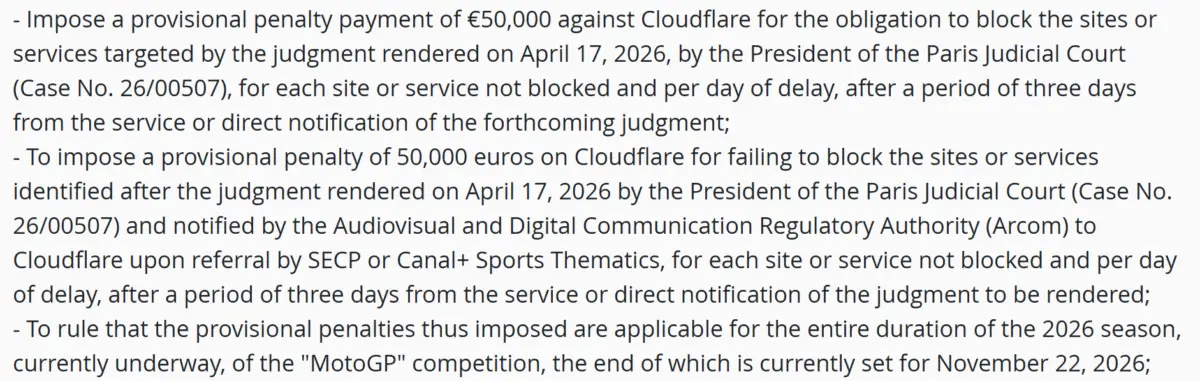
Cloudflare occupies a unique position in modern web infrastructure and was consequently singled out for specialized treatment within the injunction. Spanning several pages of the court order, Cloudflare was directed to:

- Disable its Content Delivery Network (CDN), reverse-proxy, and DNS services for a comprehensive list of target domains within a strict 24-hour window.
- Surrender origin-server IP addresses, foundational DNS records, account holder identities, billing and payment details, and 14 days of request logs for all targeted domains.
- Conduct internal audits of its user database to identify and unmask any secondary accounts sharing email addresses or billing profiles with flagged accounts.
In exchange for these sweeping compliance demands, Cloudflare secured important liability limitations. The company is only required to produce data currently in its possession, bears no affirmative duty to actively monitor user content, and its compliance does not constitute an admission of legal liability—mirroring the "no-fault" intermediary frameworks standard in European jurisprudence.
Dismissals and Global Intermediary Reach
At the outset of the litigation in early June, several hosting providers—including Enzu, Dash Networks, DigitalOcean, and HostGator—were named as defendants. However, after engaging with the legal proceedings, these hosting providers were voluntarily dismissed by the plaintiff within two weeks as they moved to comply with takedown requests.
Beyond primary hosts and registrars, the injunction lists upwards of 90 international intermediaries. Entities spanning jurisdictions as diverse as Russia, Bulgaria, Romania, Iceland, and Iran, alongside mainstream U.S. technology giants such as GitHub, Akamai, and Linode, were cataloged as providers of foundational services to the targeted pirate networks.
Future Outlook and Industry Implications
The TelevisaUnivision preliminary injunction signals a profound escalation in the legal weaponry available to major content owners operating within the United States. By securing a self-expanding, dynamic judicial order that reaches into future technologies and unproduced intellectual property, TU has charted a new blueprint for anti-piracy enforcement.
Legal Precedent and Constitutional Concerns
Legal scholars and digital civil liberties organizations are closely monitoring the fallout from the Southern District of Florida. The delegation of blacklisting authority from Article III judges to private litigants via sworn declarations raises significant questions regarding due process and the potential for overbreadth. Without mandatory judicial review for every subsequent addition to Schedule A, critics argue that legitimate websites, shared hosting IP addresses, or non-infringing services could inadvertently find themselves swept into automated enforcement actions.

The Shift Toward Infrastructure-Level Neutralization
As peer-to-peer networks and advanced IPTV providers increasingly adopt decentralized hosting architectures, rightsholders are shifting away from traditional content removal toward structural root-cause disruption. By cutting off domain registration, cloud-proxy services, and financial processing simultaneously, rightsholders can inflict catastrophic operational damage on illicit streaming networks without needing to identify or serve every anonymous operator behind the screen.
Whether other federal courts will adopt this aggressive, dynamic blueprint remains to be seen. However, for digital pirates operating within the crosshairs of major international media conglomerates, the legal landscape in the United States has grown considerably more hostile.