For the past two decades, the software engineering world has operated under an almost dogmatic consensus: Waterfall is dead.
Killed off by the agility movement, the linear, heavily gated, documentation-heavy methodology of the late 20th century was widely cast aside as a relic of a slower era. Classic Waterfall—with its rigid phases of requirements gathering, architectural design, heavy implementation, extensive testing, and eventual release—choked under the weight of late feedback. As Fred Brooks famously illustrated in The Mythical Man-Month, catching an architectural or requirements flaw late in a traditional Waterfall cycle meant incurring catastrophic financial and temporal penalties.
Agile, Scrum, Kanban, and Extreme Programming (XP) solved this "late truth" problem. By shrinking batch sizes, accelerating feature-level feedback, and embracing continuous iteration, the industry unlocked unprecedented velocity for incremental feature delivery.
Yet, as software ecosystems grew increasingly complex—sprawling into massive meshes of interdependent microservices, shared real-time data platforms, and globally imposed regulatory constraints—purely incremental approaches began to show strain. Unchecked, hyper-agile delivery frequently led to fragmented architectures, localized optimizations at the expense of global cohesion, and compounding technical debt. At a truly architectural scale, engineers and technical leads still craved a structured way to align disparate moving parts into a single, elegant design.
Now, a surprising plot twist is rippling through elite engineering circles. With the maturation of modern Large Language Models (LLMs) featuring million-token contexts, Waterfall is staging a dramatic comeback.
Not as a sluggish, bureaucratic ceremony of endless corporate approvals, but as a lightning-fast, highly practical control structure. Thanks to generative AI, a complete engineering iteration no longer requires months of synchronized team effort. Instead, a single skilled engineer can guide a probabilistic generator through a full sequential lifecycle in hours or days. Welcome to the era of Waterfall 2.0.
Executive Overview: The Paradigm Shift
To understand Waterfall 2.0, one must look past the superficial similarities to its predecessor and examine the fundamental transformation of the software creation loop.
In classic Waterfall, the high cost of backtracking was the primary driver of its failure. If an assumption made during the requirements phase proved invalid during implementation, the financial and organizational shockwaves were immense. Consequently, teams over-engineered early documentation to avoid mistakes, grinding delivery to a halt.
Waterfall 2.0 flips this economic equation entirely. By preserving the classic engineering sequence—vision, architecture, prototyping, structural scaffolding, and final code—while running each stage through an LLM at orders-of-magnitude higher speed, backtracking ceases to be a liability and becomes the primary engine of refinement.
This operational shift bridges the gap between the chaotic, fragmented nature of rapid prototyping and the structural discipline required for enterprise-grade architecture. Rather than replacing human software professionals, the methodology redefines them, ushering in the return of the "combi-shaper"—a holistic engineer capable of steering the entire product lifecycle from a high-level vantage point.
Detailed Chronology: The Five-Stage Waterfall 2.0 Pipeline
When early LLMs first entered the mainstream, they functioned largely as sophisticated autocomplete tools. However, with the arrival of ultra-long context windows and advanced agentic reasoning frameworks, the bottleneck shifted away from raw model capability toward control, direction, and context management.
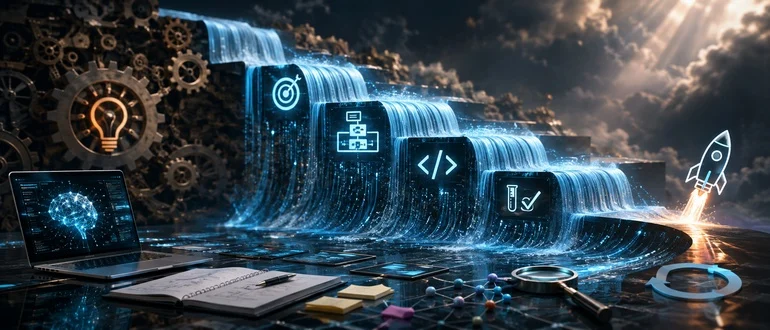
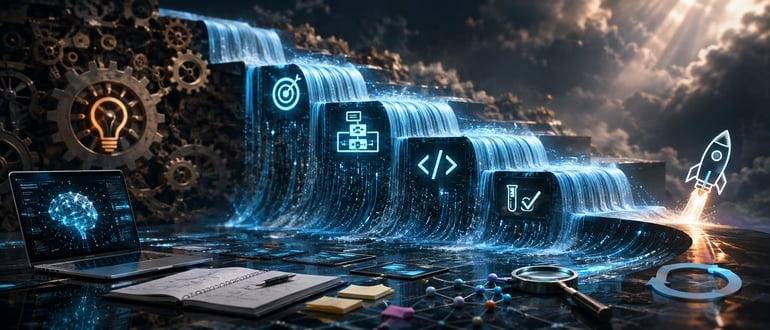
In this new paradigm, the human engineer acts as an orchestrator and validator, while the LLM handles the heavy lifting of generating artifacts. A typical bounded, meaningful slice of software engineering work moves through a five-stage pipeline with remarkable speed:
1. Vision and Requirements Synthesis (30–60 Minutes)
The cycle begins by feeding raw stakeholder notes, customer interview transcripts, product briefs, and initial brainstorms into a managed knowledge corpus. Rather than manually drafting exhaustive product requirement documents (PRDs), the engineer prompts the LLM to analyze the unstructured input, surface hidden contradictions, and synthesize a crystal-clear, cohesive project vision.
2. Architecture Decision Records (ADRs) (2–3 Hours)
Once the vision is locked, the pipeline moves to structural intent. The LLM evaluates the system constraints, performance requirements, and technical boundaries against the vision, generating comprehensive ADRs. These records explicitly document why certain technologies, patterns, or data flows are chosen, preserving historical context without manual writing drudgery.
3. Rapid Prototyping (1–2 Days)
Instead of committing immediately to a full production build, the LLM generates throwaway or iterative prototypes based on the ADRs. These functional mockups, interface designs, or proof-of-concept scripts allow the engineering team to test core technical assumptions against reality almost instantly.
4. Architectural Skeleton (~2 Hours)
With the prototype validating the core concept, the LLM constructs the core structural foundation of the system—the skeletal repository layout, core service boundaries, dependency injections, and primary routing logic. This establishes the structural rails upon which concrete features will be built.
5. Implementation, Code Generation, and Testing (0.5–2 Days)
The final stage involves scaling out the skeleton into fully realized, tested code. The model writes production-ready logic, unit tests, and integration suites. The human engineer steps in to review edge cases, verify security posture, and execute final integration checks.
Supporting Context & Metrics: The Mechanics of Bubble-Sort Backtracking
The true differentiator of Waterfall 2.0 is not its speed, but its embrace of Bubble-Sort Backtracking.
In traditional software engineering, if a fundamental flaw is discovered during the testing or implementation phase, rolling back to the design phase is treated as a project failure. In Waterfall 2.0, rolling back is frictionless.
[Vision] <---> [ADRs] <---> [Prototypes] <---> [Arch Skeleton] <---> [Code + Tests]
  ^                                                                          |
  +------------------ (Low-Cost Bubble-Sort Backtracking) -------------------+
If an engineer uncovers a fundamental data-flow bottleneck or scalability flaw during the prototyping or coding phase, they simply roll back to the Vision or ADRs, update the premise, and trigger a regeneration of downstream artifacts. The entire cyclic adjustment takes hours instead of weeks.
The Knowledge Corpus: Feeding the Generator
None of this speed is possible without a rigorously maintained knowledge corpus. Typically housed in a single, well-structured directory or repository, this corpus anchors the LLM’s outputs in objective reality, effectively mitigating hallucinations.
| Artifact Category | Recommended Preparation | Strategic Value |
|---|---|---|
| User Requirements | Markdown/plain text, preserving stakeholder phrasing | Exposes contradictions and edge-case requirements early |
| ADRs | Chronological folder structure | Captures foundational design constraints and historical rationale |
| Source Code | Repository tree with key README files | Reconstructs and understands the baseline architecture |
| API Contracts | OpenAPI/Proto specs with sample payloads | Creates enforceable integration boundaries |
| Database Schemas | DDL scripts, index definitions, relationships | Enables precise, optimized data-flow analysis |
| Visual Diagrams | Mermaid or PlantUML preferred | Minimizes visual ambiguity and structural misinterpretation |
| Metrics & Telemetry | Aggregates, logs, or exemplar queries | Grounds speculative assumptions in production realities |
Furthermore, by integrating Model Context Protocol (MCP) tool connectors, engineers can instruct the LLM to write live profiling scripts (such as SQL queries, PromQL metrics, or k6 load tests) to fetch real performance data. This quantitative grounding ensures that architectural decisions are driven by hard telemetry rather than developer intuition.
Official Perspectives: The Evolution of the Engineering Mindset
Industry veterans observing this shift note a fascinating historical parallel. Thirty years ago, software engineers were predominantly "combi-shapers"—generalists who lived intimately with customer problems and guided projects from raw conception down to low-level implementation details like memory management and assembly calls.
The hyper-specialized demands of the web era fractured this role, dividing the workforce into broad full-stack generalists on one side and hyper-focused specialists (security, performance, database administration) on the other.
With Waterfall 2.0, the industry is swinging back toward combi-shaping, albeit operating at a vastly higher tier of abstraction.
"LLMs do not replace programmers; they shift the level of abstraction at which we operate," explains enterprise systems architect Marcus Vance. "When code generation becomes essentially instantaneous, the primary bottleneck of software engineering is no longer typing syntax—it is validation, curation, and decisive trade-off management."
By bridging the disciplines of business analysis, systems architecture, coding, and quality assurance into a unified, LLM-orchestrated workflow, Waterfall 2.0 removes the institutional excuse for siloed specialization. A single skilled engineer can now orchestrate an entire engineering pipeline without losing contextual integrity along the way.
Future Outlook: The Next Abstraction Ladder
The rise of Waterfall 2.0 represents the latest rung on a long historical ladder of software abstraction:
- Assembly to High-Level Languages (C, Fortran): Moved engineers away from hardware registers and machine instructions.
- Procedural to Object-Oriented/Functional Paradigms: Elevated code organization and modular reuse.
- Monoliths to Cloud-Native Microservices: Abstracted infrastructure management through containerization and orchestration.
- Manual Coding to Generative AI Pipelines (Waterfall 2.0): Elevates the engineer from a manual implementer of syntax to an orchestrator of systemic intent and verification.
As we look toward the future of software development, the dichotomy between Agile and Waterfall is revealed to be a false choice. Agile remains unmatched for navigating short-term uncertainty through continuous user feedback. Meanwhile, Waterfall 2.0 provides the essential structural scaffold needed to maintain global architectural coherence in hyper-complex, interconnected systems.
Waterfall was never truly dead. It was simply waiting patiently for machines capable of writing—and rewriting—code at the speed of human thought.