Executive Overview
For over a decade, the digital marketing ecosystem has operated under a deceptively simple premise: a view is a view, and an impression is an engagement. Brands, agencies, and content creators have built multi-billion-dollar strategies, media buying plans, and partnership agreements on the foundational metric of the video view. However, a quiet revolution is taking place across the architecture of the internet’s largest video platforms—one that threatens to upend traditional understandings of audience reach.
Recent updates by industry giants like YouTube to their view-counting methodologies have laid bare a fundamental truth of the modern media landscape: not all views are created equal, and in many cases, a "view" may not mean anything close to genuine human engagement.
Even within a single ecosystem, the definition of a view can vary wildly depending on whether a user is watching a standard horizontal video, scrolling through an algorithmic short-form feed, or pausing on a muted autoplay preview. When scaled across the entire social media landscape—incorporating the nuanced metrics of TikTok, Instagram, Facebook, and X—the challenge becomes exponentially more complex.
This fragmentation creates severe blind spots for brand marketers, media planners, and corporate executives. As platform algorithms evolve and measurement definitions shift, relying on raw view counts as a primary Key Performance Indicator (KPI) is no longer just inaccurate; it is financially hazardous.
Furthermore, these shifts have profound implications for the creator economy. As platform updates artificially inflate or deflate view metrics, brand-creator partnerships are increasingly built on shifting sands. Creators leveraging rising view counts to negotiate higher sponsorship rates may simply be benefiting from a backend algorithmic adjustment rather than a genuine surge in audience interest.
This comprehensive report investigates the shifting definition of the digital video view, analyzes the disparate measurement standards across major social platforms, examines the strategic risks for brand marketers, and outlines a necessary roadmap for redefining engagement in the modern era.
Detailed Chronology: How the Definition of a "View" Evolved
To understand the current crisis of metrics, one must look backward to the inception of digital video. When platforms like YouTube first popularized user-generated video content in the mid-2000s, the definition of a view was relatively straightforward: a user clicked on a video, and the server registered a play.
However, as internet speeds increased, monetization models matured, and bad actors attempted to game the system with automated bot traffic, platform architectures had to adapt. The timeline of video metrics has been marked by a continuous arms race between platform integrity, monetization rules, and user behavior.
Phase One: The Wild West of Clicks (2005–2012)
In the early days of online video, a view was largely synonymous with a request to load a video file. This era was defined by minimal algorithmic filtering. If a browser loaded the player, it often counted as a view. This led to rampant view-botting, auto-refresh scripts, and misleading metrics that bore little resemblance to actual human viewership or interest.
Phase Two: The Threshold Era and Passive Consumption (2013–2018)
As advertising dollars flooded into digital video, platforms recognized the need for standardization. YouTube, Facebook, and Twitter introduced time-threshold criteria. A view was no longer just a load; it required a user to watch for a specific duration—typically 30 seconds on YouTube (or the majority of a shorter video) and a mere 3 seconds on Facebook and Twitter, often counted automatically as long as the video appeared on screen, regardless of audio or explicit user intent.
This era gave birth to the "autoplay" phenomenon. Platforms realized that by automatically playing videos as users scrolled through their feeds, they could dramatically inflate view counts. For advertisers, this created a massive disconnect: a user scrolling past a video on a mobile device for three seconds with the sound off was counted with the same weight as a user who actively clicked, sat back, and watched a ten-minute documentary.
Phase Three: The Short-Form Revolution and Micro-Views (2019–Present)
The meteoric rise of TikTok fundamentally altered media consumption habits, forcing YouTube (via Shorts), Instagram (via Reels), and other platforms to pivot toward vertical, hyper-fast, algorithmic video feeds.
In short-form environments, traditional viewing thresholds became obsolete. When content lasts 15 to 30 seconds, a 30-second completion rule is impossible. Consequently, platforms adjusted their metrics to accommodate micro-views—sometimes registering a view after just a single second of playback, or even upon loop completion.
Phase Four: The Current Recalibration (2026 and Beyond)
This brings us to the present day. With YouTube once again overhauling how it calculates and reports video views, the industry is experiencing a collective awakening. Media reporters, industry commentators, and data analysts are working overtime to map out the dizzying array of discrepancies across platforms, forcing marketers to confront the reality that a "view" is an increasingly fluid, platform-dependent construct rather than a universal standard.
Supporting Context & Metrics: A Cross-Platform Breakdown
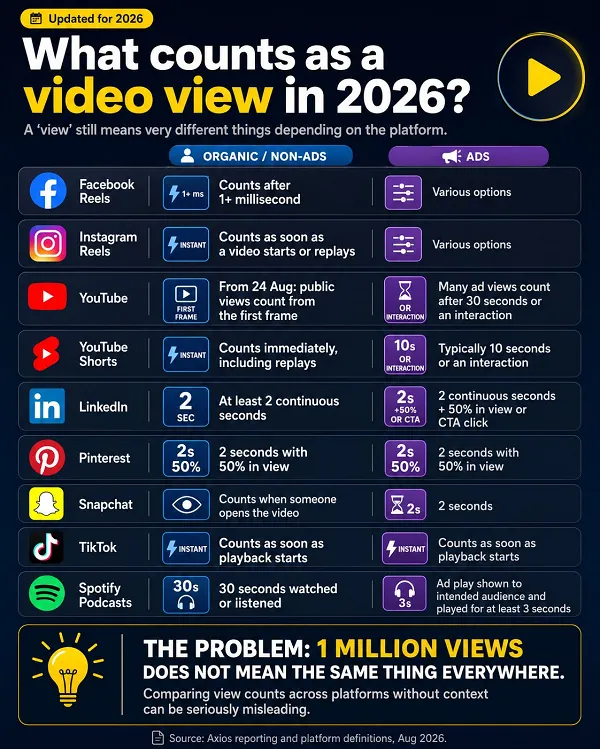
The fundamental challenge facing modern marketers is the lack of cross-platform standardization. A comprehensive look at how different networks define a view reveals a patchwork of rules, gray areas, and contextual caveats.
+------------------+----------------------------------+------------------------------------------------+
| Platform         | Primary Format View Threshold    | Key Nuances & Caveats                          |
+------------------+----------------------------------+------------------------------------------------+
| YouTube          | Varies by format (Standard vs.   | Recent methodology updates align views closer  |
|                  | Shorts vs. Live Streams)         | to real engagement, but historical data is skewed.|
+------------------+----------------------------------+------------------------------------------------+
| Meta (FB/IG)     | 3 seconds (Autoplay inclusive)   | Counts views even with sound off; heavily      |
|                  |                                  | favors passive, scroll-based impressions.      |
+------------------+----------------------------------+------------------------------------------------+
| TikTok           | Immediate playback (0–1 seconds) | Relies on algorithmic delivery; completion     |
|                  |                                  | rate and repeat loops heavily skew metrics.    |
+------------------+----------------------------------+------------------------------------------------+
| X (formerly      | 2 seconds with 50% in-view       | Requires half the video player to be visible   |
| Twitter)         | screen requirement               | for a minimum duration.                        |
+------------------+----------------------------------+------------------------------------------------+
The Anatomy of Platform Discrepancies
As detailed by industry reports from media analysts at outlets like Axios—including investigative breakdowns by reporters Sara Fischer and Kerry Flynn—and visualized by social media commentators like Matt Navarra, comparing video metrics across platforms is akin to comparing apples to oranges, or currencies with fluctuating exchange rates.
- The Passive Autoplay Trap: On platforms like Meta, a view can be registered in as little as three seconds. Because these platforms utilize aggressive autoplay features within the feed, millions of users are categorized as "viewers" simply because they paused their scrolling for a fraction of a moment while reading a caption above or below the video asset.
- The Short-Form Loop Effect: On TikTok and YouTube Shorts, user behavior is defined by high repetition and rapid-fire swiping. If a user loops a 10-second video twice, the platform may register multiple views, yet the actual cognitive engagement or retention of the brand message might be negligible.
- The Visibility and Framing Variable: Networks like X enforce specific view conditions, such as requiring a minimum percentage of the video player (e.g., 50%) to be actively visible on the user’s screen for a set number of seconds (e.g., 2 seconds). While more rigorous than simple autoplay, it still fails to measure whether the user’s eyes were actually focused on the screen, or whether they retained any brand recall.
The Marketing Implications of Gray Areas
These disparate definitions create massive gray areas for campaign measurement. When a brand runs a cross-channel video campaign allocating budget across YouTube, Meta, and TikTok, a reported "1 million views" does not mean the brand reached a million people, nor does it mean a million people willingly chose to watch the content.
- On YouTube, those views might represent intentional searches or deeply engaged click-throughs.
- On Meta, a significant portion represents passive, accidental feed impressions.
- On TikTok, those views may be the byproduct of algorithmic testing, where the platform pushes content to thousands of feeds to gauge initial drop-off rates.
For chief marketing officers (CMOs) and media buyers, treating these metrics as equivalent leads to deeply flawed attribution models, misallocated ad spend, and inflated estimates of campaign success.
Official Statements and Industry Analysis
The recent adjustments by YouTube have sparked urgent discussions across the media landscape regarding the future of digital accountability. Industry watchdogs and platform representatives alike are being forced to address the widening gap between technical metrics and true human engagement.
In recent commentary shared across professional networks and media analyses, experts have underscored the dangers of algorithmic complacency.
"When platforms alter their counting methodologies, the ripple effects are felt immediately across the entire sponsorship and creator economy," noted one senior media strategist. "Creators see their numbers jump or drop overnight, not because their content improved or deteriorated, but because the mathematical lens through which the platform views them has been refocused."
Media reporters Sara Fischer and Kerry Flynn of Axios highlighted this exact phenomenon in their deep-dive into media trends, pointing out that brands negotiating partnership deals must exercise extreme caution. When a content creator pitches a brand partnership on the back of a 30% month-over-month increase in view counts, that growth must be rigorously cross-examined. Is the creator genuinely capturing more audience mindshare, or are they simply coasting on a platform-wide algorithmic update that redefines how passive impressions are tallied?

Furthermore, platform representatives maintain that these updates are necessary to combat evolving consumption habits and ensure data accuracy against sophisticated bot behaviors. However, transparency remains a persistent pain point. As algorithms grow more complex—incorporating machine learning to predict user intent, drop-off points, and engagement signals—the exact formula for what constitutes a "view" often remains a proprietary black box.
This lack of radical transparency leaves marketers in a vulnerable position, forced to trust platform-reported metrics that are inherently incentivized to paint a rosy picture of ad inventory value.
Future Outlook: Redefining Engagement for the Next Decade
As we look toward the future of digital advertising and content creation, the writing is on the wall: the raw view count is a dying metric.
To survive and thrive in an increasingly complex media ecosystem, brands, agencies, and platforms must collectively pivot away from superficial vanity metrics and embrace a more holistic, rigorous approach to measuring audience interest and campaign effectiveness.
1. Shift from Quantitative Views to Qualitative Attention Metrics
Marketers must move past the obsession with top-of-funnel reach metrics. While views will always have a place in broad awareness campaigns, they must be supplemented—and often superseded—by attention-based metrics.
- Watch Time and Completion Rates: How long did the user actually stay? A 50% completion rate on a 60-second video is infinitely more valuable than ten 3-second autoplay views.
- Active Interaction Signals: Shares, saves, meaningful comments, and deliberate click-throughs provide a much clearer picture of consumer intent than passive views.
2. Standardize Cross-Platform Measurement Frameworks
The digital marketing industry urgently needs standardized, third-party verified measurement frameworks that cut through platform-specific spin. Independent verification tools, advanced attribution modeling, and unified media mix modeling (MMM) must replace siloed platform dashboards as the source of truth for brand investments.
3. Restructure Creator Partnerships and Contracts
Brands entering into sponsored content agreements with creators must update their contracting terms. Tying compensation solely to platform-reported view counts is an outdated practice prone to exploitation. Forward-thinking brands are moving toward performance-based compensation models, affiliate tracking, brand lift studies, and audience sentiment analysis to ensure that creator investments deliver genuine business value rather than algorithmic illusions.
4. Foster Radical Transparency from Tech Giants
Finally, social media platforms must be held to higher standards of reporting transparency. Advertisers—who ultimately fund the vast majority of these platforms through media spend—have a right to exact, unvarnished definitions of how engagement metrics are calculated, free of obfuscation. Regulatory bodies and industry associations (such as the IAB) will play a critical role in demanding clearer guidelines and standardized auditing processes.
Conclusion
The recent updates to YouTube’s view-counting methodology should serve as a wake-up call for the entire digital marketing industry. The era of accepting platform metrics at face value is over. By recognizing the vast discrepancies hidden behind the word "view," marketers can protect their budgets, forge more honest partnerships with creators, and build campaigns that measure true human engagement rather than hollow algorithmic noise. In the modern attention economy, the brands that win will not be those with the most views, but those with the deepest understanding of what those views actually mean.