Executive Overview
In an aggressive push to weave generative artificial intelligence deeper into its creator ecosystem, TikTok has officially rolled out a brand-new feature designed to auto-generate host and broadcast summaries for live-streamers. Integrated directly within the TikTok Live composer, the tool leverages machine learning models to synthesize who a creator is and what the focal point of their current broadcast will be. The resulting text can then be displayed dynamically to incoming viewers, offering an instant snapshot of the stream’s content.
Discovered initially and shared publicly on Threads by diligent app researcher Radu Oncescu, the feature promises to streamline the onboarding experience for audiences hopping into busy live streams. In theory, providing a concise, automated bio or broadcast premise could reduce bounce rates, helping casual scrollers immediately understand whether a particular broadcast matches their interests.
Yet, beneath the glossy veneer of platform innovation lies a growing industry-wide fatigue. As social media giants race to stake their claim in the generative AI gold rush, critics and digital observers are increasingly questioning the tangible utility of these micro-features. When weighed against the substantial computational infrastructure, water consumption, and energy resources required to run large-scale AI operations, tools that merely automate minor, low-stakes writing tasks—such as summarizing a live stream—begin to look less like revolutionary breakthroughs and more like solution-seeking-a-problem exercises.
This development highlights a broader cultural and technological tension: the collision between corporate tech strategies dictating the mandatory integration of generative AI everywhere, and users who are beginning to question the erosion of human authenticity in favor of automated convenience. This article provides an in-depth examination of TikTok’s latest AI tool, tracking its mechanics, analyzing its broader industry implications, and weighing the ecological and psychological costs of automating the mundane.
Detailed Chronology
The Genesis of TikTok’s Live AI Tools
For years, TikTok has invested heavily in algorithmic recommendation engines, distinguishing itself from competitors through a hyper-personalized “For You” feed. However, the pivot toward generative artificial intelligence—systems capable of creating novel text, imagery, and code rather than merely sorting existing data—has accelerated dramatically over the past twenty-four months.
As rival platforms like Meta, YouTube, and Snapchat rushed to deploy conversational chat-bots and image generators, TikTok sought ways to embed generative capabilities directly into content creation pipelines. While early iterations focused primarily on video effects, text-to-speech enhancements, and automated captioning, the platform’s engineering teams soon turned their sights toward the lucrative and highly engaging Live ecosystem.
The Discovery and Public Reveal
The existence of TikTok’s new AI-powered introduction tool came to light not through an official press release trumpeting a major corporate milestone, but via the digital underground of reverse-engineering and app research.
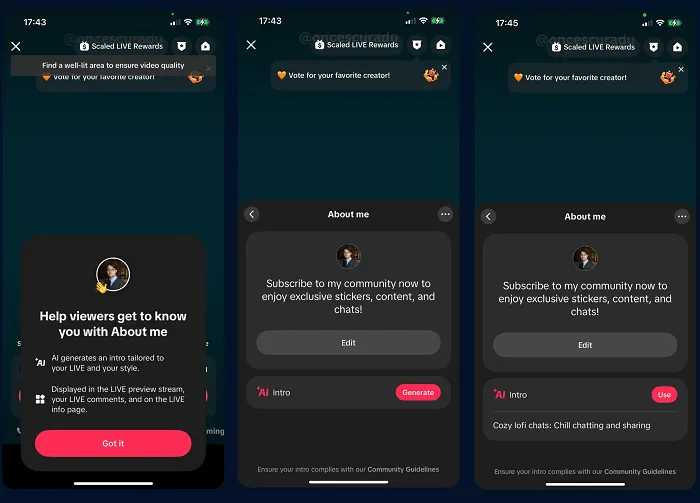
App researcher Radu Oncescu, known for dissecting unreleased code and hidden interface changes within major social applications, posted a detailed walkthrough of the feature on Threads. Oncescu’s shared sequence revealed the mechanics of the new tool:
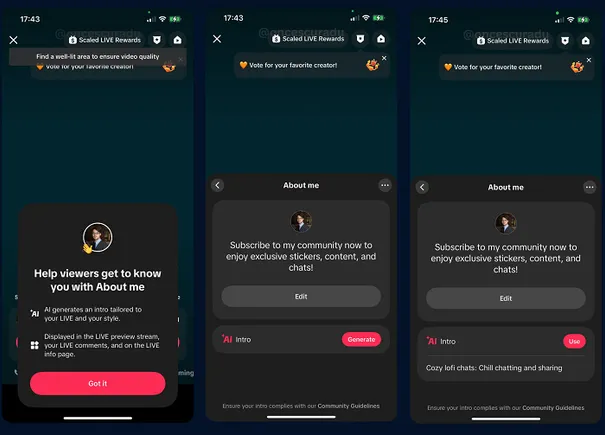
- Access Point: Within the TikTok Live composer screen, creators are presented with a distinct button prompting them to generate an audience introduction summary.
- Processing: Upon tapping the button, TikTok’s backend AI model ingests data points—likely pulling from the creator’s historical profile data, recent video captions, and real-time audio or keyword tags associated with the upcoming broadcast setup.
- Output Generation: The system then outputs a neat, concise paragraph summarizing the host’s persona and the broadcast’s stated theme.
- Deployment: Creators can review and publish this summary to greet incoming viewers, ostensibly giving context-starved audiences a faster way to catch up on ongoing live events.
Initial Reception and Critique
Almost immediately following Oncescu’s disclosure, digital marketing analysts and tech commentators began dissecting the feature’s practical implications. While the concept of a dynamic live stream introduction is conceptually sound—streamers frequently struggle to brief the endless stream of transient viewers dropping into a live room—the execution leaves major questions unanswered.
Early evaluations pointed to a stark lack of transparency regarding how the AI constructs these summaries. Does it hallucinate details based on vague historical data? How accurately does it capture the mercurial, unscripted nature of a live broadcast before it even begins? More importantly, critics began asking a more fundamental question: Is writing a short introductory summary or self-description genuinely a friction point in the human creative process that warrants heavy computational intervention?
Supporting Context & Metrics
The Environmental Toll of Micro-AI Features
To fully understand the debate surrounding TikTok’s live introduction tool, one must look beyond the user interface and examine the physical infrastructure powering it. Generative artificial intelligence is extraordinarily resource-intensive. Data centers housing graphics processing units (GPUs) require massive amounts of electricity—often generated by fossil fuels—to train and execute neural network models. Furthermore, the cooling systems necessary to prevent these server farms from overheating consume millions of gallons of fresh water daily.
When a tech giant deploys a resource-heavy AI model to automate high-frequency, low-complexity tasks—such as generating a three-sentence bio or a live-stream summary for millions of users worldwide—the cumulative environmental footprint is staggering. Critics argue that utilizing precious water and power resources for features that "don’t move the needle in a significant way" represents a glaring misalignment of priorities in an era marked by climate crisis and energy grid strains.
The Social Psychology of Automated Expression
Beyond ecological concerns lies a philosophical debate concerning the value of human friction and self-expression. Writing a bio, drafting an introductory sentence, or framing one’s creative output are not merely mechanical chores to be optimized away; they are exercises in human agency and psychological branding.
Social media platforms have traditionally thrived on the raw, unpolished, and intensely human texture of user-generated content. When artificial intelligence steps in to sanitize, standardize, and automate personal introductions:
- Homogenization: Content descriptions begin to sound identical, stripped of unique human quirks, voice eccentricities, and authentic emotional resonance.
- Alienation: Creators are encouraged to outsource fundamental aspects of their digital identity to black-box algorithms.
- Diminished Enjoyment: The act of creation—choosing words, structuring thoughts, and figuring out how to present oneself to the world—is an inherent part of the human artistic experience. Replacing these moments with automated prompts risks turning creators into passive managers of AI-generated profiles.
The Problem of "Solutionism" in Big Tech
Tech industry analysts often refer to this phenomenon as "technological solutionism"—the presumption that every human friction point, inconvenience, or creative endeavor can and should be solved by the introduction of digital tools.
While AI has demonstrated profound, undisputed value in high-impact domains—such as medical diagnostics, climate modeling, complex data analysis, and language translation—its application to social media micro-tasks often feels forced. Forcing generative text models into spaces where users are perfectly capable (and often prefer) to speak for themselves risks breeding user cynicism. If users realize that the person they are watching live couldn’t even be bothered to write their own two-line introduction without the help of a corporate language model, the foundation of parasocial trust that underpins live streaming can begin to crack.

Official Statements & Industry Perspective
While TikTok has not yet issued a comprehensive global press statement defending the ecological or philosophical implications of the live introduction tool, representatives from major social media ecosystems have consistently defended their aggressive AI rollouts as user-centric innovations.
Industry insiders note that platforms are locked in an existential race for engagement. With short-form video markets maturing and user growth plateauing in key Western territories, tech executives view generative AI as the primary vehicle for unlocking the next phase of platform monetization and creator retention.
However, external industry voices are sounding notes of caution. In recent panels examining the future of digital media, digital ethicists have urged platform developers to adopt a more discerning approach to feature deployment.
"Just because we can build a generative model to automate a text field doesn’t mean we have a moral or practical imperative to do so," notes Dr. Aris Thorne, a researcher specializing in human-computer interaction. "Platforms must start calculating the hidden costs—both psychological and environmental—of replacing simple human expression with algorithmic synthesis."
Furthermore, creator advocacy groups have expressed mixed feelings. While professional creators with massive production teams welcome tools that save administrative time, independent and micro-creators often view these forced AI integrations as gimmicky clutter that complicates the app experience without delivering meaningful growth or audience connection.
Future Outlook
Where Do We Go From Here?
As TikTok continues to test and potentially expand its suite of AI-powered creator tools, the platform stands at a critical crossroads. The trajectory of its generative AI roadmap will likely be determined by two competing forces: corporate pressure to normalize AI across all digital touchpoints, and real-world user pushback against feature fatigue.
- The Quest for Genuine Utility: If tools like the live introduction summary prove to have low adoption rates or fail to measurably improve audience retention during live broadcasts, TikTok may quietly sunset or rework them. Conversely, if creators embrace them as time-saving conveniences, they will likely become permanent fixtures of the live-streaming suite.
- Regulatory and Environmental Pressures: As public scrutiny over the carbon and water footprints of generative AI intensifies, tech companies will face mounting pressure to justify the return on investment for minor feature deployments. Regulators in regions like the European Union are already examining the environmental disclosures of large-scale data centers, which could eventually force platforms to curb frivolous AI usage.
- The Return to Authenticity: Paradoxically, as the internet becomes increasingly saturated with AI-generated text, imagery, and video, raw human authenticity is poised to become a scarce and highly valued commodity. Creators who reject automated sanitization in favor of unpolished, genuinely human interaction may find themselves resonating more deeply with audiences exhausted by synthetic content.
Conclusion
TikTok’s introduction of an AI-powered live summary tool is a micro-cosmic reflection of the broader tech landscape in 2024: an endless drive to automate, optimize, and synthesize every corner of the digital experience, regardless of whether it actually needs fixing. While framed as a productivity booster for live-streamers, the feature invites a deeper critical examination of what we lose when we outsource our introductions, our words, and our creative friction to machines. Ultimately, the market will decide whether these frictionless shortcuts represent the future of human connection, or merely an expensive exercise in technological overreach.