Executive Overview
In the modern digital ecosystem, the seamless fluidity with which users navigate the internet often masks a complex, behind-the-scenes mechanical process. When internet users enter a uniform resource locator (URL) into their browser bar, they expect instant access to information, scholarly articles, or electronic media repositories. However, a major structural reality of the modern web frequently interrupts this frictionless experience: search engine indexing latency.
Indexing latency refers to the time lag between when a web property updates its infrastructure—such as executing a domain migration—and when automated search engine crawlers process these changes, update their local caches, and accurately reflect the new routing instructions on search engine results pages (SERPs). This systemic lag becomes acutely visible during large-scale platform transitions. High-traffic digital libraries, including widely recognized open-access archives like Z-Library, frequently utilize infrastructure updates, security hardening, and load-balancing measures that necessitate shifting their official web addresses.
When these infrastructural shifts occur, users attempting to locate the current zlibrary official domain often encounter a labyrinth of outdated cache fragments, legacy links, and intermittent indexing gaps. According to documentation from Google Search Central and web migration benchmarks published by Semrush, search engines require a sustained window to process server redirects, recrawl updated server maps, and transfer historical ranking signals to a new location.
This investigative report examines the deep technical mechanics governing search engine crawling behaviors, the structural reasons high-traffic platforms modify their domains, and how users can accurately track verified properties while bypassing the friction caused by indexing delays.
Detailed Chronology: The Lifecycle of a Domain Migration and Indexing Lag
To comprehend why a platform’s web address appears to fluctuate over time, one must examine the chronological lifecycle of a website migration and the subsequent steps required for search engines to recognize the shift.
Phase 1: The Pre-Migration Architecture
Before any domain transition occurs, a digital service operates on a settled, established network infrastructure. For platforms hosting extensive repositories—spanning academic journals, textbooks, and public-domain literature—this initial phase sees the accumulation of a massive digital footprint. Over years of operation, millions of inbound links, forum mentions, social media shares, and browser bookmarks tie the legacy domain to the wider web. During this phase, search engines maintain deep caches of the site’s directory structures, categorizations, and metadata.
Phase 2: The Infrastructure Shift and Server Redirection
When administrators decide to alter the platform’s address—whether to enhance cybersecurity resilience, escape persistent distributed denial-of-service (DDoS) vectors, or optimize server load distribution—they execute a domain migration. At the server level, webmasters deploy HTTP status codes (most notably the 301 Permanent Redirect) to instruct visiting browsers that the resource has permanently moved to a new destination.
In an ideal technical scenario, an incoming request to the legacy address instantly routes the user to the new web property. However, while the human user is successfully redirected, automated web crawlers do not operate instantaneously across the global web.
Phase 3: The Crawl Latency and Indexing Gap
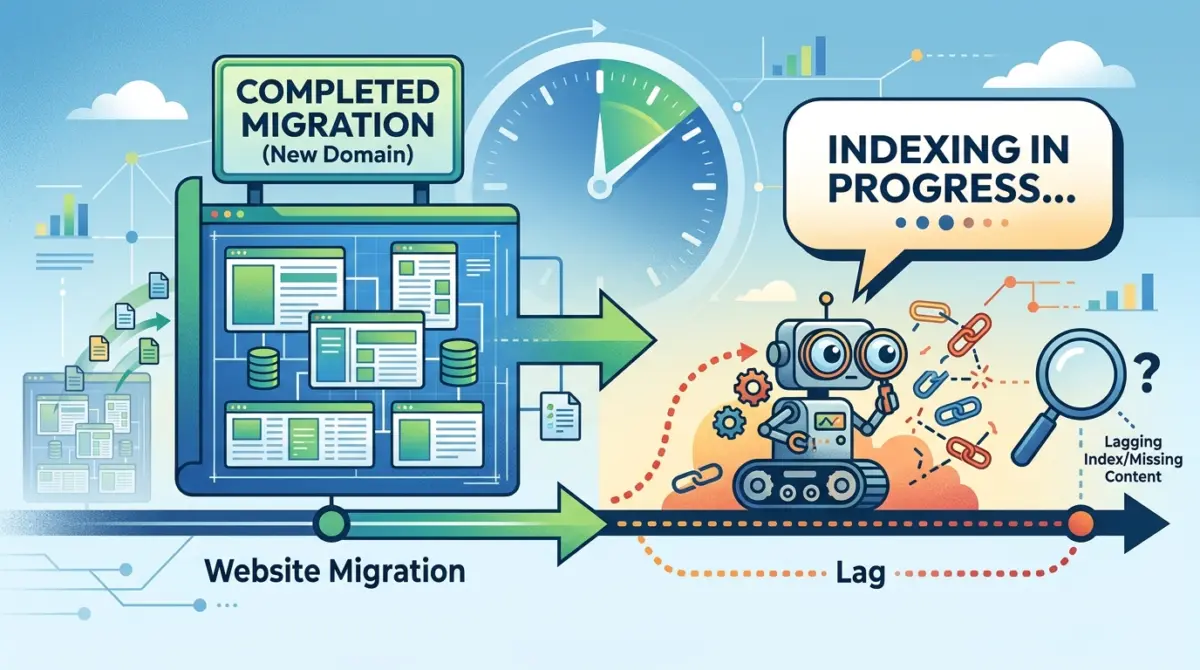
Following the redirection event, a critical window known as the indexing gap opens. Search engine bots (such as Googlebot, Bingbot, and others) operate on complex scheduling algorithms driven by crawl budgets, site authority, and historical update frequencies.
- Day 1 to Day 7: The search engine’s automated systems continue serving cached copies of the legacy domain. Snippets, meta descriptions, and old URLs remain prominent on SERPs because the search engine has not yet re-evaluated the target server or fully processed the 301 redirect signals.
- Day 8 to Day 30: As crawlers incrementally revisit the legacy URL, they encounter the redirect instructions. The engine begins the painstaking process of transferring PageRank, domain authority, and historical keyword mappings to the new address. During this phase, users frequently encounter fragmented search results, mixed listings displaying both old and new domains, and occasional 404 errors if redirects are misconfigured.
Phase 4: Stabilization and Cache Replacement
Eventually, the crawl cycle completes. The legacy URL is de-indexed or relegated to deep historical storage, while the new web address assumes full dominance on search engine results pages. For platforms like Z-Library, navigating this four-phase lifecycle repeatedly is a structural necessity of maintaining operational continuity in an adversarial or highly demanding digital landscape.
Supporting Context & Metrics: Technical Realities of Crawl Delays
To quantify the scale of these indexing challenges, industry analyses from data firms like IndexCheckr and SEO telemetry studies highlight the immense computational bottlenecks search engines face daily.
The Scale of the Crawl Queue
Modern search engines index tens of billions of web pages. When a high-traffic domain with millions of deep-link subpages alters its root address, it injects a massive computational load into the search engine’s queue.
- Crawl Budget Limitations: Search engines allocate finite crawl resources to every website based on its size, update frequency, and popularity. Even major platforms cannot force an instant, total recrawl of millions of pages simultaneously.
- The Persistence of External References: As detailed in Google Search Central’s site move guidelines, the primary hurdle during a migration is not internal server failure, but the persistence of external references. Third-party blogs, academic resource lists, discussion boards, and personal bookmarks preserve historical links long after a domain has shifted. Because search engines rely heavily on these external signals to validate authority, legacy domains often appear artificially alive in search snippets weeks after retirement.
Anatomical Continuity Amidst Browser String Modifications
A common misconception among everyday internet users is that a change in a website’s domain name implies a fundamental transformation of the platform itself. Technical audits demonstrate that this is rarely true, particularly for established digital libraries.
| Feature | Legacy Infrastructure | Migrated Infrastructure | Impact on User Experience |
|---|---|---|---|
| Browser String (URL) | old-address.example |
new-address.example |
Visible text changes in browser bar; requires bookmark updates. |
| Database & Repository | Centralized bibliographic records | Identical mirrored database | Zero loss of academic journals, textbooks, or literature. |
| User Interface (UI) | Structured search & filter tools | Identical navigation layout | Complete architectural familiarity; zero learning curve. |
| Account Credentials | Encrypted user profiles | Transferred authentication tokens | Seamless login continuity for saved reading histories. |
This architectural continuity explains why the zlibrary official site feels entirely familiar to regular patrons despite possessing a modified browser string. The underlying database—spanning millions of digital texts—remains stable while the outer routing shell adapts to network realities.
Official Statements and Industry Best Practices
Navigating platform migrations securely requires adherence to established web administration standards. Cybersecurity professionals, search engine optimization (SEO) engineers, and digital rights analysts emphasize that domain transitions must be evaluated through the lens of technical hygiene rather than speculative panic.
Guidelines from Search Engine Authorities
According to technical documentation published by major search engine webmaster support teams, domain migrations are standard administrative procedures designed to protect infrastructure integrity. Key recommendations for handling migrations emphasize:
- Implementing Clean 301 Redirects: Webmasters must ensure that every legacy URL maps precisely to its corresponding new URL rather than dumping all incoming traffic onto a generic homepage. This preserves user intent and accelerates crawler processing.
- Updating Sitemaps and Robots.txt: Submitting updated XML sitemaps directly via webmaster tools alerts crawlers to the new property structure, bypassing standard discovery delays.
- User Education and Transparent Communication: Providing verified directory updates prevents users from falling prey to phishing clones or malicious spoofing sites that attempt to exploit the indexing gap.
The Role of Digital Libraries in Modern Information Access
The ongoing high demand for platforms like Z-Library underscores a broader shift in digital information consumption. Academic literature, rare out-of-print books, and specialized research papers frequently face institutional paywalls or regional availability barriers. As noted in library marketing strategies utilizing big data analytics, user demand for decentralized, open-access knowledge repositories remains exceptionally high.
When infrastructure shifts occur, malicious actors often exploit user confusion by setting up lookalike domains designed to harvest credentials or distribute malware. Therefore, understanding the mechanics of crawl latency is not merely an exercise in technical SEO; it is a vital cybersecurity competency. Users who understand that domain changes are routine technical adjustments are far less likely to click on unverified, predatory search advertisements during indexing gaps.
Future Outlook: The Evolution of Web Discovery and Indexing
As the internet continues to scale in volume and complexity, the methods by which search engines discover, index, and update web properties are undergoing radical transformation. Examining future trends provides a clearer picture of how domain migrations and crawl delays will be handled in the coming decade.
1. The Transition to Real-Time Indexing Architectures
Traditional search engine architecture relies on batch-processing crawler bots that sweep the web on scheduled intervals. However, the rise of dynamic, API-driven web applications and frequent domain migrations has accelerated the adoption of push-based indexing models. In the future, web administration protocols may allow platforms to instantly "broadcast" address changes directly to search engine registries, drastically shrinking the traditional multi-week indexing gap down to mere minutes.
2. Decentralized Identity and Persistent Addressing
The vulnerabilities associated with traditional DNS (Domain Name System) routing—such as domain seizures, registry restrictions, and high susceptibility to crawl latency—have spurred interest in decentralized web technologies. Protocols utilizing distributed hash tables (DHTs) and content-addressed storage (such as IPFS) decouple a file’s identity from its physical location. In such a future framework, a digital library like Z-Library could theoretically be accessed via cryptographic hashes rather than mutable domain names, entirely neutralizing the friction caused by search engine indexing delays.
3. AI-Driven Crawlers and Intent Verification
Search engine algorithms are increasingly powered by artificial intelligence and large language models capable of understanding semantic context rather than just matching static keywords. Future web crawlers will be equipped to automatically analyze 301 redirect chains, evaluate server cryptographic signatures, and instantly update SERP snippets with verified new properties, protecting users from phishing variants while ensuring frictionless access to legitimate web assets.
Conclusion
Search engine indexing latency is an unavoidable mechanical byproduct of a dynamic, decentralized web. When high-traffic digital platforms execute domain migrations to ensure operational resilience and security, a transient window of search engine confusion is entirely normal.
For visitors tracking the active zlibrary official domain, recognizing the difference between underlying database stability and superficial browser string modifications is essential. By relying on verified community directories, understanding the four-phase lifecycle of web migrations, and exercising caution during search engine indexing gaps, users can seamlessly navigate the modern digital landscape without falling victim to outdated caches or malicious imitators.