Executive Overview
The landscape of software development is undergoing a seismic shift. As generative artificial intelligence (AI) tools flood the market with unprecedented volumes of newly minted code, development teams are grappling with a hidden, high-stakes crisis: application bloat and structural inefficiency. Simultaneously, the skyrocketing cost of compute infrastructure and tightening hardware capacity mean that running unoptimized code is no longer just a technical oversight—it is a severe financial liability.
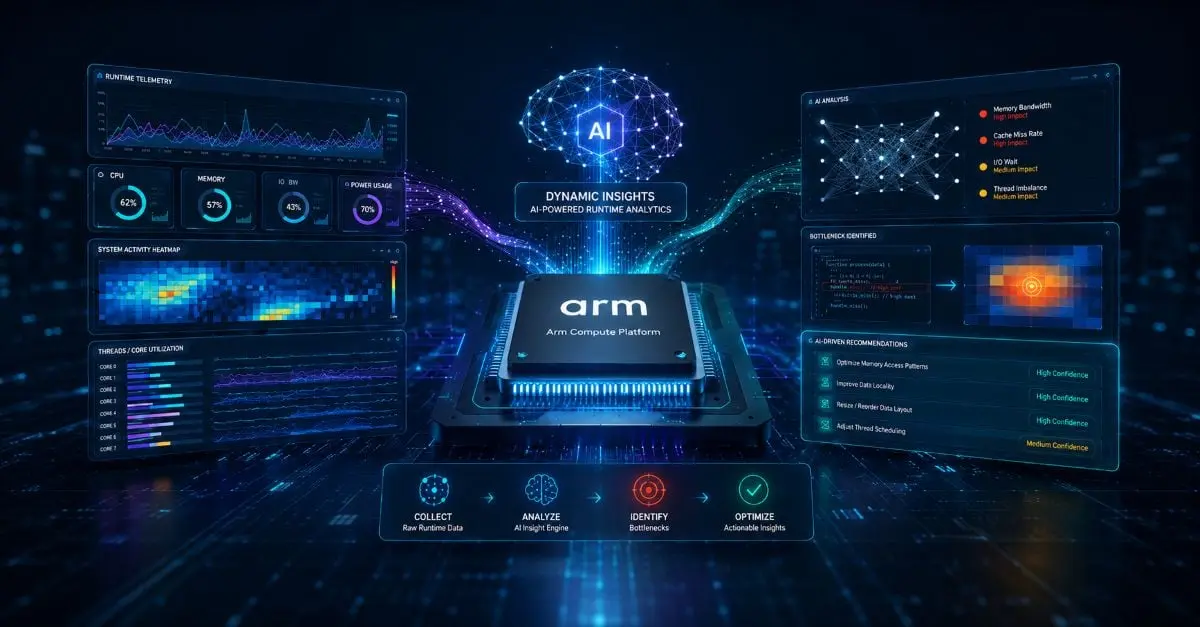
Into this pressurized environment steps Arm, the semiconductor titan whose processor architecture underpins billions of devices worldwide. Arm has officially launched its new Dynamic Insights tool, an advanced utility powered by artificial intelligence models that analyzes runtime performance data to generate precise recommendations for software optimization.
Available as an essential module within the open-source Arm Performix tool suite, Dynamic Insights represents a fundamental departure from legacy optimization paradigms. Historically, wringing maximum performance out of Arm-based platforms required elite systems engineers with deep, specialized knowledge of microarchitectures, pipeline execution, and cache management. Dynamic Insights bridges this talent gap by combining AI models—trained directly by Arm’s veteran software engineering experts—with empirical, real-world data collected while applications are actively executing.
By surfacing verified runtime evidence, the tool empowers both human developers and autonomous AI agents to diagnose bottlenecks, resolve resource starvation, and optimize application performance without needing a PhD in computer architecture. As the tech industry races to build more sustainable, cost-effective infrastructure, Arm’s latest innovation aims to transform code optimization from a rare, bottlenecked specialty into an accessible, everyday practice for developers across the globe.
Detailed Chronology: The Evolution of Arm Performix and Dynamic Insights
To understand the significance of Dynamic Insights, one must examine the trajectory of hardware-software co-design and the mounting pressures facing modern development pipelines.
The Era of Manual Profiling (Pre-2023)
For decades, optimizing software for specific processor architectures was an artisanal craft. Engineers relied on low-level profiling tools, hardware performance counters, and manual code inspections. While effective, this process was exceedingly time-consuming. Developers had to manually parse assembly code, track register allocations, and speculate on how compiler optimizations would translate to physical silicon.
As Arm architectures expanded beyond mobile phones and embedded systems into hyperscale cloud data centers, high-performance computing (HPC), and enterprise AI infrastructure, the performance gap between well-optimized code and standard compiled code widened dramatically. However, the pool of engineers capable of conducting deep architectural analysis remained stubbornly small, creating a permanent bottleneck in the software release cycle.
The AI-Generated Code Explosion (2023–2024)
The advent and mass adoption of Large Language Models (LLMs) transformed how software is built. Developers began deploying AI coding assistants to generate boilerplate code, refactor legacy systems, and accelerate feature delivery. While productivity soared, a dangerous side effect emerged: the sheer volume of code being pushed to production exploded exponentially.
Much of this AI-generated code is functionally correct but architecturally naive. It is written without awareness of the underlying hardware’s memory bandwidth, cache hierarchies, or vector extension capabilities. Consequently, modern enterprise systems began buckling under the weight of resource-inefficient software, driving up cloud computing bills and inflating carbon footprints across data centers worldwide.
The Introduction of Arm Performix and Dynamic Insights (Present)
Recognizing that manual code profiling could no longer keep pace with AI-driven software velocity, Arm developed the Arm Performix suite, culminating in the release of the Dynamic Insights module.
Alex Spinelli, senior vice president for AI and developer platforms at Arm, spearheaded the initiative to democratize performance tuning. By leveraging LLMs that have been systematically trained on institutional knowledge from Arm’s elite software engineers, the company created a system capable of interpreting complex runtime telemetry and translating it into plain-language, actionable optimization advice.
Rather than forcing developers to guess how their source code will behave on silicon, Dynamic Insights observes the actual dance between software workloads and physical hardware, bringing empirical truth to the optimization process.
Supporting Context & Metrics: The Anatomy of Runtime Optimization
Modern applications do not exist in a vacuum. A piece of code that appears clean and efficient in a static code analysis tool may behave entirely differently when subjected to real-world memory latency, thread contention, and I/O wait states. This reality underscores the core philosophy behind Dynamic Insights: Runtime evidence matters more than static assumptions.
How Dynamic Insights Operates Under the Hood
The Dynamic Insights module integrates seamlessly into the open-source Arm Performix ecosystem. When an application runs on an Arm-based processor, the tool continuously monitors execution characteristics, gathering granular telemetry data.
Specifically, Dynamic Insights targets and identifies several critical performance indicators:
- Function-Level Execution Costs: Pinpointing exact functions or loops that consume a disproportionate share of CPU cycles and execution time.
- Resource Bottlenecks: Determining whether an application is constrained by CPU compute capacity, memory bandwidth, I/O operations, or interconnect latency.
- Accelerator Utilization: Evaluating how effectively workloads leverage specialized hardware accelerators (such as NPUs or GPUs) integrated within the Arm ecosystem.
- System-Wide Ripple Effects: Uncovering whether a perceived performance degradation in one module actually originates elsewhere in the broader system architecture.
The Danger of "Fast Guessing"
Industry experts emphasize that the true value of Dynamic Insights lies not in blind automation, but in verifiable evidence. Mitch Ashley, vice president and practice lead for software lifecycle engineering at the Futurum Group, points out the critical distinction between verified insights and AI hallucinations.
"The evidence matters more than the recommendation. A suggestion a developer can’t verify is just faster guessing that regresses under real load. Teams still own proving the change holds before it ships."
By providing concrete runtime telemetry alongside AI-generated suggestions, Dynamic Insights equips development teams with the verification data they need. Developers are not asked to blindly trust an AI model; instead, they are handed the diagnostic proof required to validate, test, and safely deploy performance enhancements.
The Macroeconomics of Compute
The push for intelligent code optimization is driven by harsh economic realities. In recent years, the cost of scaling cloud infrastructure has shifted from a minor operational expense to a primary board-level concern.
- The Efficiency Deficit: Unoptimized code forces organizations to provision larger, more expensive server clusters simply to maintain baseline performance SLAs.
- Sustainability Imperatives: Enterprise data centers face mounting pressure to reduce power consumption. Inefficient code burns unnecessary CPU cycles, drawing excess power and generating preventable carbon emissions.
- Talent Constraints: With a global shortage of systems-level optimization experts, organizations can no longer afford to tie up their best senior engineers manually profiling routine application code.
By automating the discovery phase of performance tuning, Dynamic Insights addresses these macroeconomic pressures head-on, allowing enterprises to extract maximum performance from existing hardware investments.
Official Statements and Industry Perspectives
Leadership figures from both Arm and independent analyst firms have weighed in on the profound implications of the Dynamic Insights release, highlighting its potential to reshape enterprise software development workflows.
Arm Perspective: Bridging the Expertise Gap
Discussing the strategic vision behind the tool, Alex Spinelli emphasized that the convergence of advanced AI models and deep architectural expertise was the catalyst for Dynamic Insights.
"The Dynamic Insights tool provides both human developers and AI agents with verified evidence that enables them to optimize application performance using insights surfaced by AI models that have been trained by software engineering experts from Arm," said Spinelli.
He further noted that this methodology shifts the focus away from theoretical source code analysis: "That approach ensures AI guidance is based on how the workload and hardware behave together, rather than relying on source code assumptions alone."
Addressing the democratization of hardware optimization, Spinelli explained how generative AI has fundamentally changed what is possible for the average developer:
"Historically, optimizing the performance of any application required a deep understanding of the underlying processor architecture. However, as large language models understand code better, it’s now possible to surface optimization insights in a way that is much more accessible to the average developer."
This accessibility is vital in an era where developers are expected to ship features faster than ever before. Spinelli summarized the core challenge: "As the volume of code being generated in the age of AI continues to increase, it’s no longer feasible for software engineers to manually optimize every line of code. The issue, of course, is that in the absence of that optimization, the cost of running applications that consume infrastructure resources inefficiently only continues to rise."
Analyst Perspective: Eliminating the Engineering Bottleneck
Mitch Ashley of the Futurum Group provided an external industry perspective on how Dynamic Insights alters team dynamics and organizational workflows. For years, performance tuning on specialized architectures like Arm was siloed within elite tiger teams.
"Tuning code for Arm chips has been specialist work, done by a few engineers who could read what the processor was doing at runtime," Ashley observed. By shifting diagnostic data directly into the standard developer workflow, "Dynamic Insights puts that evidence in front of everyday developers so experts are no longer a bottleneck."
This shift allows senior systems architects to focus on foundational platform innovation rather than spending weeks hunting down memory leaks or inefficient CPU instruction loops in individual microservices.
Future Outlook: The Road Ahead for AI-Driven Code Optimization
As we look toward the future of software engineering, tools like Arm’s Dynamic Insights signal a permanent evolution in how hardware and software interact.
1. Autonomous Optimization Agents
The integration of Dynamic Insights into open-source tooling sets the stage for the next phase of software development: autonomous optimization agents. As AI coding assistants evolve from passive suggestion engines into proactive agents capable of executing complex refactoring tasks, they will require ground-truth telemetry to operate safely. By feeding verified runtime evidence directly into AI agents, development pipelines will soon be capable of self-optimizing—detecting performance regressions in staging environments, analyzing runtime metrics via Dynamic Insights, rewriting inefficient code blocks, and validating the fixes before human code review even begins.
2. Mainstreaming Heterogeneous Computing
As the computing world shifts toward highly heterogeneous architectures—combining traditional CPUs, specialized NPUs, GPUs, and domain-specific accelerators—the complexity of software optimization will only multiply. Tools that can dynamically map workload behavior across diverse processing units will become indispensable. Arm’s focus on runtime behavior provides a blueprint for how the broader semiconductor industry can help developers navigate this architectural complexity without drowning in low-level telemetry.
3. Sustainability as a Core Metric
Looking forward, enterprise software development will increasingly measure success not just in feature velocity and execution speed, but in joules per operation. As energy grids face unprecedented strain from AI data centers, writing energy-efficient code will become a regulatory and corporate compliance priority. Dynamic Insights and similar AI-assisted tuning frameworks will play a critical role in slashing unnecessary compute overhead, helping the technology sector scale sustainably.
Frequently Asked Questions (FAQ)
What is Arm Dynamic Insights?
Dynamic Insights is a specialized module within the open-source Arm Performix tool suite. It harnesses artificial intelligence models—trained by Arm’s internal software engineering experts—alongside real-world runtime performance data to generate precise recommendations for optimizing applications running on Arm processors.
What types of performance problems can Dynamic Insights identify?
The tool is capable of diagnosing a wide range of performance bottlenecks, including:
- Functions or loops consuming excessive execution time.
- Resource constraints tied to the CPU, memory bandwidth, or I/O subsystems.
- Inefficient utilization of specialized hardware accelerators (such as NPUs and GPUs).
- Downstream or upstream performance degradation originating elsewhere in complex system architectures.
Why does runtime data matter more than static source code analysis?
Static code analysis relies on assumptions about how code should execute. Runtime data, by contrast, captures the actual, empirical behavior of software as it interacts with physical hardware under real-world loads (including memory latency, thread contention, and cache misses). This provides developers with undeniable evidence to validate optimization recommendations before pushing changes to production.
How does Dynamic Insights impact the role of software developers?
Traditionally, optimizing code for specific processor architectures required rare, specialized systems engineers, creating a bottleneck in development pipelines. Dynamic Insights surfaces complex architectural insights in a clear, accessible format, enabling everyday developers and AI coding agents to diagnose and resolve performance inefficiencies independently.