Executive Overview
In the ongoing digital war against intellectual property theft, a landmark legal battle unfolding in a Florida federal court has established a terrifyingly effective precedent for rights holders. While the United States has historically lacked a statutory, dedicated site-blocking law equivalent to those found in parts of Europe or Asia, creative legal strategizing is successfully bridging that gap.
A comprehensive preliminary injunction secured by Mexican media powerhouse TelevisaUnivision (TU) has transformed standard civil litigation into a self-expanding, highly potent anti-piracy weapon.
Triggered initially by high-stakes contractual obligations surrounding World Cup broadcasting rights, what began as a targeted lawsuit against a handful of illicit IPTV providers has rapidly ballooned. Today, the injunction functions as a dynamic, border-spanning enforcement mechanism. It forces domain registrars to yank hundreds of web addresses offline, compels infrastructure giants like Cloudflare to hand over deep user logs, and grants TU the unprecedented power to add new targets to its crosshairs without requiring judicial approval.
For the piracy ecosystem, this case represents a tectonic shift. It proves that U.S. courts, when presented with the right arguments, can issue sweeping orders that reach far beyond traditional defendants, capturing third-party intermediaries and future-proofing enforcement against yet-to-be-created websites. For digital rights advocates and privacy groups, however, it raises profound questions regarding due process, judicial oversight, and the creeping privatization of internet censorship.

Detailed Chronology: From Emergency Order to Self-Expanding Weapon
The saga began in early June, born out of high-pressure corporate panic. TelevisaUnivision held lucrative broadcasting rights for the FIFA World Cup across 16 Latin American territories. However, its strict licensing agreement with FIFA carried a terrifying caveat: TU was contractually bound to ensure its Mexican broadcast signals did not leak into the United States. A failure to contain these transmissions threatened to plunge the broadcaster into a massive breach of contract, exposing the company to the termination and forfeiture of hundreds of millions of dollars in payments.
To compound matters, a sprawling ecosystem of unauthorized IPTV services—including Thunder TV, Sunset TV, Pop TV, Kaelus TV, and Tele Latino—was actively rebroadcasting TU’s protected signals into U.S. households. Recognizing an immediate existential threat to its financial foundation, TU filed a federal lawsuit in the U.S. District Court for the Southern District of Florida, moving swiftly to shut down the operations before they could do further damage.
The Emergency Restraining Order
On June 5, mere hours after the initial paperwork was filed, U.S. District Judge Kathleen Williams granted a sweeping Temporary Restraining Order (TRO). Crucially, this emergency action was taken ex parte, meaning the defendants were not present or heard in court prior to the judge’s signature.
The TRO immediately barred the named defendants from infringing upon TU’s copyrighted content—ranging from popular telenovelas to live sports broadcasts—and from utilizing its proprietary trademarks. More importantly, the order leveraged the concept of active concert under federal rules, binding third-party intermediaries. Internet service providers, web hosts, content delivery networks (CDNs), domain name registries, application stores, advertising networks, search engines, and payment processors were all instructed to sever ties with the listed domains and IP addresses.

Financial entities were also brought to heel. Mexican bank BBVA Bancomer and payment channel Spin by OXXO were ordered to instantly freeze funds linked to the illicit operations while unmasking the individuals controlling the accounts.
Evolution Into a Preliminary Injunction
On July 24, Judge Williams officially converted the TRO into a preliminary injunction. By this stage, the scope of the legal action had mutated far beyond its initial parameters. The injunction was no longer just a defensive shield for a specific live event; it had transformed into a self-expanding regulatory framework capable of continuously updating its own hit list.
Supporting Context & Metrics: The Mechanics of the Injunction
What makes this particular preliminary injunction a watershed moment in U.S. jurisprudence is its "futuristic" architecture and dynamic self-updating capabilities. Legal analysts are closely examining two specific design elements that set this case apart from traditional American copyright litigation.
1. Inclusions of Future Targets and Unknown Content
Typically, copyright injunctions are strictly tethered to the specific works and defendants named in a complaint. Judge Williams’ order shatters this convention.

- Future Content: The injunction protects not only TU’s current catalog or its World Cup rights, but explicitly extends to the infringement of “any copyrighted works or broadcasts that Plaintiffs may in the future produce, license, or acquire rights to transmit.” Essentially, it pre-approves copyright protection for media that does not yet exist.
- Future Platforms: The target is defined as the named IPTV operations “and any comparable system,” regardless of whether they exist today or are developed down the road. It applies “regardless of the branding, domain name, or technical configuration used.” A pirate network launching next year under a completely new name on a freshly registered domain can theoretically be targeted instantly if it utilizes TU’s streams. The order even casts a wide net over decentralized distribution models, specifically noting that BitTorrent protocols and alternative content delivery categories fall within its crosshairs.
2. Self-Expanding Without Judicial Oversight
Perhaps the most controversial aspect of the injunction is its dynamic nature. While dynamic domain-blocking orders are well-established in parts of Europe—such as the United Kingdom and Spain—they are virtually unprecedented in the United States on this scale.
Under the terms of the injunction, TU’s legal counsel does not need to return to court to request an amendment every time a new pirate site pops up. Instead, attorneys can unilaterally expand Schedule A of the injunction simply by filing a sworn declaration identifying new infringing services, IP addresses, domains, or applications. This supplementation takes effect immediately upon filing and service.
TU has wasted no time utilizing this superpower. A first supplementation was filed on June 12, followed by a second on July 10 that injected an entirely new tier of major piracy brands into the legal crosshairs—including XuperTV, Tarjeta Roja, Pirlo TV, Roja Directa, RBTV, Strikeout, and StudioMax—none of which were originally named as defendants in the initial June lawsuit.
3. The Intermediary Toll: Who Comply and Who Ignores?
An injunction is only as powerful as the entities willing to enforce it. Data gathered from WHOIS queries on targeted domains reveals a fascinating geographic divide in compliance.

Out of 474 domains queried by researchers:
- 203 domains were slapped with a
clientHoldstatus, indicating that domestic domain registrars had actively suspended them. - U.S.-facing registrars, most notably NameCheap and GoDaddy, moved rapidly to suspend nearly every domain flagged under the order.
- Conversely, domains linked to foreign registrars—such as Russia’s REGTIME-SU and the Dutch-based Registrar.eu—remained entirely untouched, demonstrating the clear jurisdictional limitations of U.S. federal court orders when confronted with entities operating outside American borders.
4. A Tailored Focus on Cloudflare
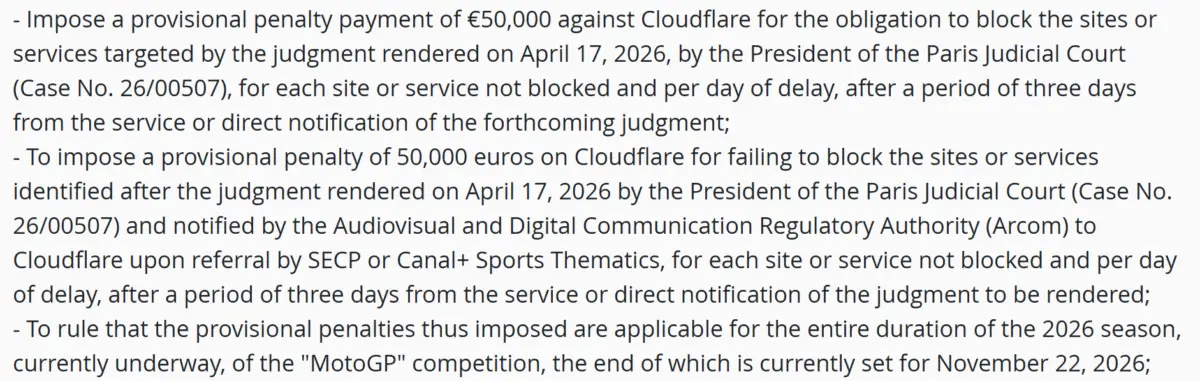
While hundreds of internet intermediaries were cited in the paperwork, infrastructure giant Cloudflare was singled out with a dedicated multi-page section of rules.
Within 24 hours of service, Cloudflare was ordered to disable its CDN, reverse-proxy, and DNS services for a massive list of domains. Furthermore, the company was compelled to hand over deeply sensitive data: origin-server IP addresses, detailed DNS records, account holder names, historical payment details, and 14 days of request logs for the targeted domains. Cloudflare was also required to cross-reference accounts to unmask hidden operators sharing billing names or email addresses with flagged entities.
While Cloudflare did secure protective boundaries—such as not being forced to proactively monitor content and only having to produce data it already possesses—the burden placed upon the network infrastructure provider is immense.

Official Perspectives and Legal Implications
To date, neither the primary defendants nor the vast majority of the 90-plus named intermediaries have appeared in court to object or mount a defense. This default stance from the pirate operators is common in illicit streaming cases, where anonymous or offshore actors frequently choose to abandon domains rather than face multi-million-dollar statutory damages in foreign jurisdictions.
However, legal scholars and digital rights organizations are watching closely. The quiet acquiescence of major intermediaries, combined with the lack of active defense, means that this aggressive legal blueprint faces little judicial pushback in the Southern District of Florida.
For rightsholders, this case provides a shining blueprint for combating the hydra-headed nature of modern piracy. When one illegal IPTV service closes, three more typically pop up under different domains hours later. By securing an injunction that automatically covers future domains, future brands, and future content—and allowing lawyers to update the list without judicial sign-off—TU has effectively streamlined the eradication of pirate infrastructure.
Future Outlook
As the preliminary injunction remains active while the broader lawsuit proceeds toward a final judgment, the long-term ramifications for the internet ecosystem are profound.

- A New Standard for U.S. Litigation: Expect major media conglomerates, sports leagues, and music labels to closely study TelevisaUnivision’s legal strategy. If other Florida courts—and courts in other jurisdictions—replicate this model, dynamic, self-expanding injunctions could become the gold standard for American copyright enforcement.
- The Offshore Safe Havens: As U.S.-based registrars like GoDaddy and NameCheap continue to aggressively enforce these orders, illicit operators will increasingly migrate their infrastructure to foreign, uncooperative jurisdictions (such as Russia, Iran, and select European offshore hubs) where U.S. federal court orders carry little practical weight.
- The Due Process Debate: Civil liberties and transparency advocates will likely begin pushing back against the lack of judicial oversight inherent in self-updating injunctions. Allowing private legal teams to unilaterally expand site-blocking registries without a judge reviewing each addition blurs the line between civil enforcement and private internet censorship.
For now, TelevisaUnivision has secured a sweeping, high-tech victory that deals a devastating blow to the specific networks targeted in its lawsuit. Whether this aggressive judicial mechanism can permanently curb the tide of global digital piracy, or simply push it further into the dark corners of the web, remains the defining question for the future of digital entertainment law.