






Executive Overview
In the high-stakes world of modern go-to-market (GTM) operations, customer success and revenue leaders face a perpetual bottleneck: the cumbersome, resource-heavy account tiering project. Traditionally requiring cross-functional collaboration across sales operations, business intelligence, finance, and product teams, a comprehensive account tiering exercise historically consumes an entire quarter. It is a grueling process of data extraction, manual spreadsheet wrangling, and subjective executive debates that often yields outdated results by the time the ink dries on the final presentation.
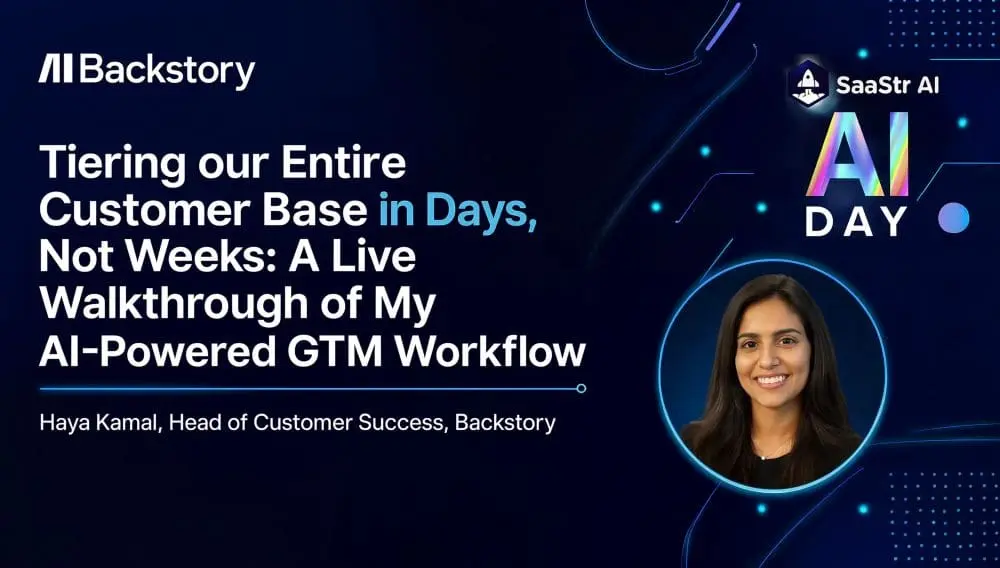
At the recent SaaStr AI Day, Haya Kamola, Head of Customer Success at Backstory and a veteran of sales leadership, shattered this industry paradigm. Facing a board-mandated directive with a punishingly short turnaround, Kamola and her team successfully categorized and tiered 141 customer accounts—defining ideal customer profiles, synthesizing disparate data streams, and establishing an actionable framework—in just three to four days.
By leveraging advanced AI workflows, custom-built connectors, and iterative prompt engineering via Claude, Kamola transformed what was once a multi-departmental administrative marathon into an agile, repeatable, twenty-minute automated process. This case study explores how Backstory engineered this operational leap, the strategic methodology behind their success, and the profound implications of AI-driven account tiering for the future of customer success and revenue operations.
Detailed Chronology: From Board Mandate to Automated Execution
The project originated from a straightforward, high-pressure executive request: evaluate Backstory’s entire 141-account customer base, establish a precise definition of high-value customers, measure every account against that benchmark, and deliver a definitive tiering framework that the executive team could immediately operationalize.
In her previous professional life, Kamola noted that this exact assignment would have required her team alongside four other departments, working diligently for three months. To compress this timeline into days without sacrificing analytical rigor, Kamola orchestrated a meticulously structured, multi-step chronological workflow.
Phase 1: Defining the "Golden Customer" Before Touching the Data
Kamola’s first and most critical strategic decision was to establish a qualitative definition of success before looking at a single data point in the CRM. Collaborating closely with account teams and senior leadership, she avoided defaulting to vanity metrics such as longevity or sheer contract size.
Instead, the team focused on behavioral and strategic markers. They identified their ideal customers as those who:
- Treated Backstory as a foundational element of their core technology stack.
- Built complex internal systems directly around the platform.
- Used Backstory as a central pillar for their five-year strategic planning.
- Actively engaged with the product roadmap and sought to influence its trajectory.
- Relentlessly discovered new internal use cases, organically pushing the product deeper into their organizations.
By aligning the organization around this behavioral archetype first, Backstory avoided the common trap of scoring accounts based solely on whatever fields happened to be populated in their CRM.
Phase 2: Identifying and Engineering Missing Signals
Once the golden customer profile was articulated, Kamola’s team mapped out the characteristics required to identify similar accounts across the broader base. These traits were split into internal customer metrics (GTM process maturity, tech stack mix, AI maturity velocity, and partner motion adoption) and relationship-specific metrics (deployment velocity, executive visibility, total addressable market [TAM], and remaining whitespace).
Crucially, many of these vital signals simply did not exist in a structured, repeatable format. For instance, quantifying "AI maturity" previously required account teams to manually categorize customers against a grueling five-layer internal framework covering culture, investment levels, technology stacks, talent, and willingness to tackle hard problems.
To eliminate this bottleneck, Backstory engineered an autonomous signal: a systematic prompt executed across every account that ingested CRM data, public company announcements (such as AI-forward product launches and funding rounds), and the account’s complete chronological conversation history (including emails, meetings, and Slack transcripts). The AI output a precise maturity score alongside its underlying rationale, transforming unstructured data into structured operational intelligence overnight.
Phase 3: The Cross-Functional Data Pull via Connectors
Rather than embarking on a traditional, friction-heavy tour of product, BI, and finance teams to collect TAM, health scores, revenue figures, renewal rates, and feature requests, Kamola bypassed manual data collection entirely.
The integration architecture relied on four strategic data connectors:
- The CRM Connector: Pulling foundational account metadata, historical revenues, and contract timelines.
- The Product Utilization Connector: Surfacing real-time adoption metrics and usage velocity.
- The Jira/Gap Board Connector: Capturing product feature requests, friction points, and engineering tickets.
- The Slack Integration Connector: Extracting internal account team dialogues—often the most candid, early indicator of customer sentiment, emerging risks, and unstated expansion opportunities.
The only manual step remaining in the entire data ingestion workflow was exporting a single CSV file from Salesforce containing account names, executive engagement levels, predicted health scores, AI maturity signals, upcoming renewal dates, and renewal Annual Contract Values (ACV).
Phase 4: Sequential Prompt Engineering and Workflow Rigor
To ensure analytical integrity, Kamola executed the analysis not as a single, monolithic prompt, but as a strictly ordered sequence within Claude, specifically utilizing environments capable of maintaining execution order.
The workflow followed a deliberate operational sequence:
- Ingestion & Normalization: Standardizing the exported CSV so that account identities matched seamlessly across disparate data sources.
- Conversation History Analysis: Treating historical communications as the primary source of truth for recent engagement, surfaced risks, and nascent opportunities.
- Utilization Assessment: Evaluating quantitative product usage data against historical baselines.
- Growth Potential Modeling: Combining Salesforce data with external research. Because Backstory prices its software per seat based on go-to-market headcount, a customer’s total GTM organization size served as the TAM indicator, while the delta to current active seats exposed the addressable whitespace.
- Jira & Gap Reconciliation: Mapping feature requests against adoption patterns.
- Reconciliation & Final Scoring: Synthesizing all data points into a cohesive, weighted scoring model.
A complete run of this automated workflow required approximately twenty minutes of processing time.
Phase 5: Iterative Refinement and Counter-Intuitive Discoveries
The success of the project was not achieved on the first draft. Kamola subjected the model to four rigorous rounds of iteration to revalidate the weighting of each data point, proving that human oversight remains irreplaceable in AI-driven operations.
Initially, the model evaluated roughly eight distinct signals. This created data noise and narrative contradictions. Through iteration, Kamola streamlined the framework down to four core scoring buckets: growth potential, AI maturity/velocity, engagement level (seniority and perception), and current account health.
The most profound breakthrough during the iteration phase involved feature requests. The initial scoring model treated a high volume of feature requests as a negative indicator, docking points for health and engagement under the conventional assumption that demanding customers are unhappy customers.
However, the empirical data revealed the exact opposite. Backstory’s highest-adopting accounts correlated strongly with a high volume of feature requests. Deep product adoption paired with a continuous stream of progressive requests was actually a powerful positive signal of long-term retention and expansion potential. In a manually constructed spreadsheet model, a foundational error of this magnitude would have gone unnoticed indefinitely.
Supporting Context & Metrics
The quantitative and operational impacts of this AI-driven tiering initiative immediately rippled across Backstory’s go-to-market organization, reshaping resource allocation and strategic planning.
The Four-Tier Output Framework
The final analytical run successfully segmented Backstory’s 141 accounts into four distinct operational tiers:
- Tier A: Strategic, high-velocity accounts receiving maximum executive attention and dedicated white-glove customer success resources.
- Tier B: Core growth accounts with high AI maturity and significant remaining whitespace.
- Tier C: Stable, self-sustaining accounts requiring automated touchpoints and low-touch monitoring.
- Tier D: At-risk or low-potential accounts that forced the executive team to confront hard realities regarding resource drainage.
Notably, Kamola emphasized the critical value of identifying Tier D accounts. Many traditional tiering projects identify top-tier accounts and stop there, leaving stagnant accounts to quietly drain team bandwidth. By forcing leadership to inspect the bottom tier using hard data, Backstory could consciously decide whether to invest in turning those relationships around or reallocating those hours elsewhere.
Operational Metrics at a Glance
- Total Accounts Analyzed: 141 customer accounts.
- Project Completion Time: 3 to 4 days (compared to a historical full quarter).
- AI Processing Time per Run: ~20 minutes.
- Number of Core Scoring Buckets: 4 (Growth Potential, AI Maturity, Engagement, Health).
- Manual Data Export Requirement: 1 Salesforce CSV export.
Official Statements and Industry Insights
Haya Kamola’s presentation at SaaStr AI Day struck a chord with revenue leaders drowning in operational complexity. Her transparency regarding the realities of AI implementation—including a humorous moment during her live demo when she realized she forgot to attach the CSV file—highlighted the speed at which modern GTM teams must operate.
"That’s what happens when you start moving too fast," Kamola remarked to the live audience, underscoring the reality that while AI accelerates execution, human vigilance remains paramount.
Reflecting on the broader strategic implications of the project, Kamola stressed that the true power of AI in customer success lies in its ability to synthesize unstructured qualitative data—such as internal Slack chatter and meeting transcripts—with quantitative CRM metrics. By turning qualitative team intuition into structured, automated signals, revenue leaders can finally bridge the gap between what customer success teams feel is happening in an account and what the data actually proves.
Future Outlook
The successful deployment of this account tiering framework has fundamentally altered how Backstory operates in the field, establishing a permanent template for agile revenue operations.
Immediate Field Impact
The new tiering model has driven three immediate changes across the GTM organization:
- Targeted Resource Allocation: Customer success managers (CSMs) immediately shifted their weekly calendars to align their time directly with the newly defined Tier A and Tier B accounts.
- Proactive Expansion Planning: Sales and CS teams utilized the whitespace and AI maturity signals to initiate proactive expansion conversations before renewal windows opened.
- Optimized Leadership Interventions: Executive sponsorship was deployed strategically based on real-time relationship visibility data rather than anecdotal escalations.
The Road Ahead
Backstory has committed to rerunning the automated tiering analysis on a strict quarterly cadence. This regular frequency will allow the organization to dynamically track customer movement between tiers, evaluate the efficacy of CSM interventions, and automatically refresh tier definitions as market conditions and product offerings evolve.
Furthermore, while the current iteration focuses exclusively on existing customers by leveraging utilization metrics, conversation history, and feature gaps, Backstory is actively exploring the development of a pre-sales version. By adapting the input parameters for prospective buyers, the company aims to apply the same rapid, AI-driven tiering methodology to its inbound pipeline—potentially compressing outbound qualification cycles from weeks into minutes.
As go-to-market teams increasingly adopt generative AI and automated workflows, Backstory’s rapid account tiering blueprint serves as an authoritative masterclass. By prioritizing qualitative definitions before data collection, automating qualitative signal generation, and embracing iterative human oversight, revenue leaders can finally turn account tiering from an annual administrative burden into a continuous, strategic competitive advantage.