Executive Overview
In the modern landscape of B2B software and artificial intelligence, a comforting myth persists: that the market is big enough for everyone, that a rising tide lifts all boats, and that successful companies are built purely on the virtuous pursuit of customer delight. We are told that founders are "Builders"—visionaries crafting positive futures, nurturing internal teams, and gently out-innovating the competition in a cooperative ecosystem of shared prosperity.
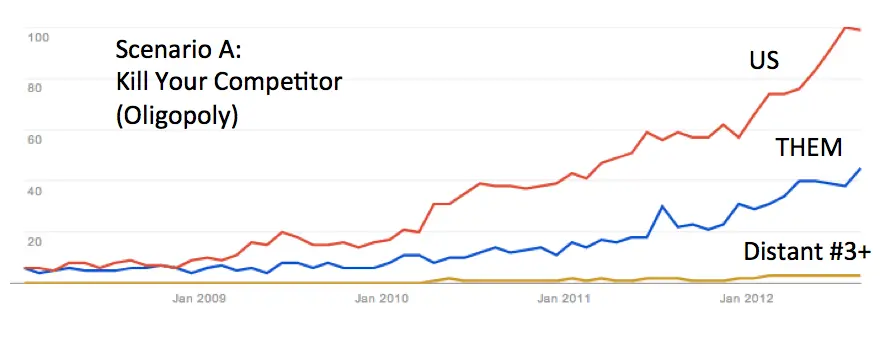
This worldview is not entirely false. It explains how #1, #2, and even #3 players can coexist in a profitable semi-equilibrium. We see this peaceful co-existence across historical and contemporary rivalries: Replit versus Lovable, Claude versus Codex, or the phenomenon known in venture capital circles as the "Postmates Effect," where the sheer expansion of the total addressable market (TAM) ensures that even a distant bronze-medalist can secure a multi-billion-dollar valuation.
However, this narrative obscures a harder, more lucrative truth. While most B2B founders naturally default to being builders, the defining companies of our era—the category creators and monopolists that rewrite industries—did not merely outpace their rivals. They eradicated them.
Look at the historical graveyard of enterprise software: Zoom did not politely share market share with WebEx; it systematically dismantled its dominance. Slack relegated HipChat to a footnote in enterprise chat history. Datadog left New Relic gasping for air, and emerging challengers like Clay are currently executing a similar playbook against entrenched giants like Zoominfo.
To survive and dominate in an oligopolistic market, founders must pivot from a purely defensive, customer-centric mindset to incorporate calculated competitive aggression. They must learn when and how to kill their top competitor—dead.
Detailed Chronology: The Evolution of Market Domination
The philosophy of competitive annihilation has evolved alongside the maturation of the software-as-a-service (SaaS) business model. Understanding how market structures have shifted from fragmented ecosystems to winner-take-all battlegrounds illuminates why the "Killer Instinct" has become non-negotiable for modern founders.
Phase 1: The Fragmented Dawn of Enterprise Cloud (Early 2000s)
In the early days of SaaS, the market was defined by friction. On-premise solutions were standard, and cloud software had to fight for basic legitimacy. During this era, coexistence was the default strategy. Competitors targeted different niches, and the sheer volume of untapped enterprises meant that #1 and #2 players could grow side-by-side without coming to blows. Venture capital was scarcer, deployment cycles were longer, and the primary battle was convincing enterprises to move to the cloud at all.
Phase 2: The Rise of the Category Killer (2010s)
As cloud infrastructure matured, the dynamics shifted. With lower distribution barriers, multiple startups began racing toward the same pool of buyers. This era gave birth to iconic enterprise clashes. Cisco’s WebEx was the undisputed incumbent in web conferencing, viewed as an unassailable utility. Yet, Zoom entered with a superior, frictionless product architecture and a relentless focus on performance. Rather than carving out a small niche, Zoom targeted WebEx’s core enterprise base directly, eventually turning a sprawling incumbent into a legacy relic. A similar dynamic played out in developer tooling and team collaboration, proving that category leadership in the cloud required direct, zero-sum combat.
Phase 3: The Age of AI and Hyper-Scale Consolidation (Present Day)
Today, the stakes are exponentially higher. The rise of generative AI has compressed decades of market development into months. While the "Postmates Effect" ensures that massive pools of capital can inflate valuations for multiple players (exemplified by the astronomical valuations of decacorns in AI), the laws of scale remain unyielding. Companies like ElevenLabs, Harvey, Legora, and Sierra are building insurmountable moats through proprietary data, massive compute investments, and deep enterprise integrations. In this hyper-accelerated environment, allowing a primary competitor to survive and iterate means risking sudden obsolescence. The timeline to market dominance has shortened, making early and decisive competitive action paramount.
Supporting Context & Metrics: The Anatomy of Market Structures
To evaluate whether to pursue a strategy of aggressive competitive elimination, founders must first diagnose their current position within the market hierarchy. Market dynamics dictate distinct playbooks for the #1, #2, and #3 players.
The #1 Player Playbook: Scaling the Lead
If an enterprise is comfortably positioned as the category leader and experiencing steady growth, the strategic imperative is expansion rather than direct combat.
- The Advantage: Capital, brand recognition, customer volume, and ecosystem gravity. Success breeds success.
- The Strategy: Focus on widening the moat. Leverage superior cash flow to fund research and development, acquire emerging threats before they scale, and lock in enterprise-grade integrations. For the market leader, the primary enemy is complacency, not the #2 player nipping at its heels.
The #2 Player Playbook: The Scrappy Challenger
The runner-up position is uniquely advantageous in B2B software.
- The Advantage: Agility. By definition, the #2 player offers a superior product for a specific subset of customers who actively rejected the #1 choice.
- The Strategy: Weaponize focus. A clear target exists, and beating the giant is a powerful cultural motivator for internal teams. Because the #1 player is burdened by legacy architecture and broad customer expectations, the #2 player can out-maneuver them in specialized zones.
The Economics of the Kill
Why push beyond this comfortable semi-equilibrium to actively destroy a competitor? The answer lies in enterprise economics. Monopolies and near-monopolies capture a disproportionate share of market profits, pricing power, and top-tier talent.
When a company successfully eliminates its primary rival, two major shifts occur:

- Strategic Pricing Power: Pricing pressure evaporates. Without a direct equivalent competitor offering steep discounts to win deals, gross retention improves, and average contract values (ACVs) rise.
- Talent and Capital Concentration: Top-tier engineering, sales, and marketing talent naturally gravitate toward the undisputed category winner, starving the remaining competitors of the human capital required to mount a comeback.
[Fragmented Market] ---> [Oligopoly (Player #1, #2, #3)] ---> [Category Consolidation / Elimination] ---> [Monopoly Margins & Pricing Power]Official Perspectives: The Philosophy of Competitive Strategy
Industry leaders and seasoned venture capitalists have long debated the balance between customer-centric building and aggressive market positioning.
Jason Lemkin, founder of SaaStr and a veteran SaaS investor, frequently highlights the paradox of the early-stage founder. Most founders are inherently "builders"—empathetic leaders focused on product architecture, team morale, and customer success. They possess a psychological makeup that recoils from zero-sum, attack-oriented thinking.
However, Lemkin notes that the structural advantages of being a first mover are counterbalanced by immense early-stage friction:
"Top advantages to being a first mover: No roadmap, tiny market, customers aren’t sure, limited legitimacy, never budgeted, VCs don’t get it, many VPs don’t get it, tiny TAM at first, seems minor to many, why wasn’t it already done if it’s so important. It’s great."
Navigating this gauntlet requires resilience, but successfully crossing the chasm transitions a startup from an underdog into an existential threat to incumbents.
Veterans of enterprise software emphasize that the "Killer Instinct" must be deployed with surgical precision rather than chaotic aggression. Allocating 50% of scarce company resources to destructive tactics—such as aggressive litigation, smear campaigns, or predatory sales tactics—is invariably dilutive and destructive to internal culture. The true "kill" is rarely achieved through dirty tricks; it is executed through product superiority, targeted go-to-market encirclement, and making it economically unviable for the competitor to secure new funding or enterprise customers.
Future Outlook: The Next Decade of B2B Warfare
As we look toward the horizon of enterprise technology, the battlegrounds are shifting. The convergence of artificial intelligence, automated workflows, and globalized remote work means that software categories are forming and consolidating faster than ever before.
The Threat of the Regenerative Competitor
A common hesitation among founders is the "Hydra Effect": If I manage to kill my top competitor, won’t another just pop up like a weed?
The short answer is yes—market capitalism guarantees that new entrants will perpetually emerge to challenge incumbents. However, in enterprise software and AI, scale matters profoundly.
Consider the barriers to entry established by modern AI leaders. Catching up to platforms like ElevenLabs, Harvey, or Sierra is no longer a matter of simply writing better code over a weekend. These entities have accumulated proprietary datasets, complex regulatory compliance frameworks, deep enterprise trust, and massive capitalization. A weed can sprout overnight, but uprooting a deeply entrenched, well-capitalized sequoia requires an entirely different order of magnitude of resources.
Conclusion: Timing the Killer Instinct
The primary danger for modern B2B founders is not that they will become overly ruthless, but that they will develop their "Killer Instinct" too late—waking up to the reality of competitive warfare only after their rival has grown too large to dismantle.
Founders must continuously audit their market position. If operating within an oligopolistic market where winner-take-all dynamics govern valuations, customer retention, and talent acquisition, building a great product is no longer enough.
It is time to challenge internal assumptions, align the organization around strategic dominance, and recognize that in the upper echelons of enterprise software, executing a clean, decisive victory over your primary rival isn’t just satisfying—it is the ultimate driver of long-term economic returns.