Executive Overview
In the modern landscape of independent video game development, the gap between an idea and a finished product is fraught with hidden assumptions, unvalidated mechanics, and the persistent human bias of creators who are simply too close to their own work. According to game designer Brian Cronin, the solution to this perennial industry hurdle is surprisingly intimate, remarkably inexpensive, and accessible to development teams of absolute any scale—ranging from massive studios down to solo creators working out of their bedrooms.
In a pivotal Game Developers Conference (GDC) talk titled Playtesting Process for Ultra Small Teams, Cronin laid out a definitive blueprint for synchronous, one-on-one video call playtesting. Far from being a makeshift strategy reserved exclusively for hobbyists, Cronin argues that this direct, highly focused methodology is the ultimate engine for driving actionable feedback, uncovering critical design flaws, and building an organic, highly engaged community from day one.
By leveraging a playcentric design model—testing early, testing often, and iterating constantly—developers can strip away guesswork. Cronin’s methodology relies on real-time observation: a designer walks a single playtester through a live build over a video call, carefully tracking behavioral nuances, body language, and immediate emotional responses. Far from replacing traditional QA, this approach serves as a direct pipeline into the player’s psychological experience, transforming erratic development cycles into structured, player-informed odysseys.
Detailed Chronology of the Method: How Synchronous Playtesting Works
To understand Cronin’s approach, one must examine the mechanics of how a successful one-on-one playtest operates in practice. Far from dropping a build onto a file-sharing site and crossing one’s fingers for a survey response, Cronin advocates for an active, highly structured engagement protocol.
Phase 1: Priming the Environment and the Player
The session begins long before the playtester touches the code. Cronin emphasizes that a developer’s primary objective in the opening minutes is to establish a safe, welcoming, and open psychological environment. Because time and attention are arguably the most valuable commodities in the modern world, the playtester must be treated not as a free bug-hunter, but as a benefactor offering the gift of honest critique.
Cronin advises developers to use specific conversational scripts designed to disarm the playtester and eradicate defensive language. The goal is to make it clear that the player cannot "break" the game, nor can they give a "wrong" answer. If something is confusing, it is fundamentally a failure of the design, not the player’s intelligence.
Phase 2: The Live Observation Loop
Once the build is running via screen-share or direct remote execution, the developer steps back into the role of an observational scientist. Muted or passively listening, the designer watches the player navigate the interface, tackle puzzles, or engage with mechanics in real time.
Cronin points out that this live observation captures data that no automated telemetry or post-test questionnaire ever could. Micro-expressions, sighs of frustration, moments of unexpected delight, and verbalized hesitations provide immediate clarity on whether a game is achieving its intended emotional impact.
Phase 3: Synthesis and Action Item Generation
The lifecycle of a playtest does not end when the video call disconnects. Cronin stresses the vital importance of a systematic approach to data processing. Developers cannot simply rely on fuzzy memories of "how the test went."
Instead, feedback must be logged into structured tracking systems—such as customized spreadsheets—where patterns can be identified, prioritized, and converted into concrete development action items. By synthesizing feedback across multiple sessions, developers can spot recurring pain points and address high-level systemic shifts before they compound into structural nightmares.
Supporting Context & Metrics: Why Developers are Blind to Their Own Games
One of the most provocative assertions in Cronin’s GDC presentation cuts straight to the ego of the creative class: Developers are notoriously bad at knowing if their games are actually fun.
The Designer’s Blind Spot
During his talk, Cronin humorously confessed to his own past vulnerabilities regarding game clarity. Things that appear blindingly obvious to a creator who has spent hundreds of hours conceptualizing, coding, and iterating on a specific menu or mechanic will frequently act as impenetrable brick walls for a fresh set of eyes.
When a designer builds a system, they possess an invisible roadmap in their head that guides them past intuitive hurdles. A playtester lacks this roadmap entirely. Consequently, what the designer believes is a transparent tutorial or self-explanatory mechanic often dissolves into confusion in front of a live audience.
The Illusion of Mind Reading
One of Cronin’s favorite phenomena in one-on-one playtesting is the "mind-reading illusion." It typically unfolds like this: a playtester hits a moment of friction, verbalizes a point of confusion out loud, and then clicks on the next logical interface element. Suddenly, their question is answered by the game design itself, leading them to turn to the developer and remark, "It’s like you read my mind!"
Of course, the designer did not possess psychic powers. Rather, the designer read dozens of other players’ minds prior to this session. By running iterative one-on-one tests, patterns inevitably emerge. Developers begin to notice that when Player A stumbles on a puzzle, they voice the exact same hesitation as Player B and Player C did the week prior.
This leads to a foundational epiphany for many independent creators:
"Everyone says, ‘It’s probably just me, it’s a me problem.’ But it’s never a them problem. It’s always a me problem."
By accepting total accountability for the player’s confusion, the developer transforms the playtest from an ego-defending exercise into an objective diagnostic tool.
Official Statements and Industry Philosophy
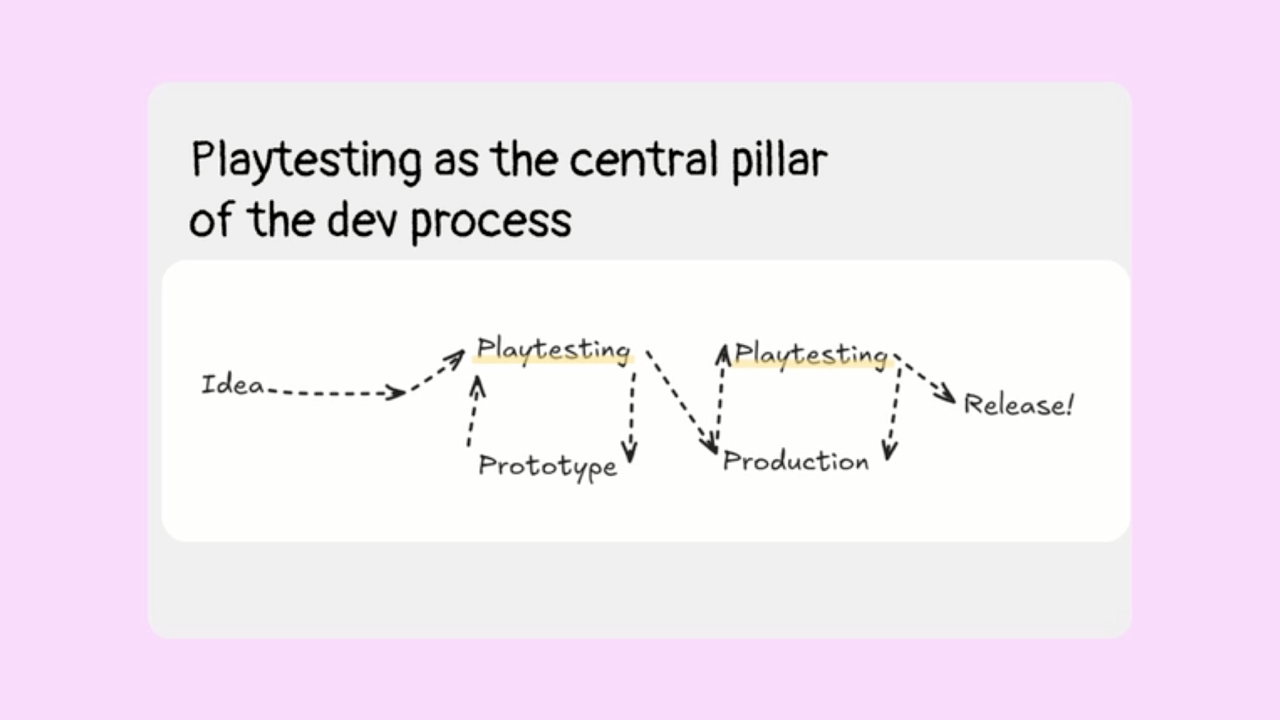
The principles championed by Cronin align closely with the broader "playcentric" model of game development, which asserts that player experience should dictate the iterative evolution of a project from its earliest conceptual sketches to its final polish.
Valuing the Human Element
By advocating for synchronous video calls rather than asynchronous, text-based feedback forms, Cronin champions a philosophy of deep empathy in game design. Quantitative data tells a developer where a player died or how long they spent in a level; qualitative, one-on-one observation tells them why the player felt alienated, bored, or exhilarated while doing so.
Furthermore, Cronin reframes the playtesting pool not as a clinical testing facility, but as the foundational bedrock of a game’s future community. For small-scale independent developers, the people who show up to help test early builds are often the most passionate early adopters.
"For small developers, this is also the seed of your early community," Cronin noted, highlighting how treating playtesters with respect pays massive dividends down the road.
In his own experience, roughly 70 percent of the active membership in his game’s Discord server originated from his pool of playtesters. Many of these individuals return session after session, forming an invested core of advocates who watch the game evolve in real time and take pride in its ultimate trajectory.
Future Outlook: Scaling the Unscalable for Teams of All Sizes
While Cronin’s presentation specifically targeted "ultra-small teams" and solo developers who might feel overwhelmed by the traditional, corporate-styled QA pipeline, the scalability of his methodology offers profound implications for the broader games industry.
Democratizing Quality Assurance
In an economic climate where video game budgets are ballooning and mass layoffs plague major publishers, finding cost-effective, high-yield validation methods is more critical than ever. Synchronous, one-on-one playtesting costs virtually nothing beyond time—making it an egalitarian powerhouse. Whether a team consists of one developer working in a basement or ten developers spread across three continents, the mandate remains identical: put a live build in front of a human being, watch them play it, listen to their unscripted reactions, and iterate without ego.
The Road Ahead for Playcentric Design
As indie development tools continue to democratize and the marketplace grows increasingly saturated with brilliant titles, discoverability and player retention will depend entirely on the immediate clarity and emotional resonance of a game’s opening moments.
By adopting Brian Cronin’s framework of empathetic, synchronous playtesting, developers can bypass the echo chambers of their own internal pipelines and connect directly with the minds of their audience. In doing so, they do not just build better games—they forge lasting communities built on mutual respect, active listening, and a shared passion for interactive art.