








Executive Overview
A sweeping regulatory shift is quietly transforming the landscape of digital publishing, search engine optimization (SEO), and content marketing. At the center of this transformation is Regulation (EU) 2024/1689—more commonly known as the European Union AI Act. While legislators have framed the act as a vital consumer protection measure designed to champion transparency and combat misinformation, its downstream technical demands are setting off alarm bells across the technology sector.
By mandating that "synthetic" content be machine-detectable, the regulation has effectively forced AI developers to build standardized tracking infrastructure directly into their large language models (LLMs). Leading the charge is Anthropic, which recently announced that all future iterations of its Claude model family will natively weave invisible, text-based watermarks into generated outputs. Other industry giants are expected to follow suit.
For consumers, these cryptographic breadcrumbs promise truth in advertising and clear labeling for machine-crafted prose. For digital marketers, copywriters, and ecommerce enterprises, however, this infrastructure unlocks a Pandora’s box of surveillance-like consequences. The capability to reliably detect AI-generated text introduces the dangerous potential for platforms, search engines, and governments to segregate, discount, or outright censor content based purely on how it was manufactured, rather than its factual accuracy, relevance, or overall quality.
As programmatic watermarking becomes an international standard, the fundamental economics of AI-assisted marketing—which has allowed lean startup teams to compete with enterprise giants through scalable content production—hang in the balance.
Detailed Chronology: From Legislative Frameworks to Cryptographic Watermarks
To understand how we arrived at an era of machine-detectable prose, it is necessary to trace the convergence of European regulatory ambition and algorithmic engineering.
1. The Legislative Impetus: Regulation (EU) 2024/1689
The journey began years prior to the finalization of the EU AI Act, amid mounting fears surrounding deepfakes, automated disinformation campaigns, and unverified synthetic media flooding public discourse. Lawmakers sought a mechanism to protect citizens’ right to informed consent. When the European Parliament officially adopted Regulation (EU) 2024/1689, it codified strict transparency obligations. Among them was a mandate requiring providers of generative AI systems to ensure that machine-generated text, audio, image, and video outputs are marked in a machine-readable format and detectable as artificially generated or manipulated.
2. The Failure of Legacy Heuristics
In the early days of generative AI, skeptics relied on superficial stylistic anomalies to flag machine text. Observers swore that the appearance of an em dash (—), an overly structured introductory clause, or an excessive use of colons (*) were dead giveaways of artificial authorship. However, these stylistic crutches quickly proved unreliable. Punctuation habits evolve, and AI developers iteratively fine-tune models to mirror organic human variance. Recognizing that guessing authorship via stylistic tropes was a fool’s errand, the industry required a deterministic, mathematically rigorous solution.
3. The Advent of SynthID-Text
Enter Google and its pioneering text-watermarking architecture, SynthID-Text. Initially detailed in academic literature and subsequently adopted by infrastructure providers, SynthID-Text bypassed the need for clunky post-hoc detection algorithms or massive lookup databases. Instead, it solved the problem at the molecular level of text generation: the token.
4. Industry Adoption and the Anthropic Pivot
Realizing that compliance with the EU AI Act would require deep architectural interventions, Anthropic shifted its development roadmap. In a watershed industry announcement, the company confirmed that all upcoming versions of its Claude models will incorporate native SynthID-Text watermarking. This move establishes a powerful precedent, transforming what was once an experimental Google research project into an unavoidable global standard for commercial LLM deployment.

Supporting Context & Metrics: Decoding the Mechanics of SynthID
To grasp the implications of automated text tracking, one must first deconstruct how modern language models generate text and how cryptographic watermarks embed themselves within those processes.
The Token Economy and Statistical Probability
In computational linguistics, a token is a bite-sized fragment of data—ranging from parts of words and punctuation marks to whole numbers and complete words. When an LLM is prompted to draft an email marketing campaign, a blog post, or a product description, it operates sequentially. It evaluates an input prompt, predicts the single most statistically probable subsequent token, appends it, and repeats the process until the text is complete.
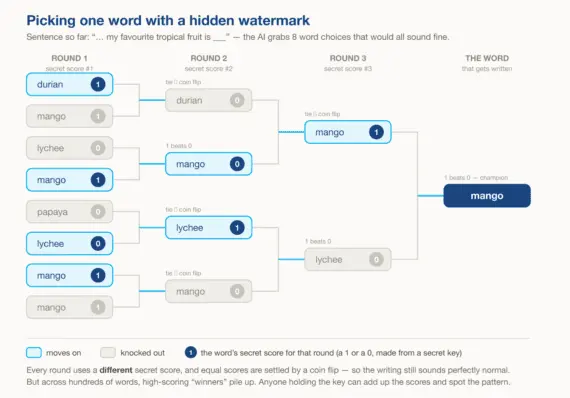
For example, if a model receives the prompt, "My favorite tropical fruit is…", it consults internal probability distributions. It does not blindly select the exact same word every time; instead, it weighs multiple plausible candidates—such as mango, papaya, durian, or lychee. These reasonable alternatives create the operational window required for SynthID to run its covert mathematical "tournaments."
How the Tournament Works
SynthID alters the standard token-selection pipeline by introducing a pseudo-randomized mathematical tournament for every single token generated:
- Candidate Pool Generation: The model compiles a list of top candidate tokens for the next position in the sentence.
- Secret Key Evaluation: Using a secret cryptographic key unique to the model, SynthID assigns hidden scores to these candidates based on a deterministic mathematical seed.
- The Bracket Matchup: The candidates are pitted against one another through a simulated tournament structure, where the secret scoring system favors specific mathematically favored tokens without degrading the semantic coherence or grammar of the sentence.
- The Winning Selection: A winning token (e.g., mango) emerges from the tournament and is written to the output stream.
Because these tournaments occur dynamically across thousands of iterations, there is no single "watermarked word." The word mango might win in one sentence and lose in another based on shifting context. However, over the span of a multi-paragraph passage, the accumulated text will contain a statistically significant density of seed-influenced token choices that ordinary chance could never replicate. That macro-level statistical signature is the watermark.
[Prompt Received]
       │
       ▼
[Token Candidate Generation] ──► (Mango, Papaya, Lychee, Durian)
       │
       ▼
[Secret Key Tournament] ─────► (Applies cryptographic scoring seed)
       │
       ▼
[Winning Token Selected] ────► "Mango" (Written into output stream)
       │
       ▼
[Repetitive Iteration] ──────► Hundreds of tournaments build the invisible watermark
Detection and Vulnerabilities
To verify whether a passage contains this watermark, a specialized "detector" algorithm equipped with the secret key breaks the text back down into its underlying tokens. It reconstructs the tournament scores to determine if the frequency of favored token choices crosses a predefined statistical detection threshold.
- Length Matters: Longer passages yield more evidence. A single sentence or two winning tokens could easily happen by chance. Hundreds of tokens provide robust statistical certainty.
- The Context Trap: Factual, highly constrained passages—or text subjected to heavy user editing during composition—produce less watermark evidence because the model has fewer acceptable alternative tokens to run through its tournaments.
- False Positives: Because detection relies on statistical probabilities rather than absolute cryptographic signatures, false positives remain an persistent hazard. If regulatory bodies or platforms set detection thresholds too aggressively, human-written content that happens to mirror statistical patterns could be wrongfully flagged as synthetic.
Official Statements and Industry Repercussions
The friction between regulatory compliance and commercial freedom has generated intense debate among stakeholders, civil liberties groups, and corporate strategists.
Industry defenders argue that transparent labeling is essential for preserving public trust in an era of hyper-realistic generative text. Proponents of the EU AI Act emphasize that consumers have a fundamental right to know whether they are engaging with a human expert or an automated system.
Conversely, trade associations representing digital marketers and independent publishers have raised alarms regarding the weaponization of detection data. Critics point out that once content is reliably tagged as AI-assisted, it creates a dangerous architectural blueprint for censorship.

"By mandating machine-readable watermarks, regulators are not just enforcing transparency—they are building the precise plumbing required for automated platforms to segregate, filter, and quietly suppress digital speech," notes a recent whitepaper by digital rights analysts. "When identification becomes frictionless, discrimination becomes programmatic."
Major platforms are already moving to capitalize on this capability. While Pinterest has publicly adjusted its distribution algorithms to throttle unverified AI content, search engines, email providers, and social networks are exploring ways to leverage watermarking infrastructure to police their ecosystems.
Future Outlook: The Strategic Crossroads for Ecommerce and Marketing
For digital marketers and ecommerce enterprises, the widespread rollout of SynthID-Text and competing watermarking protocols marks the end of the "wild west" era of generative content. The stakes moving forward involve structural changes across four critical operational pillars:
1. Watermarking as a Proxy for Quality
The gravest danger facing content marketers is that search engines, LLMs, and social media platforms will treat the presence of an AI watermark as a convenient proxy for low quality. Rather than evaluating content on its editorial merit, SEO value, or factual accuracy, automated gatekeepers may systematically discount AI-aided pages, route marketing emails directly to spam folders, or throttle social media reach.
2. The Resurgence of Human-in-the-Loop Verification
To survive the era of programmatic watermarking, marketing teams will be forced to evolve their workflows. Content generation will no longer be a simple "prompt-and-publish" exercise. Instead, organizations must adopt deep Human-in-the-Loop (HITL) editing frameworks. By heavily rewriting, restructuring, and injecting original empirical data into AI-generated drafts, creators can disrupt the statistical signature of the underlying model, rendering the watermark undetectable while preserving the efficiency gains of generative tools.
3. The Fragmentation of the Open Web
As platforms erect proprietary detection walls, the open web risks fracturing into walled gardens where synthetic content is either sequestered into designated "AI zones" or blocked entirely. This could disproportionately harm small businesses and lean ecommerce teams that rely on generative AI to scale their marketing operations, leveling the playing field against enterprise competitors with massive copywriting budgets.
4. Regulatory and Legal Pushback
As false positives inevitably trap human authors and legitimate corporate content in automated filters, legal challenges against heavy-handed algorithmic suppression are expected to mount. The friction between the EU AI Act’s transparency mandates and free expression rights will likely be fought out in international courts for years to come.
Ultimately, the integration of text watermarking represents a foundational shift in how digital information is consumed and validated. For marketers, the message is clear: the tools of automated creation are becoming smarter, but the systems designed to track, audit, and potentially silence them are evolving just as fast. Navigating this new frontier will require a delicate balance between leveraging technological efficiency and fiercely safeguarding human editorial originality.