








Executive Overview
For decades, the traditional drug research and development (R&D) pipeline has been characterized by staggering costs, astronomical attrition rates, and glacial timelines. Bringing a single new therapeutic to market typically consumes upwards of a decade and billions of dollars, with the vast majority of promising candidates failing long before they ever reach clinical trials. The core vulnerability of the pharmaceutical industry has rarely been a lack of scientific creativity; rather, it has been the catastrophic timing of failures. Time and again, candidates consume years of meticulous laboratory work only to falter in late-stage development because of unforeseen toxicity, poor pharmacokinetics, or insurmountable manufacturing hurdles.
In response to this systemic inefficiency, artificial intelligence has transitioned from an experimental novelty into the foundational infrastructure of modern biopharma. However, the true value of AI in drug discovery is frequently misunderstood. It is not about generating endless automated predictions or replacing human scientific intuition. Instead, the most impactful AI-driven platforms excel at optimizing critical, upstream decisions: which biological targets to pursue, which molecular structures to test, and whether a candidate possesses the physicochemical traits required for successful manufacturing and clinical advancement.
A true discovery and development platform is distinguished from a single-purpose prediction tool by its ability to orchestrate an entire chain of decisions. Where narrow models merely estimate a single molecular attribute in isolation, comprehensive platforms integrate biological data, generative design, chemistry, protein engineering, and automated experimental feedback. By synthesizing these multifaceted inputs into ranked, experiment-ready strategies, platforms help researchers drastically reduce avoidable failures without short-circuiting the scientific judgment essential to breakthrough medicine. This deep dive examines the mechanics of this transformation and evaluates the ten leading platforms currently reshaping the contours of pharmaceutical R&D.
Detailed Chronology: The Evolution of Computation in Medicine
To understand the current dominance of AI platforms, one must trace the convergence of computational biology, high-throughput screening, and machine learning over the past several decades.
The Pre-Digital and Early Computational Era (1980s–1990s)
Historically, drug discovery relied heavily on empirical trial-and-error, high-throughput screening of massive chemical libraries, and serendipity. By the late 1980s and 1990s, early computer-aided drug design (CADD) began to emerge. Utilizing basic physics-based molecular modeling, computational chemists could visualize small-molecule binding pockets and simulate interactions. However, these tools were computationally heavy, limited by the processing power of the era, and restricted to targets with well-defined three-dimensional structures.
The Genomic Boom and High-Throughput Highs (2000s–2010s)
The mapping of the human genome ushered in an era of unprecedented data abundance. High-throughput screening generated vast oceans of biological and chemical data. Yet, the industry quickly realized that more data did not automatically translate to more drugs. Researchers were overwhelmed by false positives and complex biological networks that human cognition alone could not map. Machine learning began to creep into bioinformatics to handle data normalization and pattern recognition, but models lacked the depth and predictive accuracy needed to truly alter downstream success rates.
The Deep Learning and Generative Leap (2020s–Present)
The current era is defined by the fusion of deep learning, vast biological foundation models, and automated robotics. Breakthroughs such as AlphaFold fundamentally altered structural biology by solving the decades-old protein folding problem. Concurrently, advancements in generative artificial intelligence—adapted from natural language processing and computer vision—began enabling the de novo creation of molecules and proteins engineered with specific functional parameters in mind. Today, AI-native biotech companies operate as closed-loop ecosystems where computational predictions instantly inform robotic wet-lab experiments, and those experimental results immediately retrain the models.
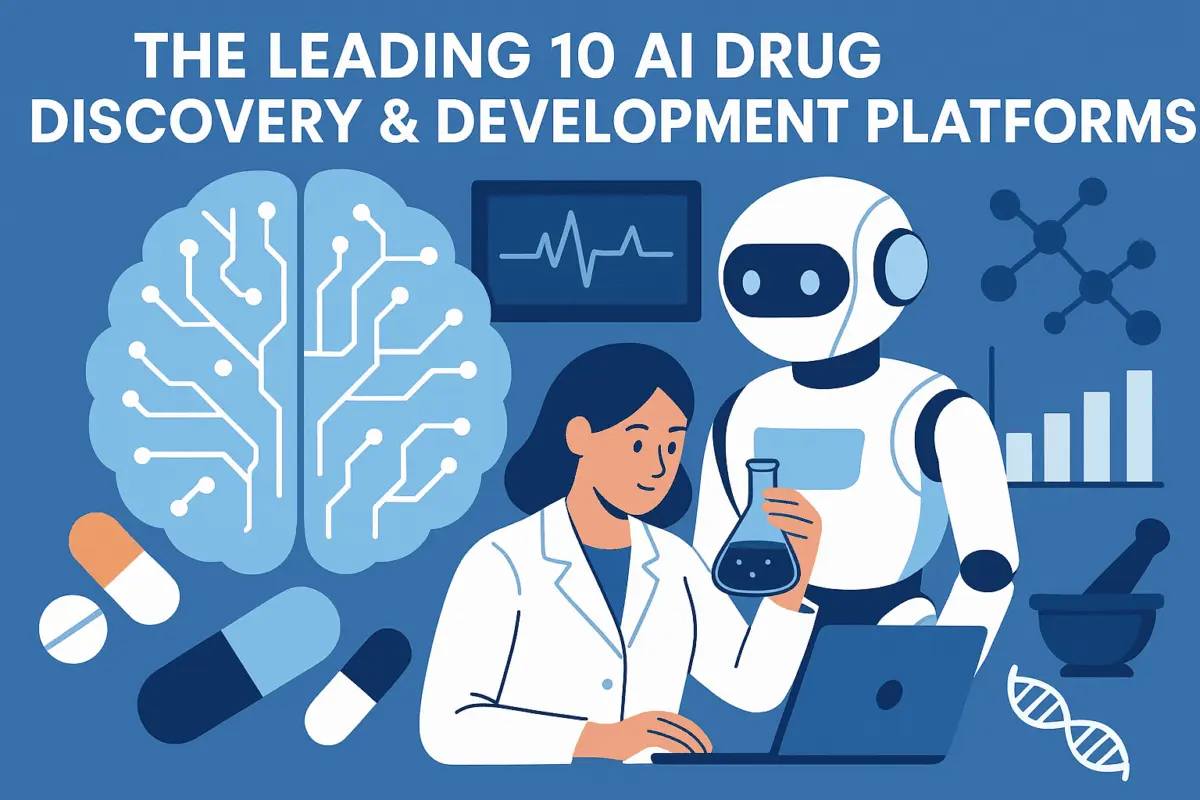
The Top 10 AI Drug Discovery & Development Platforms
No single platform is a panacea for every R&D program. Different therapeutic modalities—ranging from small molecules and monoclonal antibodies to complex cell therapies—require specialized computational ecosystems. Below is an in-depth look at the ten leading platforms defining the vanguard of the industry.
1. Converge Bio: Best AI Drug Discovery & Development Platform
Converge Bio stands out for its unique ability to marry generative AI with practical life-sciences workflows. Rather than functioning as a closed-source, single-model utility, it acts as a generative AI laboratory built specifically for biotech and pharmaceutical teams. Its core architecture connects biological foundation models directly to antibody design, target and biomarker discovery, and protein-yield optimization.
By spanning antibody engineering, multi-omic biological data analysis, and therapeutic protein production, Converge Bio provides seamless support from early target discovery through the thorny developability questions that dictate whether a biological candidate can actually be manufactured at scale.
2. Recursion
Recursion has earned its prominent reputation by treating biology fundamentally as an industrial-scale data problem. The Recursion Operating System (OS) merges massive proprietary biological and chemical datasets with automated, high-throughput experimentation, machine learning, and advanced cloud computing infrastructure.
Rather than testing isolated, preconceived hypotheses, Recursion builds expansive, multidimensional maps of biological and chemical relationships derived from cellular imaging and automated assays. Operating automated laboratories capable of running millions of experiments weekly, Recursion’s platform is tailor-made for phenotypic discovery and complex disease-biology research.
3. Insilico Medicine
Insilico Medicine is globally recognized for its comprehensive Pharma.AI platform, an end-to-end suite encompassing target discovery (Biology42), generative small-molecule design (Chemistry42), and clinical development support (Medicine42).
Chemistry42 is particularly notable for its integration of generative methodologies with physics-based modeling and classical medicinal chemistry. This hybrid approach allows research teams to rapidly generate and refine small molecules tailored to precise therapeutic profiles, bridging the gap between computational hypothesis and tangible candidate design.
4. Isomorphic Labs
Spun out of Google DeepMind, Isomorphic Labs inherits a rich lineage in protein-structure prediction, leveraging advanced machine learning models to decipher the intricate choreography of molecular interactions.
The company’s structure-first paradigm empowers computational and medicinal chemists to model how candidate molecules bind and behave against challenging biological targets with unprecedented fidelity. By enabling researchers to interrogate structural dynamics before stepping foot in the laboratory, Isomorphic Labs is redefining structure-driven drug design and attracting major pharmaceutical partnerships in the process.
5. Iambic Therapeutics
Iambic Therapeutics focuses intently on developing multimodal models that optimize candidates across both biological potency and developability parameters. Its proprietary platform features tools like NeuralPLexer, which predicts complex protein-ligand structures and binding behaviors to help scientists prioritize high-confidence molecular designs.
Furthermore, Iambic employs Enchant, a multimodal evaluation model that simultaneously assesses biological, physicochemical, pharmacokinetic, metabolic, and safety profiles. This holistic validation is critical: a molecule must not only engage its target effectively but also possess a viable, non-toxic path through human development.
6. Schrödinger
A seasoned pioneer in the space, Schrödinger has long defined the gold standard for physics-based computational chemistry. By fusing rigorous molecular simulation with modern machine learning, the platform models the fundamental physical behavior of molecules rather than relying solely on statistical pattern recognition.
This mechanistic grounding allows research teams to explore vast chemical spaces with confidence, accurately predicting binding affinities, selectivity, and thermodynamic properties while maintaining a rigorous scientific rationale for every chemical modification.
7. Xaira Therapeutics
As a high-profile, AI-native biotechnology enterprise, Xaira Therapeutics integrates machine learning, proprietary biological data generation, and deep clinical development expertise into a unified operating model.
Xaira centers its operational thesis around three foundational questions: which biology to target, which therapeutic modality is best suited to address that target, and which patient populations stand to benefit most. By bridging early computational design with translational medicine, Xaira addresses the clinical bottlenecks that traditionally derail promising computational discoveries.
8. Valo Health
Valo Health approaches drug discovery through the lens of human-centric data via its Opal Computational Platform. Recognizing that preclinical animal models often fail to translate to human biology, Valo integrates human clinical data, machine learning, knowledge graphs, and predictive modeling to identify novel targets and dissect complex patient subtypes.
This capability is particularly vital for heterogeneous diseases where distinct patient populations exhibit radically different molecular drivers, allowing developers to design precision therapies tailored to real-world human pathology.
9. Generate Biomedicines
Generate Biomedicines is a leader in the realm of generative protein design. Its platform leverages machine learning to decode the hidden grammar of protein sequences, structures, and functions, unlocking the de novo creation of novel protein therapeutics.
Rather than searching through pre-existing natural protein space, Generate Biomedicines engineers completely novel proteins optimized for binding affinity, thermal stability, specificity, and manufacturability. This capability is anchored in an iterative generate-build-measure-learn loop, where real-world laboratory feedback continually retrains the underlying generative models.
10. BenevolentAI
BenevolentAI applies sophisticated artificial intelligence to an exhaustive biomedical knowledge graph, unifying disparate scientific literature, multi-omic data, and historical experimental findings.
The platform’s core strength lies in evidence-linked target identification. By surfacing hidden connections between genes, biological pathways, and disease phenotypes that would take human researchers years to manually aggregate, BenevolentAI empowers teams to prioritize robustly supported therapeutic targets at the very earliest stages of discovery.
Supporting Context & Metrics: The Quantitative Shift in R&D
The transition toward AI-driven drug discovery is more than an aesthetic evolution; it is backed by shifting clinical metrics. Historically, the pharmaceutical industry has suffered from notoriously low success rates. According to historical benchmarks, only a small fraction of candidates entering Phase I clinical trials ultimately make it to commercial approval.
However, recent analyses indicate a tangible maturation in AI-discovered assets. A landmark 2025 analysis published in Nature Biotechnology reported that AI-discovered drugs achieved Phase I clinical trial success rates ranging between 80% and 90%, compared to the historical industry baseline of roughly 40% to 65%.
While early clinical success does not obviate the rigorous hurdles of Phase II and Phase III efficacy trials, these figures signal that AI platforms are successfully filtering out high-risk, low-efficacy candidates long before human clinical testing begins. By driving down early attrition rates, platforms are saving biopharma enterprises hundreds of millions of dollars per successful pipeline advancement.
Official Statements and Industry Perspectives
As artificial intelligence solidifies its role in pharmaceutical boardrooms, industry leaders and regulatory bodies have increasingly spoken on its trajectory:
"The true promise of AI in drug discovery is not about writing code or generating endless digital molecules; it is about compressing the timeline of uncertainty. When we can accurately rank and validate candidate molecules before they enter the wet lab, we change the economics of human health."
— Senior R&D Executive, Global Biopharmaceutical Enterprise
Regulatory agencies, including the U.S. Food and Drug Administration (FDA), have also emphasized the need for transparency and rigorous validation as AI-generated assets move closer to clinical reality. Industry consensus highlights that artificial intelligence must remain a sophisticated amplifier of human scientific judgment rather than a black-box replacement for empirical biology.
Future Outlook: From Computational Promise to Durable Advantage
The next frontier for AI drug discovery and development will not be defined by who has the flashiest model demonstrations or the largest compute clusters. Instead, the dividing line between temporary hype and durable commercial advantage will be determined by closed-loop integration.
The winning platforms of tomorrow will be those that seamlessly feed computational predictions directly into automated laboratory workflows, capture high-fidelity physical data, and use those empirical results to continuously refine their underlying generative engines. For biotechnology and pharmaceutical executives, the mandate is clear: success relies on rigorously mapping internal R&D bottlenecks to the specific platform architectures best equipped to solve them. As computation and biology continue to merge, the organizations that master this synergy will define the next century of modern medicine.