Executive Overview
The defining paradox of modern enterprise software is that almost every B2B company valued over $20 million in Annual Recurring Revenue (ARR) has integrated Artificial Intelligence into its product stack, yet the broader industry remains stuck in a severe growth malaise. For the past two years, startup founders and public company executives alike have watched their top-line expansion stall out, clustering heavily in the 10% to 30% year-over-year growth band.
The market has been ruthless in its valuation of this plateau. Public comps and private equity metrics alike demonstrate that slipping from a 22% growth trajectory to an 18% one can effectively slash a company’s enterprise value in half. The era of cheap capital, hyper-inflated multiples, and 60%+ organic growth rates has effectively vanished from the public markets.
Yet, the root cause of this stagnation is not a failure of technology, but a failure of organizational and structural imagination. CEOs are discovering that simply shipping generative AI features, bolting chatbots onto legacy interfaces, and dropping new items onto the pricing page does not move the needle. True AI-era transformation requires an agonizing, systemic tearing down and rebuilding of core products, unit economics, go-to-market (GTM) motions, and data layers.
Examining benchmark data from the SaaS Capital Index, PitchBook, and monumental market transactions like Salesforce’s acquisition of Intercom’s AI-rebranded flagship product, Fin, reveals an uncomfortable truth: most enterprise leaders are, at best, 40% of the way through this rebuild. For those holding the reins, navigating this crucible is proving to be the hardest stretch of their professional lives.
Detailed Chronology: The Evolution of the SaaS AI Pivot (2023–2026)
To understand where the enterprise software market stands today, one must trace the rapid, often chaotic evolution of the generative AI boom from its speculative inception to its current operational reckoning.
The 2023 Spark: The Gold Rush of Early LLMs
When foundational Large Language Models (LLMs) broke into the mainstream consciousness in late 2022 and early 2023, the initial response across the software-as-a-service (SaaS) landscape was frantic experimentation. Startups and legacy giants alike rushed to wrap application programming interfaces (APIs) around foundational models.
Companies scrambled to release AI-powered summaries, automated content generators, and rudimentary conversational assistants. During this phase, velocity was everything. Investors cheered any team that could slap an "AI-powered" badge onto their marketing materials, driving a brief wave of speculative enthusiasm.
The 2024–2025 Reality Check: The Feature Trap
By late 2024, the limitations of this superficial approach became glaringly obvious. While customers enjoyed novelty features, overall retention and net revenue retention (NRR) metrics failed to accelerate. Growth rates across the B2B sector compressed, sliding inexorably downward into the mid-teens and twenties.
CEOs realized that additive features—a chatbot sitting neatly in the bottom right-hand corner of a legacy workflow—did not justify higher price points or solve fundamental user fatigue. The market experienced its first major wave of disillusionment. Companies that had relied solely on wrapper software began to lose pricing power as foundational model providers (such as OpenAI, Anthropic, and Google) steadily consumed downstream use cases.
The 2025–2026 Reckoning: The Pivot to Structural Rebuilding
Entering 2026, the industry split into two distinct camps. The first camp—comprising the vast majority of B2B firms—remained trapped in incrementalism, struggling with sluggish 10% to 30% growth rates and fighting off declining valuation multiples.
The second camp embraced radical reinvention. A prominent example of this epoch-shifting pivot is Intercom. Having spent nearly four years fundamentally restructuring its architecture around an autonomous AI support agent, the 15-year-old SaaS darling took the extraordinary step in May 2026 of renaming its entire corporate entity after its flagship product, Fin. This was not merely a rebrand; it was the physical manifestation of an end-to-end operational rebuild. Just weeks later, Salesforce announced a definitive agreement to acquire Fin for approximately $3.6 billion, validating the thesis that only complete structural transformation commands top-tier market rewards.
Supporting Context & Metrics: The Anatomy of the Growth Plateau
Data from public market trackers, private equity comp sheets, and venture capital surveys paint a stark picture of the current macroeconomic reality for B2B software enterprises.

The Death of the 60%+ Growth Cohort
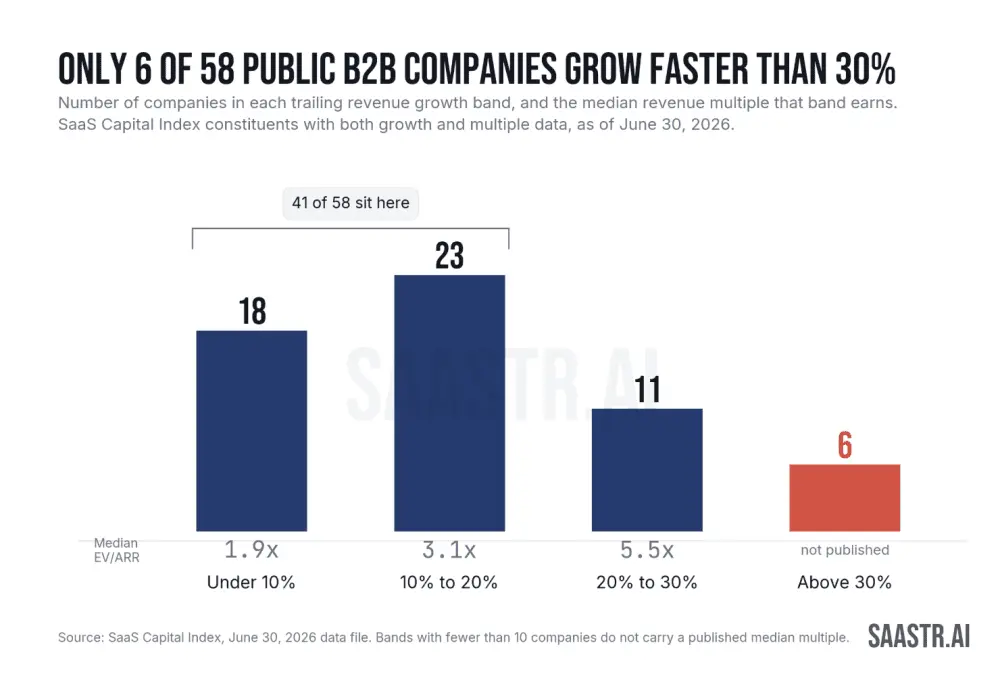
An analysis of the SaaS Capital Index constituents as of June 30, 2026, reveals a dramatic contraction in top-line velocity. Examining 58 public B2B software companies with verified growth and multiple data points highlights an unmistakable trend: the 60%+ public growth cohort has effectively disappeared.
The distribution of growth rates among public companies clusters overwhelmingly in the lower brackets:
- Under 10% Growth: Heavily penalized by the market, trading at depressed valuation multiples around 1.9x ARR.
- 10% to 20% Growth: The new baseline for many mature companies, commanding multiples hovering near 3.1x ARR.
- 20% to 30% Growth: Representing the upper quartile of public scale performance, rewarded with multiples around 5.5x ARR.
PitchBook and SaaS Capital Insights
Private market data mirrors this public compression. PitchBook’s Q2 2026 comp sheet estimates median 2026 revenue growth at a modest 13.2% (a slight uptick from 12.2% in Q1). A closer sector-by-sector breakdown reveals severe divergence:
- High-Performing Sectors: DevOps, ITOps, and developer/automation platforms lead the market with a median growth rate of 21.9%. These platforms solve infrastructural bottlenecks that directly reduce corporate headcount expenses or accelerate engineering velocity.
- Lagging Sectors: CRM, sales, marketing, customer experience (CX), collaboration, and productivity tools languish at the bottom of the growth table. These categories are deeply tied to per-seat pricing models, making them acutely vulnerable to AI-driven workforce efficiencies.
Private B2B data compiled by SaaS Capital for 2026 shows bootstrapped companies operating at a median growth rate of 20%, while equity-backed private peers sit at 25%. For a CEO currently struggling to break past an 18% growth ceiling, the uncomfortable reality is that they are merely performing at the market median—a fact rarely spoken aloud in boardrooms.
| Growth Rate Band | Public Valuation Multiple (Approx.) | Market Sentiment & Pressure |
|---|---|---|
| > 60% | Extinct / Non-Existent | Unattainable under legacy operating models; requires net-new AI architecture. |
| 20% – 30% | 5.5x ARR | The benchmark for healthy scale; requires aggressive structural execution. |
| 10% – 20% | 3.1x ARR | The danger zone; a minor slip in growth cuts enterprise value in half. |
| < 10% | 1.9x ARR | The distressed asset tier; highly vulnerable to private equity distressed buyouts. |
Official Statements & Industry Perspectives
Industry leaders, venture capitalists, and market analysts have been remarkably candid about the psychological and structural toll this transition is exacting on the technology sector.
The Myth of the "Easy" AI Feature Drop
Founders frequently ask why deploying AI features has failed to spark revenue acceleration. Industry veterans point to four structural impediments that prevent surface-level deployments from moving financial metrics:
- The Flawed Pricing Unit: If a software product charges per seat, and an AI agent makes each human employee twice as productive, the software vendor has effectively engineered a tool that shrinks its own billing base. Companies that have successfully navigated this transition have abandoned pure per-seat pricing in favor of consumption, outcome-based, or value-metric pricing models.
- Workflow Bolt-Ons vs. Workflow Elimination: Adding a conversational helper to a screen that a human still has to manually navigate is merely a feature enhancement. True AI transformation requires removing the screen entirely. Most organizations resist this because it fundamentally breaks their legacy organizational charts and product hierarchies.
- The Broken Data Layer: Nearly every ambitious AI rollout hits the same foundational wall: messy, unstructured, and unmaintained enterprise data. Stale records, duplicate database entities, and neglected fields are invisible to human workers but catastrophic for autonomous AI agents operating in production.
- Misaligned Go-To-Market (GTM) Motions: Selling software outcomes to a budget-holder accustomed to buying software seats requires an entirely different sales narrative, a different buyer champion, and a radically restructured pricing conversation.
The Temptation to Walk Away
As private equity firms circle distressed SaaS assets trading at 3x multiples, the temptation for founders to "leave the keys on the table" has never been higher. Stepping down, taking a modest buyout, and handing operations over to an incoming professional CEO looks increasingly attractive after two grueling years of public scrutiny and compressed margins.
However, industry veterans caution against premature exits. Incoming operators frequently lack the foundational intuition required to protect a company’s long-term distribution engines. When a new management team takes over a half-finished AI rebuild, they often view experimental R&D investments through a purely spreadsheet-driven lens. They cut AI budgets to preserve gross margins, failing to recognize the strategic mechanisms built by founders who spent years understanding why their products mattered in the first place.
Future Outlook: Surviving the 40% Mark
As the software industry pushes deeper into the latter half of the decade, the path forward is clear, albeit brutally demanding.
The 40% Reality Check
CEOs must accept that being 40% of the way through a fundamental architectural rebuild after two years of intense effort is not a sign of failure—it is the operational norm. Rebuilding a SaaS business from the ground up while maintaining ongoing revenue streams, managing board expectations, and competing against agile venture-backed startups is arguably the hardest challenge in the history of enterprise software.
Category Ownership in the Next Decade
The enterprises that ultimately survive this crucible will not necessarily be the ones that started with a blank slate. Instead, they will be the incumbent players who lingered at the 40% mark, absorbed the operational pain, modernized their data layers, rewrote their pricing models, and refused to hand over the keys prematurely.
For the founders still in the trenches answering board inquiries about mid-teens growth rates, the message is resolute: keep going. Those who successfully complete the remaining 60% of their AI rebuild will not merely survive the current market correction; they will command and dominate their respective software categories for the next ten years.