Executive Overview
For a quarter of a century, the landscape of Digital Asset Management (DAM) has been defined by a process of continuous, systemic evolution. From the early days of physical courier services being replaced by File Transfer Protocol (FTP) servers, to the gradual standardization of cloud-based asset repositories, the industry has always been driven by the pursuit of speed and scale. Today, however, the digital asset ecosystem faces its most profound paradigm shift yet. Artificial Intelligence has entered the archive, capable of reading, tagging, processing, and cross-referencing millions of digital objects faster than any human workforce ever could.
In a provocative and timely new essay published on DAM News, veteran industry expert Laurent Groult confronts an existential question that many organizations are quietly dancing around: If artificial intelligence can generate metadata at machine scale, does the modern DAM librarian still have a job?
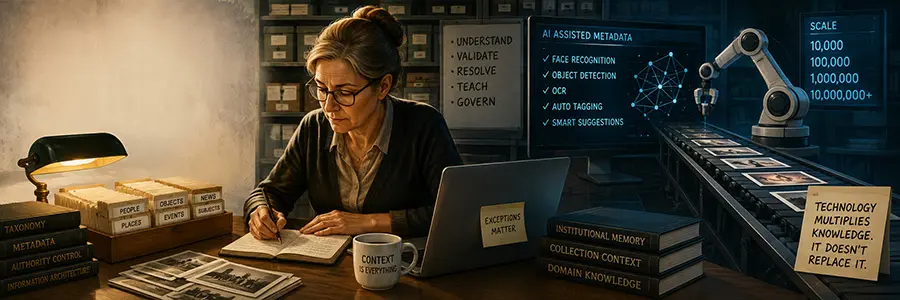
Drawing upon twenty-five years of frontline industry experience, Groult’s analysis cuts through the hype cycles currently dominating enterprise technology circles. He argues that the true value of a DAM professional was never found in the physical act of typing metadata into entry fields, but rather in the years of accumulated, nuanced judgment regarding an object, catalogue, or collection. While AI can scale this capability, it can only do so effectively if a human expert has first taught the algorithm what "correct" actually means.
Without this vital human oversight, the rapid deployment of AI-driven metadata generation shifts from a productivity driver to an enterprise-wide liability. As organizations rush to automate their archival workflows, Groult issues a stark warning: the greatest danger to modern information management is not that artificial intelligence will replace the people who understand our archives, but that corporate leadership will mistakenly believe it already has.
Detailed Chronology: The Evolution of DAM and the Rise of Machine-Scale Archives
To understand the weight of Groult’s observations, it is necessary to examine how the role of the archivist and DAM librarian has shifted alongside technological revolutions over the last twenty-five years.
Era 1: The Manual Foundation (Late 1990s – Early 2000s)
In the early days of digital asset management, physical media—such as tapes, slides, and hard drives—were supplemented or replaced by basic digital storage systems. The introduction of FTP drastically reduced the friction of moving heavy media files across geographic distances. However, organizing these assets remained an intensely manual, labor-intensive endeavor. Librarians and catalogers spent countless hours hand-typing descriptions, keywords, and copyright data into early database schemas. The bottleneck of the era was storage capacity and transfer speed, but the quality of organization relied entirely on human diligence.
Era 2: The Rise of Structured Taxonomies (2000s – 2010s)
As digital collections exploded in volume, simple folder structures gave way to sophisticated, enterprise-grade DAM platforms. This period formalized the profession of the DAM librarian. Professionals were tasked with designing robust taxonomies, metadata schemas (such as IPTC, EXIF, and Dublin Core), and strict governance models. The librarian’s primary value shifted from mere data entry to structural information architecture—ensuring that marketing teams, legal departments, and external partners could reliably find what they needed amidst terabytes of content.
Era 3: The Automation and Cloud Shift (2010s – Early 2020s)
Cloud computing transformed DAM from an on-premise infrastructural challenge to an accessible, software-as-a-service (SaaS) utility. Basic automation scripts began handling repetitive tasks, such as automated batch resizing, file format conversions, and primitive optical character recognition (OCR). Yet, semantic tagging—understanding what an image meant in a cultural, historical, or brand context—remained stubbornly human-centric.
Era 4: The Generative AI Turning Point (Present Day)
The current era is characterized by multimodal AI models capable of computer vision, natural language processing, and deep contextual inference. Modern AI can analyze an image, recognize faces, infer emotional resonance, draft alt-text, and apply complex taxonomical tags in milliseconds. This technological leap has rendered traditional, manual cataloging methods economically obsolete for high-volume operations. Consequently, the profession has reached a critical historical crossroads: adapt to the role of AI orchestration or face institutional obsolescence.
Supporting Context & Metrics: The Mathematics of Machine-Scale Error
A central pillar of Groult’s argument revolves around the concept of scale. In human-operated archiving environments, error is an expected, manageable constant. A cataloger working through a high-volume backlog might mislabel a handful of photographs due to fatigue or oversight. These errors, while unfortunate, are typically isolated, localized, and easily corrected during routine quality assurance checks.
When automation is introduced without rigorous governance, however, the geometry of error changes fundamentally. As Groult notes in his essay:
"A human being can make an error on fifty photographs during an afternoon of cataloguing. A machine can make the same error on five million assets before lunch."
This quote underscores the terrifying multiplier effect of automated systems. If a computer vision model misinterprets a brand logo, misidentifies a regulated pharmaceutical compound, or applies incorrect licensing rights to a digital asset, that single systemic misinterpretation is instantly propagated across millions of records.
The downstream consequences of such errors extend far beyond messy spreadsheets. In enterprise environments, corrupted metadata translates directly into:
- Compliance and Legal Exposure: Mis-tagged rights management data can lead to copyright violations, unauthorized commercial use, and severe financial penalties.
- Brand Erosion: AI hallucinations or biased tagging can introduce offensive or inaccurate representations of products and people into public-facing collateral.
- Search Degradation: Bloated, inaccurate metadata pollutes search algorithms, rendering internal assets functionally unfindable and destroying employee productivity.
Therefore, the introduction of AI does not eliminate the need for human quality control; it exponentially increases the stakes of that oversight. The DAM librarian transitions from a frontline data entry clerk to a high-level data steward and quality gatekeeper.
Expert Perspectives and Strategic Implications
Industry analysts and information architects have increasingly echoed Groult’s sentiments regarding the shifting nature of knowledge work. The consensus emerging across the enterprise technology sector is clear: automate the work, preserve the knowledge.
Organizations often fall into the trap of viewing AI as an out-of-the-box replacement for domain expertise. They assume that feeding an archive into a commercial large language model or computer vision platform will instantly yield a perfectly organized, searchable knowledge base. In practice, generic AI models lack the nuanced institutional memory, contextual history, and brand-specific idiosyncrasies that make an enterprise archive valuable.
Groult addresses this directly by reframing how organizations should value their human talent:
"There is very little value in asking a talented person to spend eight hours performing a repetitive task that a machine can complete in minutes. There is enormous value, however, in asking that same person to spend those eight hours teaching the machine what it does not know."
This perspective highlights a critical pivot in organizational strategy. The time reclaimed from the automation of manual tagging should not be used to downsize archival teams; rather, it should be reinvested into higher-order curation, ontology development, and machine training. Librarians must become prompt engineers, data ethicists, and semantic architects who actively supervise and refine the algorithms shaping their corporate memory.
Furthermore, the traditional apprenticeship model—where junior librarians learned the intricacies of a specific collection by manually processing records one by one—is rapidly disappearing. Organizations must consciously engineer new ways to pass down institutional knowledge to newer professionals, ensuring that the human intuition required to validate machine outputs is not lost as senior archivists retire.
Future Outlook: The Road Ahead for Digital Asset Management
As artificial intelligence continues to mature, the role of the DAM professional will undoubtedly transform, but its core importance to the enterprise will only deepen. Organizations that successfully navigate this transition will be those that view AI not as a replacement for human librarians, but as a hyper-efficient engine that requires expert steering.
Looking toward the future, several key trends are likely to shape the DAM landscape:
- The Rise of Semantic Governance: As AI-generated metadata floods repositories, the demand for sophisticated governance frameworks will skyrocket. Organizations will require dedicated professionals to audit AI outputs, monitor for algorithmic drift, and maintain the integrity of enterprise taxonomies.
- Contextual AI Training as a Core Competency: Future DAM roles will place a heavy emphasis on training and fine-tuning domain-specific models. Librarians will act as subject-matter authorities who supply AI systems with the proprietary, contextual knowledge that web-scraped models cannot possibly possess.
- Redefining ROI on Archival Labor: Enterprise leadership must shift metrics of success away from "assets processed per hour" toward "accuracy, compliance, and discoverability index."
Laurent Groult’s contribution to DAM News serves as both a wake-up call and a roadmap. The physical keyboard may fade into obsolescence as automated ingestion pipelines take over the heavy lifting of data entry, but the human intellect behind the archive is more critical than ever.
As organizations chart their path forward in an increasingly automated world, they would do well to heed Groult’s concluding warning:
"The greatest danger is not that artificial intelligence will replace the people who understand our archives. It is that organizations will believe it already has."