








Executive Overview
While Silicon Valley remains locked in a high-stakes, hyper-competitive footrace over raw algorithmic performance, parameter counts, and benchmark dominance, Google is quietly capitalizing on an asset its rivals cannot easily replicate: the deep, historic repository of personal and professional data accumulated across its sprawling ecosystem.
Although models from competitors like OpenAI, Anthropic, and Meta frequently outpace Google’s Gemini in specific coding, reasoning, or creative benchmarks, Google maintains a structural moat that is difficult to disrupt. If a user is embedded within the Google ecosystem—utilizing Gmail for communication, Google Calendar for scheduling, Google Drive for document storage, and Android for mobile computing—Gemini models already possess an intricate, deeply contextualized portrait of that individual’s daily life, habits, professional commitments, and preferences.
Now, Google is dramatically scaling the aperture of this capability. Through its latest Google Labs experimental initiative—simply designated as CC—the technology giant is moving beyond individual-centric artificial intelligence assistants. CC is engineered to extend hyper-customized, data-informed AI utility out of the individual silo and directly into the heart of the modern household. Designed to function as a collaborative, shared resource for up to six family members, CC represents a calculated strategic leap toward embedding generative AI into the foundational logistics of domestic life.
Building upon prior iterations initially conceptualized in 2025—which ultimately materialized as Gemini’s personalized "Daily Brief"—CC transforms ambient household management. It acts as an autonomous, centralized coordinator capable of parsing emails, synchronizing schedules, managing shared document repositories, and synthesizing chaotic domestic calendars into coherent, actionable morning briefings. However, as Google invites artificial intelligence deeper into the domestic sphere, the platform also forces a critical industry-wide conversation regarding privacy boundaries, family data governance, and the evolving psychological comfort levels of users sharing their digital footprints with automated agents.
Detailed Chronology: From Individual Briefs to Shared Domestic AI
To fully understand the significance of the CC experiment, it is necessary to examine the evolutionary trajectory of Google’s context-aware productivity tools over recent years.
The Genesis: 2025 Explorations and the "Daily Brief"
The foundational architecture of CC traces back to experimental concepts introduced by Google Labs in 2025. During this developmental phase, engineers and UX researchers sought to address a fundamental friction point in modern digital existence: information fragmentation. Users were perpetually jumping between disparate communication channels—email threads, messaging apps, calendar invites, and cloud storage folders—to piece together their daily schedules.
The initial experiments eventually coalesced into a commercial feature within the broader Gemini ecosystem known as the "Daily Brief." This tool leveraged advanced retrieval-augmented generation (RAG) and the vast context windows of Gemini models to scan an individual user’s personal Google account data. By processing incoming correspondence, task lists, and calendar appointments, the Daily Brief churned through the digital noise to offer concise, prioritized action items and morning suggestions directly to the user.
While the Daily Brief proved effective for single-user productivity, Google’s product teams quickly recognized a glaring limitation: modern life is rarely lived in isolation. Household management is inherently collaborative. Spouses coordinate work hours, childcare, and grocery runs; parents juggle school permissions, medical appointments, and extracurricular activities for multiple children; roommates share utility bills, chore rosters, and apartment maintenance schedules. An AI assistant restricted to a single individual’s account view could only ever solve a fraction of a household’s operational friction.
The Introduction of Google Labs’ "CC"
Recognizing this collaborative void, Google Labs initiated development on CC as a natural evolution of the Daily Brief concept. Rather than locking context inside individual user accounts, CC was architected as an independent, shared digital entity.
Assigned its own distinct Google account, CC functions effectively as a digital household member or virtual chief of staff. It is designed to scale across groups of up to six users—typically mirroring the cap for Google Family Link groups. This structural design allows multiple individuals to interact with the agent, feed it information, and draw insights from its centralized processing hub, all while maintaining nuanced control over what personal data is exposed to the shared ecosystem.
By shifting the locus of AI interaction from the individual to the household, Google is positioning CC as a bridge between disparate digital lives. The experiment signals a pivot in how tech conglomerates plan to monetize and retain ecosystem loyalty: not merely by offering superior reasoning capabilities, but by becoming indispensable to the foundational logistics of family infrastructure.
Architectural Mechanics: How CC Operates Within the Household
The engineering behind CC requires a delicate balance between total utility and rigorous privacy controls. Because a shared AI agent inherently risks becoming an intrusive surveillance vector within a family home, Google has implemented a granular permission framework governing how CC ingests, processes, and exposes data.
Independent Identity and Explicit Opt-Ins
Unlike a global system that automatically scans all linked accounts, CC operates on a strict opt-in architecture. The agent maintains its own dedicated Google account, serving as a neutral broker between participating family members.
Crucially, CC does not possess an all-seeing eye over every user’s private correspondence. By default, the AI agent is blind to the personal emails, messages, and files of the connected family members. Data sharing requires deliberate, explicit action. Users can designate specific email addresses or domains as permanently available to the CC agent—establishing automated pipelines for predictable logistical traffic, such as school scheduling notifications, pediatrician appointment confirmations, or youth sports league updates.
Multi-Modal Data Ingestion
CC is built to ingest information across a wide spectrum of digital touchpoints, transforming unstructured domestic data into structured operational awareness:
- Targeted Email Forwarding: Family members can actively forward relevant emails, travel confirmations, or event flyers directly to CC’s designated inbox.
- Google Chat Integration: Users can message CC directly via Google Chat to add fleeting thoughts, impromptu reminders, or last-minute schedule changes on the fly.
- Shared Google Drive Monitoring: One of the most powerful administrative features of CC is its ability to monitor a designated shared Google Drive folder. Families can dump unstructured documents into this repository—ranging from school permission slips and tax forms to wedding invitations and household appliance manuals. CC indexes these files, extracting key dates, action items, and relevant details automatically.
The "Your Day Ahead" Synthesis
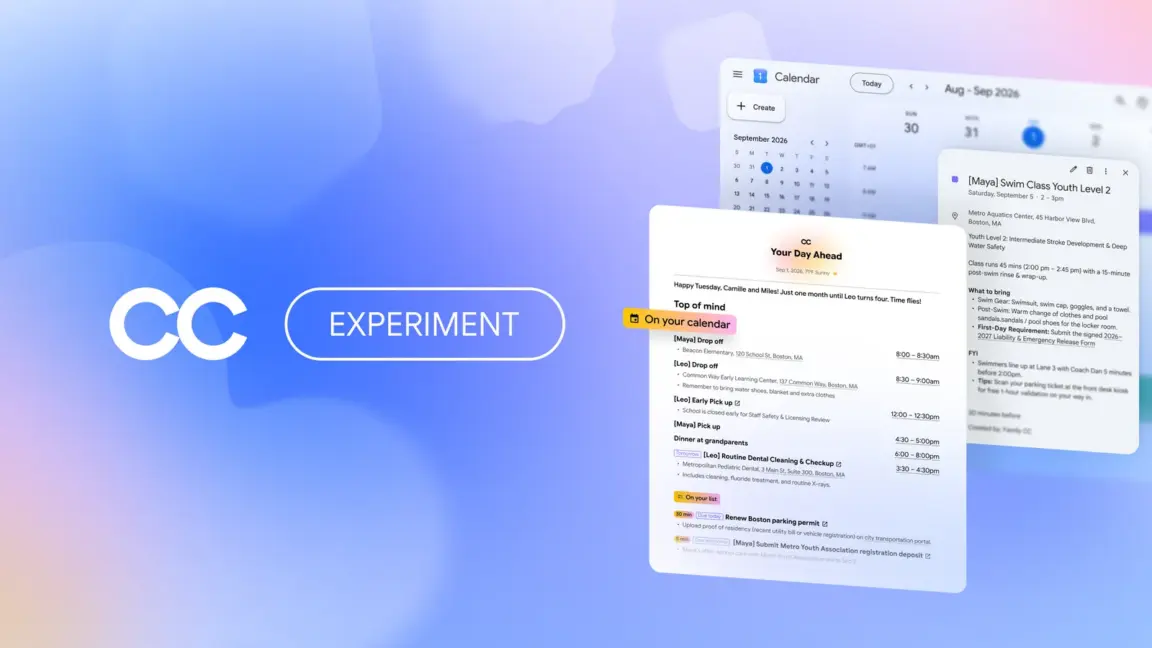
The culmination of this data ingestion process is CC’s flagship daily deliverable: the "Your Day Ahead" briefing.
Delivered directly to the inboxes of all registered family members each morning, the brief serves as an executive summary of the household’s immediate future. It synthesizes intersecting schedules, highlights looming deadlines, tracks the status of previous tasks, and flags logistical conflicts (such as two family members needing transportation at overlapping times). Furthermore, CC can autonomously write items to shared family calendars, generate collaborative task reminders, and draft documents—such as grocery lists, packing itineraries, or chore schedules—based on conversational instructions provided by any of the six authorized users.
Supporting Context & Metrics: The Ecosystem Moat and Domestic AI Market
To appreciate the strategic weight of Google Labs’ CC experiment, it is essential to analyze the broader macroeconomic and technological landscape surrounding consumer artificial intelligence.
The Battle for the Consumer Ecosystem Moat
For the past three years, the generative AI narrative has been dominated by frontier model capabilities. OpenAI’s GPT-4o, Anthropic’s Claude 3.5 Sonnet, and open-weight models from Meta have engaged in a relentless leap-frogging contest over coding benchmarks, advanced mathematics, and complex multi-step reasoning.
However, industry analysts increasingly point out that raw model intelligence is rapidly commoditizing. As open-source and proprietary models converge on high levels of general competence, the true competitive differentiator is no longer how smart an AI is, but how much relevant context it possesses about the user.
Google’s historical investments in consumer productivity tools give it a staggering advantage in this arena. Consider the footprint of the Google ecosystem:
- Gmail: Over 1.8 billion active global users.
- Google Drive: Surpassed 2 billion active users handling enterprise and personal cloud storage.
- Google Calendar & Photos: Billions of active touchpoints recording daily human behavior, relationships, travel, and milestones.
By introducing CC, Google is weaponizing this ecosystem advantage. Competitors like OpenAI can build exceptional conversational agents, but without deep, native hooks into a user’s email archive, cloud storage, and calendar history, standalone applications require tedious manual data input. Google’s strategy relies on seamless, frictionless integration: the data is already there; CC simply unlocks it and applies it collaboratively.
The Rise of Domestic and Collaborative AI
The household management sector has long been a holy grail for consumer technology companies. From the initial wave of smart speakers powered by Amazon Alexa and Google Assistant to dedicated smart home display hubs, tech giants have spent billions trying to anchor themselves in the family kitchen and living room.
Yet, previous-generation voice assistants largely stagnated. Restricted by brittle natural language understanding, reactive command-and-control paradigms, and an inability to reason across complex, unstructured documents, tools like Alexa and Google Assistant frequently devolved into glorified kitchen timers and weather reporters.
Generative AI changes this dynamic fundamentally. An agent powered by advanced large language models can perform semantic analysis on a chaotic PDF school calendar, negotiate scheduling conflicts across multiple human participants, and generate nuanced, human-like summaries of domestic responsibilities. By packaging these capabilities into a collaborative group structure, Google is attempting to pivot the smart home narrative away from hardware novelty and toward cognitive utility.
Official Statements and Industry Perspective
While Google has framed CC as an exciting step forward in ambient computing and family organization, the introduction of a multi-user, data-aggregating AI agent has naturally ignited intense discussions surrounding privacy, digital boundaries, and corporate data governance.
In accompanying documentation and blog posts detailing the Google Labs expansion, product leads emphasize that user autonomy and consent form the bedrock of CC’s design philosophy.
"CC is built from the ground up to respect the complex social dynamics of a household," notes a Google Labs product brief. "We recognize that families are not monolithic entities; they are collections of individuals with distinct boundaries, privacy expectations, and communication styles. By making CC an independent participant with strictly opt-in visibility, we ensure that family members retain absolute sovereignty over their personal digital lives while unlocking the undeniable benefits of automated household coordination."
However, independent privacy advocates and cybersecurity researchers have expressed cautious skepticism regarding the long-term implications of shared domestic AI models.
Dr. Elena Rostova, a senior researcher at the Digital Rights Institute, highlighted the psychological and operational complexities introduced by shared AI entities. "When you introduce an artificial intelligence agent that sits at the intersection of six family members’ data streams, you create a fascinating new vector for domestic friction," Dr. Rostova explained in an interview. "Even with strict opt-in rules, the margin for accidental data leakage—where sensitive personal correspondence, medical information, or private conversations are inadvertently pulled into a shared ‘Day Ahead’ summary—is non-zero. The challenge for Google will not merely be technical compliance, but maintaining the trust of every single participant in the family group over time."
Furthermore, industry analysts have noted that CC represents a clever user-acquisition and retention funnel. By anchoring an entire family unit to a shared Google Labs experiment that dictates their morning logistics, Google increases the switching costs for every member of that household. Disentangling a family from an ecosystem that successfully manages their school schedules, travel itineraries, and grocery lists is significantly more difficult than convincing a single user to abandon a standalone chatbot application.
Future Outlook: Where Shared AI Goes From Here
As CC rolls out through Google Labs to early adopters and experimental user groups, its trajectory will likely serve as a bellwether for the future of consumer AI applications. Several key trajectories will define the evolution of this technology over the coming years:
1. Granular Access Controls and Enterprise-Grade Family Governance
As families test the limits of CC, demand will inevitably grow for more sophisticated permission tiers. Future iterations will likely feature granular role-based access control (RBAC) adapted for the household—allowing parents to share specific administrative data streams while preserving teenage privacy, or enabling roommates to wall off personal financial correspondence from shared utility tracking.
2. Deep Integration with Wearables and Ambient Hardware
Currently operating primarily through email, chat, and cloud storage folders, the logical next step for CC is deep integration with ambient hardware. Imagine a future where CC interacts natively with Google Pixel devices, Android tablets, Nest smart displays, and wearable health trackers. A morning brief could expand from a written email to an ambient audio briefing delivered to a smart speaker while the family prepares breakfast, dynamically adjusting to real-time location data and biometric schedules.
3. Autonomous Action and Proactive Problem Solving
Today’s iteration of CC focuses primarily on information synthesis, task reminding, and document generation. The next frontier for domestic AI agents is autonomous execution. Rather than simply reminding a family that a utility bill is due or that soccer registration forms are sitting in Google Drive, future iterations of CC may possess secure authorization to complete transactions, book appointments, coordinate with third-party service providers, and execute multi-step administrative workflows on behalf of the household.
Conclusion
Google Labs’ CC experiment underscores a vital reality of the current artificial intelligence landscape: the war for consumer loyalty will not be won solely in the server farms training frontier models, but in the nuanced, messy architecture of everyday human life. By bridging the gap between massive personal data repositories and collaborative family logistics, Google is attempting to turn its greatest historical asset—the deep context of our digital lives—into an indispensable utility for the modern household. Whether users are ultimately willing to invite an AI coordinator into the inner sanctum of family organization remains to be seen, but the frontier of shared domestic intelligence has officially been drawn.