Executive Overview
The landscape of Digital Asset Management (DAM) is undergoing a structural paradigm shift. For over twenty-five years, industry veteran Laurent Groult has observed the architecture of digital archives evolve from physical media and early FTP file transfers to modern cloud-hosted ecosystems. Today, the field faces its most disruptive wave yet: generative and analytical artificial intelligence capable of reading, tagging, interpreting, and cross-referencing vast digital repositories at speeds unimaginable to human operators.
In a provocative new feature for DAM News titled "The Librarian Isn’t Disappearing, The Keyboard Is," Groult tackles the existential question reverberating across the information science sector: If AI can generate metadata at machine scale, does the DAM librarian still have a job?
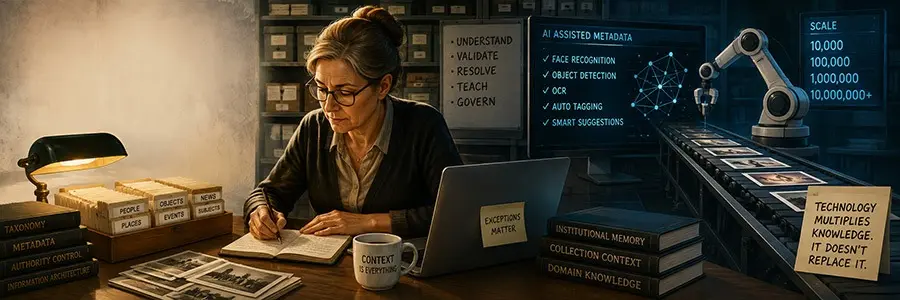
Groult’s analysis argues that the industry has historically misjudged the value of information professionals by tying their worth to their most visible, easily automated task—data entry. However, the true value of a DAM librarian has never resided in keystrokes. Instead, it lies in the decades of accumulated, highly nuanced judgment regarding contextual cataloguing, taxonomy design, intellectual property constraints, and organizational history. While AI can scale metadata generation, it lacks intrinsic comprehension of what "correct" means within a specific enterprise ecosystem.
Without human oversight, raw computational speed does not equal efficiency; rather, it equals risk multiplied exponentially. As organizations rush to embrace automation to cut costs and accelerate workflows, Groult issues a timely warning: the greatest danger to modern digital asset management is not that artificial intelligence will replace the human archivist, but that corporate leadership will mistakenly believe it already has.
Detailed Chronology: From Couriers to Cognitive Automation
To understand the weight of Groult’s current assessment, it is necessary to examine the historical trajectory of Digital Asset Management. The profession has transformed through distinct technological eras over the past quarter-century:
Phase 1: The Analog-to-Digital Transition (Late 1990s – Early 2000s)
In the nascent days of commercial DAM, the primary bottleneck was physical logistics. High-resolution imagery, video masters, and marketing collateral were moved via physical couriers, magnetic tapes, and early FTP (File Transfer Protocol) servers. Librarians and archivists served as gatekeepers of physical and early digital file systems. Their primary role was establishing rigid folder structures, managing rudimentary file naming conventions, and manually keying primitive metadata—such as titles, creation dates, and basic keywords—into early database schemas.
Phase 2: The Structured Database Era (2000s – 2010s)
As digital file sizes swelled and enterprise asset libraries expanded from thousands of items to millions, dedicated DAM software platforms matured. This era saw the standardization of embedded metadata schemas (such as IPTC and Exif standards) and the rise of complex relational databases. Librarians evolved into taxonomy architects and metadata strategists, building controlled vocabularies and multi-tiered taxonomies to ensure internal teams could locate assets efficiently across global enterprises. Data entry, however, remained largely manual, labor-intensive, and time-consuming.
Phase 3: The Cloud and Collaborative Boom (2010s – Early 2020s)
Cloud computing transformed DAM from on-premises storage solutions into ubiquitous, web-accessible ecosystems. Real-time collaboration, global brand-asset distribution, and multi-channel marketing campaigns demanded instantaneous access to digital inventory. The sheer volume of assets outpaced manual cataloguing capacities. Organizations began seeking ways to accelerate ingest processes, leading to early, rudimentary attempts at automated tagging, which were often plagued by false positives and rigid, brittle rule-based engines.
Phase 4: The Generative and Cognitive AI Era (Present Day)
Today, DAM systems are infused with advanced Computer Vision (CV), Large Language Models (LLMs), and multimodal AI systems. These tools can instantly scan complex images, interpret video transcripts, extract brand elements, and synthesize descriptive metadata in seconds. Tasks that once took an army of interns weeks of manual data entry are now executed programmatically. It is this exact technological milestone that prompted Groult to re-evaluate the core competencies of the modern information professional.
Supporting Context & Metrics: The Mathematics of Machine-Scale Error
The core thesis of Groult’s argument rests on an uncomfortable economic and operational reality: the magnification of error.
The Scale Asymmetry
In traditional, human-driven cataloguing environments, human error is an accepted, manageable variable. A skilled cataloguer operating at peak efficiency might misattribute a keyword, misread a date, or misfile a batch of fifty photographs during an exhaustive afternoon session. These errors, while unfortunate, are typically localized, discoverable during quality assurance audits, and easily corrected.
When artificial intelligence enters the equation, the operational parameters shift dramatically. As Groult points out:
"A human being can make an error on fifty photographs during an afternoon of cataloguing. A machine can make the same error on five million assets before lunch."
The Hidden Costs of Unchecked Automation
Enterprise organizations adopting AI-driven metadata generation often focus exclusively on immediate labor cost reductions—calculating the hours saved by eliminating manual data entry. However, this narrow financial perspective ignores the long-term systemic costs of low-quality or hallucinated metadata:
- Search Degradation: Inaccurate tags pollute search algorithms, leading internal teams, creative agencies, and external clients to dead ends, ultimately lowering enterprise productivity.
- Licensing and Compliance Exposure: If an AI miscategorizes a copyrighted asset, or fails to recognize a restricted likeness or expiring model release, the organization can face severe legal liabilities, copyright infringement penalties, and breach-of-contract lawsuits.
- Brand Trust Erosion: Delivering incorrect assets to external partners or publishing improperly tagged marketing materials damages institutional reputation and client trust.
- The Disappearing Apprenticeship: Historically, junior librarians learned the intricacies, quirks, and hidden depths of an organization’s archive by performing the slow, deliberate work of cataloguing items one by one. By automating this foundational step entirely, organizations risk destroying the natural pipeline that trains the next generation of deep archive specialists.
Expert Insights and Official Perspectives
Industry reactions to Groult’s feature in DAM News have highlighted a growing consensus among enterprise information architects: AI must be viewed as an accelerator of tedious labor, not a replacement for contextual intelligence.
Redefining the Role: From Typist to Teacher
The traditional image of the librarian as a passive custodian sitting behind a keyboard is obsolete. The keyboard is vanishing because the rote execution of repetitive data entry is now a machine task. However, the expertise required to govern data structures, design ethical AI guardrails, and train neural networks is more vital than ever.
Groult eloquently summarizes this shift in perspective:
"There is very little value in asking a talented person to spend eight hours performing a repetitive task that a machine can complete in minutes. There is enormous value, however, in asking that same person to spend those eight hours teaching the machine what it does not know."
Contextual Knowledge vs. Pattern Recognition
Artificial intelligence excels at pattern recognition—identifying pixels, matching audio frequencies, and clustering semantic text. Yet, AI fundamentally lacks institutional memory, cultural nuance, and domain-specific context.
- An AI can identify that an image features a specific historical landmark, but it may not know the internal corporate significance of that landmark regarding a company’s founding history.
- An AI can tag a corporate executive in a legacy video, but it cannot intrinsically understand proprietary project code names, unwritten brand guidelines, or sensitive historical controversies associated with that asset.
This is where the DAM librarian transitions into a Metadata Ethicist and AI Trainer. Organizations must invest in human capital to feed proprietary taxonomies, business rules, and qualitative context into AI training loops, ensuring that automated systems reflect the true operational reality of the enterprise.
Future Outlook: The Resilient Enterprise Archive
As digital asset ecosystems expand toward petabyte scales, the future of Digital Asset Management will not be determined by whether organizations adopt AI, but by how they govern it.
Key Imperatives for DAM Leaders in the AI Era:
- Shift Focus from Ingest to Governance: Information professionals must pivot away from spending time on manual data entry and focus heavily on metadata governance, taxonomy integrity, and algorithmic auditing.
- Establish Human-in-the-Loop (HITL) Frameworks: Automated asset ingestion must always be paired with structured human review thresholds, particularly for high-risk, high-value, or legally sensitive assets.
- Upskill Information Professionals: Organizations must actively train existing librarians in AI prompt engineering, metadata schema tuning, and machine learning oversight, bridging the gap between library science and data science.
- Preserve Institutional Memory: Companies must actively document tribal knowledge and archive context in structured formats that can be leveraged to train custom enterprise AI models, ensuring that institutional history is not lost as senior staff transition.
Conclusion
Laurent Groult’s contribution to DAM News serves as both a wake-up call and a roadmap for the information science community. The future of Digital Asset Management does not rely on resisting technological automation, nor does it rely on blindly surrendering archives to algorithms.
The true competitive advantage belongs to organizations that understand a fundamental truth: automate the work, but preserve the knowledge. By removing the keyboard from the librarian’s desk while elevating their role to system architect and AI mentor, enterprises can build resilient, intelligent archives capable of surviving and thriving in the decades to come.
For further reading and to explore the complete analysis, access the original feature by Laurent Groult directly on Digital Asset Management News.