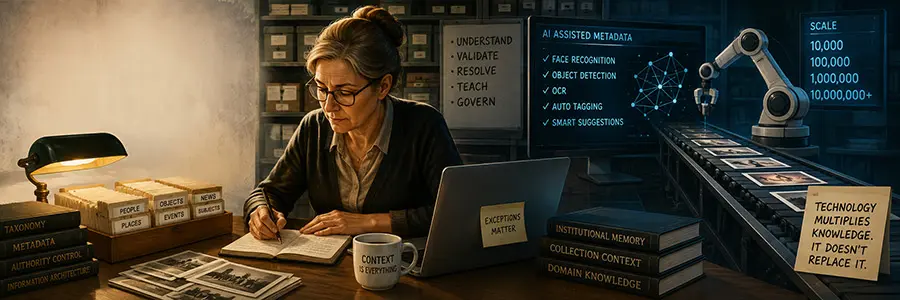
Executive Overview
For a quarter of a century, the landscape of Digital Asset Management (DAM) has undergone a relentless, structural metamorphosis. Industry veteran Laurent Groult, reflecting on twenty-five years at the forefront of the field, has witnessed the entire arc of modern archiving: from the crude days of FTP servers replacing physical couriers on bicycle, to the present era where generative artificial intelligence and computer vision models read, tag, and cross-reference massive visual archives faster than any human team ever could.
Yet, as enterprise organizations rush to embrace machine-speed workflows, a profound existential question hangs over the industry—one that professionals have danced around for the past few years: If artificial intelligence can generate robust metadata at a scale previously thought impossible, does the traditional DAM librarian still have a job?
In his latest provocative contribution to DAM News, titled "The Librarian Isn’t Disappearing—The Keyboard Is," Groult tackles this question head-on. He argues that the industry has fundamentally misunderstood the true value of the information professional. For decades, organizations mistakenly measured the worth of a librarian by their most visible, easily automatable task: typing. But the real, irreplaceable expertise of an archivist was never found in their keystrokes. It was embedded in their years of accumulated, nuanced judgment regarding an object, a historical catalogue, or a complex corporate collection.
While AI can scale cataloging exponentially, it can only do so safely if a human expert has first taught it what "correct" actually means. Without that foundational human guidance, speed does not equal efficiency. Instead, it is risk multiplied by a factor of millions. As organizations weigh the massive cost savings of automation against the integrity of their data, the consensus is shifting: the future of DAM is not about eliminating human intelligence, but about pivoting human labor away from manual execution and toward cognitive curation.
Detailed Chronology: Twenty-Five Years of DAM Transformation
To understand where the industry stands today, one must trace the rapid technological shifts that have redefined the daily life of the digital librarian over the last twenty-five years.
Phase 1: The Analog-to-Digital Bridge (Late 1990s – Early 2000s)
At the turn of the millennium, the primary challenge of asset management was sheer physical transportation and basic digital storage. Physical media—betacam tapes, slides, and heavy slide trays—were slowly being digitized. Archivists acted primarily as digital gatekeepers, using early file transfer protocols (FTP) and rudimentary folder structures to make files accessible across Local Area Networks (LANs). The focus was on preservation and foundational organization.
Phase 2: The Metadata Era and Structured Taxonomy (Mid 2000s – 2010s)
As digital cameras proliferated and rich media production exploded, simple folder structures became wholly inadequate. This era gave rise to dedicated Enterprise DAM systems. Librarians became taxonomy architects and master typists. Manual data entry—filling out Dublin Core schemas, IPTC headers, and custom keyword fields—consumed the vast majority of an archivist’s workday. The "good librarian" was often judged by their throughput: how many assets they could process and tag in an eight-hour shift.
Phase 3: The Cloud and Automated Ingestion (Late 2010s – Early 2020s)
Cloud computing decoupled asset repositories from physical corporate servers. Basic automation scripts began handling batch resizing, file conversion, and rudimentary optical character recognition (OCR). However, semantic understanding—knowing why a particular image mattered to the brand or who was featured in a nuanced historical context—remained strictly within the domain of human specialists.
Phase 4: The Generative AI Paradigm (Present Day)
Today, multimodal AI models can analyze the visual composition, emotional tone, and subject matter of millions of assets simultaneously. Machine learning algorithms can write descriptive alt-text, identify brand logos, and categorize files into complex taxonomies in fractions of a second. The keyboard, as a primary tool for data entry, is becoming obsolete. The modern archivist is no longer evaluated on how fast they can type, but on how effectively they can govern the machine learning models doing the typing for them.
Supporting Context & Metrics: The Danger of Scale Without Judgment
The core thesis of Groult’s commentary focuses on a stark economic and operational reality: the asymmetry of error in the age of generative AI.
In a traditional manual cataloging environment, human error is localized and linear. As Groult writes in his piece:
"A human being can make an error on fifty photographs during an afternoon of cataloguing. A machine can make the same error on five million assets before lunch."
This quote captures the terrifying paradox of automated metadata generation. When an AI model misinterprets a brand logo, misidentifies a regulated chemical compound in an industrial safety video, or applies culturally insensitive tags to global marketing assets, it does not make a singular mistake. It scales that mistake across the entire enterprise repository instantaneously.
The Hidden Costs of Unchecked Automation
- Licensing and Compliance Liabilities: In regulated industries (such as pharmaceuticals, finance, and global media), incorrect metadata can lead to severe legal penalties. If an AI mislabels a piece of licensed stock footage or fails to flag expiring talent rights, the financial exposure across millions of distributed assets can run into the millions of dollars.
- Search Degradation and Retrieval Failure: "Garbage in, garbage out" takes on an entirely new dimension with AI. If automated tagging introduces subtle semantic drift, enterprise search functionality breaks down. Employees spend more time hunting for the correct asset than they would have spent if it had been manually curated from the start.
- The Death of Institutional Memory: Traditionally, junior librarians learned the nuances of a collection through a gradual apprenticeship model—handling records one by one and absorbing the institutional history embedded within them. When automation replaces this tactile onboarding process, organizations risk losing the tacit, unwritten knowledge that contextualizes their digital assets.
Groult’s analysis forces organizations to look beyond the alluring metrics of software vendors—who often market AI as a complete "plug-and-play" replacement for human labor—and confront the compounding risks of unmonitored machine output.
Official Statements and Industry Insights
The discourse sparked by Groult’s article has resonated widely across the Digital Asset Management community, prompting discussions among chief information officers, enterprise architects, and senior librarians alike.
Industry leaders are increasingly warning against the premature elimination of human oversight. While enterprise software budgets are frequently audited to find areas for cost reduction, cutting the information science team to fund purely algorithmic workflows is viewed by veterans as a catastrophic false economy.
"The pitch from tech vendors is seductive," notes one enterprise DAM consultant familiar with Groult’s work. "They tell you that your AI subscription will pay for itself by letting you lay off your cataloging staff. But Laurent is pointing out what happens on day 365, when your taxonomy has drifted, your brand safety parameters have hallucinated, and your corporate history has been flattened into generic machine tags."
Furthermore, the industry is beginning to recognize that data cleansing and AI training are not one-time implementation projects; they are continuous operational requirements. As organizations ingest thousands of new digital assets daily—spanning new product lines, shifting cultural contexts, and evolving compliance regulations—the need for expert human governance only intensifies.
Groult encapsulates this shift in responsibility with a compelling proposition:
"There is very little value in asking a talented person to spend eight hours performing a repetitive task that a machine can complete in minutes. There is enormous value, however, in asking that same person to spend those eight hours teaching the machine what it does not know."
This perspective redefines the librarian’s role from a low-level administrative data entry clerk to a high-level data steward, curator, and machine-learning supervisor.
Future Outlook: The Next Decade of DAM
As we look toward the future of Digital Asset Management, what does the career path of a DAM librarian look like, and how must organizations adapt their internal structures?
1. From Typist to Ontologist and AI Trainer
The skill set required of information professionals is evolving rapidly. Future DAM librarians will spend less time opening IPTC sidecar files and more time designing semantic frameworks, auditing training datasets for algorithmic bias, and establishing guardrails for generative AI tools. They will serve as the bridge between raw algorithmic power and corporate governance.
2. The Rise of Hybrid Archival Workflows
Organizations that successfully navigate the next decade will be those that implement a symbiotic workflow. AI will handle the heavy lifting—initial ingestion, structural file conversion, broad categorization, and basic descriptive tagging. Human librarians will step in for quality assurance, edge-case curation, contextual narrative building, and the preservation of institutional memory.
3. Elevating DAM to a Strategic Enterprise Asset
For years, DAM systems were viewed as glorified digital filing cabinets—back-office tools relegated to the marketing department. As AI transforms these repositories into active engines for business intelligence and brand storytelling, the governance of these assets becomes a C-suite concern. Librarians who embrace their new roles as AI trainers and knowledge architects will find themselves sitting at the strategic decision-making table.
Conclusion: The Ultimate Warning
Laurent Groult’s twenty-five-year perspective serves as both a celebration of technological progress and a sober caution. The evolution of DAM has successfully removed the drudgery of the keyboard, freeing human talent from the mechanical prison of endless data entry.
Yet, the ultimate warning of his thesis remains urgent and clear:
"The greatest danger is not that artificial intelligence will replace the people who understand our archives. It is that organizations will believe it already has."
For enterprise leaders, the path forward requires a balanced approach. Automate the work, certainly—but never automate the knowledge, judgment, and human context that gives your digital assets their true value.