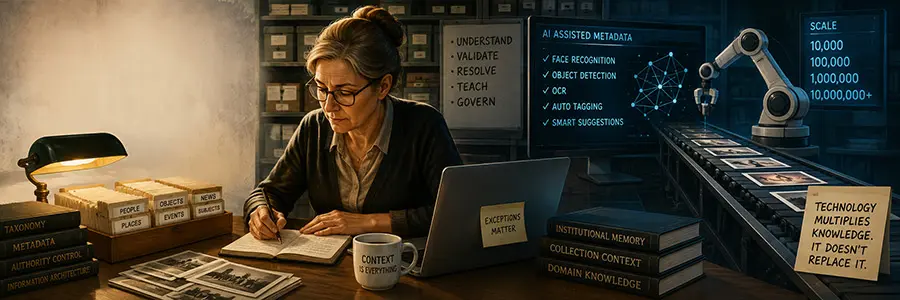
Executive Overview
For a quarter of a century, the landscape of Digital Asset Management (DAM) has undergone a series of relentless transformations. We have journeyed from physical couriers and magnetic tapes to FTP servers, cloud storage, and now, hyperscale artificial intelligence capable of reading, tagging, and cross-referencing vast multimedia archives faster than any human operator could possibly conceptualize.
Yet, as generative AI and machine learning models infiltrate every tier of enterprise data architecture, a pressing existential question hangs over the industry: If AI can generate metadata at machine scale, does the DAM librarian still have a job?
In a compelling new feature for DAM News titled "The Librarian Isn’t Disappearing—The Keyboard Is," veteran DAM expert Laurent Groult tackles this industry-wide anxiety head-on. Drawing on twenty-five years of frontline experience, Groult dismantles the common misconception that the primary value of an archivist lies in manual data entry. Instead, he posits that the true utility of the information professional has always resided in nuanced, contextual judgment—a commodity that is becoming more valuable, not less, in an automated world.
However, Groult issues a stark warning to organizations rushing to slash payroll in favor of automated algorithms. Speed without governance is not efficiency; it is risk multiplied exponentially. As enterprises navigate the shift from manual curation to algorithmic oversight, the role of the DAM librarian is not vanishing—it is undergoing a profound mutation from typist to teacher.
Detailed Chronology: A 25-Year Evolution of the DAM Landscape
To understand the weight of Groult’s assertions, one must trace the arc of Digital Asset Management from its nascent stages to the current era of generative intelligence.
1. The Era of Physical Logistics and Early Digitization (Late 1990s – Early 2000s)
In the infancy of modern media management, the industry relied heavily on physical transport. Couriers delivered hard drives, beta tapes, and optical media. When digital files finally began replacing analog counterparts, File Transfer Protocol (FTP) servers emerged as the high-tech solution for moving massive files across networks. During this era, archives were small enough that basic folder structures and rudimentary spreadsheets could suffice. Librarians were primarily tasked with intake, basic file-renaming, and physical preservation.
2. The Rise of Structured Databases and Proprietary DAMs (2000s – 2010s)
As digital asset production exploded—spurred by the democratization of high-definition digital cameras and enterprise marketing automation—simple folder hierarchies broke down. The industry saw the birth of dedicated, enterprise-grade DAM platforms. Taxonomy design, metadata schema enforcement (such as IPTC and Dublin Core), and rigid permission controls became the order of the day. The librarian’s role shifted from a passive custodian to an active architect of structural data, spending countless hours manually populating fields, tagging assets, and standardizing vocabularies.
3. The Cloud Migration and Scale Crisis (2010s – 2020)
Cloud infrastructure decoupled storage limits from physical hardware, leading to an exponential surge in data volume. Organizations began hoarding every piece of digital collateral generated, operating under the assumption that storage was cheap and searchable. Unfortunately, searchability without rigorous metadata quickly degrades into digital landfills. Librarians were overwhelmed by the sheer velocity of incoming assets, leading to widespread bottlenecks as human cataloging failed to keep pace with production cycles.
4. The Algorithmic Disruption and AI Integration (2020 – Present)
Enter computer vision, natural language processing, and generative AI. Modern DAM systems can now ingest an image, detect objects, read embedded text, recognize faces, and automatically draft descriptive metadata in milliseconds. This technological leap has triggered panic among information professionals who fear obsolescence. Yet, as Groult points out, this transition marks the death of the keyboard, not the librarian. The battleground has shifted from execution to curation, and from processing to teaching.
Supporting Context & Metrics: The Mathematics of Machine Error
The core thesis of Groult’s commentary rests on an uncomfortable mathematical reality that corporate leadership frequently overlooks: the amplification factor of automated scale.
When manual data entry was the industry standard, human error was localized and incremental. A cataloger working through a gallery of photographs might mislabel fifty images on a slow Tuesday afternoon. While regrettable, those errors were isolated, relatively easy to audit, and straightforward to correct.
In contrast, machine-scale automation obliterates human constraints. As Groult memorably notes in his article:
"A human being can make an error on fifty photographs during an afternoon of cataloguing. A machine can make the same error on five million assets before lunch."
This asymmetry introduces unprecedented risk into enterprise environments. Consider the downstream consequences of an AI model misinterpreting visual context, misidentifying a proprietary product, hallucinating compliance-sensitive details, or improperly tagging rights-managed assets across a global repository of millions of files. If an AI applies a toxic or incorrect taxonomy across a legacy archive in minutes, the cost in licensing violations, brand damage, missed search queries, and eroded client trust can total millions of dollars.
Furthermore, automated systems lack intuitive institutional memory. They can extract pixels and transcribe text, but they cannot inherently understand why an asset matters to a specific brand, how a historical campaign performed, or what unwritten cultural contexts govern a collection. Without human intervention, AI-generated metadata quickly drifts into generic, superficial tagging that strips enterprise assets of their strategic differentiation.
Official Perspectives & Industry Insights
Industry analysts, enterprise archivists, and metadata strategists have rallied around Groult’s framing of the AI transition. The consensus is clear: organizations that treat AI as a plug-and-play replacement for human expertise are walking blindfolded into a data governance nightmare.
The Death of the Traditional Apprenticeship
One of the most insidious hidden costs of premature automation is the breakdown of institutional learning. Historically, junior librarians learned the intricacies of an organization’s archive through apprenticeship—handling records one by one, questioning anomalies, and absorbing the institutional history embedded within the collection.
When machines bypass this tactile phase of cataloging, organizations risk severing the bridge between raw data and deep institutional knowledge. If new professionals never engage in the granular work of structuring archives, who will train the next generation of data stewards? Who will recognize when the machine’s underlying logic begins to warp?
Teaching the Machine: The New Job Description
Rather than rendering the archivist obsolete, AI elevates the librarian to a supervisory and pedagogical role. Large language models and computer vision tools require fine-tuning, domain-specific vocabularies, and continuous ethical oversight to align with enterprise needs.
Groult encapsulates this paradigm shift with profound clarity:
"There is very little value in asking a talented person to spend eight hours performing a repetitive task that a machine can complete in minutes. There is enormous value, however, in asking that same person to spend those eight hours teaching the machine what it does not know."
In this light, the modern DAM specialist becomes a knowledge engineer. Their value shifts from being the operator of the system to being the author of its intelligence. They define the boundaries of what "correct" means, establish ethical guardrails, manage taxonomy logic, and feed domain-specific context into the AI engine—context that no neural network could ever extract purely from a file header or image raster.
Future Outlook: Navigating the Post-Keyboard Era of DAM
As we look toward the horizon of digital asset management, the trajectory is unmistakable. The mechanical chores of tagging, transcoding, basic categorization, and routing will be fully absorbed by automated workflows. Typing metadata into rigid form fields will become a relic of the past, much like physical couriers and magnetic tape backups.
However, the organizations that thrive in this new era will not be those that hollow out their library departments in a bid to minimize overhead. On the contrary, winning enterprises will recognize that advanced technology requires elevated human oversight.
As Laurent Groult warns in his concluding remarks:
"The greatest danger is not that artificial intelligence will replace the people who understand our archives. It is that organizations will believe it already has."
Key Takeaways for Enterprise Leaders:
- Redefine Role Metrics: Move away from measuring DAM staff by output volume (e.g., assets tagged per hour) and evaluate them by governance quality, taxonomy resilience, and AI training efficacy.
- Invest in Human-in-the-Loop Frameworks: Ensure that automated metadata generation is always subjected to tiered review processes, especially for high-value, rights-managed, or compliance-heavy assets.
- Upskill Your Archivists: Empower traditional librarians to learn prompt engineering, data ontology design, and machine-learning supervision so they can actively shape the corporate AI models they rely upon.
The future of Digital Asset Management does not depend on preserving the keyboard; it depends on automating the labor while fiercely protecting the knowledge. For those willing to adapt, the librarian is stepping out from behind the screen and taking the helm.
To read Laurent Groult’s complete piece, visit the original publication on DAM News.