Executive Overview
For a quarter of a century, the Digital Asset Management (DAM) industry has been locked in a state of continuous transformation. We have watched physical couriers giving way to FTP servers, and static hard drives evolving into dynamic, cloud-native global repositories. Today, however, the industry faces an inflection point far more disruptive than any previous technological leap: artificial intelligence. Modern machine learning models can read, tag, interpret, and cross-reference millions of digital assets in a fraction of the time it would take a human team.
This technological paradigm shift has triggered an existential panic across information sciences. In a recent, thought-provoking contribution to DAM News titled "The Librarian Isn’t Disappearing—The Keyboard Is," veteran DAM expert Laurent Groult confronts the question that the industry has danced around for years: If AI can generate metadata at machine scale, does the traditional DAM librarian still have a job?
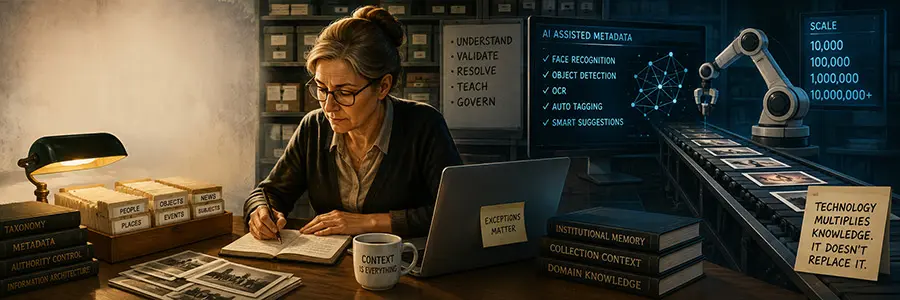
Groult’s thesis challenges the very metric by which organizations have historically valued information professionals. For decades, companies measured the worth of a librarian by their most visible, easily automated task: typing. Yet, as Groult argues, true expertise has never resided in keystrokes. It lives in the nuanced, years-long accumulation of contextual judgment about an object, a catalogue, or an entire cultural collection. While AI can scale metadata generation effortlessly, it can only do so if a human has first taught it what "correct" actually means.
Speed without human oversight is not efficiency—it is risk multiplied exponentially. As organizations rush to embrace hyper-automation, Groult issues a vital warning: the greatest danger to our archives is not that artificial intelligence will replace the people who understand them, but that organizations will mistakenly believe it already has.
Detailed Chronology: From Physical Couriers to Autonomous Archives
To understand the weight of Laurent Groult’s recent warnings, one must look back at the evolutionary trajectory of Digital Asset Management over the last twenty-five years. The journey of how organizations manage their digital footprints maps out a clear path toward the current AI revolution.
Era 1: The Analog-to-Digital Transition (Late 1990s – Early 2000s)
At the turn of the millennium, the concept of a "digital asset" was still in its infancy. Media organizations, advertising agencies, and corporate marketing departments relied heavily on physical archives—slides, beta tapes, transparencies, and paper folders. The earliest iterations of DAM systems were essentially digital filing cabinets designed to replace physical couriers and mailrooms. The introduction of FTP (File Transfer Protocol) and early local-area network (LAN) storage allowed teams to transfer bulky image files digitally, reducing turnaround times from days to hours. During this period, the "librarian" or asset manager was primarily an administrative gatekeeper, manually inputting file names, file sizes, and basic descriptions into nascent relational databases.
Era 2: The Rise of Web-Based and Cloud Repositories (2005 – 2015)
As broadband speeds accelerated and cloud computing matured, DAM platforms transitioned from on-premise local servers to web-accessible SaaS (Software-as-a-Service) ecosystems. Assets exploded in volume and variety. High-definition video, vector graphics, multi-layered marketing campaigns, and brand kits flooded corporate servers. Metadata standards began to solidify (such as EXIF, IPTC, and XMP), requiring librarians to become fluent in taxonomy design, controlled vocabularies, and rights management. The workload was largely manual, tedious, and heavily dependent on human data entry.
Era 3: The Big Data and Automation Push (2015 – 2022)
By the mid-2010s, enterprise digital libraries routinely surpassed hundreds of thousands—sometimes millions—of individual assets. Human catalogers simply could not keep pace with the sheer volume of incoming content. Early machine learning tools were introduced to assist with basic object recognition, facial tagging, and automated color extraction. However, these tools were brittle, prone to error, and lacked semantic context. Librarians shifted slightly from pure data entry to quality control, correcting mislabeled images and managing complex ingest pipelines.
Era 4: The Generative AI Era and the Death of the Keyboard (2023 – Present)
Today, we have entered the era of advanced generative and analytical artificial intelligence. Modern multimodal models can analyze a complex historical photograph, cross-reference it with corporate history, understand its emotional and contextual resonance, and draft rich, multi-paragraph descriptive metadata almost instantaneously. The physical act of typing out descriptions, keywords, and tags—the very core of the traditional cataloger’s daily routine—has been rendered obsolete. As Groult points out, the keyboard is disappearing, but the need for human curation, governance, and institutional memory has never been more critical.
Supporting Context & Metrics: The Mathematics of Scale and Risk
To fully appreciate the stakes involved in automating the archives, one must examine the stark contrast between human and machine error rates. In his article, Laurent Groult highlights an uncomfortable mathematical reality that every Chief Technology Officer and Chief Information Officer must confront:
"A human being can make an error on fifty photographs during an afternoon of cataloguing. A machine can make the same error on five million assets before lunch."
This asymmetry between human limitation and machine velocity defines the modern risk landscape of digital asset management.
The Cost of Unchecked Automation
Consider a multinational enterprise managing a digital repository of 10 million brand and media assets. Historically, a team of human librarians might process a few hundred assets a day, ensuring compliance with licensing rights, accurate geographical tagging, and nuanced cultural context. If an error slipped through—say, misattributing a copyrighted image or missing a usage restriction—the blast radius was localized and easily remediated.
Now, substitute a generative AI model trained on generalized datasets to ingest, tag, and publish the entire repository over a weekend. If the model fundamentally misunderstands a subtle brand guideline, an indigenous cultural symbol, or a strict legal disclaimer, that misunderstanding is instantly applied across all 10 million assets. The financial, legal, and reputational fallout of such a systemic error is staggering. Licensing violations, regulatory fines, and public relations crises can materialize overnight.
The Disappearing Apprenticeship Model
Beyond immediate error rates, Groult raises concerns about the erosion of organizational knowledge through the loss of the traditional "apprenticeship" model. In the past, junior librarians learned the intricacies of a collection organically. By cataloging a collection one record at a time, they absorbed the unwritten histories, institutional quirks, and deep contextual nuances that no database schema could ever capture.
When organizations prematurely replace human catalogers with automated scripts, they break this generational transfer of knowledge. The institutional memory of why certain assets matter, where specific gray areas in licensing lie, and how a collection evolved over decades has no native database field to live in. Once that human element is discarded, it is extraordinarily difficult to recover.
Official Statements and Industry Insights
The discourse surrounding Laurent Groult’s piece has resonated deeply within the broader information management, archiving, and artificial intelligence communities. Industry leaders and information scientists have weighed in on the changing responsibilities of DAM professionals in the age of generative systems.
In discussions accompanying the DAM News feature, enterprise architects have pointed out that organizations often fall into a dangerous binary trap: either viewing AI as a total replacement for human staff or rejecting it outright as a threat. Groult’s perspective carves out a vital middle ground, emphasizing that the true value of human professionals lies in curation and training rather than mechanical execution.
"There is very little value in asking a talented person to spend eight hours performing a repetitive task that a machine can complete in minutes. There is enormous value, however, in asking that same person to spend those eight hours teaching the machine what it does not know."
This sentiment echoes broader shifts in enterprise automation across multiple sectors. As routine labor is offloaded to algorithms, human workers are increasingly expected to transition from "producers" to "governors." In the context of DAM, the librarian’s role is evolving from a data-entry clerk into an AI trainer, semantic architect, and institutional ethicist.
Furthermore, data governance experts note that AI models are fundamentally reflective of their training data and curation frameworks. Without experienced librarians to establish robust taxonomies, curate high-quality training sets, and audit algorithmic outputs for bias and drift, enterprise AI initiatives inevitably degrade. The data in a corporate DAM is proprietary, highly contextual, and uniquely nuanced—qualities that generalized off-the-shelf AI models cannot parse without expert human guidance.
Future Outlook: Navigating the Autonomous Archive
As we look toward the horizon of digital asset management, what does the future hold for the DAM librarian? Laurent Groult’s contribution offers both a cautionary tale and a strategic roadmap for organizations navigating the AI transition.
1. From Mechanical Execution to Strategic Governance
The future DAM professional will spend less time categorizing individual JPEG files and more time designing the governance frameworks that dictate how AI interacts with enterprise assets. This includes establishing ethical boundaries for automated tagging, monitoring algorithmic bias, managing complex digital rights management (DRM) workflows, and ensuring compliance with evolving global data privacy regulations (such as GDPR and regional copyright laws).
2. Teaching the Machine: Domain-Specific Context
General-purpose AI models understand objects, colors, and broad categories, but they frequently fail to grasp proprietary corporate context, industry-specific terminology, and deeply nuanced historical archives. Librarians will act as domain-specific teachers. By feeding rich, curated human expertise into fine-tuned models, information professionals will create intelligent repositories that genuinely understand the unique value propositions of their respective organizations.
3. Redefining Organizational Mindsets
Ultimately, Groult’s concluding warning serves as the definitive guiding principle for the industry moving forward:
"The greatest danger is not that artificial intelligence will replace the people who understand our archives. It is that organizations will believe it already has."
Organizations that treat AI as a silver bullet—a magical box that eliminates the need for human oversight—will likely find themselves buried under mountains of high-speed, low-accuracy metadata. Conversely, enterprises that empower their DAM librarians to lay down the keyboard and take up the mantle of AI supervisors will unlock unprecedented efficiency without sacrificing quality, accuracy, or trust.
The keyboard may be disappearing from the daily routine of the digital asset manager, but the human intellect behind the archive is more indispensable than ever. The future of DAM does not belong to the machines that process the work, but to the professionals who possess the wisdom to teach them how to do it right.