Executive Overview
For over two decades, the business-to-business (B2B) software industry operated on a simple, immutable rule: you price by the head.
The per-seat licensing model—charging per user, per month—was a brilliantly effective proxy for corporate value. More employees meant more workflows, more data input, and inherently more utility extracted from an enterprise application. For SaaS vendors, it provided predictable recurring revenue, smooth valuation multiples, and a clear path to public markets.
Today, that model is collapsing under the weight of artificial intelligence, four years of aggressive enterprise price inflation, and a fundamental shift in corporate budgeting.
According to recent insights shared by ZoomInfo CEO Henry Schuck following extensive discussions with top-tier consultants and enterprise buyers, the universal consensus on where B2B pricing is heading can be summarized in three words: nobody knows. Experts are divided, customers are rebelling, and pricing strategies are shifting week by week. Yet, as software leaders quickly realize, standing still is no longer a conservative choice—it is a slow, compounding death spiral.
This structural breakdown is not merely an evolutionary hiccup caused by generative AI. It is a profound, structural divorce between billing metrics and actual business value. As software systems increasingly handle tasks that once required entire teams of human workers, a model that penalizes efficiency by shrinking invoices when headcounts drop has become mathematically untenable. Consequently, three distinct monetization frameworks have emerged to replace the dying seat model: Consumption, Outcome, and Resolution pricing.
Detailed Chronology: How B2B Pricing Reached a Breaking Point
To understand how the B2B tech sector arrived at this chaotic crossroads, it is necessary to trace the compounding pressures that have transformed the enterprise software landscape between 2022 and 2026.
Phase 1: The Headroom Erasure (2022–2025)
As macroeconomic conditions tightened following the post-pandemic boom, legacy SaaS vendors leaned heavily on their primary lever for revenue growth: continuous price hikes on existing seats.
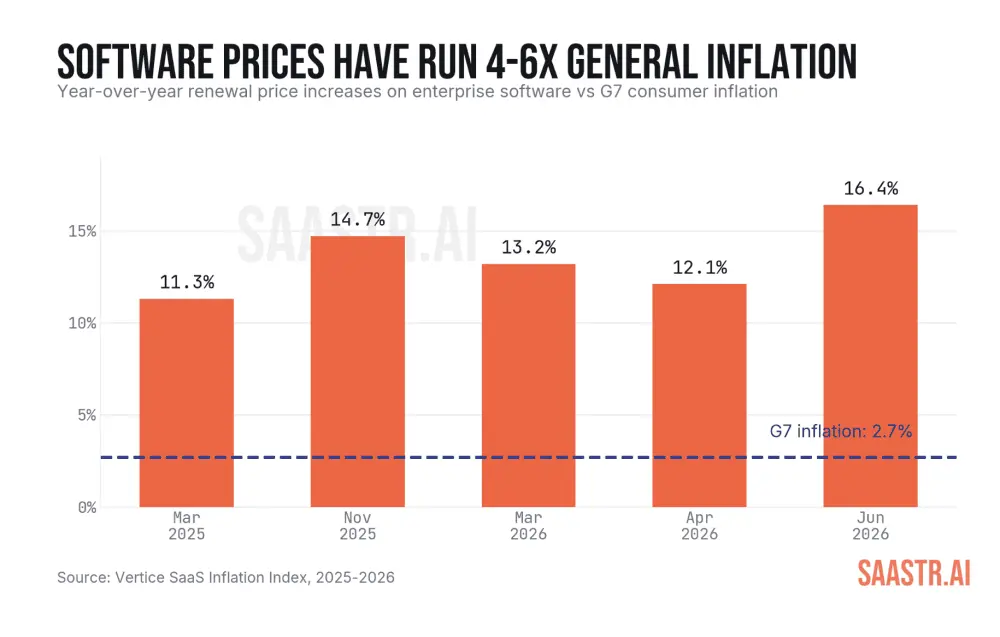
Data from the Vertice SaaS Inflation Index—compiled from tens of billions of dollars in processed tech spend—revealed that software price inflation consistently ran between 12% and 16.4% annually through mid-2026, vastly outpacing general G7 inflation rates hovering around 2.7%.
This relentless compounding reached an inflection point in late 2025. According to Zylo’s SaaS Management Index, which tracks over 40 million licenses and $75 billion in enterprise spend, the average enterprise portfolio remained flat at roughly 305 applications, yet total annual SaaS expenditure surged by another 8% to hit $55.7 million.
Put simply: enterprises were buying less software, but paying vastly more for what they already had. By mid-2026, Zylo reported that 79% of IT leaders experienced price increases during renewals, while 61% were forced to cut entirely planned internal projects just to absorb these compounding software costs.
Phase 2: The Great Budget Reallocation (2025–2026)
The tipping point arrived when Chief Information Officers (CIOs) stopped treating software inflation as a routine cost of doing business and began actively seeking reductions. The catalyst? The exponential financial pull of AI infrastructure and token-based computing.
A landmark March 2026 survey of 141 CIOs conducted by Redpoint Ventures revealed that enterprise AI initiatives—specifically inference costs and token consumption—are rarely funded through net-new budgets. Instead, Creative Strategies data indicates that only about 28 cents of every incremental AI dollar comes from fresh IT budget. The remaining 72 cents is cannibalized directly from existing software stacks.
Corporate giants have begun formalizing this shift. Publicis Sapient publicly announced plans to cut traditional SaaS licenses—including cornerstone enterprise tools like Adobe—by roughly half, replacing them with leaner, AI-native workflows. When a Fortune 500 entity writes that playbook, procurement departments across the Global 2000 instantly follow suit. For traditional per-seat vendors, renewal tables turned hostile: software sellers were no longer negotiating upgrades; they were actively being treated as the funding source for AI tokens.

Phase 3: The Decoupling of Headcount and Output (Mid-2026)
By the middle of 2026, the fundamental premise of seat-based pricing—that human headcount correlates with business output—completely unraveled.
When an enterprise support team handles triple the customer inquiry volume using the exact same 40 human agents because AI-driven workflows handle Tier-1 queries, seat pricing delivers flat billing for triplicated output. Conversely, if headcount drops from 40 to 25 because automation absorbs the heavy lifting, the vendor’s invoice shrinks precisely as their software delivers maximum operational leverage.
The software market itself did not slow down—total enterprise tech spend continued to climb past 15% annual growth. However, legacy per-seat categories (such as CRM, sales automation, and collaboration suites) flatlined into single-digit growth, proving that the buying appetite remained robust, but the billing unit was broken.
Supporting Context & Metrics: The Three Emerging Models
With the per-seat model in structural decline, the B2B market has splintered into three alternative pricing architectures. Each carries its own distinct operational challenges, implementation hurdles, and risk profiles.
1. Consumption Pricing (Credits, Tokens, and Metered Runs)
- The Mechanism: Customers pay for precisely what they utilize—measured in API calls, records processed, or tokens consumed. Pioneers like Snowflake, Databricks, MongoDB, and Stripe have relied on this approach for years.
- The Pitfall: Bill shock. Without built-in guardrails, enterprise finance teams terrified of runaway AI inference costs view consumption models with deep suspicion. Forecasting annual budgets becomes a nightmare when consumption fluctuates wildly month-to-month.
- The Remedy: Vendors must pair consumption pricing with intelligent agent-driven controls. Rather than leaving customers exposed to unchecked meter spikes, modern platforms allow finance teams to program automated limits—for instance: "Spend up to $1,000 on data enrichment this month, prioritizing high-value records, and hard-stop." When paired with real-time usage transparency, bill shock largely dissipates.
2. Outcome Pricing (Charging for Business Results)
- The Mechanism: Customers pay exclusively when a defined, tangible business milestone is achieved (e.g., a closed-won deal, a verified cost reduction, or a completed workflow).
- The Pitfall: Attribution wars and reverse bill shock. In complex go-to-market motions, tracing a direct line between a software interaction and a multi-month enterprise sales cycle is notoriously difficult. Furthermore, if the software performs exceptionally well, the resulting bill can dwarf traditional subscription tiers, causing panic among conservative CFOs.
- The Proof Point: Palantir represents the gold standard of enterprise outcome alignment. In Q2 2026, Palantir reported a staggering 93% year-over-year revenue increase to $1.935 billion, with US commercial revenue surging 149% to $764 million. While not metered in a literal SaaS sense, Palantir structures every enterprise contract around measured dollar impact, scaling fees directly with realized client value.
3. Resolution Pricing (The Simplified Middle Ground)
- The Mechanism: A streamlined version of outcome pricing where software buyers pay for a single, easily countable unit of work that either succeeded or failed.
- The Examples: Customer support AI platforms have heavily adopted this paradigm. Sierra charges a predictable per-resolution rate (averaging roughly $1.50 per successfully resolved inquiry), while HubSpot charges around $0.50, leaving human escalations unbilled.
- The Strategic Shift: This model removes ambiguity. When both vendor and buyer look at the same binary metric—whether a ticket was closed or a record was successfully verified—pricing friction evaporates. However, incumbents in data and API services face a brutal transition: moving from charging for "every API call attempted" (even when results return
NULL) to charging solely for "valid, verified records found" represents an immediate revenue cut on day one.
Official Statements and Industry Insights
The pricing upheaval has forced tech executives and market leaders to re-evaluate their fundamental go-to-market strategies.
Industry veteran and investor Jason Lemkin noted the unprecedented nature of market shifts in mid-2026, highlighting companies that successfully decoupled revenue from headcount:
"Almost everyone’s growth rate decays at scale. Not Palantir. It just pulled off a quarter (and a year) like we’ve never seen: 12 consecutive quarters of accelerating growth, 47% GAAP operating margins, and revenue up 93% year-over-year."
The secret to this re-acceleration, analysts note, lies not merely in a clever pricing page, but in a complete operational overhaul. Companies like Palantir and Sierra bypass traditional software hurdles by deploying forward-engineered workflows directly onto customer data before a contract is signed, absorbing implementation risk that legacy SaaS vendors spent decades offloading onto buyers.
Similarly, corporate consolidation reflects this desperate race for outcome-based architecture. Salesforce’s strategic move to acquire customer-automation platform Fin (formerly Intercom) for approximately $3.6 billion underscores the immense value of pre-established resolution models. Fin entered the market with transparent outcome pricing ($0.99 per resolved ticket) and over 30,000 active customers. For legacy giants, buying an outcome-priced business is vastly faster—and infinitely less culturally disruptive—than attempting to convert a massive, entrenched seat-priced core.
Future Outlook: How Incumbents Must Adapt
As the software industry looks toward the remainder of the decade, the writing is on the wall for pure per-seat monetization. Seats measure the corporate org chart; modern AI software measures output.
For incumbent SaaS vendors burdened by legacy billing systems, migrating away from seats requires simultaneous, load-bearing transformations across four distinct operational pillars:
- Revenue Recognition & Financial Modeling: Transitioning from predictable annual recurring subscription billing (ARR) to variable, usage- or outcome-based cash flows requires complete alignment with corporate accounting standards and predictable forecasting models.
- Compensation & Sales Incentive Structures: Sales teams accustomed to commission structures tied to multi-year seat expansion must be retrained and re-incentivized around consumption growth and verified business outcomes.
- Customer Success (CS) Motions: The role of Customer Success must evolve from managing license adoption and user logins to driving deep, measurable workflow efficiency and ROI verification.
- Product Architecture: Software engineering teams must build robust metering, telemetry, and automated financial guardrails directly into the core product stack to prevent both vendor margin erosion and buyer bill shock.
New market entrants will continue to hold a massive competitive advantage simply because they never inherited the baggage of a seat-based legacy base. They began their journeys pricing by the resolution, the token, or the outcome.
For incumbent software enterprises, survival requires courage. While nobody possesses a crystal ball to predict the exact equilibrium of 2030 B2B pricing, one reality is absolute: standing still is no longer an option. Software providers must select an alternative metric, launch pilot tests within targeted market segments immediately, and align their billing units directly with the actual, tangible value they deliver in the age of intelligent automation.