









Executive Overview
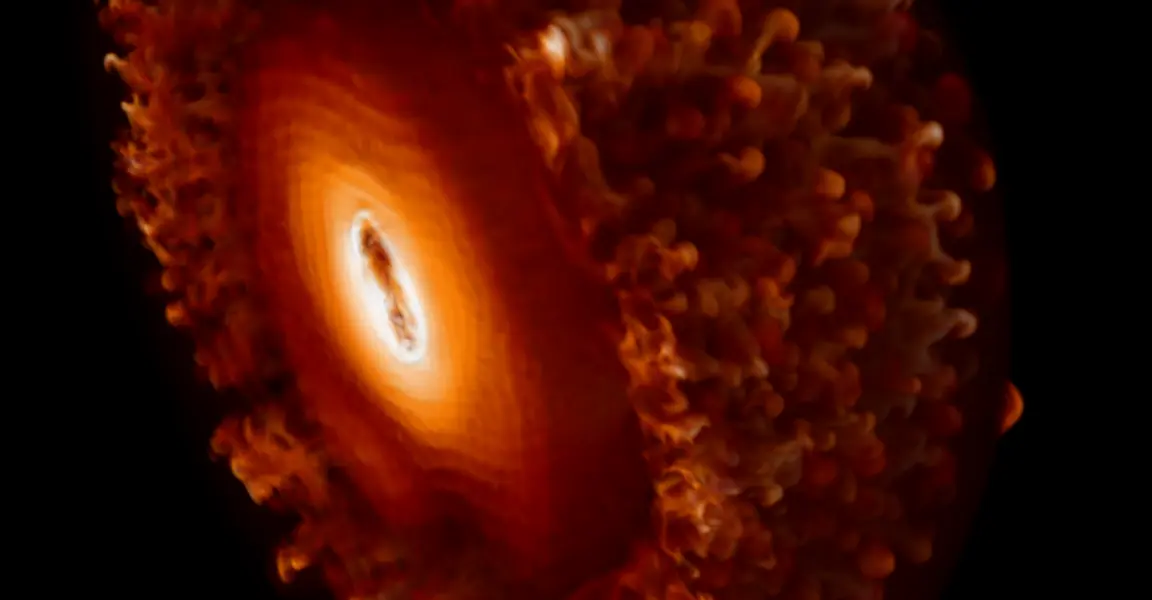
For decades, the foundational paradigm of core-collapse supernovae has remained largely unaltered in astrophysics textbooks. When a massive star exhausts the nuclear fuel at its core, it begins synthesizing progressively heavier elements through endothermic, or energy-consuming, reactions. Stripped of the outward radiation pressure that previously stabilized it against the crushing pull of its own mass, the stellar core undergoes a catastrophic inward collapse. This dramatic implosion ultimately births an ultra-dense neutron star or a stellar-mass black hole, while the colossal release of gravitational binding energy drives a shockwave that violently obliterates the remainder of the star.
While this macroscopic narrative remains robust, contemporary observations and theoretical models have long wrestled with stubborn discrepancies. Statistical inventories of observed supernovae relative to cosmic star-formation rates suggest a glaring mismatch: the universe appears to be generating more than enough progenitor stars to fuel a much higher frequency of stellar explosions than astronomers actually detect. Furthermore, targeted observations of red supergiants—the expected progenitors of many core-collapse events—reveal a noticeable deficit in dying stars of this classification.
To help reconcile these cosmic puzzles, a recent study published in Physical Review D by astrophysicists Mariam Gogilashvili and Irene Tamborra of the University of Copenhagen points to a previously underappreciated mechanism: flavor-changing neutrinos. While standard core-collapse models acknowledge neutrinos as vital thermodynamic agents, they typically treat these elusive particles as static entities. By failing to account for neutrino "flavor oscillation"—the quantum mechanical phenomenon wherein particles seamlessly shift identities among electron, muon, and tau states—traditional simulations may be overlooking a critical energy sink.
According to Gogilashvili and Tamborra’s new modeling, rapid neutrino flavor conversion alters the energy distribution within the collapsing core. By shifting energy away from electron-flavor neutrinos and into heavier-lepton neutrinos, these fluid particles effectively starve the nascent shockwave of the thermal pressure it needs to escape. For a significant fraction of massive stars, this energy deficit stalls the explosion entirely, leading to a direct, silent collapse into a black hole. This provocative finding offers a compelling theoretical bridge to explain missing supernovae, the scarcity of red supergiant detonations, and the origins of unexplained mass gaps in black hole populations.
Detailed Chronology and Theoretical Evolution
To understand the magnitude of this recent development, it is necessary to retrace how our comprehension of core-collapse physics has evolved, alongside the persistent roadblocks that have bedeviled theorists.
The Standard Model of Stellar Demise
The life of a massive star (defined broadly as anything exceeding roughly eight to ten solar masses) is a delicate balancing act. Throughout most of its existence, outward thermal pressure generated by thermonuclear fusion counteracts the inward gravitational vector. However, as hydrogen fuses into helium, and helium subsequently fuses into heavier elements like carbon, oxygen, neon, and silicon, the energy yield per nuclear reaction diminishes.
Eventually, the core is transformed into an inert iron-nickel ball. Because iron represents the peak of nuclear binding energy per nucleon, fusing it consumes energy rather than releasing it. Deprived of thermal support, the core collapses on a millisecond timescale. Protons and electrons are crushed together via electron capture, forming an immense sea of neutrons and releasing a blinding flood of neutrinos.
[Massive Star Core Exhausts Fuel]
       ↓
[Endothermic Reactions & Iron Core]
       ↓
[Gravitational Collapse (Neutron Star / Black Hole Birth)]
       ↓
[Neutrino Emission & Shockwave Generation]
       ↓
[Stalled Shockwave vs. Neutrino Heating / Flavor Oscillation]
       ↓
[Outcome: Supernova Explosion OR Direct Silent Collapse]
As the inner core reaches nuclear saturation density, it stiffens abruptly, halting the collapse of the innermost matter and rebounding. This rebound generates an outward-propagating shockwave. However, as this shockwave plows through the outer layers of the core, it expends tremendous energy dissociating iron nuclei back into free nucleons. Left to its own devices, this shockwave quickly stalls, turning into an accretion shock that would spell the doom of the star—trapping all matter inside a growing black hole—were it not for a crucial auxiliary mechanism.
Enter the Neutrino Wind
Decades of theoretical work have established that neutrinos are the ultimate saviors of the supernova. Though famously dubbed "ghost particles" due to their extraordinarily weak interactions with ordinary matter, the sheer density of a collapsing stellar core generates them in incomprehensible quantities. Trillions upon trillions of neutrinos stream outward from the newly formed proto-neutron star.
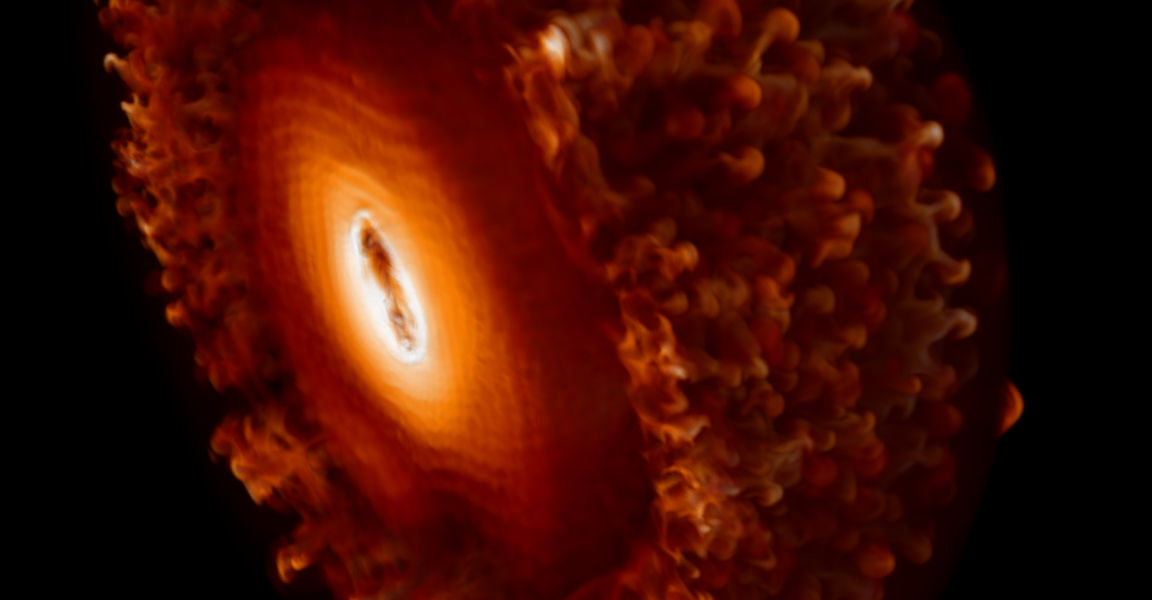
As these neutrinos race past the stalled shockwave, a tiny fraction of them inevitably collide with the surrounding nucleons. These interactions transfer thermal energy to the post-shock region, heating the matter and reviving the shockwave. If this neutrino-driven heating is robust enough, the shock accelerates, shatters the stellar envelope, and produces a brilliant supernova. If it fails, gravity wins absolute victory, and the star collapses silently into a black hole without an optical display.
The Quantum Chameleon: Flavor Oscillation
For decades, supernova models treated neutrinos as uniform populations divided cleanly into electron types and their antiparticles, ignoring the quantum reality established by neutrino oscillation physics. Neutrinos exist in three distinct flavors—electron neutrinos ($nue$), muon neutrinos ($numu$), and tau neutrinos ($nu_tau$), along with their respective antiparticles. Crucially, neutrinos do not possess a fixed flavor state as they propagate; instead, they exist in quantum superpositions, periodically swapping identities.
Inside the extreme environment of a collapsing star, these oscillations are further amplified by collective neutrino-neutrino interactions. As Gogilashvili and Tamborra point out in their Physical Review D paper, this constant identity-shifting radically modifies the relative spectra of electron neutrinos versus heavy-lepton neutrinos. Because electron-flavor neutrinos interact far more readily with normal matter via charged-current reactions than their muon and tau counterparts, altering the flavor balance directly impacts the heating and cooling dynamics behind the shockwave.
Supporting Context, Methodology, and Observational Discrepancies
The impetus for modeling flavor-changing neutrinos stems not from abstract theoretical curiosity, but from tangible observational anomalies that have puzzled astronomers for years.
The Missing Supernovae and Red Supergiant Mystery
When astrophysicists tally the rate of star formation across cosmic history and compare it to the observed rate of core-collapse supernovae, an accounting error emerges. The universe appears to harbor a demographic deficit: there are simply not enough observed explosions to account for the deaths of all the massive stars being born.
Furthermore, stellar archaeology allows astronomers to identify the progenitor stars of certain historical supernovae by examining archival pre-explosion imagery. These surveys have repeatedly turned up a puzzling absence of red supergiants among the exploded progenitors. Red supergiants—massive, evolved stars like Betelgeuse—represent a major fraction of massive stellar deaths. If they are not blowing up as frequently as expected, where are they going?
The Copenhagen study suggests an answer: many of these stars are dying, but they are doing so via "failed supernovae." By incorporating instantaneous neutrino flavor oscillations into their simulations, Gogilashvili and Tamborra discovered that energy is systematically bled away from electron neutrinos and funneled into heavy-lepton neutrinos. This reduces the charged-current heating rate directly behind the shockwave. Without sufficient thermal reinforcement, the shock stalls permanently, and the star collapses directly into a black hole without a luminous explosion. This phenomenon preferentially impacts stars in the 15 to 30 solar mass range—precisely the mass bracket populated by red supergiants.
Gravitational Waves and the Black Hole Mass Gap
Further evidence supporting the revised models comes from gravitational-wave astronomy. Detectors like LIGO, Virgo, and KAGRA have cataloged the mergers of dozens of black holes resulting from stellar deaths. Statistical analysis of these mergers hints at a "mass gap" in black hole distributions—a scarcity of objects within certain mass ranges that defies expectations from uniform evolutionary models.
Furthermore, when a star undergoes a failed supernova, the entirety of its outer envelope falls back onto the nascent stellar remnant. This massive accretion event significantly increases the final mass of the resulting black hole. By accounting for flavor-oscillation-driven failed supernovae, astrophysicists can better model the mass spectrum of stellar-mass black holes, helping to explain the features observed in gravitational-wave data.

Methodological Approach of the Copenhagen Study
Simulating the full complexity of neutrino quantum kinetics inside a collapsing star is computationally prohibitive. The momentum, trajectory, and birth location of every neutrino relative to the stellar center dictate its individual oscillation frequency, creating a web of non-linear interactions.
To make the problem tractable, Gogilashvili and Tamborra employed a simplified yet powerful framework:
- Instantaneous Flavor Conversion: The model assumes that flavor changes occur rapidly at defined boundaries as neutrinos travel outward from the core-matter coupling zone to the high-density shock region.
- Equipartition of Energy: Energy carried by the neutrinos is divided evenly across all six types (electron, muon, tau, and their respective antiparticles).
- Massive Progenitor Suite: The researchers simulated the evolutionary death throes of nearly 200 distinct progenitor stars, spanning a broad mass range from 9 solar masses up to 120 solar masses.
- Density Cutoffs: Three varying density cutoffs were tested to define the precise spatial boundary of the shockwave, establishing a robust bracket of potential physical outcomes.
Implications and Sensitivity Analysis
While the simplified model successfully maps out broad trends, the researchers’ sensitivity analysis reveals that the outcomes are remarkably responsive to fine-tuned parameters.
When shifting from a low-density cutoff to a high-density cutoff for the shockwave boundary, the rate of failed supernovae roughly doubled. Under the high-density conditions, an overwhelming majority—nearly 90 percent—of the modeled stars failed to undergo a successful supernova. While astrophysicists agree that a 90 percent failure rate is likely an artifact of the model’s idealized assumptions rather than physical reality, the extreme sensitivity underscores how profoundly neutrino flavor physics dictates the final fate of a star.
Moreover, the model deliberately leaves out certain complex phenomena, such as hydrodynamic convection within the proto-neutron star and nuanced multi-angle neutrino transport. Despite these limitations, the study delivers an undeniable conceptual breakthrough: a known, fundamental quantum phenomenon—neutrino flavor oscillation—can act as a decisive valve, venting energy out of the core and tipping the scales between a brilliant supernova explosion and a silent gravitational collapse.
Future Outlook
The work by Gogilashvili and Tamborra marks a vital step forward, serving as an explicit invitation to the computational astrophysics community. To move beyond simplified treatments, future research will require next-generation three-dimensional hydrodynamic simulations that couple full quantum kinetic neutrino transport directly to stellar core evolution.
As observational astronomy enters an era of unprecedented precision—bolstered by next-generation gravitational-wave detectors, wide-field optical surveys like the Vera C. Rubin Observatory, and advanced neutrino detectors like IceCube-Gen2—the window into the hidden interiors of dying stars is opening wider than ever before. Resolving the discrepancies between stellar birth rates and supernova explosions will ultimately require mastering the subatomic behavior of the universe’s most elusive chameleons. By decoding how neutrinos trade identities in the dying breath of a star, scientists are one step closer to understanding the grand life-and-death cycle of the cosmos.