Executive Overview
The landscape of B2B advertising is undergoing a profound structural transformation. For years, the engine room of enterprise marketing has run on friction: analysts manually exporting CSV reports, reconciling fragmented naming conventions, stitching together disjointed datasets from a dozen different platforms, and attempting to glean insights long after the optimization window has slammed shut. Today, that labor-intensive paradigm is giving way to autonomous execution.
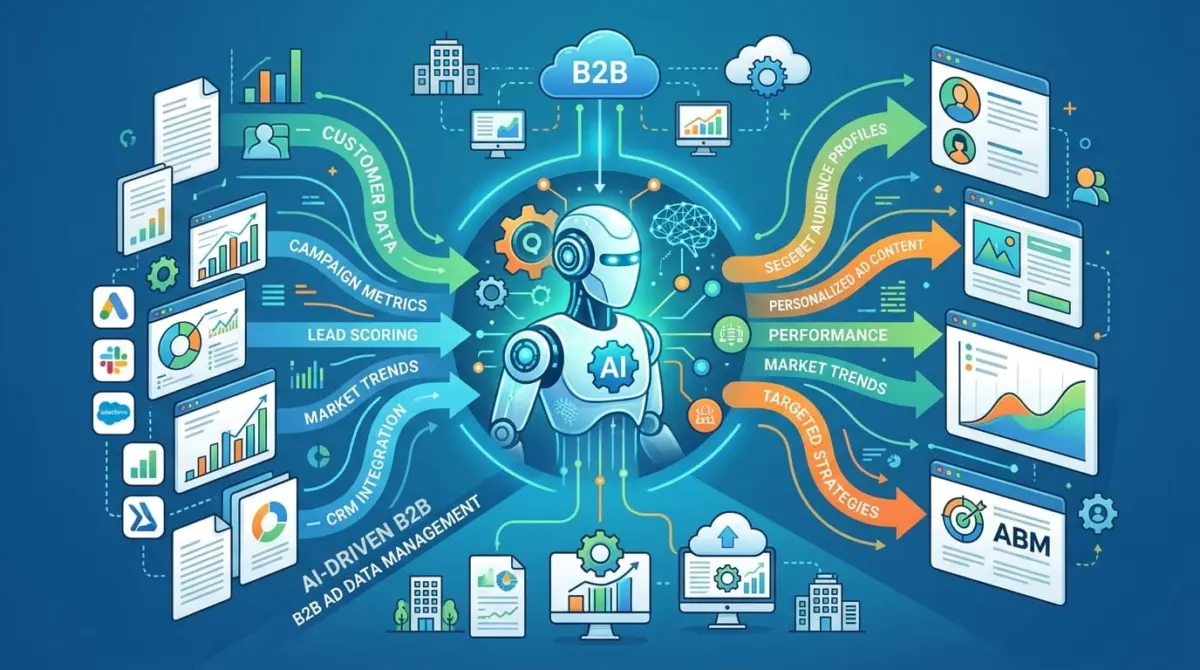
Artificial intelligence agents are no longer confined to the realm of passive analytics or simplistic conversational prompts. Instead, they are being embedded directly into the marketing technology stack to manage the least visible yet most time-consuming segment of digital advertising: data management itself. By autonomously cleaning, normalizing, and acting upon real-time data streams, AI agents are shifting marketing operations from a reactive, human-dependent chore into a proactive, machine-driven engine.
Adoption rates across the enterprise are surging to meet this technological leap. According to McKinsey’s State of AI survey, 65% of organizations reported using generative AI regularly in early 2024—nearly doubling the adoption share recorded just ten months prior. Meanwhile, major enterprise software providers are rapidly baking autonomous capabilities into their core offerings. Salesforce introduced Agentforce to run autonomous workflows across its sales and marketing clouds, and HubSpot deployed its Breeze agents to tackle analogous go-to-market tasks.
As open communication standards like the Model Context Protocol (MCP) streamline how these systems integrate, the question facing marketing leaders is no longer whether autonomous agents will alter the industry, but how quickly organizations can adapt their data infrastructure to support them.
Detailed Chronology: From Static Automation to Agentic Execution
To understand the current wave of autonomous marketing agents, it is helpful to trace the chronological evolution of marketing technology over the past decade. The industry has moved steadily through three distinct phases of operational capability:
Phase 1: Rule-Based Automation (2015–2020)
Early marketing automation tools were strictly deterministic. They relied on rigid, human-programmed “if-this-then-that” logic. If a prospect filled out a specific landing page form, the system triggered a predefined email sequence. If a campaign budget hit a ceiling, an alert was sent to a human administrator. While these tools reduced repetitive administrative tasks, they lacked contextual awareness. They could not interpret messy, unstructured datasets, nor could they adapt when underlying variables shifted unexpectedly.
Phase 2: Predictive Analytics and BI Dashboards (2020–2023)
As data volumes exploded, the industry shifted toward business intelligence (BI) dashboards and predictive analytics engines. Tools began forecasting lead scores, customer lifetime values, and churn probabilities based on historical trends. However, these systems remained fundamentally passive. They presented insights to human analysts, who still bore the burden of exporting data, cleaning spreadsheets, rewriting queries, and manually reallocating ad spend across channels. The workflow was heavily bottlenecked by human bandwidth.
Phase 3: The Rise of Autonomous Agents (2023–Present)
The current era is characterized by agentic AI—systems capable of pursuing overarching business goals by planning their own multi-step workflows, selecting appropriate tools, and executing actions autonomously. Rather than waiting for a human analyst to pull a report, modern AI agents sit directly within the software stack. They continuously ingest live data, normalize disparate inputs, evaluate real-time intent signals, and adjust active advertising campaigns dynamically. This shift marks the transition from software that assists human work to software that executes it.
Supporting Context & Metrics: The Mechanics of Modern B2B Data
B2B advertising data presents unique complexities that make it an ideal testing ground for autonomous agents. Unlike business-to-consumer (B2C) transactions, which are often fast and transactional, B2B sales cycles run for months and involve complex buying committees. A single target account interacts with a brand across myriad touchpoints: LinkedIn ad impressions, Google search queries, content downloads, CRM interactions, and website visits.
Each of these systems records customer journeys differently, creating deep fragmentation. Historically, bridging this divide required brittle custom APIs and exhausting manual data-wrangling exercises. Autonomous agents disrupt this bottleneck through two primary mechanisms: real-time data unification and continuous normalization.
Unifying Fragmented Data Streams
Instead of relying on rigid, hard-coded connectors that break whenever a software vendor updates an API, modern agents utilize open protocols like the Model Context Protocol (MCP)—an open standard initially introduced by Anthropic in late 2024 and subsequently adopted by major AI players like OpenAI and Google DeepMind.
An MCP server exposes an advertising platform’s underlying data schemas and permitted actions in a structured, uniform format. When an AI agent connects to a platform—such as LinkedIn Campaign Manager via an ad-tech MCP server—it queries live spend, impression, and conversion data as easily as if it were accessing a native database. This eliminates the need for manual CSV exports, endless reconciliation debates, and custom pipeline maintenance.
Automated Cleaning and Normalization
Dirty data compounds rapidly in B2B environments. A single enterprise account may be logged across different systems as "IBM," "I.B.M.", and "International Business Machines." If left unchecked, these discrepancies corrupt downstream attribution models and executive dashboards.
Autonomous agents combat this issue continuously rather than waiting for quarterly cleanup projects. By running background normalization routines, agents reconcile naming mismatches, deduplicate entity records, and automatically flag anomalous tracking tags before they pollute reporting pipelines. Consequently, marketing analysts are liberated from spreadsheet triage, shifting their focus toward high-level strategic insights.
Sharper Targeting Through Intent Data and Dynamic Scoring
Because B2B sales cycles are long and committee-driven, effective targeting relies on continuous behavioral monitoring. Intent data providers like 6sense and Bombora track enterprise research habits across the web, exposing which companies are actively investigating specific solutions.
- Real-Time Intent Matching: An AI agent wired into third-party intent streams monitors target accounts around the clock. The moment a target organization exhibits a surge in relevant research topics, the agent adjusts ad delivery that same day—shifting impressions toward rising buying interest and throttling spend on accounts that have gone cold.
- Self-Updating Lead Scores: Traditional marketing operations teams typically refresh lead scores on a fixed weekly or bi-weekly schedule. Autonomous agents, by contrast, rescore leads continuously against live user interactions. The moment an account crosses a specific engagement threshold, the agent alerts sales representatives immediately while the buying window remains wide open.
Official Statements and Industry Insights
Industry leaders and market analysts have been vocal about the rapid trajectory of agentic AI within enterprise operations.
In its strategic technology outlook, Gartner forecasted that agentic AI will autonomously make at least 15% of day-to-day work decisions by 2028—a dramatic leap from essentially zero in 2024. Gartner analysts emphasize that data-heavy, rules-rich, and instantly measurable environments—such as digital advertising operations—sit squarely at the front of this transformation queue.
Reflecting on the broader enterprise adoption wave, McKinsey & Company researchers noted in their 2024 global AI assessment that organizations are moving past experimental use cases toward deep operational integration. As generative AI adoption rates surge across sectors, companies are discovering that the true competitive differentiator is no longer access to algorithms, but data readiness.
Technology vendors are actively redesigning their architectures to support this shift. Executives at Salesforce and HubSpot have publicly positioned their respective agentic ecosystems (Agentforce and Breeze) as foundational layers designed to shoulder the administrative burden of go-to-market teams. According to enterprise software strategists, the ultimate goal is not to eliminate human oversight, but to elevate human marketers from tactical data-wranchers into strategic directors.
Future Outlook: Preparing for the Agentic Enterprise
As organizations look toward the remainder of the decade, the integration of AI agents into marketing operations will accelerate. However, the path to autonomous execution is not without its hurdles.
The primary barrier to successful agentic deployment is no longer software capability; it is data hygiene. Companies with fragmented, unverified, and messy data repositories will find themselves unable to grant autonomous agents the operational autonomy required to drive ROI. Conversely, organizations that invest heavily in clean data architecture, clear governance frameworks, and standardized open protocols will reap compounding rewards.
For marketing leaders and operations executives, the immediate roadmap is clear and pragmatic:
- Audit Existing Workflows: Identify the repetitive, highly manual data processes—such as weekly report generation, attribution mapping, and budget pacing—where human teams spend the majority of their time.
- Fix Underlying Data Quality: Clean up CRM schemas, standardize account naming conventions, and ensure tracking parameters are uniform across all ad platforms.
- Pilot Incrementally: Deploy a single autonomous agent to manage one isolated, high-friction process (such as real-time budget reallocation or cross-channel attribution stitching) before scaling agentic workflows enterprise-wide.
Ultimately, the commercial advantage in the coming years will not belong to the enterprise with the largest software budget or the highest number of AI agents. It will belong to the organizations whose foundational data is clean enough, structured enough, and trusted enough to let artificial intelligence take the wheel.