








Executive Overview
Six years ago, the narrative of the e-commerce software market seemed to possess a predictable binary structure. At the absolute apex sat Shopify, the undisputed market titan scaling at a breathtaking velocity. Trailing closely—yet credibly—was BigCommerce. For public market investors looking for a standalone, pure-play alternative to Shopify, BigCommerce was the only game in town. While competitors like Magento huddled inside Adobe, Commerce Cloud operated as a division of Salesforce, and WooCommerce lived within Automattic, BigCommerce stood alone as a publicly traded pure-play.
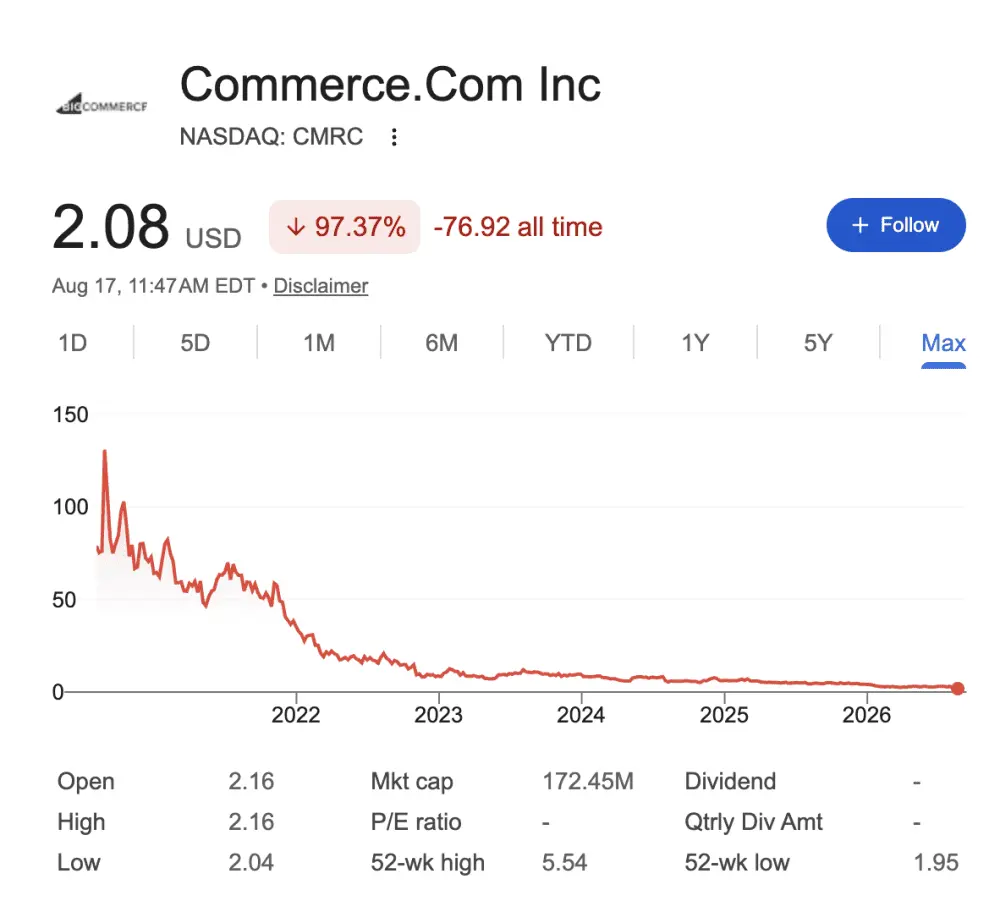
It was tailored more heavily toward B2B use cases, possessed a robust architecture, and commanded the respect of enterprise tech analysts. Just a month before its public debut, Intuit valued that promise at $1.5 billion, attempting a buyout that BigCommerce ultimately rejected. Instead, the company went public at $24 a share, closed its first trading day at $72.27, and etched its name into the history books as one of the largest IPO pops of 2020, boasting a market capitalization of roughly $4.8 billion.
Today, that same company—rebranded as Commerce.com and trading under the ticker CMRC—commands a market capitalization of roughly $200 million, trading at less than 1x its Annual Recurring Revenue (ARR). It is currently fighting off a hostile takeover bid from a significantly smaller rival, and its full-year 2026 revenue guidance sits at a midpoint lower than its actual revenue output in 2025.
Everyone knew Shopify was winning back in 2020. But with the benefit of hindsight, the true value of this historical trajectory lies not in the final score, but in the shape of the decay. It offers a masterclass in how competitive gaps widen in B2B software, what happens when growth stall meets cost discipline, and why second place in a platform market is a precarious mirage rather than a defensible moat.
Detailed Chronology: From the 2020 IPO Peak to the CMRC Collapse
The 2020 High-Water Mark
In July 2020, Meritech Capital’s IPO breakdown labeled BigCommerce “a very distant #2”—which, at the time, was accepted as a viable bull case. The e-commerce boom catalyzed by global lockdowns made the pie look endlessly expandable. BigCommerce’s rejection of Intuit’s $1.5 billion offer felt justified by the public market’s euphoric reception. An IPO pop to a $4.8 billion valuation signaled that Wall Street was eager for exposure to the digitizing merchant economy.
However, beneath the celebratory opening bell, the foundational mechanics of the business were already diverging from the industry leader. While Shopify was aggressively transforming from a simple software subscription tool into an embedded financial ecosystem, BigCommerce remained tethered to a traditional SaaS pricing model.
The Slow, Relentless Deceleration
The erosion of BigCommerce’s market position did not happen overnight. There was no single catastrophic quarter marked by a massive data breach, a botched platform migration, or a corporate governance scandal. Instead, the decline was defined by quiet, steady deceleration.
From 2020 through 2022, the revenue gap between Shopify and BigCommerce hovered relatively flat at around 20x. For a brief window, it genuinely looked like a two-player market. But as the macroeconomic environment shifted, the divergence widened dramatically. The gap grew not because BigCommerce experienced absolute collapses in revenue, but because its growth rate steadily bled out: sliding from 27% to 11%, down to 7%, and finally trickling down to 3%. Meanwhile, Shopify—operating at a scale twenty times larger—maintained a relentless compound growth rate between 26% and 30%.
The Turnaround Toolkit and the Hostile Bid
In a desperate bid to reverse its fortunes, management deployed every page from the classic tech turnaround playbook:
- Leadership and Identity: The company brought in a new CEO and undertook a sweeping rebrand from BigCommerce to Commerce.com.
- AI-Driven Restructuring: Leadership executed workforce realignments explicitly aimed at leveraging artificial intelligence and automation to slash operational burn.
- Margin Expansion: The cost discipline worked. The company delivered consecutive quarters of positive GAAP net income, blowing past Q2 non-GAAP operating income guidance ($8.1 million actual vs. $4–$5 million projected).
Despite these operational victories, the market remained unimpressed. Alongside the Q2 earnings beat, management shocked investors by slashing full-year revenue guidance by $18 million at the midpoint. Wall Street analysts at Barclays and UBS slashed price targets down to the $3.00 to $3.50 range. Capitalizing on the vulnerability, a tiny competitor—Rezolve AI—launched a hostile takeover bid, with its CEO publicly characterizing Commerce.com’s growth trajectory as “embarrassing.”
Supporting Context & Metrics: Software vs. Transaction
The core structural failure that doomed BigCommerce’s business model can be distilled into a single strategic divergence: BigCommerce sold software; Shopify sold the transaction.
The Revenue Composition Chasm
To understand the divergence, one must examine where platform revenue originates. For traditional SaaS models, subscription fees account for the lion’s share of top-line health. In Commerce.com’s case, subscription solutions still represent roughly 75% of its quarterly revenue ($63.1 million out of an $84.5 million quarter).
Shopify inverted this ratio long ago. Merchant solutions—payments, capital, shipping, and financial services embedded directly into the checkout flow—make up the overwhelming majority of Shopify’s monetization engine.

The Compounding Power of GMV Alignment
When a merchant utilizes an e-commerce platform, their Gross Merchandise Value (GMV) fluctuates over time.
- The Shopify Model: Shopify takes a fractional cut of every transaction. If a merchant scales from $1 million in annual sales to $50 million, Shopify scales right alongside them, capturing immense upside without needing to upsell a higher software tier.
- The BigCommerce Model: BigCommerce traditionally collected a predictable, fixed subscription fee. Whether a merchant processed $1 million or $50 million, the software revenue remained largely identical.
Six years of compounding on that single structural choice resulted in a 40x revenue gap and a nearly 1,000x market capitalization gap. Commerce.com’s CFO explicitly acknowledged this blind spot, pointing to payments, cross-sell, and attach rates as the primary strategic focus moving forward. The company rolled out BigCommerce Payments with PayPal, reporting that transaction volume is running 30% ahead of internal projections. It is undeniably the right operational fix—it simply arrived six years after Shopify made transactional monetization the centerpiece of the e-commerce economy.
Official Statements & Industry Analysis
The ongoing saga at Commerce.com has ignited intense debates across venture capital and enterprise software circles regarding the viability of niche strategies for trailing competitors.
The Analyst Scorecard Fallacy
Conventional wisdom dictates that when a company finds itself as a distant number two in a platform market, it should carve out a defensible niche, focus upstream on enterprise B2B customers, and win on feature sets. BigCommerce executed this playbook to absolute perfection.
The company built a highly flexible, open-API architecture tailored to complex enterprise workflows. Year after year, it dominated independent analyst evaluations. Notably, BigCommerce swept 24 out of 24 medals in the Paradigm B2B Combines for four consecutive years, leaving competitors in the dust regarding pure technical capability.
Yet, the financial scoreboard exposed a harsh reality:
- Account counts steadily shrank.
- Revenue per account (ARPU) rose to compensate.
This dynamic—price capture on a shrinking base—can mask underlying decay for a few quarters, but it is ultimately a finite strategy. Winning analyst scorecards in a specialized segment while the market leader captures that exact same segment four times faster is not a defensible niche. It is simply a slower loss wrapped in superior marketing collateral.
The Limits of Cost Discipline
The market’s reaction to Commerce.com’s recent profitability milestones highlights a brutal truth about modern public markets: Profitability does not fix a growth problem; it merely buys time to fix one.
When a company successfully slashes costs, expands operating margins, and posts positive GAAP net income, but simultaneously guides full-year revenue downward, the market immediately strips away its growth multiple. Cost-cutting can preserve cash reserves, but it cannot manufacture structural demand in a market where the platform network effects heavily favor the incumbent.
Future Outlook & Lessons for B2B Founders
Most B2B software companies are not market leaders, and statistically, they never will be. However, the cautionary tale of Commerce.com proves that second place is not a natural moat. A trailing market position is only sustainable if the company can match or exceed the growth velocity of the category leader.
For B2B founders, product leaders, and investors evaluating enterprise software bets, the collapse of BigCommerce yields five foundational takeaways:
- Growth Rates Trump Margins at Scale: Margin expansion and disciplined cost-cutting are defensive safeguards, but they cannot replace top-line expansion. If growth stalls while the category leader accelerates, multiple contraction is mathematically inevitable.
- Monetize the Transaction, Not Just the Seat: Software-only SaaS models face severe terminal velocity limits. If your revenue does not scale directly with the underlying economic success of your customer, you are leaving massive amounts of value on the table.
- Winning the Feature War is Insufficient: Having a superior product or sweeping analyst accolades does not protect a company from a dominant platform ecosystem. Distribution, network effects, and embedded financial services routinely defeat pure technical superiority.
- The Danger of the Shrinking Base: Relying on rising Average Revenue Per User (ARPU) to offset declining customer acquisition is a temporary fix. Price increases on a static or contracting user base eventually hit a ceiling.
- Two Models Cannot Coexist Indefinitely: A market may occasionally be big enough for two competing companies, but it is rarely big enough for two fundamentally contradictory business models when one captures the economic lifeblood of the transaction.
Final Thoughts
Shopify and BigCommerce looked at the exact same digital horizon in 2020, armed with comparable product surfaces and equal conviction that e-commerce would reshape global commerce. Both were entirely correct about the macro trend. Yet, their structural divergence in monetization—getting paid when merchants grow versus getting paid when merchants sign up—created an unbridgeable chasm.
The market was undeniably big enough for two companies, but it ultimately proved unforgiving to a business model that failed to compound alongside its users. As Commerce.com navigates its current hostile takeover bid and attempts to pivot its financial architecture, its trajectory stands as a permanent monument to the ruthless arithmetic of B2B platform markets: In software, growth velocity isn’t everything—it is the only thing.