Executive Overview
Every few years, the Digital Asset Management (DAM) community confronts a quiet, persistent question that is rarely spoken aloud in corporate boardrooms: Exactly how much are organizations paying the professionals responsible for preventing enterprise metadata schemas from collapsing under their own weight?
For well over a decade, the DAM Salary Survey has served as the definitive mirror for the industry, reflecting back the compensation trends, demographic shifts, and evolving responsibilities of those who manage the digital lifecycle of global brands. Now in its fifth iteration, the 2026 DAM Salary Survey has officially opened its doors for submissions. Spearheaded by a dedicated committee of industry veterans—Elizabeth Keathley, Lisa Grimm, Deb Fanslow, and Jennifer Tyner—the survey aims to gather honest, anonymized data on what DAM practitioners earn today.
As digital assets multiply exponentially across enterprise environments, the role of the DAM manager has transitioned from a specialized administrative function to a critical pillar of organizational operations. Yet, despite the increasing complexity of AI-driven tagging, rights management, and cloud infrastructure integration, compensation transparency across the sector remains sporadic. The 2026 survey seeks to remedy this information gap, providing practitioners, hiring managers, and enterprise leaders with reliable benchmarking data. Participation is entirely anonymous, takes approximately ten minutes, and—true to the survey’s open-access ethos—the final results will be published freely for the global community rather than locked behind expensive corporate paywalls.
Detailed Chronology: The Evolution of the DAM Salary Survey
To understand the significance of the 2026 survey, one must examine the longitudinal history of the initiative. What began as an informal inquiry into professional compensation has evolved into a vital longitudinal study charting the maturation of an entire industry.
2012–2014: The Formative Years
The survey’s origins trace back to 2012 under the umbrella of the now-defunct DAM Foundation. During this initial phase, the primary goal was simply to establish a baseline for a nascent profession. At the time, Digital Asset Management was frequently treated as an offshoot of IT, creative production, or corporate library science. The 2012 and subsequent 2014 surveys faced the structural hurdles typical of early-stage industry research: small sample sizes, ambiguous job titles, and a fragmented understanding of what a DAM practitioner actually did day-to-day. Nevertheless, these early efforts proved that professionals were hungry for hard data regarding their market value.
2017: Revival and Refinement
Following the dissolution of the DAM Foundation, the survey faced an uncertain future until a coalition of industry leaders—Ralph Windsor, Elizabeth Keathley, Lisa Grimm, and Deb Fanslow—revived the project for a 2017 study.
The 2017 results, drawn from over 100 respondents, painted a vivid portrait of a specialized workforce. Notably, the dataset revealed a high concentration of professionals holding advanced library and information science degrees. Furthermore, the 2017 data began to surface complex demographic patterns, hinting at emerging gender and regional pay gaps that the authors noted required deeper, long-term tracking to fully understand and address.
2024: A Post-Pandemic Turning Point
Skipping ahead to the 2024 survey, the landscape of work had undergone a seismic shift driven by the global pandemic and the normalization of distributed workforces. Managed by an expanded authorial committee, the 2024 iteration captured a profession that had gained immense institutional value during the digital acceleration of the early 2020s.
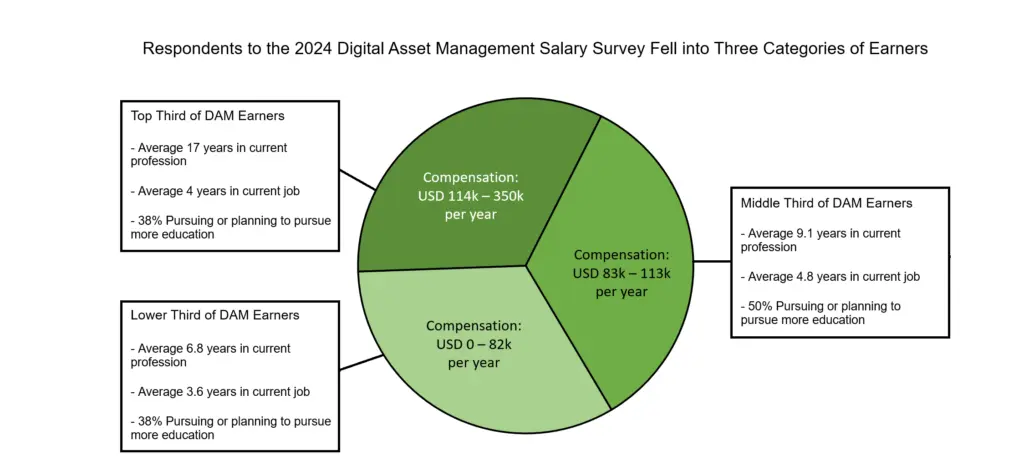
The 2024 results revealed a median full-time salary of $99,000, with a mean of $109,645. Most fascinatingly, the 2024 data illustrated how geographic location—historically a primary driver of compensation, with major hubs like London, New York, and Los Angeles commanding steep premiums—had lost much of its predictive power. With nearly half of all respondents working fully remotely, experience had emerged as the single most reliable factor correlating with higher pay.
2026: The Current Landscape
Now, in 2026, the survey enters its fifth major installment. The organizing committee—comprising Keathley, Grimm, Fanslow, and Tyner—brings decades of collective domain expertise to the project. Their continued stewardship ensures methodological consistency, allowing the community to track real-time shifts against historical baselines. As artificial intelligence, automated metadata generation, and multi-cloud repositories redefine the daily responsibilities of DAM professionals, the 2026 survey arrives at a crucial juncture.
Supporting Context & Metrics: Analyzing Past Trends
A rigorous review of historical data illuminates the trajectory that has led to the 2026 survey. By comparing previous benchmarks, industry analysts can identify structural trends that define modern digital asset management employment.
The Disruption of Geographic Premiums
For decades, physical proximity to major media and corporate centers dictated earning potential in creative and information-centric fields. A DAM manager working in Manhattan or central London could routinely expect a compensation package significantly higher than peers in smaller markets, compensating for the high cost of living.
However, the 2024 survey data disrupted this narrative permanently. As organizations embraced remote and hybrid operating models, the talent pool flattened. Employers looking for expert metadata architects and system administrators began sourcing talent globally or nationally without geographic constraints. Consequently, while major economic centers still host high-paying roles, the absolute reliance on location as a salary predictor has diminished. The 2026 survey will test whether this trend toward location-agnostic compensation has solidified or if inflationary pressures and return-to-office mandates are altering the equation once again.
Experience as the Ultimate Currency
While formal credentials—such as MLIS degrees, project management certifications, and software-specific accreditations—remain valuable entry points, historical salary surveys consistently point to direct, hands-on experience as the primary lever for salary growth.
Managing enterprise-scale taxonomies, navigating complex cross-departmental stakeholder dynamics, and executing seamless platform migrations require a nuanced skill set that cannot be learned in a classroom alone. The widening gap between entry-level compensation and senior-level remuneration highlights the premium organizations place on battle-tested DAM veterans who can preemptively solve operational bottlenecks before they disrupt marketing supply chains.

The Gender and Diversity Equation
Early iterations of the survey hinted at persistent demographic imbalances and compensation disparities within the industry. While the field has historically skewed toward certain educational backgrounds and demographics, contemporary workplace discussions increasingly demand transparency regarding pay equity. By gathering granular, anonymized demographic and compensation data, the survey series provides an essential tool for identifying and recturing systemic pay gaps within information management professions.
Official Perspectives: The Committee Behind the Survey
The success and longevity of the DAM Salary Survey are testaments to the dedication of its authors. Maintaining a project of this scale on a voluntary basis requires deep commitment to the professional community.
Elizabeth Keathley, Lisa Grimm, Deb Fanslow, and Jennifer Tyner represent a formidable brain trust in the world of digital asset management. Their collective backgrounds span information science, library architecture, enterprise metadata consulting, and operational strategy. Speaking on the release of the 2026 edition, the committee emphasizes that the initiative’s primary objective has always been empowerment through transparency.
"When professionals enter salary negotiations or corporate restructuring discussions, they are too often forced to rely on generalized recruiter estimates or guesswork," notes the committee’s collective ethos. "DAM is a specialized, highly technical discipline that underpins the entire digital footprint of modern enterprises. Professionals deserve hard, peer-verified data to back up their worth."
Furthermore, the authors stress that the utility of the survey is entirely dependent on community engagement. Data collection in specialized B2B niches is notoriously challenging; professionals facing heavy workloads are often reluctant to complete external forms. Yet, the authors remind the community that investing ten minutes in completing the survey directly contributes to a collective resource that benefits every practitioner navigating the job market.
Future Outlook: Why the 2026 Survey Matters More Than Ever
As the digital asset management landscape looks toward the remainder of the decade, several transformative forces are reshaping the profession, making the 2026 salary data exceptionally timely.
The AI Integration Boom
The rapid integration of artificial intelligence and machine learning into DAM platforms has fundamentally altered daily workflows. Automated tagging, facial recognition, predictive search, and generative AI asset creation tools promise unprecedented efficiency. However, they also introduce complex new challenges regarding rights management, metadata governance, and data integrity.
Rather than replacing human oversight, AI has elevated the role of the DAM manager. Organizations now desperately require skilled professionals who can train models, audit automated metadata, and establish ethical guardrails for digital assets. The 2026 survey will help determine whether this expanded technological remit is translating into commensurate financial compensation for DAM practitioners.
Enterprise Recognition and Job Title Evolution
For years, "DAM Manager" was just one of many hats worn by marketing coordinators, IT specialists, or creative producers. Today, Digital Asset Management is increasingly recognized as a distinct discipline with dedicated departments, specialized budgets, and executive-level reporting lines (such as Directors of Digital Asset Management and Enterprise Metadata Strategists).
As the profession solidifies its status within the corporate hierarchy, salary benchmarks must reflect this elevated stature. The data gathered in 2026 will serve as a vital barometer of whether enterprise compensation packages are keeping pace with the soaring strategic importance of digital assets.
Taking Action: How to Participate
The call to action for the digital asset management community is clear. Whether you administer an enterprise-scale DAM system, wrangle complex metadata schemas, manage intricate digital rights clearances, or ensure that brand assets flow seamlessly across global channels, your voice matters.
Relying on recruiter estimates or outdated salary reports puts professionals at a disadvantage during annual reviews, internal promotions, or job transitions. By contributing to the 2026 DAM Salary Survey, practitioners help build an accurate, transparent, and empowering dataset for the entire industry.
The survey is completely anonymous, takes roughly ten minutes to complete, and will be made freely available to the public upon completion.
Take the next step in shaping your professional future: Access and fill out the 2026 DAM Salary Survey here. Share the link with your colleagues, professional networks, and industry groups to ensure the dataset is as comprehensive and representative as possible.