






Executive Overview
The rapid integration of generative artificial intelligence (AI) and autonomous coding agents into software development lifecycles (SDLC) has fundamentally transformed how modern engineering teams build applications. From scaffolding complex microservices to debugging legacy codebases, developers increasingly lean on tools like Claude Code, OpenAI Codex, Cursor, and OpenCode to accelerate delivery timelines. However, this productivity boon comes with a steep, often unpredictable financial penalty. While the marginal cost of an individual model token continues a steady downward trajectory, the sheer volume of consumption has exploded exponentially, leading to runaway cloud and API expenditures.
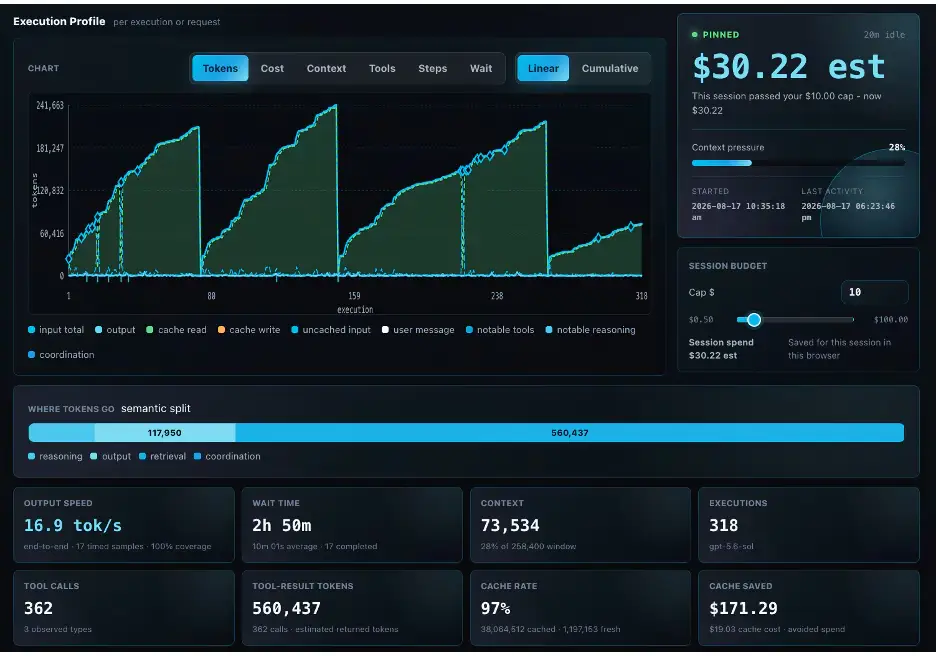
To address this mounting enterprise challenge, Splunk—the prominent observability and data analytics arm of Cisco—has officially released an open-source utility dubbed Token Meter. Designed specifically to bridge the visibility gap between developers writing code and finance teams auditing cloud overhead, Token Meter reads local AI agent trace files directly from a developer’s machine. By mapping these logs against public model pricing tiers, the tool surfaces real-time costs, operational efficiency metrics, and session activity profiles.
Token Meter arrives at a critical inflection point for the enterprise technology sector. According to recent market research data from the Futurum Group, just under 50% of global organizations report that their artificial intelligence expenditures have outpaced initial budgetary allocations. As DevOps and platform engineering teams grapple with the mandate to optimize financial operations (FinOps) without stunting developer velocity, tools providing granular, edge-level telemetry are transitioning from "nice-to-have" utilities to mission-critical infrastructure.
Detailed Chronology & Technical Architecture
The Mechanics of Token Tracking at the Edge
Historically, tracking the financial footprint of generative AI applications has relied on centralized API gateway logs, aggregate billing dashboards provided by model vendors, or retrospective monthly invoices. These legacy approaches suffer from high latency, offering insights long after a budget has been breached or an inefficient workflow has concluded.
Token Meter takes a decentralized, edge-native approach. Engineered to run seamlessly across macOS and Linux operating systems, the tool monitors local trace files generated during AI agent execution. It captures runtime activity across a diverse ecosystem of coding agents, including:
- Claude Code
- OpenAI Codex
- Cursor
- OpenCode
- Kiro
- Pi
Rather than intercepting network traffic or requiring intrusive middleware modifications within application codebases, Token Meter reads the historical logs and active session files that coding agents write directly to local disk storage. It then cross-references this raw data against a dynamically updated database of public model rates.
Granular Performance and Cost Metrics
By parsing these local execution traces, Token Meter exposes a comprehensive suite of performance indicators that go far beyond simple dollar-and-cent accounting. Key metrics surfaced by the tool include:
- Output Speed: Measured in tokens per second, allowing teams to evaluate model responsiveness and latency bottlenecks.
- Idle Wait Time: The precise duration a run spends waiting for model inference versus active execution.
- Input-Output Ratios: The structural split between fresh context injected into the prompt and generated output tokens.
- Tool Call Efficiency: Tracking how much contextual data an AI agent hands back to the system following an external tool invocation or function call.
Comprehensive Filtering and Analytical Dashboards
Token Meter is built with a multi-tabbed interface and an advanced query engine designed for deep-dive investigations. Developers and platform engineers can segment sessions using sophisticated runtime, model, state, and time filters. This capability enables technical leads to trace precise executions, individual events, tool activities, context window growth, retries, system failures, and coverage warnings.
Furthermore, the tool supports multi-dimensional comparative analysis. Engineering managers can compare token consumption, estimated financial costs, timing latency, context lengths, and tool usage metrics across different agents, underlying AI models, days, individual sessions, and specific developer tools.

The accompanying dashboard interface is structured into distinct functional zones:
- Timeline View: A chronological ledger of raw execution events.
- Tools Tab: Aggregated statistics on tool utilization and API handoffs.
- Insights Tab: Derived signals highlighting behavioral trends or token bloat.
- Alerts Tab: Real-time budget monitoring and threshold tracking.
When a running session breaches a predefined financial threshold or exhibits an abnormal cost spike, Token Meter issues immediate notifications. Additionally, the inclusion of a read-only Model Context Protocol (MCP) server allows engineering teams to pipe this telemetry data directly back into their AI coding agents, closing the loop between awareness and autonomous optimization.
Supporting Context & Metrics: The Generative AI Budget Crisis
The Law of Exponential Consumption
To fully understand the utility of Splunk’s Token Meter, one must examine the macroeconomic pressures facing contemporary software engineering departments. The economics of Large Language Models (LLMs) are governed by a paradoxical trend: while the unit cost per token has plummeted due to hardware efficiencies and algorithmic breakthroughs, the total cost of ownership (TCO) for AI infrastructure has skyrocketed.
As autonomous coding agents become more capable, developers assign them increasingly complex, multi-step workflows. A task that once required a single prompt and response now triggers recursive loops, multi-agent debates, automated testing suites, and massive context window refreshes. Each iteration consumes thousands—sometimes millions—of tokens in background context overhead.
Empirical Evidence: The Futurum Group Findings
This dynamic has caught corporate finance departments off guard. A landmark study published by the Futurum Group highlights a pervasive industry trend: 46.9% of enterprises report that their AI spend exceeded projected budgets entering the second half of the year.
This budgetary variance stems from several systemic issues:
- Opaque Usage Patterns: Individual developers utilizing desktop AI extensions without centralized cost attribution.
- Unoptimized Context Windows: Agents repeatedly ingesting entire codebases (or massive dependency trees) into the prompt context for trivial edits.
- Model Over-Provisioning: Deploying frontier, high-cost models (such as top-tier reasoning engines) for tasks that could be handled efficiently by smaller, open-weight, or distilled models.
For DevOps teams, the mandate is no longer just about accelerating deployment pipelines; it is about establishing rigorous AI FinOps frameworks. The challenge lies in reducing waste without inadvertently stifling developer productivity or degrading the quality of the software being shipped.
Official Statements & Industry Perspective
In announcing the launch of Token Meter, Splunk leadership emphasized the vital intersection of artificial intelligence observability and financial governance.
Hao Yang, Vice President and Head of AI for Splunk, shared critical insights into the strategic direction of enterprise AI consumption during the rollout:
"As AI continues to advance, DevOps teams should be able to strike a better balance between consuming tokens and relying on platforms from, for example, Splunk to minimize consumption of tokens. Eventually, how AI agents access and process data will become much more federated as providers of AI model services look for ways to help organizations keep costs under control."
Yang’s perspective underscores a broader industry evolution. As organizations mature in their AI adoption maturity curve, raw usage must be governed by intelligent data routing and context management. Rather than sending every query to the most expensive foundational model available, future development environments will dynamically route tasks based on complexity, cost thresholds, and historical performance data surfaced by tools like Token Meter.
Industry analysts note that Cisco’s integration of Splunk positions the combined entity uniquely in the observability landscape. By pushing monitoring capabilities directly to the developer’s local machine—the "edge" of the software development lifecycle—Splunk is expanding its aperture from traditional server-side log analytics to developer-centric productivity telemetry.
Future Outlook: The Evolution of AI FinOps and Agentic Workflows
Moving Toward Federated Data Access and Smart Routing
Looking ahead, the release of tools like Token Meter signals a transitional phase in how engineering organizations manage artificial intelligence resources. Several key developments are expected to shape the landscape over the next 24 to 36 months:
- Standardization of Agent Trace Logs: As more coding agents and development environments emerge, standardizing how telemetry data is written to disk will become paramount. Open-source initiatives championed by organizations like Splunk will likely drive open logging specifications across the AI tooling ecosystem.
- Automated Model Downgrading and Fallbacks: Future iterations of development environments will likely incorporate automated policy engines. If Token Meter’s underlying telemetry detects that an agent is burning through budget on a routine refactoring task using an expensive frontier model, the system can automatically downgrade the session to a localized or cost-effective open-source model without disrupting the developer.
- Deepening Integration with Enterprise FinOps: Connecting local developer telemetry with centralized enterprise cloud spend dashboards will enable real-time chargebacks and accurate cost allocation across engineering business units. CFOs and VP of Engineering will gain the visibility required to calculate the exact ROI of AI-assisted software development.
Conclusion
The proliferation of generative AI in software engineering is irreversible. However, the era of unchecked, black-box AI spending is rapidly coming to a close. By empowering developers and platform engineers with granular, real-time visibility into local agent sessions, Splunk’s Token Meter provides a vital weapon in the fight against budget overruns. As organizations strive to balance innovation with fiscal responsibility, tools that democratize AI cost awareness will become foundational pillars of modern engineering excellence.
Frequently Asked Questions (FAQ)
What is Splunk Token Meter?
Token Meter is an open-source utility developed by the Splunk arm of Cisco. It reads local log files generated by AI coding agents on a developer’s machine and prices them against public model rates to surface real-time token usage, estimated costs, model activity, tool execution, session duration, and performance metrics.
Which AI coding tools and environments does Token Meter support?
The tool is engineered for broad compatibility across major operating systems (macOS and Linux) and supports a wide variety of popular AI coding agents, including Claude Code, OpenAI Codex, Cursor, OpenCode, Kiro, and Pi. This enables developers to compare performance and expenditures across different models and workflows.
How can DevOps teams leverage Token Meter to control AI costs?
Token Meter provides deep visibility into where and how tokens are being consumed across the development lifecycle. By highlighting inefficient sessions, excessive context growth, or expensive model selections—and by issuing automated alerts when spending crosses predefined thresholds—Token Meter helps teams establish proactive AI FinOps practices and determine when a less expensive model or optimized workflow is appropriate.