Executive Overview
The landscape of autonomous logistics is undergoing a radical transformation, spearheaded by ambitious engineering paradigms and aggressive venture capital investment. Airbound, an Indian autonomous drone technology startup, has successfully closed a $37 million Series A funding round. This latest injection of capital arrives less than a year after the company secured an $8.65 million seed round, pushing its total institutional funding to nearly $50 million within a mere three years of operational history.
The Series A round was led by prominent venture capital firm Greenoaks, with strategic participation from delivery giant DoorDash, high-profile investor Lachy Groom, Lightspeed Venture Partners, and Humba Ventures. This formidable coalition of backers underscores a growing conviction in the venture’s core thesis: that aerial delivery can eventually match—and even undercuts—the per-unit economic costs of traditional ground transportation.
Founded in 2023 and led by visionary young entrepreneur Naman Pushp, Airbound is not merely trying to build another delivery service. Instead, the company is positioning itself as the foundational aircraft manufacturer and infrastructure architect for the future of global logistics. By fundamentally redesigning vertical-flight aircraft to achieve an unprecedented payload-to-weight ratio, Airbound aims to solve the historic Achilles’ heel of the drone delivery industry: prohibitive operational costs driven by structural inefficiency.
As the company scales its manufacturing footprint in Bengaluru, expands its landmark healthcare partnerships, and collaborates with regional governments to pioneer regulatory frameworks, it is systematically clearing the path toward mass-scale autonomous aerial transport. While significant regulatory hurdles and pre-revenue commercial realities remain, Airbound’s long-term vision paints a compelling picture of a future where urban and regional supply chains take to the skies.
Detailed Chronology: From Inception to Multi-Million Dollar Scale
The Formative Phase (2023)
Airbound emerged onto the tech landscape in 2023 under the leadership of Naman Pushp. From its inception, the startup identified a fundamental flaw in the prevailing commercial drone industry: conventional multirotor and fixed-wing drones were engineered with heavy structural frameworks that consumed the vast majority of their energy just keeping themselves airborne. This engineering reality severely restricted payloads, limited ranges, and inflated costs, relegating drone delivery to a high-priced novelty rather than a viable macro-logistics alternative.
Recognizing that ground-level trucking remains the gold standard for cost-effective freight movement, Pushp and his engineering team went back to the drawing board. They sought to discard conventional aviation design rules in favor of a hyper-optimized architecture inspired by aerospace mechanics rather than hobbyist drone design.
The Seed Milestone and Rapid Iteration (Late 2024 – Early 2025)
By late 2024, Airbound had transitioned from a stealth engineering outfit to an operational flight-testing entity. This progress culminated in an $8.65 million seed round announced in October 2024. The capital provided the runway necessary to transition from initial prototypes to rigorous field trials across southern India.
Over the course of its operations, Airbound has quietly amassed an impressive flight record, completing over 13,000 autonomous flights across the bustling urban and suburban landscapes of Bengaluru and Guntur. These rigorous operational hours served as an invaluable proving ground, validating the reliability of the company’s navigation systems, airframes, and flight-control software under real-world atmospheric and traffic conditions.
The Series A Acceleration (2025 – Present)
The closing of the $37 million Series A round marks a pivotal evolutionary leap for the three-year-old startup. With heavyweights like Greenoaks and DoorDash entering the cap table, Airbound now possesses the financial ammunition required to transition from regional pilot projects to large-scale network deployments.
The funding will directly support the refinement of its next-generation aircraft, the expansion of its 43,000-square-foot manufacturing facility in Bengaluru, and the deployment of an ambitious three-city commercial drone network in the state of Andhra Pradesh. Despite growing to a team of over 150 employees, the startup remains laser-focused on long-term technological dominance rather than short-term revenue generation—a testament to its ambition to become the "Boeing of the drone era."
Supporting Context & Metrics: Engineering Efficiency and Real-World Validation
Redefining the Physics of Flight
To understand Airbound’s market potential, one must examine its core aerodynamic philosophy. Conventional aircraft suffer from an inherent weight penalty: the heavy batteries, motors, and structural supports required to maintain flight consume most of the aircraft’s lift capacity, leaving very little margin for commercial cargo. This makes moving small loads via traditional aircraft economically non-viable.
Airbound’s engineering response is radical yet elegant: build vertical-flight drones designed to weigh significantly less than the cargo they carry.
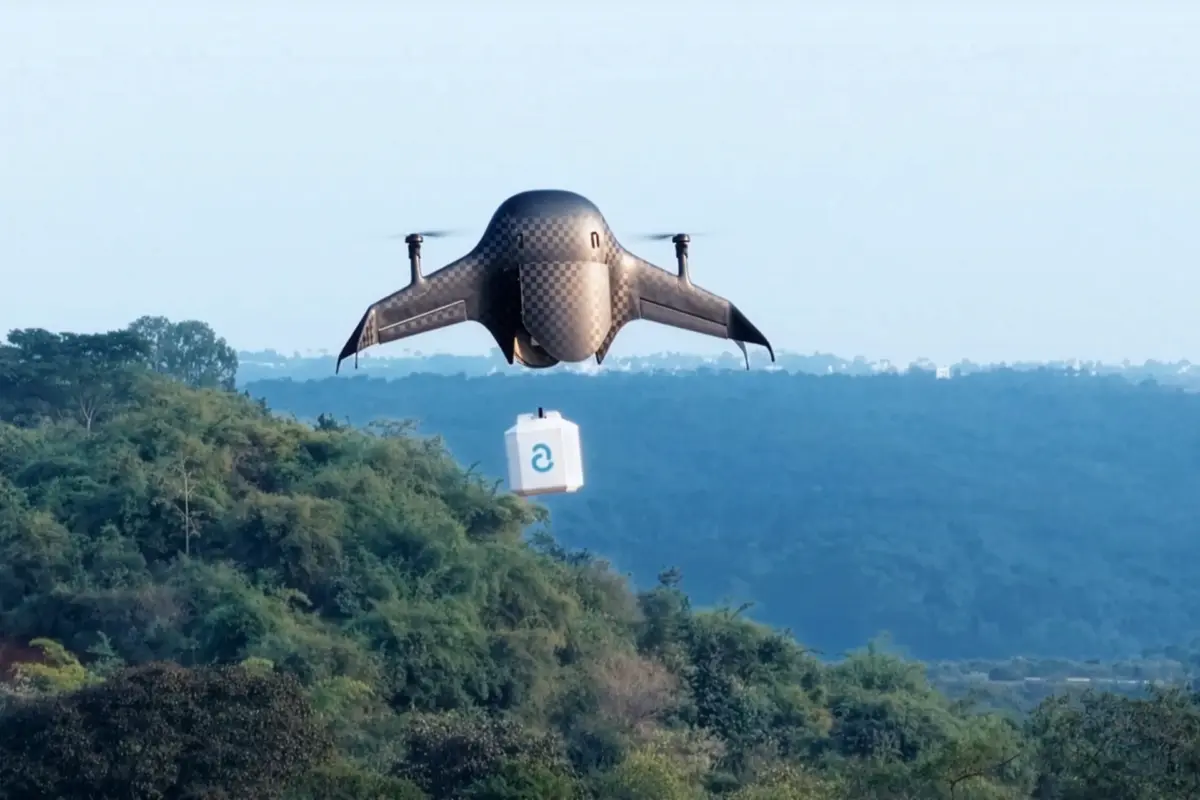
- The TRT Current Generation: Airbound’s current operational drone, designated as the TRT, weighs a mere 3.3 pounds (approx. 1.5 kg) while boasting a payload capacity of approximately 2.2 pounds (approx. 1 kg).
- The Next-Generation Platform: Under development is a larger iteration expected to weigh roughly 6.6 pounds (3 kg) while capable of carrying payloads up to 11 pounds (5 kg).
Rather than relying on traditional runways or complex infrastructure, Airbound utilizes a rocket-like, tail-sitter design. The aircraft takes off and lands vertically in an upright position, smoothly transitioning into horizontal flight once airborne. This vertical takeoff and landing (VTOL) capability ensures that the network remains agnostic to traditional airport infrastructure, allowing point-to-point delivery routing directly within urban and suburban corridors.
The Narayana Health Partnership: Proving Speed and Utility
While many drone startups rely on theoretical projections, Airbound has already embedded its technology into critical real-world infrastructure. The company has executed more than 1,000 automated flights in partnership with major Indian hospital network Narayana Health.
On the operational Narayana route, a single active Airbound drone transports sensitive diagnostic medical samples over a 2.5-mile distance in roughly seven minutes. When evaluated against traditional ground transport, the efficiency gains are staggering. By road, the exact same trip can take anywhere from three to five hours. This delay is rarely due purely to transit time; rather, road logistics require couriers to wait until a sufficient volume of samples can be bundled together to justify the dispatch of a vehicle.
This success has laid the groundwork for an expanded deployment. Narayana Health’s newly constructed Banashankari hospital in Bengaluru was purposefully designed without an on-site diagnostic laboratory or blood bank. Instead, the facility relies entirely on Airbound’s autonomous drone network to connect instantaneously with centralized laboratories, proving that aerial logistics can fundamentally alter hospital architecture and urban healthcare planning.
Official Statements and Industry Vision
Naman Pushp, founder and CEO of Airbound, has been vocal about the company’s macroeconomic ambitions and its distinct positioning within the broader autonomous mobility ecosystem.
"We want to build towards a world where everything has cost parity with trucking," Pushp asserted during an interview discussing the company’s long-term pricing targets.
Achieving cost parity with ground freight requires stripping away the operational redundancies that plague modern logistics. By focusing on ultra-lightweight airframes and fully autonomous flight loops, Airbound aims to drive the per-delivery cost down to fractions of a dollar—a milestone the company actively worked toward during its seed phase.
Furthermore, Pushp has drawn a sharp distinction between Airbound’s business model and those of other drone delivery operators who seek to act as consumer-facing courier services.
"That’s the Boeing role — the aircraft airlines everywhere rely on, not the airline itself," Pushp explained, outlining the startup’s ultimate ambition.
By designing and manufacturing its aircraft in-house at its 43,000-square-foot Bengaluru facility, Airbound is positioning itself as a universal Original Equipment Manufacturer (OEM). Rather than competing directly with regional logistics fleets, Airbound intends to supply its hyper-efficient aircraft to third-party logistics providers, e-commerce giants, and healthcare networks across the globe.
Future Outlook: The Three-City Network and Scaling Challenges
The Andhra Pradesh Three-City Vision
Airbound’s most audacious upcoming milestone is the establishment of a comprehensive multi-city drone delivery network spanning three urban centers in the southern Indian state of Andhra Pradesh. The startup has already signed a formal memorandum of understanding with the state government, outlining a target of 10,000 daily flights dedicated to retail, e-commerce, and healthcare logistics.
Achieving this high-frequency throughput will require a deployed fleet ranging between 250 and 1,000 aircraft, depending on the precise route configurations and demand densities across the network. Pushp estimates that the initial launch will likely scale efficiently with approximately 250 active airframes. Crucially, this agreement does not involve government subsidies or public funding contracts; instead, the Andhra Pradesh administration is actively collaborating with Airbound to formulate the forward-looking regulatory framework necessary to safely orchestrate thousands of daily autonomous flights.
Navigating the Bottlenecks: Regulation Over Manufacturing
While Airbound’s 43,000-square-foot manufacturing facility in Bengaluru is fully equipped to scale airframe production, Pushp maintains that manufacturing capacity will not be the primary limiting factor in the company’s growth trajectory.
Instead, the single greatest bottleneck facing Airbound—and the autonomous drone industry at large—remains regulatory clearance. Specifically, securing Beyond Visual Line of Sight (BVLOS) operational certifications is the critical gating item. Operating commercial delivery networks at scale is mathematically impossible without regulatory frameworks that permit autonomous drones to navigate outside the direct line of sight of ground operators.
These ongoing regulatory constraints have naturally limited Airbound’s immediate capacity to monetize its flight hours, leaving the 150-employee startup largely pre-revenue at this stage of its lifecycle. However, the leadership team remains unfazed by short-term financial metrics, prioritizing technological moat-building and regulatory compliance over immediate cash flow generation.
"The goal is to be a giant in a few decades, not to make revenue as soon as we can," Pushp emphasized.
Conclusion
As Airbound deploys its $37 million Series A capital injection, the company stands at the vanguard of a quiet revolution in global transport. By refusing to accept the heavy structural inefficiencies of legacy aviation, Airbound has engineered a compelling technological bridge between the speed of flight and the economic efficiency of trucking.
With deep-pocketed backers like Greenoaks and DoorDash, strategic validation from healthcare giants like Narayana Health, and an expanding regulatory partnership with the government of Andhra Pradesh, Airbound is methodically constructing the foundational architecture of the autonomous sky. If the company succeeds in its mission, the daily delivery of retail goods, e-commerce packages, and life-saving medical supplies will no longer be bound by the asphalt of congested city streets—it will soar quietly, efficiently, and affordably overhead.