Executive Overview
Artificial intelligence has fundamentally transformed digital marketing, reshaping how brands interact with consumers across the Google Ads ecosystem. From Performance Max and AI Max Search campaigns to automated asset generation and dynamic audience expansion, machine learning algorithms now dictate vast swaths of media spend, ad creation, and targeting. While these systems promise unprecedented efficiency and higher conversion volumes, they carry a hidden risk: hyper-autonomous behavior that can dilute brand equity, misalign messaging, and waste valuable advertising budgets on low-intent or entirely inappropriate traffic.
For years, digital advertisers relied on tactical exclusions—chiefly negative keywords and placement lists—to keep their ads clear of unwanted search queries. However, in today’s hyper-advanced, intent-driven search landscape, traditional negative keywords are no longer enough. An algorithm can easily bypass a blocked term if a user expresses the underlying intent through entirely different phrasing.
Consequently, the paradigm of campaign management has shifted. Advertisers can no longer focus solely on what Google’s AI should target; they must rigorously define who and what the machine must avoid. By leveraging advanced mechanisms such as text guidelines, asset optimizations, URL exclusions, and strict controls over account-level automated assets and optimized targeting, digital marketers can build the necessary guardrails to steer AI toward profitable, high-intent consumers while protecting their brand’s bottom line.
Detailed Chronology: The Evolution of AI Control in Google Ads
The integration of machine learning into Google Ads has progressed rapidly over the past decade, moving from simple predictive bidding models to fully autonomous, generative AI campaigns. Understanding this trajectory highlights why manual oversight has become both more difficult and more essential.
Phase 1: The Rule-Based Era and Basic Exclusions
In the early days of keyword-based advertising, control was entirely manual. Advertisers specified exact-match, phrase-match, or broad-match keywords, accompanied by static negative keyword lists. If an advertiser sold luxury leather goods, they simply added "cheap," "discount," and "free" to their negative keyword lists, and the system strictly obeyed.
Phase 2: The Rise of Smart Bidding and Automated Targeting
As machine learning entered the fold through "Smart Bidding" algorithms (such as Target CPA and Target ROAS), Google began looking beyond strict keyword matches to predict the likelihood of a conversion. This era introduced broader matching behaviors and early forms of audience expansion. While performance often improved, advertisers began noticing a loss of granular control over search query reports, sparking early debates over algorithmic "black boxes."
Phase 3: The Performance Max Revolution
The launch of Performance Max (PMax) represented a massive leap forward—and a significant loss of direct visibility. PMax campaigns pooled text, image, video, and product feed assets across Google’s entire inventory—Search, Display, YouTube, Discover, Gmail, and Maps—driven entirely by automated intent prediction. While powerful, many digital marketers struggled with ads serving on irrelevant placements or displaying mismatched messaging.
Phase 4: The Generative AI Era and Modern Guardrails
Today, Google Ads utilizes generative AI to dynamically write ad copy, pull automated promotional pricing directly from websites, and generate custom imagery and video assets on the fly. Recognizing that unconstrained generative AI can introduce severe brand safety risks, Google has gradually rolled out advanced control mechanisms. Tools like text guidelines, asset-level exclusions, and URL-level blocks in Performance Max and AI Max Search campaigns represent the latest evolution: giving advertisers the power to program behavioral guardrails directly into the machine learning models.
Supporting Context & Metrics: The Anatomy of AI Over-Automation
To appreciate why guardrails are indispensable, one must examine how autonomous features operate beneath the hood and where they frequently disconnect from business reality.
1. The Limitation of Traditional Negative Keywords
Consider a digital storefront that specializes in premium, artisanal laptop cases. An advertiser might meticulously populate their negative keyword list with terms like "cheap," "budget," "discount," and "inexpensive."
However, intent-driven AI operates on semantic meaning rather than literal strings. A consumer searching for a low-cost laptop case might type "minimalist protection for students" or search exclusively for "affordable laptop sleeves" without ever triggering the literal keyword flags. Because the underlying intent is price-sensitive, an unguided AI model might still match this user to a high-end product page, resulting in high click-through rates (CTR) but abysmal conversion rates and wasted ad spend.
2. Text Guidelines and Messaging Restrictions
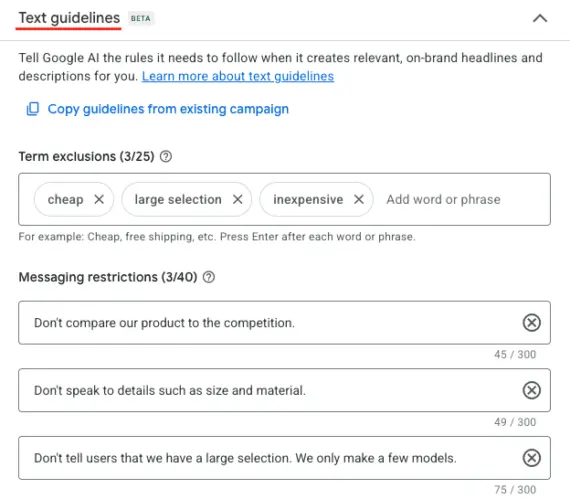
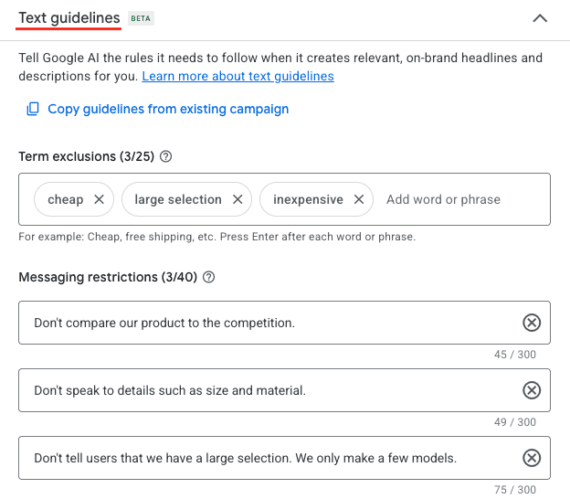
To combat semantic mismatch, Google introduced text guidelines within Performance Max and AI Max Search frameworks. These settings allow advertisers to explicitly state messaging boundaries. For instance, a brand can instruct the AI:
- Term Exclusions: Block terms like "cheap," "large selection," and "inexpensive."
- Messaging Restrictions: Explicitly forbid claims such as "Don’t compare our product to the competition" or enforce tone-of-speech guidelines that align exclusively with luxury buyers willing to pay a premium.
By feeding these textual guardrails into the model, the AI stops treating every high-volume search as a viable target and begins qualifying traffic based on qualitative business parameters.
3. URL Exclusions and Asset Optimization
Automated campaigns often scan an entire website domain to find landing pages. Without intervention, a PMax campaign might drive high-value traffic directly to a clearance page, an outdated blog post, or a discontinued product variant.
URL exclusions allow marketers to wall off specific sections of their site. Coupled with asset optimization features—which enable advertisers to toggle off automated image and video enhancements—brands regain control over the visual and navigational journey of the consumer.
4. Account-Level Automated Assets: The Hidden Danger
Tucked deep within the Google Ads user interface lies the "Account-level automated assets" section. While easily overlooked, its impact is profound. Google’s system frequently crawls websites to dynamically populate:
- Sitelinks and callouts
- Dynamic images and videos
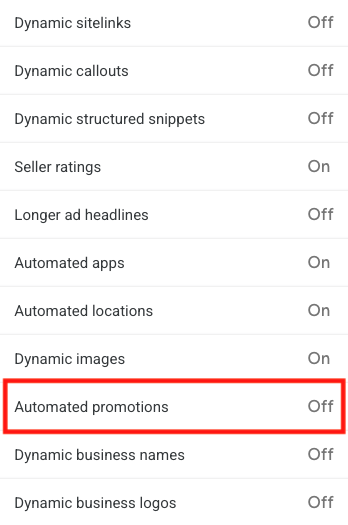
- Automated promotions (pulling real-time discounts or sales banners from site text)
Left unchecked, Google’s AI may pull discounted items or apply logos and brand names in ways that violate internal brand compliance guidelines. Advertisers must audit these settings by navigating to Settings > Advanced settings, inspecting the status of automated assets, and disabling unwanted features like automated promotions if they contradict pricing strategies. Furthermore, marketers can review what the AI has independently generated by visiting the Assets tab in the left-hand navigation and applying the filter "Added by: Google AI."
5. Optimized Targeting and Audience Expansion: Timing is Everything
Features like Optimized Targeting for Search Partners, Display Network, Demand Gen, and Video campaigns promise incremental growth. Google’s interface often displays encouraging metrics next to these toggles—such as claims that campaigns average "20% more conversions" with optimized targeting enabled.
However, enabling these features prematurely can severely damage a campaign’s performance. If turned on before the algorithm has accumulated sufficient first-party conversion data, optimized targeting acts like a loose cannon, scattering budget across low-converting audiences and diluting the core signal. Industry best practice dictates a strict sequencing rule: Train the AI first on established, high-intent traffic, and only introduce optimized targeting and audience expansion after the conversion history is deep and robust.
Official Industry Perspectives and Expert Analysis
Digital marketing veterans and platform architects have increasingly emphasized that the future of paid search lies not in micro-managing every keyword, but in managing the parameters of autonomy.
Industry analysts point out that while Google’s machine learning models are extraordinarily powerful at pattern recognition, they fundamentally lack business context. An algorithm understands conversions, clicks, and cost-per-acquisition, but it does not understand profit margins, brand prestige, or inventory constraints.
"AI is a brilliant engine, but it is a terrible driver," notes one senior paid search strategist. "If you do not supply the steering wheel—through text guidelines, URL blocks, and strict asset controls—the algorithm will drive your budget straight toward the path of least resistance, which is rarely the path of highest profitability."
Google’s own product documentation acknowledges the tension between automation and control, framing features like text guidelines and asset exclusions as collaborative guardrails designed to bridge the gap between machine efficiency and human strategy. Yet, experts warn that these settings are frequently buried within secondary menus, requiring proactive auditing to uncover.
Future Outlook: The Next Frontier of AI Governance in Advertising
As we look toward the future of digital advertising, the relationship between human marketers and machine learning will continue to evolve. Several key trends are expected to shape the landscape over the coming years:
- Granular Natural Language Guardrails: Expect platforms to adopt increasingly sophisticated natural language processing interfaces for advertisers. Instead of checking boxes or entering simple term exclusions, marketers will likely converse directly with campaign management agents, setting complex, multi-layered business rules (e.g., "Never target users looking for free trials, and ensure no ad copy references our discount tier unless a specific seasonal promotion is active").
- First-Party Data Integration: As privacy regulations tighten and third-party cookies phase out entirely, the efficacy of AI will rely almost exclusively on first-party data. Advertisers who master the art of feeding clean, segmented customer lifetime value (LTV) data into Google Ads—while pairing it with strict negative guardrails—will vastly outperform those who rely on default platform settings.
- The Rise of "AI Auditors": A new sub-specialty within digital marketing is emerging, focusing entirely on algorithmic governance. These professionals specialize in auditing automated assets, monitoring generative AI drift, and ensuring that machine-driven campaigns remain aligned with corporate identity and margin goals.
Conclusion
Artificial intelligence is an indispensable tool in modern advertising, offering scale and precision that human teams could never achieve manually. However, scale without direction is simply accelerated waste. By shifting focus from mere targeting to active behavioral exclusion—utilizing text guidelines, asset optimization, URL exclusions, and careful timing of optimized targeting—advertisers can harness the immense power of Google’s algorithms while keeping their brand reputation and profit margins firmly secure.