Executive Overview
The artificial intelligence landscape is witnessing yet another seismic shift as Google steps forward with the launch of its latest model iteration, Gemini 3.8 Flash. In an industry historically dominated by a relentless push for sheer parameter scale and astronomical computing costs, Google’s latest deployment signals a pragmatic—yet fiercely competitive—pivot toward efficiency, specialization, and market disruption.
At the center of this release is a striking achievement: Gemini 3.8 Flash has surged to the absolute top of the DeepSWE leaderboard, a premier benchmark measuring an AI model’s capacity to autonomously resolve complex software engineering problems. What makes this feat particularly compelling for enterprise buyers and developers alike is that it accomplishes this elite-tier performance at a significantly lower cost point, facilitated by current promotional and discounted rate structures.
This development stands in stark contrast to recent historical friction within Google’s internal roadmap. Industry reports previously indicated that Google was forced to delay the rollout of Gemini 3.5 Pro after its coding benchmarks failed to outclass or match competing market alternatives. However, if the preliminary benchmark data and ecosystem integration metrics for Gemini 3.8 Flash reflect operational reality, Google has not only closed that gap but has weaponized its "Flash" moniker—traditionally reserved for lightweight, speed-optimized iterations—to go toe-to-toe with the industry’s heavy-hitting flagship models.
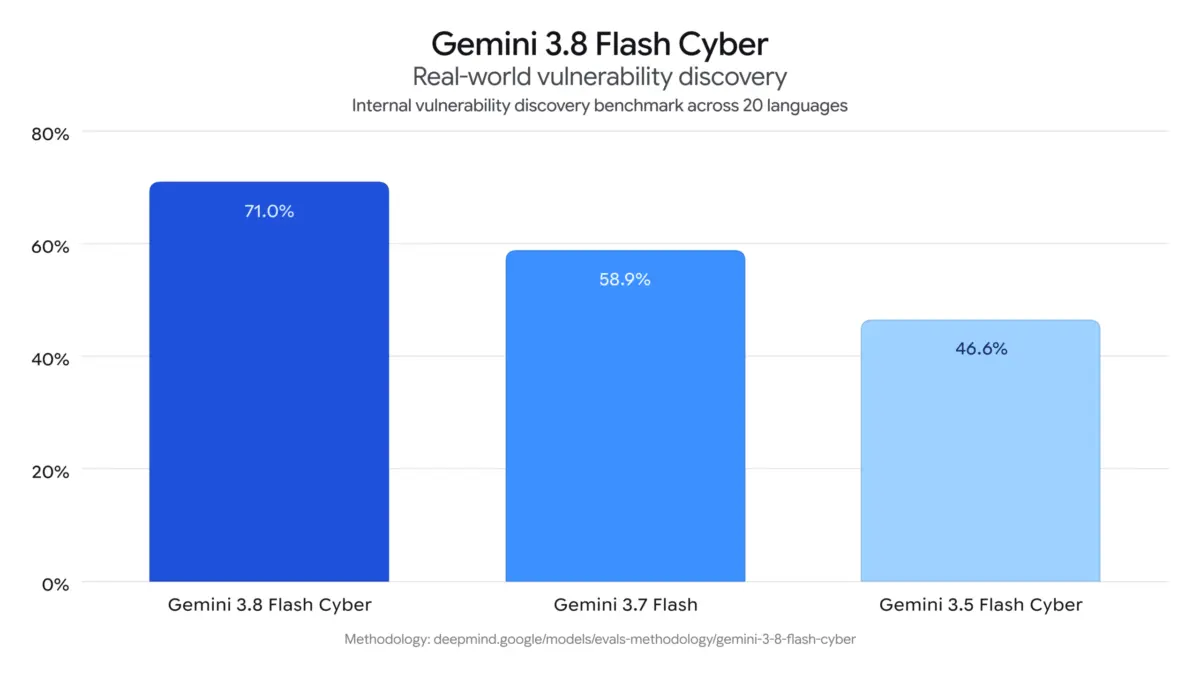
Simultaneously, Google is expanding its specialized ecosystem with the introduction of Gemini 3.8 Flash Cyber, a domain-specific variant engineered to tackle automated vulnerability discovery and remediation. While general-purpose consumer models grab public headlines, these specialized vertical agents are quietly redefining the cybersecurity landscape. Initial internal benchmarks and enterprise partner testimonials suggest that Gemini 3.8 Flash Cyber represents a quantum leap in automated threat identification and patch generation.
This report provides a comprehensive examination of Gemini 3.8 Flash and its cybersecurity counterpart. We will analyze the underlying performance metrics across software engineering and agentic computer use, trace the strategic pivot in Google’s AI development cycle, review quantitative findings from enterprise partners, and evaluate the accessibility roadmap for developers and consumers alike.
Detailed Chronology & Strategic Context: Overcoming the 3.5 Stumbles
To fully understand the gravity of the Gemini 3.8 Flash release, one must contextualize the turbulent trajectory of Google’s previous model generations. Over the past eighteen months, the generative AI race has evolved from a game of general conversational fluency into a brutal contest of multi-step reasoning, autonomous execution, and code generation.
During the development cycle of Gemini 3.5 Pro, Google reportedly encountered internal roadblocks. Reports surfaced that the company had to stall or heavily revise its deployment schedules because the model’s coding and logic performance benchmarks fell short of rival models offered by OpenAI and Anthropic. In a market where a few percentage points on the HumanEval or SWE-bench leaderboards can translate into billions of dollars in enterprise cloud commitments, falling behind in software engineering capabilities is an existential threat.
Google’s response to this competitive pressure appears to be a dual-pronged strategy: accelerating iteration cycles and leaning heavily into architectural efficiency. Rather than waiting for a monolithic, resource-heavy "Ultra" model to solve its coding deficiencies, Google optimized its mid-tier architecture.
The result of this strategic recalibration is Gemini 3.8 Flash. By streamlining the model’s underlying transformer layers and refining its post-training alignment for code-base navigation, Google achieved an unexpected breakthrough. Landing at the pinnacle of the DeepSWE leaderboard proves that speed and efficiency no longer require a trade-off against deep analytical and programmatic reasoning. For an industry watching profit margins closely against compute costs, the arrival of a top-tier coding model packaged as a cost-effective "Flash" tier represents a major market disruptor.
Supporting Context & Metrics: Breaking Down the Benchmarks
While marketing claims from major technology firms must always be greeted with a degree of healthy skepticism, third-party benchmarks and competitive evaluations offer a window into the true capabilities of Gemini 3.8 Flash.
1. The DeepSWE Leaderboard Triumph
The DeepSWE benchmark evaluates an AI’s ability to interact with massive, undocumented codebases, diagnose obscure bugs, write comprehensive unit tests, and synthesize functional patches that pass rigorous continuous integration (CI) pipelines. Historically, this domain has been the stronghold of expensive, slow-reasoning models. Gemini 3.8 Flash’s ascent to the top of this leaderboard marks a watershed moment: a lightweight model outperforming heavier architectures in software engineering tasks. Crucially, because it operates under Google’s Flash pricing tier, it delivers these capabilities at a fraction of the inference cost of its competitors.
2. Agentic Computer Use: The OSWorld-2.0 Battleground
Despite its triumph in software engineering, Gemini 3.8 Flash reveals the nuanced limitations that all current AI models face when transitioning into generalized digital workers. In OSWorld-2.0—a stringent evaluation framework designed to test end-to-end agentic computer use (such as navigating operating systems, manipulating desktop applications, and executing cross-platform workflows)—Gemini 3.8 Flash demonstrates measurable progress over its predecessor, Gemini 3.7 Flash.
However, a performance gap remains. Gemini 3.8 Flash still trails behind the current market leader in agentic workflows, Anthropic’s Claude Opus. To be fair to Google, OpenAI’s premier models also face friction in this specific test environment, highlighting that autonomous desktop navigation remains one of the final frontiers for modern foundation models. While Gemini can write a sophisticated patch for a complex backend service with ease, teaching it to reliably manage a desktop operating system like a human user continues to be a work in progress.
3. The Specialized Metrics of Gemini 3.8 Flash Cyber
Moving beyond general coding and computer use, Google has tailored a distinct derivative: Gemini 3.8 Flash Cyber. Designed to replace the earlier 3.5 cybersecurity variant, this model is engineered explicitly for offensive and defensive security operations.
While consumer-facing applications may overlook this model, its internal and partner evaluations paint a startling picture of capability:
- Internal Testing: Google reports that Gemini 3.8 Flash Cyber demonstrates a substantial reduction in false positives alongside a dramatic increase in the frequency of generating working, production-ready security patches.
- Chrome Security Team: Internal deployments within Google’s Chrome security division yielded a staggering 2.6x increase in patch accuracy when utilizing the new model to address browser-level vulnerabilities.
- Cloud Infrastructure: Google’s internal Cloud security teams documented a milestone case study where Gemini 3.8 Flash Cyber independently discovered a critical, zero-day-style vulnerability within a complex cloud service architecture in just two hours.
Official Statements and Industry Validation
The credibility of any new AI release is ultimately tested by its reception among third-party validators and enterprise partners. Google has accompanied the launch of the Gemini 3.8 Flash ecosystem with strong endorsements from major cybersecurity and cloud infrastructure heavyweights.
Industry leaders such as Wiz and Palo Alto Networks have publicly commented on the utility of the new cyber-focused model. In statements released alongside the architecture, representatives from these firms highlighted the model’s unprecedented speed in parsing massive threat logs, isolating anomalies, and mapping out remediation strategies.
"The velocity at which modern cloud environments evolve means that human security analysts are frequently outpaced by the sheer volume of generated code and configuration drift," noted an enterprise security strategist familiar with early deployments of Gemini 3.8 Flash Cyber. "Models like 3.8 Flash Cyber are no longer optional testing curiosities; they are becoming the foundational triage layer for enterprise security operations centers (SOCs)."
Google’s internal teams have echoed these sentiments, emphasizing that the reduction in human hours required to verify vulnerability reports allows security engineers to focus on architectural hardening rather than chasing routine patch cycles.
Future Outlook: Accessibility, Ecosystem Integration, and the Road Ahead
As Gemini 3.8 Flash rolls out across the global Google ecosystem starting today, the practical implications for developers, enterprises, and everyday users are coming into sharp focus.
Accessibility and Pricing Tiers
Google is maintaining its tiered access model for the new releases, balancing enterprise monetization with developer experimentation:
- Consumer Integration: Within the consumer-facing Gemini mobile and web applications, access to Gemini 3.8 Flash will continue to require a Pro or Ultra subscription, mirroring the rollout strategy of previous Flash iterations.
- Developer Freedom: For developers, researchers, and hobbyists who want to audit the model’s capabilities, kick the tires on its coding logic, or test its performance boundaries without upfront financial commitment, Google AI Studio offers immediate access to tinker with the model for free.
- The Restricted Tier (Flash Cyber): Unlike the standard developer-accessible Flash model, Gemini 3.8 Flash Cyber is subject to stringent safety controls. It is currently locked behind a gated preview restricted strictly to trusted enterprise testers, security partners, and government entities to prevent malicious misuse of its vulnerability-discovery capabilities.
The Broader Horizon
The launch of Gemini 3.8 Flash marks a mature turning point in the generative AI industry. The era of winning market share purely through unconstrained model size and reckless compute scaling is giving way to an era of hyper-efficient specialization. By proving that a "Flash"-tier model can conquer the DeepSWE leaderboard while simultaneously powering high-accuracy cyber defense engines, Google has rewritten the playbook on what lightweight AI architectures can achieve.
As these models integrate deeper into IDEs, CI/CD pipelines, and enterprise security platforms over the coming months, the dividing line between human developer and AI collaborator will continue to blur. Whether Google can leverage this momentum to challenge Claude Opus’s dominance in broader agentic computer use remains to be seen, but one thing is certain: the race for software engineering supremacy has entered its most competitive phase yet.