Executive Overview
The commercialization of nuclear fusion has long been hindered by a seemingly insurmountable paradox: while the physics of generating net-positive energy have been proven in controlled laboratory settings, translating those breakthroughs into a viable, continuous commercial power source requires industrializing processes that were never designed for mass production.
Enter Inertia Enterprises, a heavily backed fusion startup that has just cleared a monumental hurdle on its roadmap to commercial viability. In an exclusive first look provided to the tech and energy sectors, Inertia announced that it has successfully slashed the time required to manufacture its specialized fusion fuel pellets from several days—and in some cases, weeks—down to a matter of minutes.
This dramatic reduction in manufacturing latency checks off one of the core 10 engineering barriers identified in Inertia’s phase-one commercial power plant roadmap. Backed by $450 million in venture capital from prominent investors, including Alphabet’s GV and Bessemer Venture Partners, the startup was founded on the premise of commercializing technology pioneered at the Lawrence Livermore National Laboratory’s National Ignition Facility (NIF).
However, translating an elaborate, bespoke scientific experiment into a scalable assembly line is no small feat. By rethinking the manufacturing pipeline—and enlisting industrial engineering talent from giants like Apple—Inertia has transformed fuel pellet production from a painstakingly slow bottleneck into a streamlined, high-speed operation. This breakthrough not only paves the way for the continuous operation of commercial fusion reactors, which are projected to consume roughly 10 fuel pellets every second, but it also dramatically reduces the facility’s reliance on tritium, a scarce and radioactive hydrogen isotope. As Inertia continues to build out its public-private partnership with the NIF, this achievement signals a definitive shift in the global fusion race: moving away from proof-of-concept science and marching squarely toward mass manufacturing.
Detailed Chronology: From NIF Prototypes to Mass Manufacturing
The Legacy of the National Ignition Facility
To understand the significance of Inertia’s recent breakthrough, one must first look at the origin of inertial confinement fusion technology. The National Ignition Facility, situated within the Lawrence Livermore National Laboratory, made history when it successfully executed a fusion experiment that produced more energy than it consumed—a long-sought milestone known as scientific energy breakeven.
Yet, the methodologies used at the NIF were never optimized for commerce. Making fuel pellets at the facility is a delicate, art-like endeavor requiring painstaking care, precision equipment, and extensive quality control. The process could take a week or more per batch, generating only a handful of usable targets a year.
As Jeff Lawson, co-founder and CEO of Inertia, bluntly assessed when evaluating the technology: "When you really double-click on it, you’re like, wait a minute, they’re only making a handful of them a year. I put on my commercial hat and was like, wait a minute, I know the word for this: Prototypes."
Re-engineering the Blueprint
Recognizing that a prototype-based approach could never sustain a commercial power grid, the leadership team at Inertia—which includes co-founder and chief scientist Annie Kritcher, the very scientist who designed the record-breaking NIF fusion experiment—pivoted toward an industrial manufacturing mindset.
The startup began actively recruiting elite engineering talent from consumer electronics manufacturing powerhouses like Apple. These industrial engineers were tasked with a daunting mandate: figure out how to take a hyper-sensitive, laboratory-grown component and replicate it a billion times over inside a factory environment.
The physical construction of the fuel pellet itself illustrates the immense complexity of the task. The exterior consists of a spherical diamond shell. Encased just inside is a thin, crystalline layer of frozen deuterium and tritium—the heavy isotopes of hydrogen that serve as the actual fuel for the fusion reaction. At the very center lies a pressurized gaseous mixture of the same isotopes. To achieve successful ignition, each solid layer must maintain a near-perfect spherical geometry.
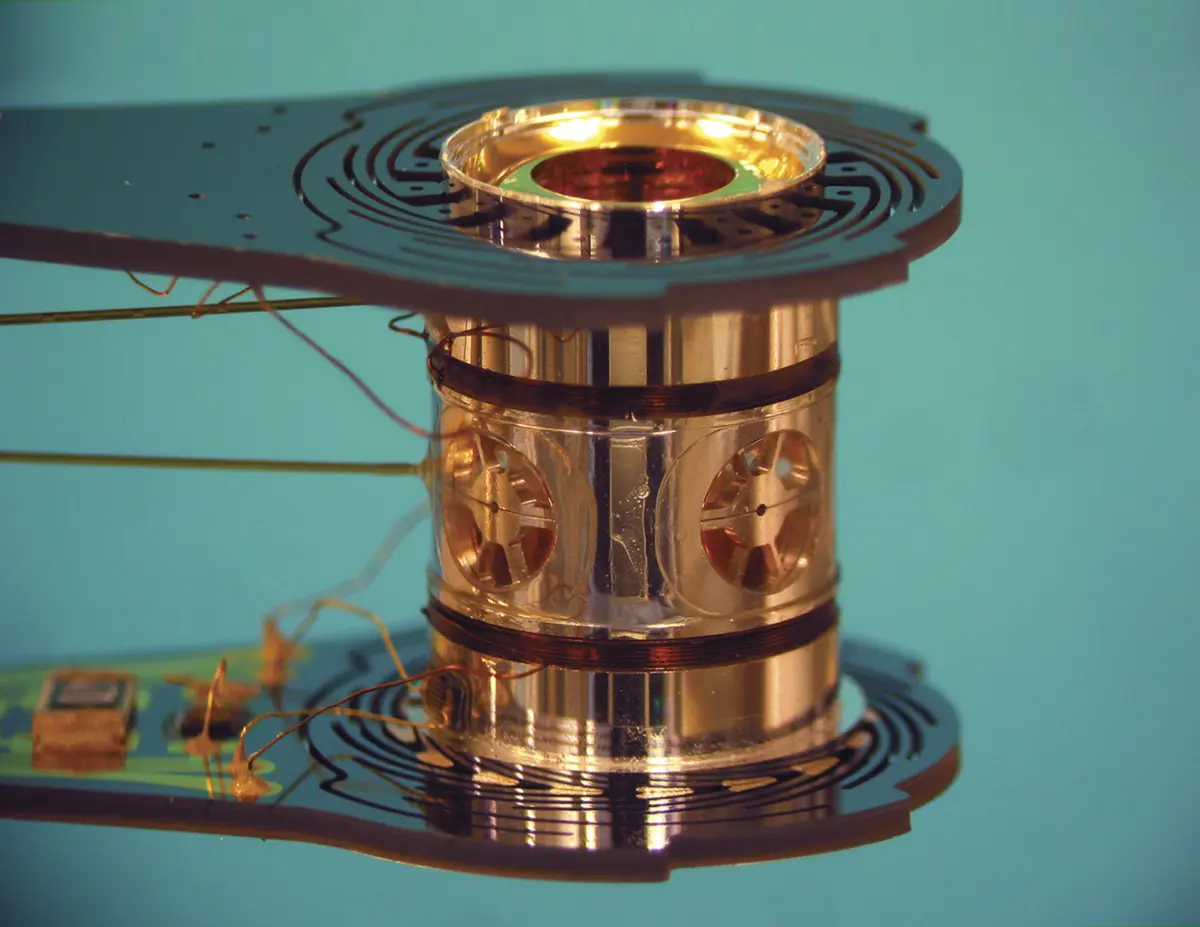
These fuel pellets are subsequently housed inside small gold cylinders known as hohlraums. When blasted by high-energy lasers, the hohlraums convert that light into X-rays, which uniformly compress the fuel pellet to pressures and temperatures high enough to trigger atomic fusion. Even microscopic imperfections in the spherical symmetry of the pellet can disrupt the compression wave, degrading the reaction and preventing the fusion yield from reaching its full potential.
Accelerating the Crystal Growth Cycle
By asking a fundamental engineering question—"What happens if you try to do it faster?"—Inertia’s team systematically restructured the production pipeline. Through iterative rounds of development and optimization, the startup achieved a major breakthrough: they successfully grew the necessary hydrogen isotope crystals in approximately 30 minutes, a process that historically dragged on for up to a week at the NIF.
When combined with the rest of the assembly stages, a single, high-precision fuel pellet can now be produced from start to finish in roughly two to three hours. This monumental compression of the production timeline was developed in close collaboration with the NIF under an ongoing public-private partnership, validating the synergy between government-backed foundational research and private-sector engineering muscle.
Supporting Context & Metrics: Overcoming Physics and Supply Chain Realities
Leveraging Laser Margin
While manufacturing microscopic diamond shells filled with cryogenic hydrogen isotopes sounds unforgivingly rigid, Inertia possesses a distinct architectural advantage that sets its approach apart from traditional experimental facilities.
The startup is engineering its commercial reactor to utilize a laser driver that is roughly four times more powerful than the system currently deployed at the NIF. This deliberate over-engineering provides Inertia with a crucial operational buffer. Because the laser system packs significantly more energy, the reactor can successfully tolerate minor imperfections in the fuel pellets without jeopardizing the overall ignition process.
"We actually have a lot of margin," CEO Jeff Lawson explained. "That’s our strategy, to oversize our driver, our laser, to give us lots of margin to go play with in every other part of the system." This philosophy of building margin into the physical drivers directly alleviated the crushing perfectionism previously required during the manufacturing stage, allowing production speeds to ramp up exponentially.
The Tritium Challenge
Beyond the engineering hurdles of speed and geometry, fusion startups face a formidable supply chain bottleneck: tritium. Tritium is a radioactive isotope of hydrogen that is vital for achieving optimal fusion reactions. However, it is exceedingly rare and expensive, commanding a market price of roughly $30,000 per gram. According to data published by the journal Science, the entire global stockpile of tritium hovers at around a mere 25 kilograms.
While most commercial fusion concepts—including Inertia’s—plan to breed their own tritium on-site using subsequent neutron capture reactions once the power plants are running, startups still require an initial inventory to bootstrap their operations. Furthermore, holding large quantities of radioactive material introduces strict regulatory, safety, and financial burdens.
By collapsing the fuel-filling latency down to minutes, Inertia fundamentally changes its inventory dynamics. A faster, on-demand manufacturing process means the facility does not need to stockpile massive quantities of finished, tritium-laden fuel pellets in advance. Instead, pellets can be manufactured just-in-time, keeping the facility’s active radioactive footprint remarkably small.
When operating at full commercial capacity, Inertia’s projected power plant design will consume approximately 10 fuel pellets every second. Scaling production to meet this ravenous consumption rate without inflating the facility’s tritium inventory is a masterclass in modern industrial design.
"By reducing the latency of this step, you’ve made your facility smaller; you’ve made the whole thing faster, the whole thing more efficient," Lawson noted.
Official Statements and Industry Perspective
The announcement underscores a broader cultural and operational evolution within the clean energy sector. For decades, nuclear fusion was viewed primarily as a physics problem—an academic pursuit constrained by plasma confinement times, magnetic field stability, and laser ignition thresholds.
However, as venture funding pours into the sector—exemplified by Inertia’s $450 million Series funding round led by heavyweights like Bessemer Venture Partners and GV—the paradigm has shifted from pure physics to systems engineering and supply chain logistics.
Industry analysts have pointed out that Inertia’s ability to draw talent from consumer hardware industries represents a crucial maturation phase for the fusion market. While theoretical physicists unlock the underlying mechanisms of plasma dynamics, industrial engineers are the ones who must construct the factories capable of delivering baseload clean energy to the modern grid.
The partnership between Inertia Enterprises and the Lawrence Livermore National Laboratory also serves as a blueprint for how public infrastructure can successfully seed private enterprise. By leveraging decades of federally funded research at the NIF, commercial startups are able to bypass foundational trial-and-error phases, pivoting directly into the commercialization and mass-production challenges that private capital is uniquely equipped to solve.
Future Outlook: The Road Ahead for Commercial Fusion
With one of its top 10 commercialization barriers officially checked off, Inertia Enterprises faces an aggressive roadmap ahead. The milestone proves that laser-driven inertial fusion is not inherently bound to the slow, bespoke manufacturing timelines of 20th-century scientific laboratories.
Yet, significant challenges remain. The startup must still successfully scale its newly minted manufacturing process from laboratory pilot lines to high-throughput industrial factories capable of churning out millions of flawless diamond-shelled pellets. It must also prove that its oversized laser drivers can perform reliably over years of continuous commercial operation without degrading or introducing prohibitive maintenance costs.
Nevertheless, the psychological and technical barrier has been breached. By demonstrating that fuel pellet production can be accelerated from a one-week bottleneck to a 180-minute assembly line, Inertia has turned a theoretical impossibility into an engineering reality. As the global race to commercialize clean, limitless fusion power intensifies, startups that master the intersection of advanced physics and mass manufacturing will undoubtedly lead the charge toward a carbon-free energy future.