








Executive Overview
The rapid integration of autonomous artificial intelligence agents into modern DevOps pipelines has ignited a fierce debate regarding control, autonomy, and security. A widespread misconception in enterprise architecture assumes that any AI system capable of invoking external tools inherently constitutes an unmitigated safety hazard. However, engineering reality points to a much more precise vulnerability: the critical failure occurs when a routine workflow automatically translates an internal model recommendation into an external, irreversible action without maintaining a durable decision record.
This conceptual distinction carries profound implications for platform engineering and Site Reliability Engineering (SRE) teams. An intelligent agent can safely summarize a failed production deployment, draft a comprehensive rollback strategy, or classify a complex software dependency alert without risking system stability. Yet, the exact moment that same agent opens an external change request, modifies a critical feature flag, initializes an incident ticket, messages an external customer, or pushes an unverified configuration file to production, the underlying architecture requires far more than a high-confidence prediction score from the model.
It demands a rigorous, uncompromising change-control gate.
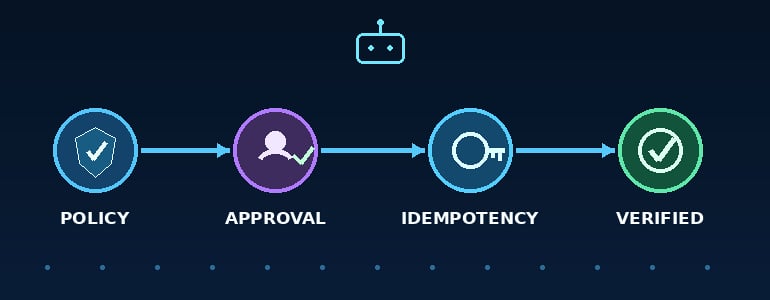
Designing such a gate requires moving away from fragile, prompt-based safeguards and embracing deterministic, boring engineering patterns. A reliable tool-using agent runtime must verify whether governance policies are current, pause execution to secure explicit human authorization, execute a strictly idempotent outbound request, and verify receipt confirmation before concluding the workflow. Far from slowing down innovation, this deliberate methodology provides the structural foundation required to scale autonomous DevOps safely across enterprise environments.
Detailed Chronology: The Evolution of Autonomous Tool Execution
Phase 1: The Illusion of High-Confidence Autonomy
In the early stages of generative AI adoption within software engineering, teams focused heavily on model evaluation metrics, token efficiencies, and task success rates. If a Large Language Model (LLM) achieved a 95% confidence score on a benchmarking dataset for infrastructure configuration, developers routinely granted the system direct API access to staging and production environments.
This approach treated the AI model as an experienced human operator who could intuitively judge right from wrong. However, execution logs soon revealed the limitations of this paradigm. High model confidence only reflects the statistical likelihood that a text generation aligns with training distributions; it offers zero guarantees regarding whether a specific action is reversible, who owns the ultimate business consequences, whether corporate security policies shifted while the agent was processing, or if an identical command had already been successfully transmitted during a network timeout.
Phase 2: Recognizing the Architectural Gap
As incidents caused by automated hallucinations and looping retries accumulated, security architects recognized that model evaluation and workflow execution must be treated as separate decision domains. Treating a prompt as a policy enforcement engine proved disastrous.
Industry standards, including the National Institute of Standards and Technology (NIST) AI Risk Management Framework (RMF), began emphasizing that AI risk management must encompass governance, rigorous measurement, and continuous management throughout the entire system life cycle—rather than relying solely on pre-deployment model evaluations. Concurrently, advancements in durable agent runtimes (such as state machine architectures and graph-based workflow orchestrators like LangGraph) made the broader control problem explicit: because a paused workflow can restart a node when it resumes, all outbound side effects must be entirely idempotent.
Phase 3: The Rise of Durable, State-Machine-Driven Workflows
To mitigate these systemic risks, modern platform engineering evolved toward explicit, state-machine-driven execution models. Rather than allowing an agent to execute arbitrary loops, systems began implementing strict state validations:
type ChangeState =
  | "queued"
  | "policy_blocked"
  | "approval_required"
  | "transmitting"
  | "submitted"
  | "verified"
  | "submission_unverified"
  | "rejected";

type ChangeRequest =  "send_message";
  destination: string;
  summary: string;
  idempotencyKey: string;
;
By explicitly separating approval_required from transmitting, systems gained the ability to present an unambiguous action payload to an operator before executing the command, while simultaneously preserving a verifiable, immutable audit trail of the resulting telemetry.

Supporting Context & Metrics: Analyzing Control Designs
To evaluate the real-world operational friction and failure modes of unmanaged agent architectures versus tightly gated workflows, simulation models provide critical quantitative insights.
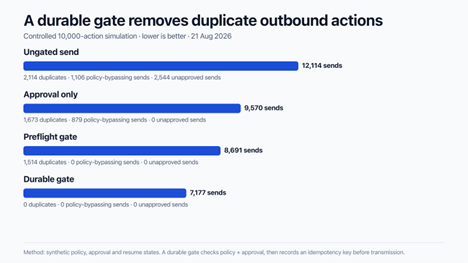
A deterministic simulation of 10,000 outbound agent actions—modeled with a 9% policy-change rate, a 21% non-approval rate, and 1 to 3 workflow resume events—demonstrates how different control designs impact operational safety:
| Control Design | Total Sends | Duplicate Sends | Policy-Bypassing Sends | Unapproved Sends |
|---|---|---|---|---|
| Ungated Send | 12,114 | 2,114 | 1,106 | 2,544 |
| Approval Only | 9,570 | 1,673 | 879 | 0 |
| Preflight Gate | 8,691 | 1,514 | 0 | 0 |
| Durable Gate | 7,177 | 0 | 0 | 0 |
Deconstructing the Simulation Data
- Ungated Sends: Without any architectural constraints, the simulated system suffered from widespread policy violations, thousands of unapproved actions, and massive duplication caused by unhandled network retries.
- Approval-Only Implementations: While stopping unapproved actions, human approvals alone failed to prevent race conditions and duplicate transmissions during workflow crashes or network timeouts.
- Preflight Gates: Implementing a policy check immediately before execution eliminated policy bypasses, yet still generated over 1,500 duplicate sends. This occurred because workflow resume events repeatedly re-entered the execution path.
- Durable Gates: By combining preflight policy validation, explicit human checkpoints, and stable idempotency keys, the durable gate reduced duplicate, unauthorized, and policy-bypassing transmissions to absolute zero.
Official Statements and Industry Perspectives
Platform engineers and compliance officers increasingly stress that safety cannot be outsourced to the prompt layer.
"An AI agent is only as safe as its boundaries. When we allow probabilistic models to interface directly with deterministic infrastructure APIs, we are essentially writing asynchronous multi-threaded code with a random number generator. Enterprise systems require deterministic state machines to wrap probabilistic intelligence."
— Principal Cloud Architect, Enterprise DevOps Infrastructure Group
Furthermore, regulatory compliance frameworks are shifting from voluntary guidance to mandatory auditing requirements for automated systems. Security compliance auditors emphasize that any automated pipeline capable of modifying production configurations must provide cryptographic proof of authorization and execution integrity.
Future Outlook: The Path Toward Frictionless Governance
As artificial intelligence agents transition from experimental assistants to foundational pillars of autonomous operations, the engineering challenge will no longer be about making models smarter, but about making agent runtimes boring, predictable, and fully observable.
The Four-Tier Action Classification Model
To prevent operator fatigue while maintaining strict oversight, future enterprise runtimes will rely heavily on action classification matrices:
- Read-Only Actions: (e.g., fetching deployment records, inspecting system logs) — Default Control: Allow automatically with a comprehensive audit trail.
- Reversible Internal Actions: (e.g., creating draft change tickets, adding labeling metadata) — Default Control: Allow automatically or utilize periodic sample reviews.
- Material but Reversible Actions: (e.g., modifying feature flags, queueing rollback procedures) — Default Control: Named human approval coupled with strict idempotency keys.
- External or Hard-to-Reverse Actions: (e.g., deploying code to production, messaging external customers, deleting persistent storage volumes) — Default Control: Mandatory named approval, real-time policy re-validation, idempotency enforcement, and cryptographic receipt verification.
Conclusion
AI agents possess the unprecedented capability to accelerate software delivery, but speed must never outpace accountability. By decoupling model confidence from execution rights, implementing strict policy re-validations, maintaining immutable state transitions, and enforcing robust idempotency, engineering teams can build autonomous systems that are not only powerful, but deeply dependable. The ultimate goal of AI safety in DevOps is not to shackle innovation, but to create a transparent, verifiable operational framework that engineers and auditors can trust implicitly.