Executive Overview
The rapid, relentless rise of artificial intelligence (AI), machine learning training models, and high-performance computing (HPC) has fundamentally rewritten the rules of data center engineering. For decades, traditional air cooling—relying on standard perimeter Computer Room Air Handler (CRAH) units, raised floors, and rows of cabinet fans—successfully managed the thermal loads of standard enterprise hardware. However, as organizations deploy dense arrays of modern Graphics Processing Units (GPUs) and specialized accelerators, standard rack power densities have catapulted from a historical baseline of 5 to 10 kilowatts (kW) to staggering new thresholds of 30 kW, 50 kW, 60 kW, and beyond.
At these levels, air simply ceases to be a viable medium for thermal management. Air possesses a relatively low volumetric heat capacity, meaning that massive volumes must be forced through increasingly cramped server chassis using large, power-hungry fans. This dynamic creates compounding operational issues: exorbitant energy consumption, severe acoustic pollution, and the inevitable formation of thermal hot spots that place immense physiological stress on delicate silicon components.
To prevent widespread thermal throttling and hardware degradation, the data center industry is undergoing a historic architectural pivot toward liquid cooling. Far from being a fleeting novelty, liquid cooling represents a transformative shift in facility design and operational economics. By capturing heat at or near the source, modern liquid-cooling frameworks eliminate the inefficiencies of forced-air circulation, slash energy footprints, and unlock unprecedented rack-density thresholds. As tech expert Brien Posey notes, modern AI server racks operate much like high-end gaming PCs, but scaled up exponentially to industrial proportions, requiring a sophisticated toolkit of liquid-based solutions to survive the thermal pressures of next-generation computing.
Detailed Chronology and Technical Evolution
The integration of liquid cooling into commercial and enterprise data centers did not happen overnight; it is the culmination of decades of thermal engineering evolution, driven by the widening chasm between processor power consumption and ambient air cooling capabilities.
Phase One: The Air-Cooling Era and the Density Wall
Historically, data centers were designed around predictable, low-density thermal profiles. Servers drew power measured in single-digit kilowatts per rack, and cooling infrastructure was designed to handle uniform, room-wide heat rejection. Cold air was pushed through under-floor plenums into cold aisles, drawn through the front of the server chassis by onboard fans, and exhausted into hot aisles.
As multi-core processors, specialized accelerators, and dense GPU configurations entered the market, power densities began an aggressive upward trajectory. By the late 2010s, standard air cooling systems were visibly straining. Facilities attempting to support 20 kW to 30 kW per rack via air were forced to dial up fan speeds to maximum capacity, resulting in diminishing thermal returns and massive spikes in auxiliary power usage (often referred to as parasitic power).
Phase Two: The Parallel from Consumer Computing to Enterprise
The fundamental physics governing liquid cooling were long proven in high-performance consumer hardware, specifically gaming PCs utilizing water blocks and closed-loop liquid coolers. The realization that liquids—such as water or engineered dielectric fluids—possess thousands of times more heat-carrying capacity per unit volume than air eventually bridged the gap between enthusiast hardware and enterprise data center architecture.
As generative AI workloads exploded in the early 2020s, data center operators could no longer treat liquid cooling as an exotic, niche alternative. It quickly transitioned into a core requirement for any facility aiming to host enterprise-grade AI training clusters.
Phase Three: The Diversification of Liquid Architectures
Today, the industry recognizes that liquid cooling is not a monolithic product, but rather a flexible toolkit comprising three primary architectural models:
- Rear-Door Heat Exchangers (RDHx): Designed primarily as a non-disruptive, retrofit-friendly bridge for existing brownfield facilities.
- Direct-to-Chip (Cold Plate) Cooling: The current gold standard for dense AI and HPC deployments, targeting individual high-heat components while leaving secondary components to auxiliary air systems.
- Immersion Cooling: A radical, total-submersion paradigm that redefines the relationship between hardware and cooling media to achieve the highest possible density thresholds.
Supporting Context & Metrics: Air vs. Liquid Mechanics
To fully comprehend the structural advantages of liquid cooling, one must examine the thermodynamic differences between air and liquid media.
| Metric / Feature | Traditional Air Cooling | Rear-Door Heat Exchanger (RDHx) | Direct-to-Chip Cooling | Immersion Cooling |
|---|---|---|---|---|
| Max Supported Density | ~10 kW – 15 kW per rack | Up to 35 kW – 50 kW | 70 kW – 100+ kW per rack | 100 kW to 200+ kW per rack |
| Primary Heat Capture Point | Room-wide exhaust / Chassis interior | Rack exhaust air | Direct chip surface (Cold plate) | Entire server chassis submerged |
| Cooling Medium | Ambient / Conditioned air | Water / Glycol loop | Dedicated IT coolant / Water loop | Dielectric fluid (Single or Two-phase) |
| Primary Retrofit Challenge | Physical space, airflow paths | Airflow dependency | Manifold installation, quick-disconnects | Specialized tanks, facility redesign |
| Acoustic Profile | Extremely loud (High fan RPMs) | Moderate | Quiet | Nearly silent |
The Thermodynamic Advantage
Air has a notoriously low specific heat capacity. To remove heat effectively, operators must move massive volumes of air at high velocities, necessitating large server fans that consume significant amounts of electrical energy. Furthermore, air acts as an insulating blanket rather than an effective thermal conductor, making it difficult to prevent localized hot spots within densely packed chassis.
Conversely, water and engineered coolants can carry thousands of times more heat per unit volume than air. By establishing direct contact with heat sources, liquid cooling systems drastically reduce the volume of fluid required. This efficiency allows systems to operate using warm-water loops, which unlock two transformative economic benefits:
- Reduced Chiller Reliance: Warmer coolant return temperatures mean facilities can bypass energy-intensive mechanical chillers for significant portions of the year, relying instead on dry coolers or cooling towers.
- Waste Heat Reuse: Because liquid cooling captures thermal energy in a concentrated, high-grade form, facilities can redirect waste heat to warm nearby municipal buildings, district heating networks, or industrial processes, fundamentally altering the total cost of ownership (TCO) and sustainability metrics of modern data centers.
Detailed Breakdown of Liquid Cooling Technologies
1. Rear-Door Heat Exchanger (RDHx) Cooling
For facilities looking to modernize legacy infrastructure without undertaking disruptive overhauls, Rear-Door Heat Exchangers offer an accessible entry point. An RDHx replaces the standard back door of an IT equipment rack with a liquid-cooled coil system.
- The Car Radiator Analogy: As Brien Posey explains, an RDHx functions on the exact inverse principle of a car radiator. In an automobile, hot engine coolant flows to a radiator where ambient air passes over the coils to dissipate heat. In an RDHx-equipped rack, servers generate heat and push hot air backward through a liquid-filled coil integrated into the rack door. The circulating liquid absorbs the thermal energy from the exhaust air, dropping its temperature significantly before it enters the data hall.
- Active vs. Passive Designs: Passive RDHx units rely entirely on internal server fans to push air through the coils, making them ideal for moderate-density retrofits. Active RDHx units incorporate integrated fans within the door itself, providing consistent airflow and handling higher thermal loads independently of server fan performance.
- Use Cases: Retrofitting existing brownfield data centers where minimal disruption to active IT hardware is paramount.
2. Direct-to-Chip (Cold Plate) Cooling
Direct-to-chip cooling represents the current industry workhorse for high-density AI clusters. In this setup, custom metal blocks—known as cold plates—are mounted directly onto the surface of high-heat components such as CPUs, GPUs, and memory modules using thermally conductive paste.
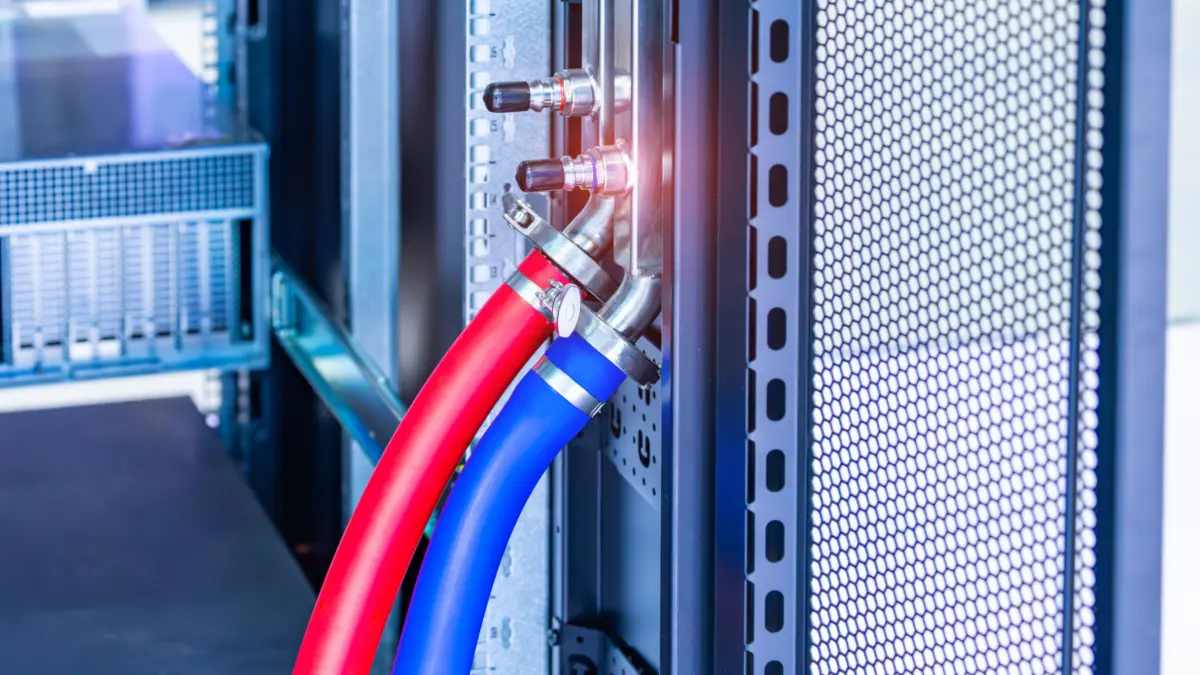
- The Closed Loop Architecture: Coolant enters the server rack via facility connections, flowing through a distribution manifold and secure quick-disconnect valves that allow technicians to service individual servers without draining the entire system. The fluid flows through the cold plates, absorbing heat directly from the silicon die.
- The CDU Connection: Once warmed, the fluid exits the server and returns to a Coolant Distribution Unit (CDU), which isolates the internal IT loop from the facility water loop while regulating pressure, flow rates, and temperature.
- Hybrid Operations: While direct-to-chip captures 70% to 90% of a server’s total thermal load, auxiliary fans are typically retained to cool low-load components like power supplies and networking cards. This approach is exceptionally well-suited for GPU-dense AI training environments.
3. Immersion Cooling
Immersion cooling represents the most radical departure from traditional data center design. Instead of piping cooling media to specific components, immersion cooling involves submerging entire server chassis directly into a bath of specialized dielectric fluid.
- Dielectric Fluid Safety: Because the fluid is non-conductive, electrical components continue to operate safely while fully immersed.
- Single-Phase vs. Two-Phase Systems:
- Single-phase immersion circulates a warm dielectric fluid bath via pumps through an external heat exchanger, transferring heat to the facility water loop without the fluid ever changing state.
- Two-phase immersion utilizes a specialized fluid engineered to boil at very low temperatures. The heat generated by the chips causes the fluid to vaporize into steam; this vapor rises, contacts a condenser coil positioned at the top of the sealed tank, transforms back into liquid droplets, and drips back into the bath, utilizing latent heat of vaporization for hyper-efficient thermal transfer.
- Advantages and Trade-offs: Immersion cooling delivers unmatched thermal uniformity, eliminates acoustic noise entirely by removing the need for server fans, and enables extreme rack densities exceeding 100 kW. However, it requires a complete rethinking of operational workflows, specialized hardware handling procedures, and higher initial capital expenditures.
Future Outlook and Strategic Recommendations
The transition from air to liquid cooling is no longer a speculative trend; it is an operational imperative driven by the relentless expansion of AI and high-performance computing. As rack densities continue to climb toward and beyond 100 kW, data center operators can no longer rely on brute-force air circulation without incurring unsustainable energy penalties and operational risks.
However, choosing the right approach requires a nuanced evaluation of long-term strategic goals:
- Brownfield Upgrades: Facilities bound by existing infrastructure footprints often find immediate value in deploying Rear-Door Heat Exchangers to extend the lifespan of legacy air-cooled halls.
- High-Performance AI Clusters: Organizations deploying dense GPU arrays will find Direct-to-Chip cooling to be the most practical method for source-level heat removal without requiring complete architectural redesigns.
- Maximum Density & Greenfield Visionaries: Enterprises building next-generation facilities optimized strictly for extreme compute density will increasingly look toward Immersion Cooling as the ultimate long-term solution for energy efficiency and thermal stability.
Ultimately, liquid cooling is a versatile, multi-faceted engineering toolkit. By carefully weighing trade-offs in efficiency, density, operational complexity, and total cost of ownership, data center architects can successfully navigate the thermal challenges of the AI era and future-proof their digital infrastructure for decades to come.