Executive Overview
For decades, the enterprise software industry has peddled a comforting corporate fairy tale: the "Single Source of Truth" (SSOT). In boardroom presentations and software pitch decks, this concept is invariably visualized as a pristine, monolithic repository where all brand assets, product information, and marketing collateral live in perfect, frictionless harmony.
However, anyone who has ever spent a Tuesday afternoon hunting for a localized product asset across a fractured ecosystem of Digital Asset Management (DAM) platforms, Product Information Management (PIM) systems, Content Management Systems (CMS), and forgotten corporate Dropbox folders knows the painful truth. That pristine single source of truth is a slide-deck platitude, not a lived enterprise reality.
In a compelling new feature piece for Digital Asset Management News titled “One Source of Truth, Many Sources of Reality,” marketing, DAM, and eCommerce specialist Taylor Jones cuts through the industry marketing fluff. Drawing on extensive consulting experience, Jones argues that data and digital assets are, by default, fragmented across modern organizations. Rather than chasing an impossible architectural singularity where all data lives in one place, Jones posits a more pragmatic approach for 2026 and beyond: treat the single source of truth as an ongoing aspiration that you govern toward, rather than a final destination you ever truly arrive at.
This comprehensive overview delves into Jones’s sharpest insights regarding enterprise ownership, the operational pitfalls of treating migrations as mere storage moves, the limitations of AI-assisted tagging, and why modern organizations must pivot from chasing a mythical "repository to rule them all" to establishing a single source of governance.
Detailed Chronology: The Evolution of the Fragmentation Crisis
To understand how modern enterprises arrived at this state of chronic asset fragmentation, one must trace the evolution of digital infrastructure over the past twenty years.
The Early Days: Centralized Storage and Shared Drives
In the early 2000s, the "single source of truth" was often little more than a network-attached storage (NAS) device or a departmental shared drive. As digital volumes exploded—spurred by the transition from print-first marketing to digital-first multi-channel campaigns—these shared drives quickly mutated into chaotic digital landfills. Duplicate files, ambiguous naming conventions (Banner_Final_v3_FINAL(2).jpg), and the total absence of version control led to widespread organizational frustration.
The Rise of Specialized Systems (DAM, PIM, and CMS)
To solve the shared-drive crisis, enterprise architects introduced specialized platforms. DAM systems emerged to manage rich media (images, videos, design files); PIM and Product Experience Management (PXM) systems were built to handle structured product attributes and specifications; and CMS platforms were deployed to publish experiences to the web.
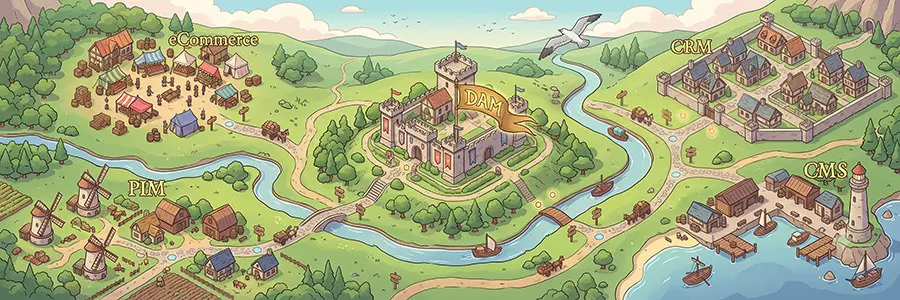
While these platforms successfully solved localized operational challenges, they inadvertently created siloed kingdoms. Instead of unifying the enterprise, they multiplied the number of places where "truth" resided. A product image might live in the DAM, its associated sizing metadata in the PIM, and the published hero banner in the CMS—with local variants scattered across regional marketing teams’ unmanaged cloud storage accounts.
The 2026 Reality Check
Fast-forward to 2026, and the proliferation of cloud-native tools, generative AI asset creation, and localized hyper-personalization campaigns has accelerated fragmentation to unprecedented levels. As Jones highlights in his commentary, the promise of a unified repository hasn’t necessarily died, but enterprises are finally waking up to the realization that technical integration alone cannot bridge operational divides. The realization that "truth" is inherently multi-sourced has forced a re-evaluation of how digital ecosystems are designed, funded, and governed.
Supporting Context & Metrics: Anatomy of an Organizational Mess
One of the most revealing aspects of Jones’s analysis is his examination of why certain pockets of an enterprise remain pristine and organized, while others resemble a digital disaster zone.
Ownership vs. Platform Capabilities
When analyzing why specific segments of a digital ecosystem function smoothly while others fail, Jones points away from the software itself and toward a more fundamental human element: ownership and accountability.
To illustrate this, Jones contrasts the relative tidiness of eCommerce product data slices with the chaotic state of organizational DAM systems:
"The eCom slice was tight because it had a clear owner, a clear downstream consumer, and a system whose whole job was product data. The organizational DAM was a mess because it had none of those things."
In many organizations, the eCommerce catalog is strictly governed because revenue is directly tied to accurate, up-to-date product listings. There are clear Key Performance Indicators (KPIs), dedicated merchandising teams, and well-defined downstream channels (like Shopify, Amazon, or headless storefronts) consuming the data.
Conversely, enterprise DAM systems are frequently treated as dumping grounds for global marketing collateral, corporate headshots, and historical campaign assets. Without a clear owner, dedicated stewards, or an immediate revenue-generating mandate, these repositories quickly devolve into unregulated digital swamps.
The "Storage Move" Fallacy
Another recurring pitfall highlighted in the discourse is the widespread misunderstanding of what a platform migration actually entails. Organizations routinely budget for and execute "lift-and-shift" projects, mistakenly believing that moving files from an old server or legacy cloud bucket into a new, state-of-the-art DAM platform constitutes a successful project.
This approach inevitably invites operational failure. As Jones notes, anyone who has lived through a DAM migration or attempted to sanitize messy data for cross-platform integration knows the sinking feeling of realizing that moving unorganized files simply means you now have unorganized files in a much more expensive system.
True migration work is not about storage capacity; it is about rigorous tagging, aggressive de-duplication, metadata standardization, and workflow mapping. When organizations confuse a storage move with an architectural transformation, they set themselves up for failure.
Official Perspectives & Expert Insights: Who Should Drive DAM Strategy?
As digital asset ecosystems grow increasingly complex, organizations face a persistent governance question: Who should be in the driver’s seat when making DAM and metadata decisions?
Balancing Creative Vision with Technical Discipline
Historically, Digital Asset Management systems have fallen under the direct purview of creative and brand teams. After all, designers, art directors, and brand managers are the primary producers and heavy consumers of high-resolution visual assets.
However, Jones argues that while creative intuition is vital for brand consistency, relying solely on creative teams to architect a DAM is a strategic misstep. Taxonomy design, metadata modeling, and the complex mechanics of cross-platform integration demand a different kind of operational discipline.
"Someone who owns the data model, understands the migration mechanics, and can map how assets actually flow between the DAM, the PIM/PXM, and every downstream integration."
To build a resilient digital ecosystem, organizations must pair creative stakeholders with technical specialists—data architects, systems integrators, and DAM administrators—who understand how information flows across the enterprise tech stack.
The Myth of AI-Assisted Autonomy
In the current tech landscape, no discussion of DAM or metadata is complete without addressing Artificial Intelligence. With generative AI and automated computer vision tools capable of recognizing objects, faces, and settings within seconds, many organizations assume that AI will soon eliminate the need for manual tagging and governance.
Jones offers a much more measured, grounded perspective on AI-assisted tagging. While AI is undeniably powerful for identifying the visually obvious—such as recognizing that an image contains a red bicycle or a mountain landscape—it completely misses the deeper organizational context that gives an asset its true enterprise value.
“…a lot of the tags that make a DAM authoritative aren’t visual at all. Which product or products does this asset belong to? Which campaign, which region, which usage rights, which internal approval state?”
AI cannot infer whether an image is approved for use in the EMEA market during Q3, whether its licensing rights expire next Tuesday, or which specific SKU variant it supports. These crucial metadata layers require human intent, clear business rules, and rigorous administrative oversight. AI is a powerful assistant, but it is no substitute for human organizational context.
Future Outlook: Moving from a Single Source of Truth to a Single Source of Governance
As organizations look toward the future of digital asset management and enterprise architecture, the core takeaway from Jones’s insights is clear: stop chasing the architectural chimera of a single, all-encompassing repository.
The Rise of Federated Ecosystems
The modern enterprise tech stack is inherently multi-system by design. Products belong in the PIM, rich media belongs in the DAM, web copy and localized experiences live in the CMS, and fast-moving campaign iterations will always find temporary homes in cloud storage buckets and collaboration tools.
Trying to force all of these distinct data types into a single monolithic database is an exercise in futility that stifles agility and frustrates end-users. Instead, future-proof organizations are embracing federated ecosystems where systems are securely connected via robust APIs and integration middleware.
The Power of Single Governance
If there cannot be a single repository to rule them all, what takes its place? Jones concludes with a simple, highly practical maxim: architecture-wise, there is no single source of truth; instead, there must be a single source of governance.
Establishing a single source of governance requires:
- Named Accountability: Assigning clear, unambiguous ownership to every data domain and asset category within the enterprise.
- Explicit Handoffs: Defining precise, automated workflows that govern how assets flow between the DAM, PIM, CMS, and downstream channels.
- Continuous Auditing: Treating data hygiene and metadata compliance not as a one-time project, but as an ongoing operational habit.
By abandoning the impossible dream of absolute technical centralization and replacing it with disciplined, cross-functional governance, organizations can finally tame their digital chaos—turning the messy reality of multi-source ecosystems into a competitive operational advantage.
For further reading on this topic and to explore Taylor Jones’s complete feature article, visit Digital Asset Management News.