Executive Overview
For decades, the "Single Source of Truth" (SSOT) has been the ultimate corporate north star. Promoted relentlessly across slide decks, keynote presentations, and strategic roadmaps, it promises a utopian enterprise where every digital asset, product image, marketing document, and brand video lives in one harmonious, instantly accessible ecosystem. However, according to a compelling new editorial contribution by Digital Asset Management (DAM), marketing, and eCommerce specialist Taylor Jones, this elusive concept is fundamentally flawed.
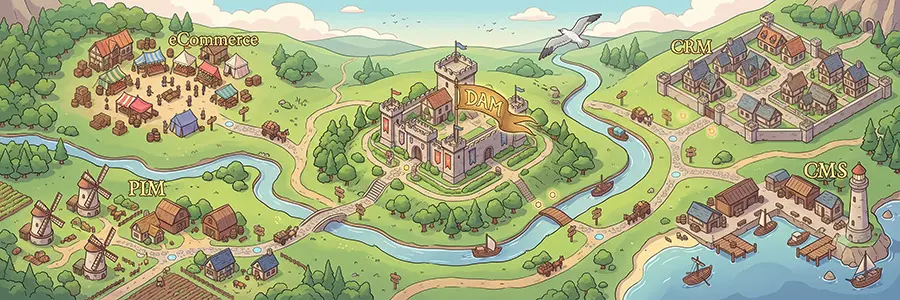
In his recent thought leadership piece, "One Source of Truth, Many Sources of Reality," Jones dismantles the traditional paradigm, arguing that in the modern enterprise, truth is fragmented by default. Rather than residing in a singular, monolithic platform, organizational data is invariably scattered across a complex web of systems—spanning the official DAM, Product Information Management (PIM) or Product Experience Management (PXM) platforms, Content Management Systems (CMS), and, inevitably, that one forgotten Dropbox folder a business unit keeps meaning to migrate.
Rather than treating the SSOT as a literal destination, Jones advocates for a pragmatic shift: view it as an ongoing aspiration that organizations must actively govern toward. This comprehensive report unpacks Jones’s insights, exploring the root causes of digital fragmentation, the pitfalls of treating storage migrations as data cleanup projects, the limitations of AI-assisted metadata tagging, and the structural imperatives required to govern a multi-platform digital ecosystem effectively in 2026.
Detailed Chronology and Evolution of the DAM Dilemma
To understand why the single source of truth remains elusive, one must examine how enterprise digital storage has evolved over the last twenty years.
The Early Days: The Shared Drive Era
In the infancy of digital marketing, organizations relied on local area network (LAN) drives, early FTP servers, and localized desktop storage. As digital asset volume exploded with the advent of high-resolution digital photography and video marketing, these ad-hoc storage methods collapsed under their own weight. Files were duplicated across departments, version control was non-existent, and finding an approved marketing asset often felt like searching for a needle in a digital haystack.
The Rise of the Monolithic DAM
To combat this chaos, the industry pivoted toward the enterprise Digital Asset Management system. The pitch was seductive: consolidate all visual and rich-media assets into one centralized vault. Vendors promised that the DAM would act as the undisputed arbiter of brand assets, ensuring legal compliance, brand consistency, and operational efficiency.
However, as enterprise tech stacks expanded to include specialized PIMs for eCommerce, robust CMS platforms for localized web delivery, and cloud collaboration spaces, the monolithic DAM could no longer contain the entirety of operational reality. Assets needed to be syndicated, transformed, and contextualized for dozens of downstream channels. Instead of eliminating silos, the implementation of a DAM often added yet another repository to the enterprise architecture.
The 2026 Reality Check
Fast-forward to 2026, and the digital landscape is more decentralized than ever. As Jones notes in his evaluation, the sheer velocity of multi-channel marketing makes a single, all-encompassing repository technically and operationally unfeasible. Organizations no longer look for a single repository; instead, they grapple with an intricate ecosystem where different systems hold distinct pieces of the puzzle. The realization that "truth" is distributed across multiple platforms has forced digital leaders to abandon dogmatic centralization in favor of agile, governance-first orchestration.
Supporting Context & Metrics: Why Systems Fail and Succeed
One of the sharpest observations in Jones’s commentary centers on the dichotomy of digital hygiene within the enterprise. Why do certain pockets of an organization—such as eCommerce catalogs—remain pristine, highly structured, and efficient, while enterprise DAMs frequently descend into chaotic digital graveyards?
Ownership and Accountability as Differentiators
According to Jones, the disparity does not stem from the underlying technology platform, but rather from human factors: ownership and accountability.
"The eCom slice was tight because it had a clear owner, a clear downstream consumer, and a system whose whole job was product data. The organizational DAM was a mess because it had none of those things."
In a typical eCommerce environment, the stakes are immediate and measurable. If product imagery is missing, mislabeled, or outdated, conversion rates drop, and revenue is directly impacted. This financial clarity enforces strict operational discipline. There is a designated product data owner, a defined workflow, and an immediate consumer (the online storefront).
Conversely, enterprise DAMs are often deployed as generic corporate utilities. Without a dedicated cross-functional owner, clear downstream dependencies, and enforced governance policies, these systems quickly become dumping grounds. Teams upload assets without standardized metadata, fail to purge obsolete files, and bypass established workflows, transforming a multi-million-dollar software investment into an unmanageable repository.
The Migration Fallacy
Another critical friction point identified in the discourse is the catastrophic misunderstanding of what a system migration entails. Organizations routinely budget time and capital for the technical storage move—transferring gigabytes or terabytes from legacy servers to a cloud-based DAM—while completely neglecting the grueling, foundational work of data sanitization.
A storage move is merely a logistical exercise. True migration requires exhaustive de-duplication, rigorous taxonomy redesign, metadata standardization, and rights-management auditing. When leadership treats a migration as an IT infrastructure project rather than a data governance overhaul, they inevitably replicate legacy disorganization in a shiny new environment.
Official Perspectives and Stakeholder Insights
Navigating the complexities of modern digital asset ecosystems requires a fundamental rethink of who drives platform decisions and how technology is integrated. Industry practitioners and technical stakeholders are increasingly aligned on several core principles.
Bridging the Gap Between Creative and Technical Leadership
Historically, DAM selection and administration have been handed off entirely to creative teams. While creative professionals understand visual assets, brand aesthetics, and campaign workflows, they are rarely equipped to design complex enterprise data models or architect API-driven integrations.
Jones emphasizes that successful DAM stewardship demands a hybrid leadership model. While creative teams must drive user experience and visual standards, they must partner closely with technical stakeholders who understand system architecture.
"Someone who owns the data model, understands the migration mechanics, and can map how assets actually flow between the DAM, the PIM/PXM, and every downstream integration."
Without this technical partnership, organizations end up with beautifully curated asset libraries that cannot communicate effectively with eCommerce engines, localization tools, or enterprise resource planning (ERP) systems.
The Limits of AI-Assisted Tagging
As artificial intelligence and machine learning become native features of modern DAM platforms, organizations are increasingly leaning on automated tagging to streamline asset intake. While AI excels at recognizing visual elements—such as identifying a red sneaker, an outdoor setting, or a corporate logo—Jones cautions that algorithmic efficiency is no substitute for organizational context.
The most valuable metadata attributes in an enterprise DAM are rarely visual. They require deep institutional knowledge and contextual awareness:
- Which specific product SKU(s) does this asset support?
- Which regional marketing campaign does it belong to?
- What are the precise geographic and temporal usage rights associated with the talent featured in the image?
- What is the current internal legal approval state of the asset?
AI can accelerate the preliminary categorization of assets, but human governance and contextual tagging remain non-negotiable for establishing true enterprise authority.
Future Outlook: Moving from Repositories to Governance
As organizations look toward the remainder of the decade and beyond, the strategic imperatives surrounding Digital Asset Management are undergoing a profound evolution. The pursuit of the monolithic Single Source of Truth is officially giving way to a more mature, realistic philosophy: the Single Source of Governance.
Architecting for Multi-Source Reality
Architecturally speaking, enterprise leaders must accept that there is no longer "one repository to rule them all." The modern digital supply chain is inherently distributed. PIM platforms will govern product specifications, CMS platforms will manage localized web experiences, creative clouds will handle raw production files, and the DAM will serve as the central hub for rich-media activation.
Instead of fighting this multi-source reality, future-proof organizations will focus on building robust, API-first integrations that allow data and assets to flow seamlessly between systems without manual intervention.
The Pillars of Sustainable Digital Governance
To thrive in this fragmented ecosystem, enterprises must institutionalize four foundational pillars:
- Named Accountability: Every category, collection, and integration point within the digital ecosystem must have a designated human owner responsible for its ongoing health and maintenance.
- Deliberate Handoffs: Integration workflows between the DAM, PIM, CMS, and regional repositories must be mapped explicitly, defining how assets move, transform, and retire across systems.
- Continuous Curation: Digital asset management must be treated as an ongoing business process, not a one-time project. Regular audits, metadata enforcement, and lifecycle archiving must be embedded into daily operations.
- Pragmatic Aspirations: Leaders must abandon the illusion of frictionless perfection. By acknowledging that fragmentation is an inherent characteristic of enterprise scale, organizations can focus their energy on building resilient, well-governed pathways rather than chasing an impossible myth.
Ultimately, Taylor Jones’s insights serve as a timely wake-up call for marketing leaders, DAM practitioners, and enterprise architects alike. By trading the comforting illusion of the single source of truth for the practical discipline of single-source governance, organizations can finally turn their fragmented digital ecosystems into engines of competitive advantage.