Executive Overview
For decades, the standard machinery of software delivery has relied on a comforting, predictable contract: source code changes, automated tests validate those changes, a discrete build artifact is minted, and the application is promoted sequentially through lower environments to production. This traditional Continuous Integration and Continuous Delivery (CI/CD) paradigm is optimized exclusively around static deterministic code logic.
However, the rapid enterprise adoption of Artificial Intelligence and Machine Learning (AI/ML) has fundamentally fractured this model. In AI-enabled applications, production behavior can drift, degrade, or mutate entirely even when a single line of application source code remains untouched.
Today, a model version bump, a silent feature store transformation, an updated prompt configuration, a revised retrieval-augmented generation (RAG) index, or an evolving data dependency can radically alter the output of an enterprise AI system. Despite this reality, many engineering organizations continue to treat machine learning assets as secondary attachments to the standard software release train.
This oversight has created a dangerous operational chasm. When an LLM begins hallucinating, or a predictive model begins outputting biased or economically catastrophic scores, traditional incident response tools often prove useless. Teams can easily identify the exact application container image running in production, but they remain utterly blind to the specific model weights, vector embeddings, or prompt templates that actually generated the anomalous output.
To bridge this gap, engineering leadership, DevOps practitioners, and MLOps pioneers must fundamentally rethink their delivery pipelines. AI assets must be elevated to first-class production artifacts. This requires expanding version control past application binaries, rewriting the parameters of automated testing to incorporate statistical validation, embedding rigorous operational fitness gates, enforcing progressive delivery, and establishing clear ownership boundaries across traditionally siloed teams. Ultimately, modern software engineering demands that we treat AI delivery not as a simple code deployment, but as a complex, multi-layered supply chain.
Detailed Chronology: The Evolution of Software Delivery Meets the AI Imperative
To understand how enterprise deployment pipelines reached this critical juncture, it is helpful to trace the chronological evolution of software delivery and observe where the traditional DevOps framework diverges from modern machine learning operations (MLOps).
Phase 1: The Monolithic Era and Manual Deployments (Pre-2010s)
In the early days of enterprise software, deployments were rare, highly manual events. Code was bundled into heavy releases every few months. Testing was largely manual, and rollbacks were dreaded operations involving overnight maintenance windows. Configuration drift between staging and production was a constant source of friction, and software was viewed as a static product rather than an ongoing service.
Phase 2: The DevOps Revolution and the Rise of CI/CD (2010s–2020)
The advent of cloud computing, containerization (most notably Docker), and infrastructure-as-code transformed software development. CI/CD pipelines emerged as the gold standard for engineering velocity. Automated unit, integration, and security tests were codified. Tools like Jenkins, GitLab CI, and GitHub Actions automated the path from code commit to production deployment.
In this era, the software supply chain was mathematically straightforward:
$$textSource Code Commit rightarrow textAutomated Tests rightarrow textBuild Artifact (Container Image) rightarrow textProduction$$
If an application failed in production, the culprit was almost always a recent code change or an environmental misconfiguration, both of which could be swiftly investigated via standard version control systems (like Git) and application performance monitoring (APM) tools.
Phase 3: The Early MLOps Disconnect (2020–2023)
As data science matured and deep learning models moved from academic research papers into enterprise applications, organizations rushed to integrate AI capabilities. Initially, data science teams operated in silos. They trained models in Jupyter notebooks, saving .pkl or .h5 files locally or tossing them over the wall to software engineers, who wrapped them in API endpoints (often using Flask or FastAPI) and deployed them using standard CI/CD pipelines.
This created an architectural mismatch. Traditional pipelines treated machine learning models like static binary assets—equivalent to a static image file or a configuration text file. When model performance degraded due to data drift or shifting user behavior, the CI/CD pipeline had no mechanism to detect, test, or safely roll back the change independently of the application code.
Phase 4: The Modern AI-Native Supply Chain Crisis (Present Day)
Today, enterprises are deploying complex, multi-component AI applications featuring large language models (LLMs), dynamic vector databases, external prompt management systems, and automated feature pipelines.
Modern production environments no longer run on code alone; they run on a complex interplay of probabilistic models, statistical data dependencies, and deterministic code logic. Consequently, traditional CI/CD pipelines are failing under the weight of non-deterministic behavior. Organizations are realizing that continuous integration must encompass data, models, and prompts, while continuous delivery must account for operational fitness, statistical regression, and sophisticated rollback strategies.
Supporting Context & Metrics: The Cost of Non-Deterministic Deployments
The integration of AI into core business workflows introduces unique operational risks that cannot be mitigated by traditional software testing alone. Examining the underlying mechanics of AI delivery reveals why a structural overhaul of enterprise CI/CD is no longer optional.
Version More Than the Application: The Multi-Dimensional Release
For a conventional web service or microservice, a Git commit identifier and a corresponding container image hash are generally sufficient to reconstruct the exact state of a production deployment.
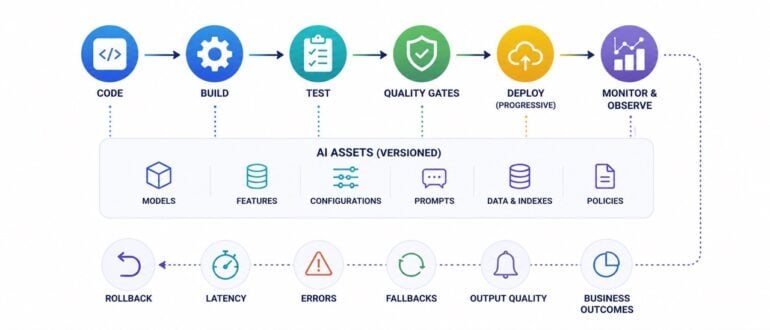
For an AI-enabled service, however, this approach leads to blind spots. Teams must identify and version an expanded matrix of assets:
- Model Versions & Weights: The exact iteration of the machine learning model or fine-tuned LLM.
- Feature Definitions: The schemas, transformations, and aggregation logic used by feature stores (e.g., Feast, Tecton) to generate inference inputs.
- Inference Configurations: Hyperparameters, quantization settings, context window limits, and tokenization rules.
- Policy Rules & Guardrails: Content filters, moderation APIs, and deterministic safety overlays (e.g., NeMo Guardrails).
- Data Schemas & Retrieval Indices: Vector database embeddings, RAG chunking strategies, and underlying knowledge base snapshots.
Without rigorous traceability across all these dimensions, incident response deteriorates into expensive guesswork. When an AI system produces unexpected, harmful, or legally non-compliant outputs, teams may know which application container image is running, but they remain completely unable to isolate which specific model iteration, feature transformation, or prompt configuration caused the failure.
Expanding Automated Testing for the AI Path
Unit, integration, and security tests remain foundational, but they are entirely insufficient for AI-enabled releases. Pipelines must incorporate tests that validate the behavior and systemic dependencies of the AI execution path.
Essential checks in a modern AI-centric CI/CD pipeline include:
- Schema Validation & Feature Availability: Ensuring that incoming production data matches the exact schemas expected by the model and that feature stores are responsive.
- Model-Load and Inference Latency Tests: Verifying that a new model artifact loads cleanly into memory without triggering out-of-memory (OOM) errors and that inference times remain within acceptable thresholds.
- Output-Range and Invariant Checks: Testing models against boundary conditions to ensure outputs do not violate business, physical, or regulatory limits.
- Statistical Regression Testing: Running the new model version against a curated, representative golden test dataset to evaluate metric shifts (e.g., accuracy, BLEU score, toxicity metrics) relative to the baseline.
Crucially, engineering teams must learn to balance deterministic tests with statistical tests. While a traditional software function can be tested for an exact expected value (e.g., assert calculate_tax(100) == 15), AI outputs inherently require tolerance ranges, quality thresholds, or probabilistic comparisons against benchmark suites. CI systems must be architected to execute and evaluate both patterns concurrently.
Release Gates for Operational Fitness
A machine learning model can demonstrate stellar accuracy metrics in an offline staging environment while remaining an absolute failure as a production asset. A newly optimized model might consume excessive GPU memory, introduce severe inference latency spikes, generate excessive downstream API calls, or degrade catastrophically under peak user traffic.
Modern delivery pipelines must evaluate operational fitness prior to promotion. Performance testing, resource utilization profiling, and concurrency stress tests must be integrated directly into the deployment pipeline. A pipeline should never automatically assume that a model artifact is production-ready simply because its offline predictive accuracy metric improved.
[Model Training / Fine-Tuning]
       │
       ▼
[Artifact Registry (Models, Prompts, Features)]
       │
       ▼
[Automated CI Pipeline]
 ├── Unit & Integration Tests (Deterministic)
 ├── Statistical Regression & Invariant Tests
 └── Operational Fitness & Resource Profiling (GPU/CPU/Latency)
       │
       ▼
[Progressive Delivery / Canary Deployment]
 ├── Shadow Mode Execution
 └── Incremental Traffic Shifting (1% → 10% → 50% → 100%)
       │
       ▼
[Production Monitoring & Observability]
 └── Telemetry tied to Business KPIs & Behavioral Guardrails
Progressive Delivery and Rollback Strategies
"Big-bang" AI releases introduce unacceptable systemic risk. Because many subtle failures in AI applications only become visible when exposed to messy, real-world production traffic, progressive delivery is mandatory.
- Canary Deployments: New models or AI configurations can initially receive a tiny fractional percentage of live requests while automated telemetry compares latency, error rates, fallback triggers, and business KPIs against the existing baseline.
- Shadow Deployments: The new model processes live production traffic in parallel without controlling the actual customer-facing response. This allows engineering teams to evaluate real-world behavioral differences safely before the model is activated for end users.
Furthermore, defining a rollback strategy for AI systems is significantly more complex than standard applications. While rolling back a stateless microservice involves reverting a container image tag, rolling back an AI system may require synchronizing model versions, feature transformation scripts, embedding caches, and downstream data schemas. Separating model-serving runtimes from core business applications when they operate on different release cadences is critical to maintaining agility.
Official Statements: Industry Perspectives on AI Delivery
As the engineering community grapples with the operational realities of deploying AI at scale, leading technologists and industry organizations have articulated the urgent need for robust MLOps and CI/CD evolution.
Dr. Andrew Ng, globally recognized AI pioneer and founder of DeepLearning.AI, has consistently emphasized the shift from model-centric to data-centric AI engineering. Addressing enterprise deployment challenges, Dr. Ng noted:
"For a long time, the AI community focused almost entirely on downloading open-source models and tweaking network architectures. But in production systems, the bottleneck is rarely the model architecture itself—it is the data pipeline, the feature consistency, and the continuous evaluation loop. If you cannot reliably version, test, and audit your data and your models with the same rigor you apply to source code, your AI initiatives will inevitably stall out in the valley of deployment."
Industry analysts at Gartner have similarly underscored the governance and operational risks associated with unregulated AI pipelines. In recent enterprise infrastructure advisory reports, Gartner analysts emphasized:
"Organizations that treat generative AI and machine learning models as traditional software binaries are exposing themselves to severe compliance, operational, and reputational risks. Modern enterprise CI/CD frameworks must evolve into comprehensive supply chain systems that govern data provenance, prompt configurations, model weights, and behavioral drift detection as first-class citizens."
Future Outlook: The Next Decade of AI-Native CI/CD
As we look toward the future of enterprise software engineering, the boundary between application code and machine learning logic will continue to dissolve. Software is transitioning from explicit, human-authored procedural instructions to implicit, probabilistic directives governed by models, prompts, and dynamic data loops.
1. Fully Autonomous Self-Healing Pipelines
In the next five years, CI/CD pipelines will increasingly leverage specialized AI agents to monitor production telemetry, detect behavioral drift, and autonomously trigger retraining, fine-tuning, or prompt-optimization loops. When a model exhibits performance degradation, the pipeline will not merely alert human operators; it will automatically ingest recent production feedback data, generate synthetic training datasets, fine-tuning the model in an isolated staging environment, execute comprehensive statistical safety suites, and initiate a progressive canary rollout—all with minimal human intervention.
2. Universal Standards for AI Software Bills of Materials (SBOMs)
Just as regulatory compliance and cybersecurity demands have driven widespread adoption of Software Bills of Materials (SBOMs) for traditional open-source libraries, the software industry will establish universal standards for AI Bills of Materials (AIBOMs). These manifests will cryptographically bind every production decision to its precise components: the exact base model, fine-tuning datasets, prompt templates, vector embeddings, safety filter rules, and inference hardware configurations.
3. Organizational Convergence: DevOps Meets MLOps
The historical organizational friction between application software engineers, data scientists, machine learning platform engineers, and site reliability engineers (SREs) will give way to unified platform engineering disciplines. Explicit, automated contracts between these previously siloed teams will be codified directly into infrastructure-as-code repositories.
Ultimately, organizations that master this transition—treating AI delivery as a reproducible, testable, and observable supply chain—will capture the velocity and innovation speed associated with modern DevOps, without sacrificing the rigorous safety, compliance, and reliability controls that production-grade enterprise AI demands.