Executive Overview
The landscape of modern warfare is experiencing a paradigm shift as artificial intelligence transitions from experimental defense concepts into ubiquitous, frontline ordnance. In a landmark development financed by a $100 million international procurement contract—widely attributed by defense analysts to the German government—Ukraine is set to receive 50,000 first-person-view (FPV) strike drones upgraded with advanced, US-developed edge-computing autonomy kits.
Manufactured locally by Ukrainian firm SkyFall and integrated with edge-AI avionics systems engineered by Munich- and US-based autonomy provider Auterion, these systems convert low-cost "kamikaze" quadcopters into fire-and-forget precision munitions. By utilizing advanced visual-inertial odometry and machine vision, these drones bypass traditional electronic warfare (EW) hurdles. They can lock onto and track moving targets—ranging from armored personnel carriers and artillery pieces to high-value electronic warfare systems—without relying on GPS signals or maintaining a continuous human radio link.
This initiative represents a watershed moment in the economics of defense technology. While Western militaries traditionally rely on six- and seven-figure precision munitions manufactured over multi-year timelines, this program delivers mass-scale lethality at roughly $2,000 per unit. It marries the agility and low unit cost of commercial FPV components with hardened, resilient machine intelligence.
Detailed Chronology & Technological Evolution
From Manual Piloting to Edge-AI Autonomy
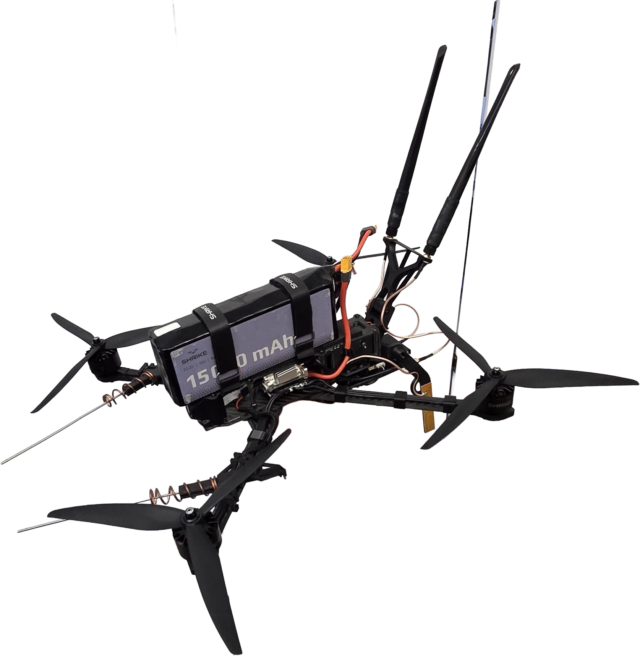
Since the full-scale Russian invasion in 2022, Ukrainian forces have transformed commercial off-the-shelf FPV drones into formidable tactical weapons. Traditionally, these platforms—such as the $400 SkyFall Shrike drone carrying explosive payloads—required manual human piloting right up to the point of impact.
However, heavy enemy radio-frequency (RF) jamming and physical line-of-sight obstructions, such as buildings and dense forest terrain, historically caused significant mission attrition rates. When a drone lost its radio connection moments before striking a target, the kinetic energy and payload were squandered.
To overcome these countermeasures, mid-July marked the operational deployment of the first batch of Shrike drones equipped with Auterion’s Skynode S strike kits. This hardware-software integration fundamentally alters the drone’s flight control architecture:
- Manual Approach: A human operator flies the FPV drone into the general operational theater using traditional manual controls.
- Target Designation: Upon spotting a target up to half a mile away, the operator designates it through the onboard camera feed with minimal training inputs.
- Terminal Guidance Activation: With a simple command toggle, the system switches to a "fire-and-forget" mode.
The Mechanics of Visual-Inertial Navigation
Auterion’s software relies entirely on optical data captured by the drone’s primary onboard camera processed via an $18 Western-made ARM system-on-a-chip. Because the system calculates target trajectories visually rather than depending on satellite constellations, it is immune to the rampant GPS-spoofing and localized jamming that plagues contemporary battlefields.
Even if hostile forces sever the radio link via sophisticated directional jamming or if terrain occludes the pilot’s view, the drone’s onboard computer autonomously closes the distance, tracking and homing in on the moving target until impact.
Supporting Context & Operational Metrics
Economic Disparities in Modern Ordnance
The economics of the Ukraine conflict have forced a radical reimagining of military supply chains. For decades, Western defense contractors have prioritized exquisitely engineered, low-volume munitions costing hundreds of thousands—or millions—of dollars apiece. These systems, while highly effective, are ill-suited for a war of attrition where thousands of assets are expended monthly.
- Standard FPV Drones: ~$400 (Manual piloting, highly susceptible to EW jamming).
- AI-Upgraded Shrike Drones (Auterion/SkyFall): ~$2,000 (Autonomous terminal guidance, high resistance to electronic countermeasures).
- Long-Range AI "Hornet" Drones: ~$5,000 (Developed by Perennial Autonomy, founded by former Google CEO Eric Schmidt; capable of carrying 5kg payloads over 200km to strike infrastructure deep inside Russian-held territory).
- Traditional Western Precision Munitions: $30,000 to $1,000,000+ per shot, produced in batches of dozens.
By keeping the per-unit cost remarkably low while exponentially increasing hit probabilities against high-value targets—such as $19 million Russian Mi-28 attack helicopters, heavy artillery, and armored columns—the Auterion-Skyfall partnership achieves cost-attrition symmetry that traditional defense industrial bases struggle to match.
Scaling and Deployment Milestones
The current $100 million contract for 50,000 units is Auterion’s largest delivery order to date, though it builds upon a previous $50 million Pentagon-backed contract from July 2025 that supplied 33,000 Skynode drone strike kits to Ukraine. Fulfillment is managed largely through Auterion’s engineering hub in Munich, Germany, operating in tandem with Ukrainian manufacturing partners who rapidly integrate the avionics into airframes.
Official Statements & Industry Perspectives
The Human-in-the-Loop Imperative
As the deployment of autonomous systems accelerates, questions surrounding artificial intelligence accountability and "killer robots" have taken center stage. Despite the technical feasibility of fully autonomous targeting loops—which have seen limited experimental deployment in localized tests—industry leadership maintains a strict ethical boundary regarding human agency.
"I am not sure if our adversaries eventually will allow us that, because they might enter into a way of warfare where we have to send autonomous systems against autonomous systems and let them make split-second decisions," noted Lorenz Meier, co-founder and CEO of Auterion, in interviews with defense tech reporters. "लेकिन until we are at that point, we as a company, and I personally believe, it’s really good if a human operator makes a life-or-death decision."
Meier emphasized that the technology is designed to reduce cognitive load and skill barriers rather than remove human command entirely. Training a raw recruit to pilot complex FPV drones traditionally required weeks of intensive simulation and flight practice. With Auterion’s interface, operators can be trained within 60 seconds:
"We found that we can train people within—I’m not kidding—60 seconds to operate this drone and even to operate the swarm, because you just move up and down to steer them in the right direction towards the target," Meier explained. "And when you are close enough to acquire the target, you just select it on the screen."
Ukraine as a Crucible for Rapid Innovation
Meier, who has visited Ukraine eight times to collaborate directly with military leadership and frontline manufacturing outfits, has consistently lauded the country’s unique defense ecosystem. Unlike rigid Western defense procurement cycles that demand perfection before deployment, Ukraine’s iterative approach embraces failure as a stepping stone.
"The Ukrainian forces are relatively accepting of initial battlefield failure," Meier observed. "A lot of the Ukrainian firms didn’t show up with a perfectly working product—they showed up with something that was better than nothing, and then iterated through a lot of failures towards a point where it works every single time."
This feedback loop—where live battlefield metrics instantly inform software patches and hardware revisions—has created a hyper-accelerated R&D cycle that legacy military contractors in the United States and Europe are struggling to emulate.
Future Outlook: Swarm Tactics and Institutional Integration
The Evolution Toward Drone Swarms
Looking ahead, the software architecture deployed in these 50,000 strike kits lays the groundwork for multi-drone autonomous swarms. Utilizing Auterion’s Nemyx system—which has already undergone live-fire combat demonstrations at the US military’s Camp Blanding test range in Florida—a single operator will soon be able to command a coordinated cluster of autonomous strike drones.
In a swarm configuration, human operators point the formation toward a designated objective area. The onboard mesh network and AI algorithms then autonomously coordinate task allocation:
- Target Prioritization: The swarm automatically identifies and prioritizes higher-value assets (e.g., radar installations over transport vehicles).
- Redundancy Prevention: As individual drones neutralize specific targets, remaining swarm members dynamically reassign themselves, ensuring munitions are never wasted on already-destroyed objects.
- Collective Execution: The operator can command the entire swarm to execute a synchronized strike or abort the mission globally with a single input.
Implications for Global Defense and the US Military
The lessons learned in the skies over Ukraine are already reverberating through Western defense establishments. The US Pentagon’s "Drone Dominance" program faces mounting pressure to pivot toward high-volume, low-cost autonomous solutions that can bypass traditional multi-year bureaucratic hurdles.

However, a major technological bottleneck remains: interoperability. As armies deploy thousands of heterogeneous drones from dozens of different manufacturers, armed forces require a unified operating system for command-and-control infrastructure.
Drawing from his background in open-source software and hardware standards, Meier envisions a future where defense ecosystems mirror commercial smartphone operating systems:
"You need the autonomy to fold into your command system, which means you need the same operating system, and maybe you can afford to integrate two or three—like there are apps for iOS and Android and I think that’s OK," Meier concluded. "But you can’t have 15."
As the war in Ukraine continues to redefine the boundaries of military technology, the integration of $18 microchips and edge-AI software into mass-produced FPV drones signals the end of an era for exclusively high-cost defense manufacturing. The future belongs to scalable, intelligent, and resilient swarms—forever altering how great powers view air superiority on the modern battlefield.